




Interstitial Lung Disease Market Synopsis:
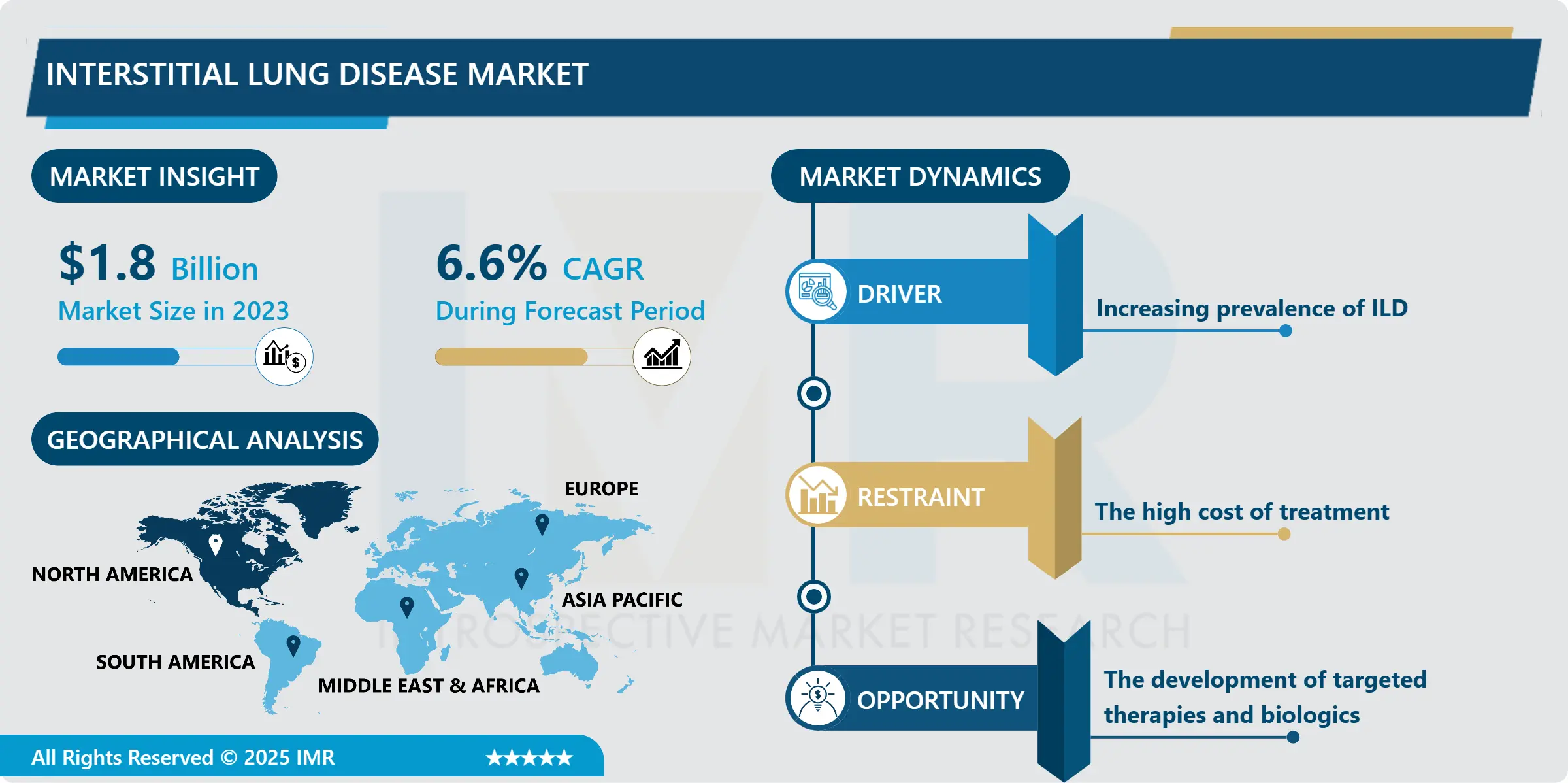
Interstitial Lung Disease Market Size Was Valued at USD 1.8 Billion in 2023, and is Projected to Reach USD 3.2 Billion by 2032, Growing at a CAGR of 6.6% From 2024-2032.
Interstitial Lung Disease (ILD) are diseases that affect the interstitium, the tissue and the space surrounding alveoles of the lungs. ILD is a disease that causes the gradual build-up of scar tissue in the lungs making it difficult for the lungs to deliver oxygen to the bloodstream. This disease can be attributed to humoral factors, the effects of the environment, hereditary factors, autoimmune diseases and infections. This condition results in shortness of breath, coughing that does not cease, fatigue and in critical cases respiratory complications. Although Intersitial Lung Disease could be defined as different diseases such as IPF, sarcoidosis, and hypersensitivity pneumonitis, its classification cannot be simplified and thus can be considered a critical diagnosis. Since the path of this disease leads to inevitable changes in the lungs, it is essential to detect it in the early stages.
The market for Interstitial Lung Disease is rapidly expanding because of the increased prevalence of ILD across the world, increasing elderly population, and raising disease awareness. Specifically, one type of ILD called idiopathic pulmonary fibrosis (IPF), is becoming more common and will require more effective treatments. It is also advancing through the development of technologies through which ILD may be diagnosed early including high resolution CT scans and genetic profiling. Moreover, novel therapeutic agents, the progression of biologics and Targeted therapy that work toward probing the fibrosis seemed to have heightened interest in the market. These therapies have met clinical trial safety and efficacy and are anticipated to transform the face of ILD treatment.
Pharmaceutical companies’ rising rate of research and development to find new therapies for ILD is one of the factors bolstering the market growth. More potent drugs are being researched due to an increase in knowledge as to the etiology of ILD. In addition, the collaborations between the biotechnology firms and research universities are speeding up the development of drugs for ILD also for diseases such as IPF. Due to this there has been keen emphasis and interest in discovering more efficient treatment methods thus resulting in formation of competitive market environment, thus expected to grow throughout the forecast period. The demand for ILD treatment can further be supplemented with the more clinical trials, more approvals and relatively more brands of the drug approved for treating ILD than in the past.
Interstitial Lung Disease Market Trend Analysis:
Rise of Biologic Treatments
-
One phenomenal that was evident in the Interstitial Lung Disease market is the rising promise in biologic medications. These therapies are availed increasingly because the former kind works at molecular level where fibrosis and inflammation are initiated. As precision medicine is moving forward, the biologic agents which were initially developed to block certain proteins, enzymes or receptors in the pathophysiology of the disease are even being personalized. This is characterised by a rising approval of new biological agents such as monoclonal antibodies, growth factor inhibitors and other biologics that have demonstrated potential at clinical trials. Therefore, biologic drugs are expected to form a huge percentage of treatment method for ILD, as compared to corticosteroids and immunosuppressive drugs. These therapies offer much hope to the patients by halting the advance of this disease and enhance their lungs’ ability.
Growing Demand for Targeted Therapies
-
Furthermore, the growing demand for efficient therapeutic methods currently stands as a highly promisable opportunity in the Interstitial Lung Disease industry. This has spurred the need for effective drugs that can treat pathology at its source rather than just being able to reduce inflammation and fibrosis which have shown promising results. Additionally, when the disease increases in popularity around the world, it truly becomes a driver for research and development in the market. Scientists have also urged pharmaceutical firms to research on more effective combinations of drugs and bio drugs for treatment of various kinds of ILD. The opening for value creation is in creating treatment regimens that have more acceptable side effects and better therapeutic impact on the patient. Furthermore, with the increase of targeted therapies, treatment with drugs based on the genetics of a patient can become new market leaders in the fight against ILD and a decrease in the incidence of the disease around the world.
Interstitial Lung Disease Market Segment Analysis:
Interstitial Lung Disease Market is Segmented on the basis of Disease Type, Drug Type, Distribution Channel, and Region
By Disease Type, Interstitial Pneumonia segment is expected to dominate the market during the forecast period
-
The Interstitial Pneumonia segment holds the largest market share in the Interstitial Lung Disease market throughout the forecast period. This population comprises diseases like the idiopathic pulmonary fibrosis that fall under the most severe category of the ILD. Interstitial Pneumonia cause fibrosis of lung tissues, consequently affects the breathing and leads to low levels of oxygen in the blood. That is why the subsequent treatment for the diseases such as IPF is searched mostly due to high mortality rates for such conditions. Similarly, the necessity of therapies for Interstitial Pneumonia is assumed to be the highest among the existing types of ILD, which will provide a boost to the market.
By Drug Type, Corticosteroids segment expected to held the largest share
-
The Corticosteroids segment is anticipated to capture the largest share in the Interstitial Lung Disease market, due to the fact that these medicines are commonly used in controlling inflammation and fibrosis in ILD patients. Systemic corticosteroids are the most common drugs used to manage initial treatment of ILD because of their capacity to suppress inflammation and immunological response. However, serious side effects of long-term corticosteroid use including weight gain and increased susceptibility to infections have not dampened the use of corticosteroids in the management of ILD patients. The corticosteroids, particularly the orally inhaled products, capture a large market share because they are very effective, fairly inexpensive, and administered easily.
Interstitial Lung Disease Market Regional Insights:
North America is Expected to Dominate the Market Over the Forecast period
-
It is predicted that North America will occupy a very large share in the entire Interstitial Lung Disease market, globally, by the year 2023. The region’s protruding standing in this project can be explained by raised figures in the occurrence of ILD, particularly IPF alongside availability of good health care facilities. Also, the United States, based on research and development investments, drug approvals, and new therapy introduction remains an unswerving leader in this market. It is estimated that North America has the largest share of the market, Availability of technological support, high levels of investments in the development of healthcare services and infrastructure, early diagnosis, and treatment also contribute to the market’s growth in the examined region.
Active Key Players in the Interstitial Lung Disease Market
-
AbbVie (USA)
- Actelion Pharmaceuticals (Switzerland)
- Boehringer Ingelheim (Germany)
- Bristol-Myers Squibb (USA)
- Cipla Limited (India)
- Galapagos NV (Belgium)
- Gilead Sciences, Inc. (USA)
- GlaxoSmithKline (UK)
- InterMune (USA)
- Merck & Co., Inc. (USA)
- Novartis International AG (Switzerland)
- Pfizer Inc. (USA)
- Roche Holding AG (Switzerland)
- Sanofi (France)
- Teva Pharmaceuticals (Israel)
- Other Active Players.
|
Global Interstitial Lung Disease Market |
|||
|
Base Year: |
2023 |
Forecast Period: |
2024-2032 |
|
Historical Data: |
2017 to 2023 |
Market Size in 2023: |
USD 1.8 Billion |
|
Forecast Period 2024-32 CAGR: |
6.6% |
Market Size in 2032: |
USD 3.2 Billion |
|
Segments Covered: |
By Disease Type |
|
|
|
By Drug Type |
|
||
|
By Distribution Channel |
|
||
|
By Region |
|
||
|
Key Market Drivers: |
|
||
|
Key Market Restraints: |
|
||
|
Key Opportunities: |
|
||
|
Companies Covered in the report: |
|
||
Chapter 1: Introduction
1.1 Scope and Coverage
Chapter 2:Executive Summary
Chapter 3: Market Landscape
3.1 Market Dynamics
3.1.1 Drivers
3.1.2 Restraints
3.1.3 Opportunities
3.1.4 Challenges
3.2 Market Trend Analysis
3.3 PESTLE Analysis
3.4 Porter's Five Forces Analysis
3.5 Industry Value Chain Analysis
3.6 Ecosystem
3.7 Regulatory Landscape
3.8 Price Trend Analysis
3.9 Patent Analysis
3.10 Technology Evolution
3.11 Investment Pockets
3.12 Import-Export Analysis
Chapter 4: Interstitial Lung Disease Market by Disease Type
4.1 Interstitial Lung Disease Market Snapshot and Growth Engine
4.2 Interstitial Lung Disease Market Overview
4.3 Interstitial Pneumonia
4.3.1 Introduction and Market Overview
4.3.2 Historic and Forecasted Market Size in Value USD and Volume Units (2017-2032F)
4.3.3 Key Market Trends, Growth Factors and Opportunities
4.3.4 Interstitial Pneumonia: Geographic Segmentation Analysis
4.4 Idiopathic Pulmonary Fibrosis
4.4.1 Introduction and Market Overview
4.4.2 Historic and Forecasted Market Size in Value USD and Volume Units (2017-2032F)
4.4.3 Key Market Trends, Growth Factors and Opportunities
4.4.4 Idiopathic Pulmonary Fibrosis: Geographic Segmentation Analysis
4.5 Nonspecific Interstitial Pneumonitis
4.5.1 Introduction and Market Overview
4.5.2 Historic and Forecasted Market Size in Value USD and Volume Units (2017-2032F)
4.5.3 Key Market Trends, Growth Factors and Opportunities
4.5.4 Nonspecific Interstitial Pneumonitis: Geographic Segmentation Analysis
4.6 Hypersensitivity Pneumonitis
4.6.1 Introduction and Market Overview
4.6.2 Historic and Forecasted Market Size in Value USD and Volume Units (2017-2032F)
4.6.3 Key Market Trends, Growth Factors and Opportunities
4.6.4 Hypersensitivity Pneumonitis: Geographic Segmentation Analysis
4.7 Cryptogenic Organizing Pneumonia (COP)
4.7.1 Introduction and Market Overview
4.7.2 Historic and Forecasted Market Size in Value USD and Volume Units (2017-2032F)
4.7.3 Key Market Trends, Growth Factors and Opportunities
4.7.4 Cryptogenic Organizing Pneumonia (COP): Geographic Segmentation Analysis
4.8 Sarcoidosis
4.8.1 Introduction and Market Overview
4.8.2 Historic and Forecasted Market Size in Value USD and Volume Units (2017-2032F)
4.8.3 Key Market Trends, Growth Factors and Opportunities
4.8.4 Sarcoidosis: Geographic Segmentation Analysis
4.9 Acute Interstitial Pneumonitis
4.9.1 Introduction and Market Overview
4.9.2 Historic and Forecasted Market Size in Value USD and Volume Units (2017-2032F)
4.9.3 Key Market Trends, Growth Factors and Opportunities
4.9.4 Acute Interstitial Pneumonitis: Geographic Segmentation Analysis
Chapter 5: Interstitial Lung Disease Market by Drug Type
5.1 Interstitial Lung Disease Market Snapshot and Growth Engine
5.2 Interstitial Lung Disease Market Overview
5.3 Corticosteroids
5.3.1 Introduction and Market Overview
5.3.2 Historic and Forecasted Market Size in Value USD and Volume Units (2017-2032F)
5.3.3 Key Market Trends, Growth Factors and Opportunities
5.3.4 Corticosteroids: Geographic Segmentation Analysis
5.4 Anti-fibrotic Medication
5.4.1 Introduction and Market Overview
5.4.2 Historic and Forecasted Market Size in Value USD and Volume Units (2017-2032F)
5.4.3 Key Market Trends, Growth Factors and Opportunities
5.4.4 Anti-fibrotic Medication: Geographic Segmentation Analysis
5.5 Pirfenidone
5.5.1 Introduction and Market Overview
5.5.2 Historic and Forecasted Market Size in Value USD and Volume Units (2017-2032F)
5.5.3 Key Market Trends, Growth Factors and Opportunities
5.5.4 Pirfenidone: Geographic Segmentation Analysis
5.6 Nintedanib
5.6.1 Introduction and Market Overview
5.6.2 Historic and Forecasted Market Size in Value USD and Volume Units (2017-2032F)
5.6.3 Key Market Trends, Growth Factors and Opportunities
5.6.4 Nintedanib: Geographic Segmentation Analysis
Chapter 6: Interstitial Lung Disease Market by Distribution Channel
6.1 Interstitial Lung Disease Market Snapshot and Growth Engine
6.2 Interstitial Lung Disease Market Overview
6.3 Hospital Pharmacies
6.3.1 Introduction and Market Overview
6.3.2 Historic and Forecasted Market Size in Value USD and Volume Units (2017-2032F)
6.3.3 Key Market Trends, Growth Factors and Opportunities
6.3.4 Hospital Pharmacies: Geographic Segmentation Analysis
6.4 Retail Pharmacies
6.4.1 Introduction and Market Overview
6.4.2 Historic and Forecasted Market Size in Value USD and Volume Units (2017-2032F)
6.4.3 Key Market Trends, Growth Factors and Opportunities
6.4.4 Retail Pharmacies: Geographic Segmentation Analysis
6.5 Online Pharmacies
6.5.1 Introduction and Market Overview
6.5.2 Historic and Forecasted Market Size in Value USD and Volume Units (2017-2032F)
6.5.3 Key Market Trends, Growth Factors and Opportunities
6.5.4 Online Pharmacies : Geographic Segmentation Analysis
Chapter 7: Company Profiles and Competitive Analysis
7.1 Competitive Landscape
7.1.1 Competitive Benchmarking
7.1.2 Interstitial Lung Disease Market Share by Manufacturer (2023)
7.1.3 Industry BCG Matrix
7.1.4 Heat Map Analysis
7.1.5 Mergers and Acquisitions
7.2 ABBVIE (USA)
7.2.1 Company Overview
7.2.2 Key Executives
7.2.3 Company Snapshot
7.2.4 Role of the Company in the Market
7.2.5 Sustainability and Social Responsibility
7.2.6 Operating Business Segments
7.2.7 Product Portfolio
7.2.8 Business Performance
7.2.9 Key Strategic Moves and Recent Developments
7.2.10 SWOT Analysis
7.3 ACTELION PHARMACEUTICALS (SWITZERLAND)
7.4 BOEHRINGER INGELHEIM (GERMANY)
7.5 BRISTOL-MYERS SQUIBB (USA)
7.6 CIPLA LIMITED (INDIA)
7.7 GALAPAGOS NV (BELGIUM)
7.8 GILEAD SCIENCES INC. (USA)
7.9 GLAXOSMITHKLINE (UK)
7.10 INTERMUNE (USA)
7.11 MERCK & CO. INC. (USA)
7.12 NOVARTIS INTERNATIONAL AG (SWITZERLAND)
7.13 PFIZER INC. (USA)
7.14 ROCHE HOLDING AG (SWITZERLAND)
7.15 SANOFI (FRANCE)
7.16 TEVA PHARMACEUTICALS (ISRAEL)
7.17 OTHER ACTIVE PLAYERS
Chapter 8: Global Interstitial Lung Disease Market By Region
8.1 Overview
8.2. North America Interstitial Lung Disease Market
8.2.1 Key Market Trends, Growth Factors and Opportunities
8.2.2 Top Key Companies
8.2.3 Historic and Forecasted Market Size by Segments
8.2.4 Historic and Forecasted Market Size By Disease Type
8.2.4.1 Interstitial Pneumonia
8.2.4.2 Idiopathic Pulmonary Fibrosis
8.2.4.3 Nonspecific Interstitial Pneumonitis
8.2.4.4 Hypersensitivity Pneumonitis
8.2.4.5 Cryptogenic Organizing Pneumonia (COP)
8.2.4.6 Sarcoidosis
8.2.4.7 Acute Interstitial Pneumonitis
8.2.5 Historic and Forecasted Market Size By Drug Type
8.2.5.1 Corticosteroids
8.2.5.2 Anti-fibrotic Medication
8.2.5.3 Pirfenidone
8.2.5.4 Nintedanib
8.2.6 Historic and Forecasted Market Size By Distribution Channel
8.2.6.1 Hospital Pharmacies
8.2.6.2 Retail Pharmacies
8.2.6.3 Online Pharmacies
8.2.7 Historic and Forecast Market Size by Country
8.2.7.1 US
8.2.7.2 Canada
8.2.7.3 Mexico
8.3. Eastern Europe Interstitial Lung Disease Market
8.3.1 Key Market Trends, Growth Factors and Opportunities
8.3.2 Top Key Companies
8.3.3 Historic and Forecasted Market Size by Segments
8.3.4 Historic and Forecasted Market Size By Disease Type
8.3.4.1 Interstitial Pneumonia
8.3.4.2 Idiopathic Pulmonary Fibrosis
8.3.4.3 Nonspecific Interstitial Pneumonitis
8.3.4.4 Hypersensitivity Pneumonitis
8.3.4.5 Cryptogenic Organizing Pneumonia (COP)
8.3.4.6 Sarcoidosis
8.3.4.7 Acute Interstitial Pneumonitis
8.3.5 Historic and Forecasted Market Size By Drug Type
8.3.5.1 Corticosteroids
8.3.5.2 Anti-fibrotic Medication
8.3.5.3 Pirfenidone
8.3.5.4 Nintedanib
8.3.6 Historic and Forecasted Market Size By Distribution Channel
8.3.6.1 Hospital Pharmacies
8.3.6.2 Retail Pharmacies
8.3.6.3 Online Pharmacies
8.3.7 Historic and Forecast Market Size by Country
8.3.7.1 Russia
8.3.7.2 Bulgaria
8.3.7.3 The Czech Republic
8.3.7.4 Hungary
8.3.7.5 Poland
8.3.7.6 Romania
8.3.7.7 Rest of Eastern Europe
8.4. Western Europe Interstitial Lung Disease Market
8.4.1 Key Market Trends, Growth Factors and Opportunities
8.4.2 Top Key Companies
8.4.3 Historic and Forecasted Market Size by Segments
8.4.4 Historic and Forecasted Market Size By Disease Type
8.4.4.1 Interstitial Pneumonia
8.4.4.2 Idiopathic Pulmonary Fibrosis
8.4.4.3 Nonspecific Interstitial Pneumonitis
8.4.4.4 Hypersensitivity Pneumonitis
8.4.4.5 Cryptogenic Organizing Pneumonia (COP)
8.4.4.6 Sarcoidosis
8.4.4.7 Acute Interstitial Pneumonitis
8.4.5 Historic and Forecasted Market Size By Drug Type
8.4.5.1 Corticosteroids
8.4.5.2 Anti-fibrotic Medication
8.4.5.3 Pirfenidone
8.4.5.4 Nintedanib
8.4.6 Historic and Forecasted Market Size By Distribution Channel
8.4.6.1 Hospital Pharmacies
8.4.6.2 Retail Pharmacies
8.4.6.3 Online Pharmacies
8.4.7 Historic and Forecast Market Size by Country
8.4.7.1 Germany
8.4.7.2 UK
8.4.7.3 France
8.4.7.4 The Netherlands
8.4.7.5 Italy
8.4.7.6 Spain
8.4.7.7 Rest of Western Europe
8.5. Asia Pacific Interstitial Lung Disease Market
8.5.1 Key Market Trends, Growth Factors and Opportunities
8.5.2 Top Key Companies
8.5.3 Historic and Forecasted Market Size by Segments
8.5.4 Historic and Forecasted Market Size By Disease Type
8.5.4.1 Interstitial Pneumonia
8.5.4.2 Idiopathic Pulmonary Fibrosis
8.5.4.3 Nonspecific Interstitial Pneumonitis
8.5.4.4 Hypersensitivity Pneumonitis
8.5.4.5 Cryptogenic Organizing Pneumonia (COP)
8.5.4.6 Sarcoidosis
8.5.4.7 Acute Interstitial Pneumonitis
8.5.5 Historic and Forecasted Market Size By Drug Type
8.5.5.1 Corticosteroids
8.5.5.2 Anti-fibrotic Medication
8.5.5.3 Pirfenidone
8.5.5.4 Nintedanib
8.5.6 Historic and Forecasted Market Size By Distribution Channel
8.5.6.1 Hospital Pharmacies
8.5.6.2 Retail Pharmacies
8.5.6.3 Online Pharmacies
8.5.7 Historic and Forecast Market Size by Country
8.5.7.1 China
8.5.7.2 India
8.5.7.3 Japan
8.5.7.4 South Korea
8.5.7.5 Malaysia
8.5.7.6 Thailand
8.5.7.7 Vietnam
8.5.7.8 The Philippines
8.5.7.9 Australia
8.5.7.10 New Zealand
8.5.7.11 Rest of APAC
8.6. Middle East & Africa Interstitial Lung Disease Market
8.6.1 Key Market Trends, Growth Factors and Opportunities
8.6.2 Top Key Companies
8.6.3 Historic and Forecasted Market Size by Segments
8.6.4 Historic and Forecasted Market Size By Disease Type
8.6.4.1 Interstitial Pneumonia
8.6.4.2 Idiopathic Pulmonary Fibrosis
8.6.4.3 Nonspecific Interstitial Pneumonitis
8.6.4.4 Hypersensitivity Pneumonitis
8.6.4.5 Cryptogenic Organizing Pneumonia (COP)
8.6.4.6 Sarcoidosis
8.6.4.7 Acute Interstitial Pneumonitis
8.6.5 Historic and Forecasted Market Size By Drug Type
8.6.5.1 Corticosteroids
8.6.5.2 Anti-fibrotic Medication
8.6.5.3 Pirfenidone
8.6.5.4 Nintedanib
8.6.6 Historic and Forecasted Market Size By Distribution Channel
8.6.6.1 Hospital Pharmacies
8.6.6.2 Retail Pharmacies
8.6.6.3 Online Pharmacies
8.6.7 Historic and Forecast Market Size by Country
8.6.7.1 Turkiye
8.6.7.2 Bahrain
8.6.7.3 Kuwait
8.6.7.4 Saudi Arabia
8.6.7.5 Qatar
8.6.7.6 UAE
8.6.7.7 Israel
8.6.7.8 South Africa
8.7. South America Interstitial Lung Disease Market
8.7.1 Key Market Trends, Growth Factors and Opportunities
8.7.2 Top Key Companies
8.7.3 Historic and Forecasted Market Size by Segments
8.7.4 Historic and Forecasted Market Size By Disease Type
8.7.4.1 Interstitial Pneumonia
8.7.4.2 Idiopathic Pulmonary Fibrosis
8.7.4.3 Nonspecific Interstitial Pneumonitis
8.7.4.4 Hypersensitivity Pneumonitis
8.7.4.5 Cryptogenic Organizing Pneumonia (COP)
8.7.4.6 Sarcoidosis
8.7.4.7 Acute Interstitial Pneumonitis
8.7.5 Historic and Forecasted Market Size By Drug Type
8.7.5.1 Corticosteroids
8.7.5.2 Anti-fibrotic Medication
8.7.5.3 Pirfenidone
8.7.5.4 Nintedanib
8.7.6 Historic and Forecasted Market Size By Distribution Channel
8.7.6.1 Hospital Pharmacies
8.7.6.2 Retail Pharmacies
8.7.6.3 Online Pharmacies
8.7.7 Historic and Forecast Market Size by Country
8.7.7.1 Brazil
8.7.7.2 Argentina
8.7.7.3 Rest of SA
Chapter 9 Analyst Viewpoint and Conclusion
9.1 Recommendations and Concluding Analysis
9.2 Potential Market Strategies
Chapter 10 Research Methodology
10.1 Research Process
10.2 Primary Research
10.3 Secondary Research
|
Global Interstitial Lung Disease Market |
|||
|
Base Year: |
2023 |
Forecast Period: |
2024-2032 |
|
Historical Data: |
2017 to 2023 |
Market Size in 2023: |
USD 1.8 Billion |
|
Forecast Period 2024-32 CAGR: |
6.6% |
Market Size in 2032: |
USD 3.2 Billion |
|
Segments Covered: |
By Disease Type |
|
|
|
By Drug Type |
|
||
|
By Distribution Channel |
|
||
|
By Region |
|
||
|
Key Market Drivers: |
|
||
|
Key Market Restraints: |
|
||
|
Key Opportunities: |
|
||
|
Companies Covered in the report: |
|
||


