




Injectable Drugs Market Synopsis:
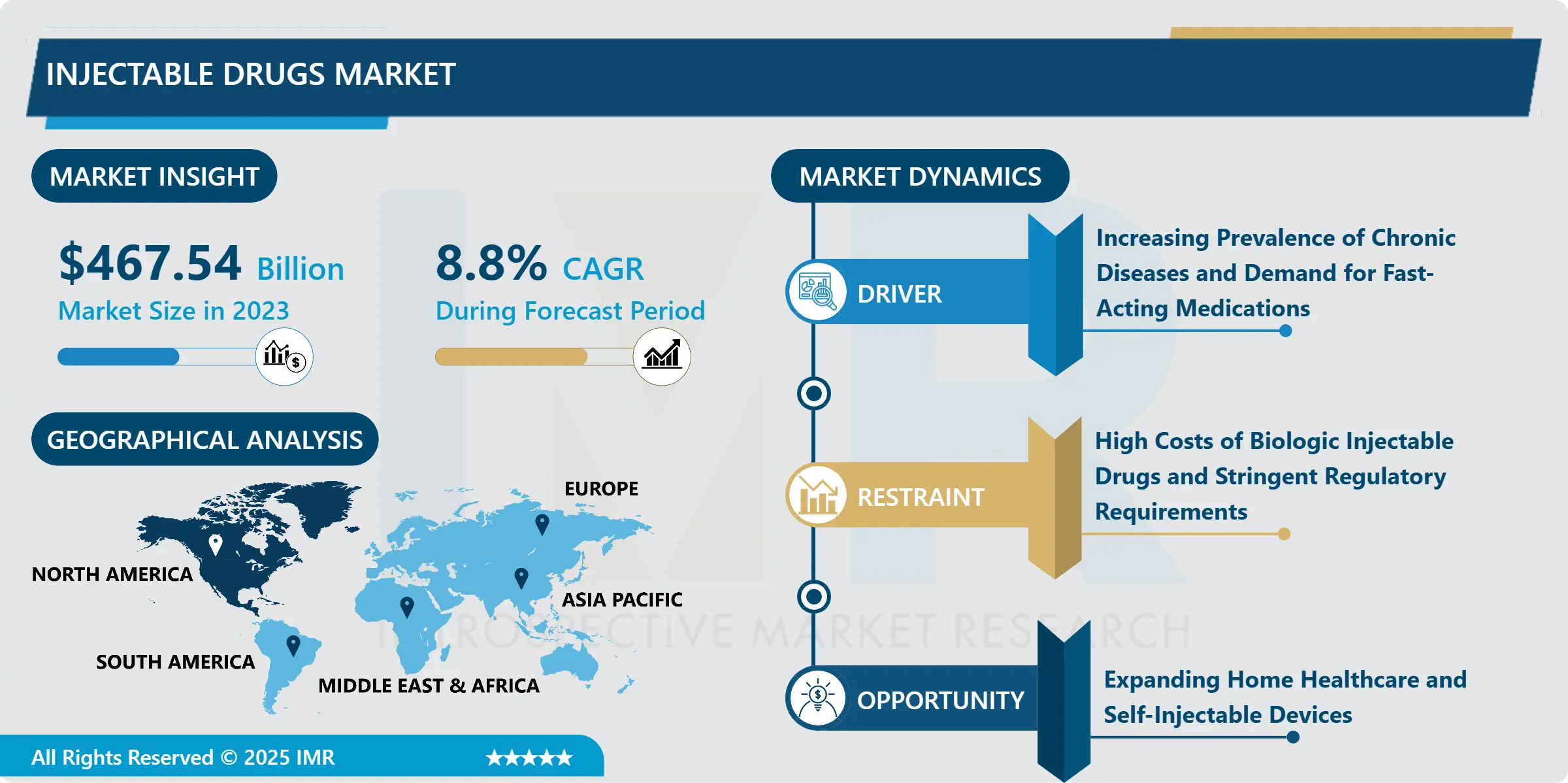
Injectable Drugs Market Size Was Valued at USD 467.54 Billion in 2023, and is Projected to Reach USD 998.80 Billion by 2032, Growing at a CAGR of 8.8 % From 2024-2032.
The Injectable Drugs Market has products which are administered to the body through injections; IM, Sub-Q, and IV products. Such drugs are crucial in ensuring the delivery of medication whose absorption in the body cannot be well achieved through ingestion with the intent of responding to emergencies, or managing on-going chronic ailments, or in controlling the dosage necessary for the medication. Biologic injectables are a broad category of therapies across many therapeutic categories, including cancer, immunology, and infection, as well as antibiotics and small-molecule products.
The Injectable Drugs Market has experienced high growth over the past few years due to growing prevalence of disease such as chronic and infection diseases. High incidences of lifestyle diseases together with increasing world’s population’s average age contribute to increased need for medications that can be delivered through injections hence injectable drugs. Biologics, usually injected, received high social approval since biologics introduced new targeted therapies for multifactorial and multisingle diseases, such as cancer, rheumatoid arthritis, and diabetes. This is because biotechnology continues to advance providing better solutions in the development of exciting biological treatments and injectables.
Moreover, due to the COVID-19 pandemic people are increasingly requesting injectable drugs, including vaccines and other essential drugs for critical care.. Major players in the pharmaceutical production segment are now aiming at improving production capabilities and diversifying the ‘injectable drugs’ portfolio. Among the growth factors are the shifting of healthcare towards home, coupled with increased access to self-injectable devices. With more and more patients now looking to receive more treatments within the comfort of their homes for chronic diseases, the category of injectable drugs or injectable drug delivery systems has remained highly active.
Injectable Drugs Market Trend Analysis:
Growing Demand for Biologics and Biosimilar Injectables
-
One of the major developments within the Injectable Drugs Market is the increasing popularity of biologic drugs & biosimilar injectables. They are autogenous, products from living organisms and are employed in diseases with low availability of treatment methods including autoimmune diseases, cancers, and hereditary disorders. Replacing the patents of some of the biologic drugs, biosimilars in today’s context have become an established concept that delivers cheaper biologics to the patients and physicians. This has enhanced access to expensive health care especially to those that arent fully developed yet in the market. The growth of Biologics and biosimilars market is further encouraged by the technological advancement in biotechnology, increased regulatory support for biosimilar approval and growing demand for personalized medicine in the coming years.
Expansion of Self-Injectable Devices and Home Healthcare
-
Technological advancement in self-injection and home healthcare services is also seen as a big opportunity in the Injectable Drugs Market. As many chronic diseases like diabetes, rheumatoid arthritis, and multiple sclerosis are treated outside the clinic, the need for self-injectable drugs has also grown. Advancements in injection delivery systems like autoinjectors and prefilled syringes are enhancing patient’s compliance and safety when used outside the clinical setting. Such a shift minimizes hospitalization and in a way brings down the overall costs of managing people’s health. Given the growing proportion of elderly patients and the increasing incidence of chronic diseases, home care and the need for self-injectable drugs will also increase, establishing potential for the development of practical, safe self-injection technologies by manufacturers of injectable drugs.
Injectable Drugs Market Segment Analysis:
Injectable Drugs Market is Segmented on the basis of molecule type, route of administration, distribution channel, and Region
By Molecule Type, small molecule segment is expected to dominate the market during the forecast period
-
The injectable small molecule category is expected to dominate the global Injectable Drugs Market as it is evident that small molecules are used in the treatment of different diseases. Small molecules have a less complicated synthesis process and can be introduced in different forms such as injection to exhibit rapid curative impacts. It is especially used in critical care, oncology and infectious disease where quick response is paramount. As new techniques in cancer and other disease treatments are discovered, the use of injectable small molecules will increase, R& D and the simplicity of small molecule synthesis being other indispensable factors. As these diseases increase, the segment with small molecule treatments will continue to be a strong driver for this market growth.
By Route of Administration, the Intravenous segment expected to held the largest share
-
Depending on the type of delivery, the intravenous (IV) segment is expected to account for the largest portion of the Injectable Drugs Market owing to high hospital use and outpatient prescriptions. I.V administration is used for infusion of fluids, nutrients and medication straight into the blood stream where they are a quick onset of action as is needed in emergency cases or client on critical care. IV drug delivery is preferred most where accuracy of the dosage is needed and with drugs that are not well absorbed orally. As the patient’s admission and long-term illnesses that necessitate intravenous therapy increase, for example, malignancy and infectious diseases, intravenous injectables stay in demand. The segment’s growth is also driven by the higher tendency of IV treatments in home-based cases as new technologies serve the IV administration outside of hospital facilities.
Injectable Drugs Market Regional Insights:
North America is Expected to Dominate the Market Over the Forecast period
-
It is estimated that the market for Injectable Drugs will see the most growth in North America over the given period due to various factors including sound healthcare system, high healthcare spending, and customers’ demand for new and improve therapeutic product solutions. The United States is the largest supplier of the North American market thanks to good development of the pharmaceutical industry and a high rate of diseases, including cancer, diabetes, and cardiovascular diseases. There are many factors which support sustainable growth in this region such as; increasing demand for more specialized biologic and biosimilar products connected with an aging population. Additionally, larger populations, well established pharmaceutical industries, new product development and a mature regulatory environment in the United States supports the availability of new injectable drugs, giving market control to North America.
- The same is true with injectable drugs such as vaccines that have been on the rise in North America due to the COVID-19 pandemic as the region continues to be at the frontline in immunization and combating the virus. Canada also holds a large proportion of this market due to an increasing need for injectable biologics as well as biosimilars as the country extends healthcare coverage and addition of new therapeutical forms. Today’s North American healthcare system emphasizes the patient-centric concept, which has boosted market demand further by promoting home-use self-injection devices. Technological development of treatment and patient-centric administration is still a focus area in the region and this would help North America to dominate the Injectable Drugs market in the coming years of the forecast period.
Active Key Players in the Injectable Drugs Market:
-
Amgen Inc. (USA)
- AstraZeneca plc (UK)
- Baxter International Inc. (USA)
- Becton, Dickinson and Company (USA)
- Biocon Limited (India)
- Bristol-Myers Squibb Company (USA)
- Eli Lilly and Company (USA)
- Fresenius SE & Co. KGaA (Germany)
- GlaxoSmithKline plc (UK)
- Johnson & Johnson (USA)
- Merck & Co., Inc. (USA)
- Novartis AG (Switzerland)
- Pfizer Inc. (USA)
- Sanofi S.A. (France)
- Teva Pharmaceutical Industries Ltd. (Israel)
- Other Active Players
|
Global Injectable Drugs Market |
|||
|
Base Year: |
2023 |
Forecast Period: |
2024-2032 |
|
Historical Data: |
2017 to 2023 |
Market Size in 2023: |
USD 467.54 Billion |
|
Forecast Period 2024-32 CAGR: |
8.8 % |
Market Size in 2032: |
USD 998.80 Billion |
|
Segments Covered: |
By Molecule Type |
|
|
|
By Route of administration |
|
||
|
By Distribution Channel |
|
||
|
By Region |
|
||
|
Key Market Drivers: |
|
||
|
Key Market Restraints: |
|
||
|
Key Opportunities: |
|
||
|
Companies Covered in the report: |
|
||
Chapter 1: Introduction
1.1 Scope and Coverage
Chapter 2:Executive Summary
Chapter 3: Market Landscape
3.1 Market Dynamics
3.1.1 Drivers
3.1.2 Restraints
3.1.3 Opportunities
3.1.4 Challenges
3.2 Market Trend Analysis
3.3 PESTLE Analysis
3.4 Porter's Five Forces Analysis
3.5 Industry Value Chain Analysis
3.6 Ecosystem
3.7 Regulatory Landscape
3.8 Price Trend Analysis
3.9 Patent Analysis
3.10 Technology Evolution
3.11 Investment Pockets
3.12 Import-Export Analysis
Chapter 4: Injectable Drugs Market by Molecule Type
4.1 Injectable Drugs Market Snapshot and Growth Engine
4.2 Injectable Drugs Market Overview
4.3 Small
4.3.1 Introduction and Market Overview
4.3.2 Historic and Forecasted Market Size in Value USD and Volume Units (2017-2032F)
4.3.3 Key Market Trends, Growth Factors and Opportunities
4.3.4 Small: Geographic Segmentation Analysis
4.4 Large
4.4.1 Introduction and Market Overview
4.4.2 Historic and Forecasted Market Size in Value USD and Volume Units (2017-2032F)
4.4.3 Key Market Trends, Growth Factors and Opportunities
4.4.4 Large: Geographic Segmentation Analysis
Chapter 5: Injectable Drugs Market by Route of Administration
5.1 Injectable Drugs Market Snapshot and Growth Engine
5.2 Injectable Drugs Market Overview
5.3 Intravenous
5.3.1 Introduction and Market Overview
5.3.2 Historic and Forecasted Market Size in Value USD and Volume Units (2017-2032F)
5.3.3 Key Market Trends, Growth Factors and Opportunities
5.3.4 Intravenous: Geographic Segmentation Analysis
5.4 Intramuscular
5.4.1 Introduction and Market Overview
5.4.2 Historic and Forecasted Market Size in Value USD and Volume Units (2017-2032F)
5.4.3 Key Market Trends, Growth Factors and Opportunities
5.4.4 Intramuscular: Geographic Segmentation Analysis
5.5 subcutaneous
5.5.1 Introduction and Market Overview
5.5.2 Historic and Forecasted Market Size in Value USD and Volume Units (2017-2032F)
5.5.3 Key Market Trends, Growth Factors and Opportunities
5.5.4 subcutaneous: Geographic Segmentation Analysis
5.6 Others
5.6.1 Introduction and Market Overview
5.6.2 Historic and Forecasted Market Size in Value USD and Volume Units (2017-2032F)
5.6.3 Key Market Trends, Growth Factors and Opportunities
5.6.4 Others: Geographic Segmentation Analysis
Chapter 6: Injectable Drugs Market by Distribution channel
6.1 Injectable Drugs Market Snapshot and Growth Engine
6.2 Injectable Drugs Market Overview
6.3 Hospital
6.3.1 Introduction and Market Overview
6.3.2 Historic and Forecasted Market Size in Value USD and Volume Units (2017-2032F)
6.3.3 Key Market Trends, Growth Factors and Opportunities
6.3.4 Hospital: Geographic Segmentation Analysis
6.4 Retail
6.4.1 Introduction and Market Overview
6.4.2 Historic and Forecasted Market Size in Value USD and Volume Units (2017-2032F)
6.4.3 Key Market Trends, Growth Factors and Opportunities
6.4.4 Retail: Geographic Segmentation Analysis
6.5 online Pharmacies
6.5.1 Introduction and Market Overview
6.5.2 Historic and Forecasted Market Size in Value USD and Volume Units (2017-2032F)
6.5.3 Key Market Trends, Growth Factors and Opportunities
6.5.4 online Pharmacies : Geographic Segmentation Analysis
Chapter 7: Company Profiles and Competitive Analysis
7.1 Competitive Landscape
7.1.1 Competitive Benchmarking
7.1.2 Injectable Drugs Market Share by Manufacturer (2023)
7.1.3 Industry BCG Matrix
7.1.4 Heat Map Analysis
7.1.5 Mergers and Acquisitions
7.2 AMGEN INC. (USA)
7.2.1 Company Overview
7.2.2 Key Executives
7.2.3 Company Snapshot
7.2.4 Role of the Company in the Market
7.2.5 Sustainability and Social Responsibility
7.2.6 Operating Business Segments
7.2.7 Product Portfolio
7.2.8 Business Performance
7.2.9 Key Strategic Moves and Recent Developments
7.2.10 SWOT Analysis
7.3 ASTRAZENECA PLC (UK)
7.4 BAXTER INTERNATIONAL INC. (USA)
7.5 BECTON
7.6 DICKINSON AND COMPANY (USA)
7.7 BIOCON LIMITED (INDIA)
7.8 BRISTOL-MYERS SQUIBB COMPANY (USA)
7.9 ELI LILLY AND COMPANY (USA)
7.10 FRESENIUS SE & CO. KGAA (GERMANY)
7.11 GLAXOSMITHKLINE PLC (UK)
7.12 JOHNSON & JOHNSON (USA)
7.13 MERCK & CO. INC. (USA)
7.14 NOVARTIS AG (SWITZERLAND)
7.15 PFIZER INC. (USA)
7.16 SANOFI S.A. (FRANCE)
7.17 TEVA PHARMACEUTICAL INDUSTRIES LTD. (ISRAEL)
7.18 .
7.19 OTHER ACTIVE PLAYERS
Chapter 8: Global Injectable Drugs Market By Region
8.1 Overview
8.2. North America Injectable Drugs Market
8.2.1 Key Market Trends, Growth Factors and Opportunities
8.2.2 Top Key Companies
8.2.3 Historic and Forecasted Market Size by Segments
8.2.4 Historic and Forecasted Market Size By Molecule Type
8.2.4.1 Small
8.2.4.2 Large
8.2.5 Historic and Forecasted Market Size By Route of Administration
8.2.5.1 Intravenous
8.2.5.2 Intramuscular
8.2.5.3 subcutaneous
8.2.5.4 Others
8.2.6 Historic and Forecasted Market Size By Distribution channel
8.2.6.1 Hospital
8.2.6.2 Retail
8.2.6.3 online Pharmacies
8.2.7 Historic and Forecast Market Size by Country
8.2.7.1 US
8.2.7.2 Canada
8.2.7.3 Mexico
8.3. Eastern Europe Injectable Drugs Market
8.3.1 Key Market Trends, Growth Factors and Opportunities
8.3.2 Top Key Companies
8.3.3 Historic and Forecasted Market Size by Segments
8.3.4 Historic and Forecasted Market Size By Molecule Type
8.3.4.1 Small
8.3.4.2 Large
8.3.5 Historic and Forecasted Market Size By Route of Administration
8.3.5.1 Intravenous
8.3.5.2 Intramuscular
8.3.5.3 subcutaneous
8.3.5.4 Others
8.3.6 Historic and Forecasted Market Size By Distribution channel
8.3.6.1 Hospital
8.3.6.2 Retail
8.3.6.3 online Pharmacies
8.3.7 Historic and Forecast Market Size by Country
8.3.7.1 Russia
8.3.7.2 Bulgaria
8.3.7.3 The Czech Republic
8.3.7.4 Hungary
8.3.7.5 Poland
8.3.7.6 Romania
8.3.7.7 Rest of Eastern Europe
8.4. Western Europe Injectable Drugs Market
8.4.1 Key Market Trends, Growth Factors and Opportunities
8.4.2 Top Key Companies
8.4.3 Historic and Forecasted Market Size by Segments
8.4.4 Historic and Forecasted Market Size By Molecule Type
8.4.4.1 Small
8.4.4.2 Large
8.4.5 Historic and Forecasted Market Size By Route of Administration
8.4.5.1 Intravenous
8.4.5.2 Intramuscular
8.4.5.3 subcutaneous
8.4.5.4 Others
8.4.6 Historic and Forecasted Market Size By Distribution channel
8.4.6.1 Hospital
8.4.6.2 Retail
8.4.6.3 online Pharmacies
8.4.7 Historic and Forecast Market Size by Country
8.4.7.1 Germany
8.4.7.2 UK
8.4.7.3 France
8.4.7.4 The Netherlands
8.4.7.5 Italy
8.4.7.6 Spain
8.4.7.7 Rest of Western Europe
8.5. Asia Pacific Injectable Drugs Market
8.5.1 Key Market Trends, Growth Factors and Opportunities
8.5.2 Top Key Companies
8.5.3 Historic and Forecasted Market Size by Segments
8.5.4 Historic and Forecasted Market Size By Molecule Type
8.5.4.1 Small
8.5.4.2 Large
8.5.5 Historic and Forecasted Market Size By Route of Administration
8.5.5.1 Intravenous
8.5.5.2 Intramuscular
8.5.5.3 subcutaneous
8.5.5.4 Others
8.5.6 Historic and Forecasted Market Size By Distribution channel
8.5.6.1 Hospital
8.5.6.2 Retail
8.5.6.3 online Pharmacies
8.5.7 Historic and Forecast Market Size by Country
8.5.7.1 China
8.5.7.2 India
8.5.7.3 Japan
8.5.7.4 South Korea
8.5.7.5 Malaysia
8.5.7.6 Thailand
8.5.7.7 Vietnam
8.5.7.8 The Philippines
8.5.7.9 Australia
8.5.7.10 New Zealand
8.5.7.11 Rest of APAC
8.6. Middle East & Africa Injectable Drugs Market
8.6.1 Key Market Trends, Growth Factors and Opportunities
8.6.2 Top Key Companies
8.6.3 Historic and Forecasted Market Size by Segments
8.6.4 Historic and Forecasted Market Size By Molecule Type
8.6.4.1 Small
8.6.4.2 Large
8.6.5 Historic and Forecasted Market Size By Route of Administration
8.6.5.1 Intravenous
8.6.5.2 Intramuscular
8.6.5.3 subcutaneous
8.6.5.4 Others
8.6.6 Historic and Forecasted Market Size By Distribution channel
8.6.6.1 Hospital
8.6.6.2 Retail
8.6.6.3 online Pharmacies
8.6.7 Historic and Forecast Market Size by Country
8.6.7.1 Turkiye
8.6.7.2 Bahrain
8.6.7.3 Kuwait
8.6.7.4 Saudi Arabia
8.6.7.5 Qatar
8.6.7.6 UAE
8.6.7.7 Israel
8.6.7.8 South Africa
8.7. South America Injectable Drugs Market
8.7.1 Key Market Trends, Growth Factors and Opportunities
8.7.2 Top Key Companies
8.7.3 Historic and Forecasted Market Size by Segments
8.7.4 Historic and Forecasted Market Size By Molecule Type
8.7.4.1 Small
8.7.4.2 Large
8.7.5 Historic and Forecasted Market Size By Route of Administration
8.7.5.1 Intravenous
8.7.5.2 Intramuscular
8.7.5.3 subcutaneous
8.7.5.4 Others
8.7.6 Historic and Forecasted Market Size By Distribution channel
8.7.6.1 Hospital
8.7.6.2 Retail
8.7.6.3 online Pharmacies
8.7.7 Historic and Forecast Market Size by Country
8.7.7.1 Brazil
8.7.7.2 Argentina
8.7.7.3 Rest of SA
Chapter 9 Analyst Viewpoint and Conclusion
9.1 Recommendations and Concluding Analysis
9.2 Potential Market Strategies
Chapter 10 Research Methodology
10.1 Research Process
10.2 Primary Research
10.3 Secondary Research
|
Global Injectable Drugs Market |
|||
|
Base Year: |
2023 |
Forecast Period: |
2024-2032 |
|
Historical Data: |
2017 to 2023 |
Market Size in 2023: |
USD 467.54 Billion |
|
Forecast Period 2024-32 CAGR: |
8.8 % |
Market Size in 2032: |
USD 998.80 Billion |
|
Segments Covered: |
By Molecule Type |
|
|
|
By Route of administration |
|
||
|
By Distribution Channel |
|
||
|
By Region |
|
||
|
Key Market Drivers: |
|
||
|
Key Market Restraints: |
|
||
|
Key Opportunities: |
|
||
|
Companies Covered in the report: |
|
||


