




Ingestible Sensors Market Synopsis:
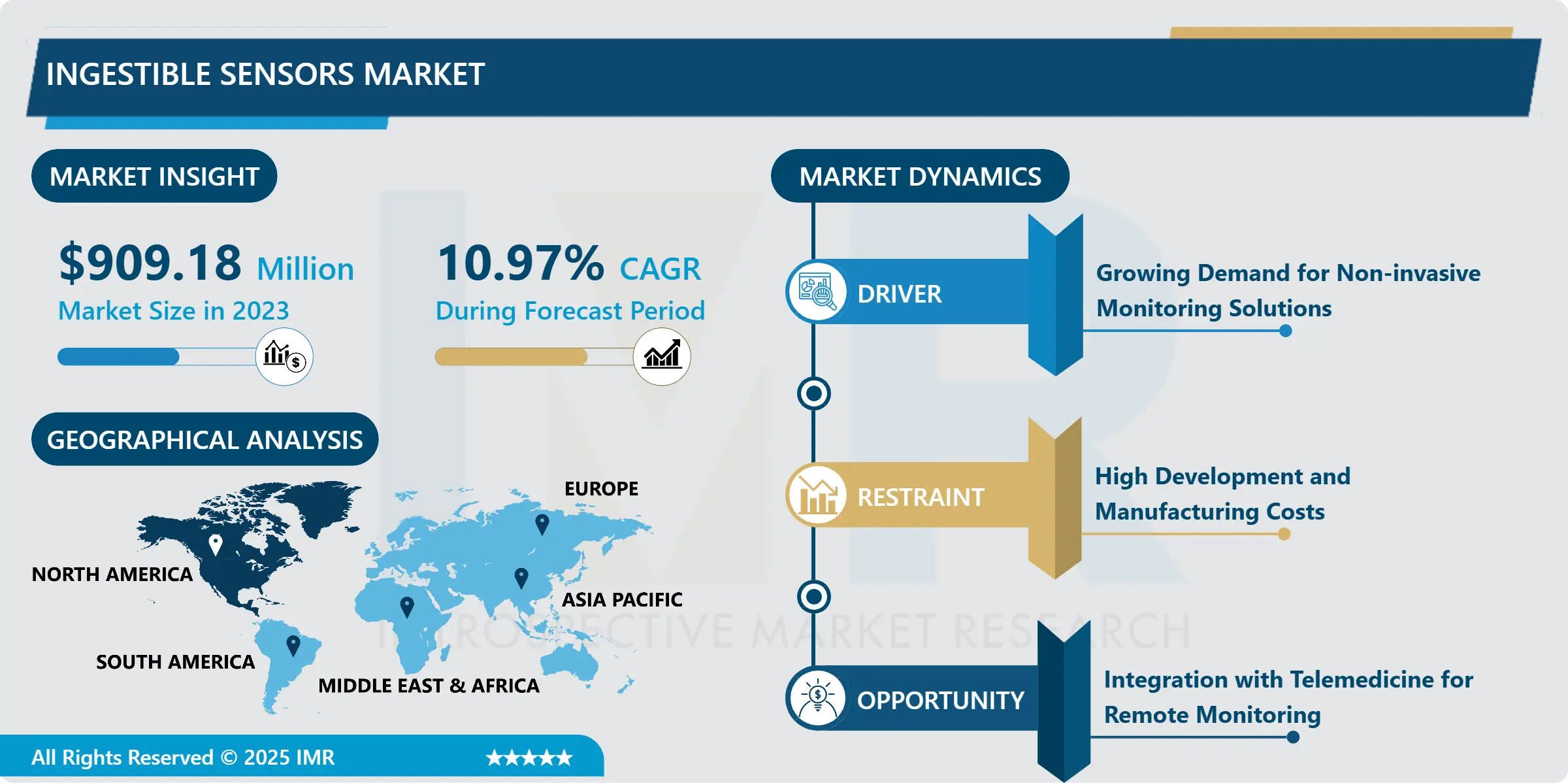
Ingestible Sensors Market Size Was Valued at USD 909.18 Million in 2023, and is Projected to Reach USD 2,320.06 Million by 2032, Growing at a CAGR of 10.97% From 2024-2032.
Ingestible sensors are small size devices that go through the GI tract to track several parameters encompassing temperature, pH, and pressure within the body. It is most often applied for medical applications like diagnostics or disease supervision and also for controlling drug delivery, providing real-time information.
The ingestible sensors market has expanded considerably in the past several years since more and more people require real time, non invasive health monitoring solutions. These sensors are changing the face of healthcare because, in place of measuring external physiological parameters or observing signs, it is possible to monitor what is happening within the body and use this information to control chronic diseases, deliver medications and assess for pathological changes. They are usually in the form of those that can be taken orally or used in invasive procedures to transmit the information externally by phone/friend devices making IOT easily available to the doctors.
In the healthcare sector, ingestible sensors’ technologies remain to be an essential component of the improving healthcare industry and the individualized medicine practices as well as remote observation. Market drivers for the global market include the rising incidence of conditions that can be managed chronically and demand for procedures that are noninvasive. Furthermore, increases in portable devices and new and improved sensor technologies, such as battery life, data transfer, or improving accuracy, have extended the functionality of ingestible sensors. Their use in medical diagnostics, treatment of diseases and monitoring of drug delivery also indicates that the market could expand.
The ingestible sensors market is also adding on to the increasing spending on healthcare and digital technologies. These devices can also be used for collections of essential physiological information to aid the doctors in their decision making and to also change the patient’s health for the better. Integrating these sensors with smartphone and wearables, the process of surveillance and managing of the health is becoming far simpler for both the end-users and the doctors. Further, regulatory development and a higher acceptance of telemedicine services are creating novel growth possibilities for the market. Ingestible sensors are deemed to have been at the forefront in facilitating the delivery of efficient healthcare solutions since the use of remote health monitoring solutions is set to increase in the nearest future.
Yet the market is not devoid of challenges which include data privacy and security issues and market regulation challenges. However, the costs associated with transducer development and production may be high; making some markets turn away from the use of the sensors. However, due to the trend for the development of more individualized approaches to health care and the constant improvement of sensor technologies on the market, the market is expected to evolve in the following years.
Ingestible Sensors Market Trend Analysis:
Increased Adoption of Smart Ingestible Sensors
- As a part of the concerning topic of digital health and individualized medicine, there is emerging interest in the development of smart ingestible sensors. Such sensors are characterized by wireless communication to deliver a flow of information to other devices like a smartphone or cloud. Therefore the connectivity eases the process of regular follow up of patients’ conditions through remote observation in case they can be treated from distance. These sensors can measure such processes as pH level temperature and pressure among others, this is useful for tracking a patient status especially when the patient suffers from a chronic disease or for monitoring the progress of drug delivery.
- Another trend that we find is a combination of artificial intelligence (AI) and machine learning (ML) with smart ingestible sensors. These technologies may be able to interpret all that the sensors may capture, and in the process detect and diagnose any sort of health complications that the patient may be likely to develop hence aiding in early detection of these complications. AI and ML can help improve diagnosis, treatment regimes and overall flow and operational efficiency within the health delivery system. The merging of AI with smart ingestible sensors is revolutionizing the interacting approaches taken by healthcare givers when handling patients and making the process more resourceful and patient led.
Integration with Telemedicine for Remote Monitoring
- probably one of the biggest opportunities for the ingestible sensors market stems from their potential application in telemedicine for remote patient monitoring. As the trend of telemedicine is progressing, especially after the pandemic COVID-19, the need for non-invasive and real-time monitoring is increasing. Ingestible sensors together with telemedicine makes it possible for the physicians to diagnose their patients from a distance and provide the appropriate treatment. This is especially useful to patients with chronic illness that need recurring check up but cannot always afford a visit to a health facility.
- Through the application of the ingestible sensors, together with telemedicine, the healthcare providers will be able to learn of a patient’s health status and modify treatment in real-time. This eliminates probabilities of physical consultation and therefore enhances the delivery of healthcare services especially to the hard kornered areas. In addition, it supplies patients with more options for the management of their health, thereby enabling them to manage serious illnesses from the comfort of their homes. With the telemedicine market growing at a fast rate, there is a likely chance that the use of ingestible sensors is also going to grow hence this is good chance for the growth in the market.
Ingestible Sensors Market Segment Analysis:
Ingestible Sensors Market is Segmented on the basis of Type, Application, End User, and Region
By Type, Temperature Sensors segment is expected to dominate the market during the forecast period
- Based on the location, ingestible sensors can be categorized into several types, the most common of which are Temperature sensors, pH sensors and pressure sensors. Thermometers are used internally to measure body temperature that is significant when treating infections and inflammatory diseases Temperature sensors: pH sensors help monitor the acidity or alkalinity of the stomach or intestines which is helpful when diagnosing diseases such as ulcers and acid reflux. On the other hand, pressure sensors are utilized in order to monitor pressures within the body, especially the digestive system in order to diagnose obstructions and other disorders.
- These sensor types are increasingly being used because the market is demanding increasingly accurate sensors and there is a need for more immediate data. Temperature sensors are most commonly used in medical diagnostics and disease monitoring, as they provide fast and precise measurements pH and pressure sensors are gradually being successfully used in gastrointestinal disease diagnosis and management, as such diseases are becoming more widespread all over the world. The steady improvement in the sensor technology is expected to further improve performance and equally improve the accurate measurement in various medical fields thereby increasing their applicability.
By Application, Medical Diagnostics segment expected to held the largest share
- portable sensors are used in different branches of medicine. The first and perhaps the most straight forward is in medical diagnostics, where these sensors are used to track such essential parameters such as temperature, PH and pressure among others. It is employed as a diagnostic tool in different diseases inclusive of gastrointestinal diseases, infections amongst others. Furthermore, ingestible sensors have high application in drug delivery monitoring with the identification of the absorption and metabolism rate of drugs. This is especially the case for individualized medication where the right dose and the right time to deliver that dose is vital to patient success.
- Another one is the application in the medical field as the actionable therapeutic approach; ingestible sensors are utilized to track diseases like diabetes, gastrointestinal diseases, as well as cardiovascular diseases. The advantage of these sensors is that they feed data continuously, and the physicians using them can observe the patient’s improvement and vice versa. Another emerging application is athlete monitoring which is enabled by ingestible sensors giving details on the athlete’s degree of hydration, body temperature and metabolic activity. The above data is employed in training as well as enhancement of performance by the athletes.
Ingestible Sensors Market Regional Insights:
North America is Expected to Dominate the Market Over the Forecast period
- At present, North America has the largest share in the ingestible sensors market due to the developed healthcare system, extensive usage of digital technologies in health care services, and significant spending on the development of high-profile health care amenities. More specifically, the United States has a highly specialized dense of healthcare providers and med-tech industries that are at the forefront of establish ingestible sensor technologies. However, North America has a conducive environment for medical device inventions, and the ingestible sensors have been approved as well as implemented into the healthcare system. These factors have placed North America at the largest consumer of ingestible sensors which helped the market to grow.
- In addition, North America especially the United States with the increasing use of telemedicine and remote patient monitoring is also fuelling the demand for ingestible sensors. These sensors are comparable to the current requirements for constant, real-time health assessment, an element of telemedicine. The high and rising incidence and prevalence of chronic diseases and the increasing life expectancy coupled with a developed healthcare system in the United States will support the use of ingestible sensors. While the market develops, North America will remain the leader of the ingestible sensors market.
Active Key Players in the Ingestible Sensors Market:
- CapsoVision, Inc. (U.S.)
- Medtronic (Ireland)
- HQ, Inc. (U.S.)
- MC10 (U.S.)
- Medimetrics Personalized Drug Delivery B.V. (Netherlands)
- DARÉ BIOSCIENCE (U.S.)
- Olympus Corporation (Japan)
- Oracle (U.S.)
- Atmo Biosciences (Australia)
- Otsuka Holdings Co., Ltd. (Japan)
- etectRx (United States)
- IntroMedic (South Korea)
- JINSHAN Science & Technology (China)
- Other Active Players
Key Industry Developments in the Ingestible Sensors Market:
- August 2024- OpiAID, a startup headquartered in North Carolina, introduced Life-Saving Technology to address the Opioid Crisis. This ingestible sensor detects indications of overdose by monitoring vital signs obtained from a patient's stomach.
- July 2024- A group of engineers at a company situated in the Science and Technology Park of Amirkabir University of Technology in Tehran developed edible bio-sensors to provide data on the health status of cattle.
|
Global Ingestible Sensors Market |
|||
|
Base Year: |
2023 |
Forecast Period: |
2024-2032 |
|
Historical Data: |
2017 to 2023 |
Market Size in 2023: |
USD 909.18 Million |
|
Forecast Period 2024-32 CAGR: |
10.97% |
Market Size in 2032: |
USD 2,320.06 Million |
|
Segments Covered: |
By Type |
|
|
|
By Application |
|
||
|
By End User |
|
||
|
By Region |
|
||
|
Key Market Drivers: |
|
||
|
Key Market Restraints: |
|
||
|
Key Opportunities: |
|
||
|
Companies Covered in the report: |
|
||
Chapter 1: Introduction
1.1 Scope and Coverage
Chapter 2:Executive Summary
Chapter 3: Market Landscape
3.1 Market Dynamics
3.1.1 Drivers
3.1.2 Restraints
3.1.3 Opportunities
3.1.4 Challenges
3.2 Market Trend Analysis
3.3 PESTLE Analysis
3.4 Porter's Five Forces Analysis
3.5 Industry Value Chain Analysis
3.6 Ecosystem
3.7 Regulatory Landscape
3.8 Price Trend Analysis
3.9 Patent Analysis
3.10 Technology Evolution
3.11 Investment Pockets
3.12 Import-Export Analysis
Chapter 4: Ingestible Sensors Market by Type
4.1 Ingestible Sensors Market Snapshot and Growth Engine
4.2 Ingestible Sensors Market Overview
4.3 Temperature Sensors
4.3.1 Introduction and Market Overview
4.3.2 Historic and Forecasted Market Size in Value USD and Volume Units (2017-2032F)
4.3.3 Key Market Trends, Growth Factors and Opportunities
4.3.4 Temperature Sensors: Geographic Segmentation Analysis
4.4 pH Sensors
4.4.1 Introduction and Market Overview
4.4.2 Historic and Forecasted Market Size in Value USD and Volume Units (2017-2032F)
4.4.3 Key Market Trends, Growth Factors and Opportunities
4.4.4 pH Sensors: Geographic Segmentation Analysis
4.5 Pressure Sensors
4.5.1 Introduction and Market Overview
4.5.2 Historic and Forecasted Market Size in Value USD and Volume Units (2017-2032F)
4.5.3 Key Market Trends, Growth Factors and Opportunities
4.5.4 Pressure Sensors: Geographic Segmentation Analysis
4.6 Others
4.6.1 Introduction and Market Overview
4.6.2 Historic and Forecasted Market Size in Value USD and Volume Units (2017-2032F)
4.6.3 Key Market Trends, Growth Factors and Opportunities
4.6.4 Others: Geographic Segmentation Analysis
Chapter 5: Ingestible Sensors Market by Application
5.1 Ingestible Sensors Market Snapshot and Growth Engine
5.2 Ingestible Sensors Market Overview
5.3 Medical Diagnostics
5.3.1 Introduction and Market Overview
5.3.2 Historic and Forecasted Market Size in Value USD and Volume Units (2017-2032F)
5.3.3 Key Market Trends, Growth Factors and Opportunities
5.3.4 Medical Diagnostics: Geographic Segmentation Analysis
5.4 Drug Delivery Monitoring
5.4.1 Introduction and Market Overview
5.4.2 Historic and Forecasted Market Size in Value USD and Volume Units (2017-2032F)
5.4.3 Key Market Trends, Growth Factors and Opportunities
5.4.4 Drug Delivery Monitoring: Geographic Segmentation Analysis
5.5 Disease Management
5.5.1 Introduction and Market Overview
5.5.2 Historic and Forecasted Market Size in Value USD and Volume Units (2017-2032F)
5.5.3 Key Market Trends, Growth Factors and Opportunities
5.5.4 Disease Management: Geographic Segmentation Analysis
5.6 Athlete Monitoring
5.6.1 Introduction and Market Overview
5.6.2 Historic and Forecasted Market Size in Value USD and Volume Units (2017-2032F)
5.6.3 Key Market Trends, Growth Factors and Opportunities
5.6.4 Athlete Monitoring: Geographic Segmentation Analysis
5.7 Others
5.7.1 Introduction and Market Overview
5.7.2 Historic and Forecasted Market Size in Value USD and Volume Units (2017-2032F)
5.7.3 Key Market Trends, Growth Factors and Opportunities
5.7.4 Others: Geographic Segmentation Analysis
Chapter 6: Ingestible Sensors Market by End-User
6.1 Ingestible Sensors Market Snapshot and Growth Engine
6.2 Ingestible Sensors Market Overview
6.3 Hospitals & Clinics
6.3.1 Introduction and Market Overview
6.3.2 Historic and Forecasted Market Size in Value USD and Volume Units (2017-2032F)
6.3.3 Key Market Trends, Growth Factors and Opportunities
6.3.4 Hospitals & Clinics: Geographic Segmentation Analysis
6.4 Research Institutes
6.4.1 Introduction and Market Overview
6.4.2 Historic and Forecasted Market Size in Value USD and Volume Units (2017-2032F)
6.4.3 Key Market Trends, Growth Factors and Opportunities
6.4.4 Research Institutes: Geographic Segmentation Analysis
6.5 Homecare Settings
6.5.1 Introduction and Market Overview
6.5.2 Historic and Forecasted Market Size in Value USD and Volume Units (2017-2032F)
6.5.3 Key Market Trends, Growth Factors and Opportunities
6.5.4 Homecare Settings: Geographic Segmentation Analysis
6.6 Sports & Fitness Centers
6.6.1 Introduction and Market Overview
6.6.2 Historic and Forecasted Market Size in Value USD and Volume Units (2017-2032F)
6.6.3 Key Market Trends, Growth Factors and Opportunities
6.6.4 Sports & Fitness Centers: Geographic Segmentation Analysis
Chapter 7: Company Profiles and Competitive Analysis
7.1 Competitive Landscape
7.1.1 Competitive Benchmarking
7.1.2 Ingestible Sensors Market Share by Manufacturer (2023)
7.1.3 Industry BCG Matrix
7.1.4 Heat Map Analysis
7.1.5 Mergers and Acquisitions
7.2 CAPSOVISION INC. (U.S.)
7.2.1 Company Overview
7.2.2 Key Executives
7.2.3 Company Snapshot
7.2.4 Role of the Company in the Market
7.2.5 Sustainability and Social Responsibility
7.2.6 Operating Business Segments
7.2.7 Product Portfolio
7.2.8 Business Performance
7.2.9 Key Strategic Moves and Recent Developments
7.2.10 SWOT Analysis
7.3 MEDTRONIC (IRELAND)
7.4 HQ INC. (U.S.)
7.5 MC10 (U.S.)
7.6 MEDIMETRICS PERSONALIZED DRUG DELIVERY B.V. (NETHERLANDS)
7.7 DARÉ BIOSCIENCE (U.S.)
7.8 OLYMPUS CORPORATION (JAPAN)
7.9
7.10 OTHER ACTIVE PLAYERS
Chapter 8: Global Ingestible Sensors Market By Region
8.1 Overview
8.2. North America Ingestible Sensors Market
8.2.1 Key Market Trends, Growth Factors and Opportunities
8.2.2 Top Key Companies
8.2.3 Historic and Forecasted Market Size by Segments
8.2.4 Historic and Forecasted Market Size By Type
8.2.4.1 Temperature Sensors
8.2.4.2 pH Sensors
8.2.4.3 Pressure Sensors
8.2.4.4 Others
8.2.5 Historic and Forecasted Market Size By Application
8.2.5.1 Medical Diagnostics
8.2.5.2 Drug Delivery Monitoring
8.2.5.3 Disease Management
8.2.5.4 Athlete Monitoring
8.2.5.5 Others
8.2.6 Historic and Forecasted Market Size By End-User
8.2.6.1 Hospitals & Clinics
8.2.6.2 Research Institutes
8.2.6.3 Homecare Settings
8.2.6.4 Sports & Fitness Centers
8.2.7 Historic and Forecast Market Size by Country
8.2.7.1 US
8.2.7.2 Canada
8.2.7.3 Mexico
8.3. Eastern Europe Ingestible Sensors Market
8.3.1 Key Market Trends, Growth Factors and Opportunities
8.3.2 Top Key Companies
8.3.3 Historic and Forecasted Market Size by Segments
8.3.4 Historic and Forecasted Market Size By Type
8.3.4.1 Temperature Sensors
8.3.4.2 pH Sensors
8.3.4.3 Pressure Sensors
8.3.4.4 Others
8.3.5 Historic and Forecasted Market Size By Application
8.3.5.1 Medical Diagnostics
8.3.5.2 Drug Delivery Monitoring
8.3.5.3 Disease Management
8.3.5.4 Athlete Monitoring
8.3.5.5 Others
8.3.6 Historic and Forecasted Market Size By End-User
8.3.6.1 Hospitals & Clinics
8.3.6.2 Research Institutes
8.3.6.3 Homecare Settings
8.3.6.4 Sports & Fitness Centers
8.3.7 Historic and Forecast Market Size by Country
8.3.7.1 Russia
8.3.7.2 Bulgaria
8.3.7.3 The Czech Republic
8.3.7.4 Hungary
8.3.7.5 Poland
8.3.7.6 Romania
8.3.7.7 Rest of Eastern Europe
8.4. Western Europe Ingestible Sensors Market
8.4.1 Key Market Trends, Growth Factors and Opportunities
8.4.2 Top Key Companies
8.4.3 Historic and Forecasted Market Size by Segments
8.4.4 Historic and Forecasted Market Size By Type
8.4.4.1 Temperature Sensors
8.4.4.2 pH Sensors
8.4.4.3 Pressure Sensors
8.4.4.4 Others
8.4.5 Historic and Forecasted Market Size By Application
8.4.5.1 Medical Diagnostics
8.4.5.2 Drug Delivery Monitoring
8.4.5.3 Disease Management
8.4.5.4 Athlete Monitoring
8.4.5.5 Others
8.4.6 Historic and Forecasted Market Size By End-User
8.4.6.1 Hospitals & Clinics
8.4.6.2 Research Institutes
8.4.6.3 Homecare Settings
8.4.6.4 Sports & Fitness Centers
8.4.7 Historic and Forecast Market Size by Country
8.4.7.1 Germany
8.4.7.2 UK
8.4.7.3 France
8.4.7.4 The Netherlands
8.4.7.5 Italy
8.4.7.6 Spain
8.4.7.7 Rest of Western Europe
8.5. Asia Pacific Ingestible Sensors Market
8.5.1 Key Market Trends, Growth Factors and Opportunities
8.5.2 Top Key Companies
8.5.3 Historic and Forecasted Market Size by Segments
8.5.4 Historic and Forecasted Market Size By Type
8.5.4.1 Temperature Sensors
8.5.4.2 pH Sensors
8.5.4.3 Pressure Sensors
8.5.4.4 Others
8.5.5 Historic and Forecasted Market Size By Application
8.5.5.1 Medical Diagnostics
8.5.5.2 Drug Delivery Monitoring
8.5.5.3 Disease Management
8.5.5.4 Athlete Monitoring
8.5.5.5 Others
8.5.6 Historic and Forecasted Market Size By End-User
8.5.6.1 Hospitals & Clinics
8.5.6.2 Research Institutes
8.5.6.3 Homecare Settings
8.5.6.4 Sports & Fitness Centers
8.5.7 Historic and Forecast Market Size by Country
8.5.7.1 China
8.5.7.2 India
8.5.7.3 Japan
8.5.7.4 South Korea
8.5.7.5 Malaysia
8.5.7.6 Thailand
8.5.7.7 Vietnam
8.5.7.8 The Philippines
8.5.7.9 Australia
8.5.7.10 New Zealand
8.5.7.11 Rest of APAC
8.6. Middle East & Africa Ingestible Sensors Market
8.6.1 Key Market Trends, Growth Factors and Opportunities
8.6.2 Top Key Companies
8.6.3 Historic and Forecasted Market Size by Segments
8.6.4 Historic and Forecasted Market Size By Type
8.6.4.1 Temperature Sensors
8.6.4.2 pH Sensors
8.6.4.3 Pressure Sensors
8.6.4.4 Others
8.6.5 Historic and Forecasted Market Size By Application
8.6.5.1 Medical Diagnostics
8.6.5.2 Drug Delivery Monitoring
8.6.5.3 Disease Management
8.6.5.4 Athlete Monitoring
8.6.5.5 Others
8.6.6 Historic and Forecasted Market Size By End-User
8.6.6.1 Hospitals & Clinics
8.6.6.2 Research Institutes
8.6.6.3 Homecare Settings
8.6.6.4 Sports & Fitness Centers
8.6.7 Historic and Forecast Market Size by Country
8.6.7.1 Turkiye
8.6.7.2 Bahrain
8.6.7.3 Kuwait
8.6.7.4 Saudi Arabia
8.6.7.5 Qatar
8.6.7.6 UAE
8.6.7.7 Israel
8.6.7.8 South Africa
8.7. South America Ingestible Sensors Market
8.7.1 Key Market Trends, Growth Factors and Opportunities
8.7.2 Top Key Companies
8.7.3 Historic and Forecasted Market Size by Segments
8.7.4 Historic and Forecasted Market Size By Type
8.7.4.1 Temperature Sensors
8.7.4.2 pH Sensors
8.7.4.3 Pressure Sensors
8.7.4.4 Others
8.7.5 Historic and Forecasted Market Size By Application
8.7.5.1 Medical Diagnostics
8.7.5.2 Drug Delivery Monitoring
8.7.5.3 Disease Management
8.7.5.4 Athlete Monitoring
8.7.5.5 Others
8.7.6 Historic and Forecasted Market Size By End-User
8.7.6.1 Hospitals & Clinics
8.7.6.2 Research Institutes
8.7.6.3 Homecare Settings
8.7.6.4 Sports & Fitness Centers
8.7.7 Historic and Forecast Market Size by Country
8.7.7.1 Brazil
8.7.7.2 Argentina
8.7.7.3 Rest of SA
Chapter 9 Analyst Viewpoint and Conclusion
9.1 Recommendations and Concluding Analysis
9.2 Potential Market Strategies
Chapter 10 Research Methodology
10.1 Research Process
10.2 Primary Research
10.3 Secondary Research
|
Global Ingestible Sensors Market |
|||
|
Base Year: |
2023 |
Forecast Period: |
2024-2032 |
|
Historical Data: |
2017 to 2023 |
Market Size in 2023: |
USD 909.18 Million |
|
Forecast Period 2024-32 CAGR: |
10.97% |
Market Size in 2032: |
USD 2,320.06 Million |
|
Segments Covered: |
By Type |
|
|
|
By Application |
|
||
|
By End User |
|
||
|
By Region |
|
||
|
Key Market Drivers: |
|
||
|
Key Market Restraints: |
|
||
|
Key Opportunities: |
|
||
|
Companies Covered in the report: |
|
||


