




Industrial Microbiology Market Synopsis:
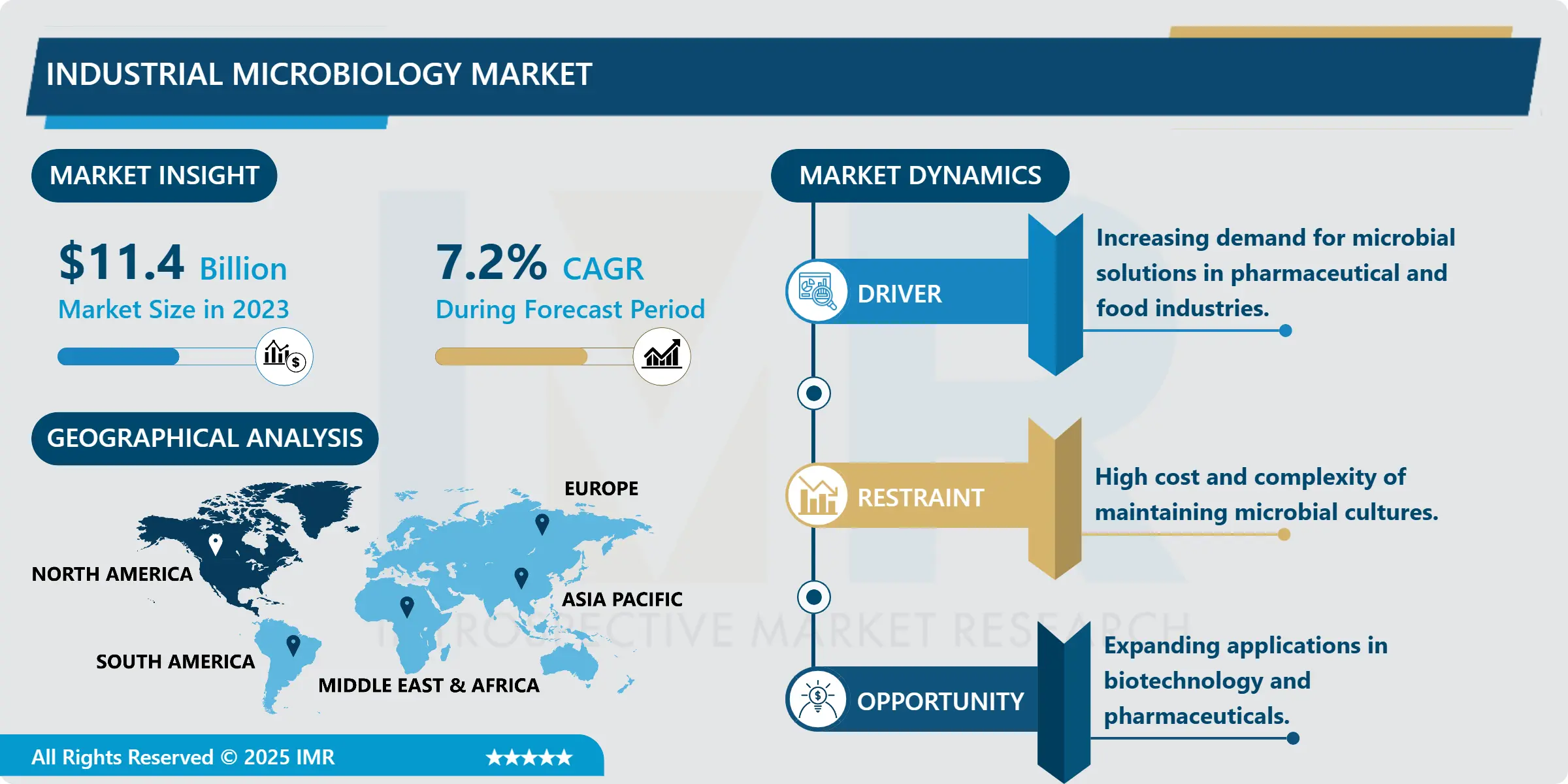
Industrial Microbiology Market Size Was Valued at USD 11.4 Billion in 2023, and is Projected to Reach USD 21.7 Billion by 2032, Growing at a CAGR of 7.2% From 2024-2032.
Industrial Microbiology is sub discipline of Applied Microbiology is defined as the use of microbiology for generation for intended non-medical use which includes food and beverages, environment, agriculture and bioenergy among others. This comprise of microbial products, equipments and services used in testing for quality, contamination, and efficient formulation of compound in this market. In industries microbial activity is widely used in fermentation, biotransformation and enzyme production to optimize cost effective sustainable solutions.
Industrial Microbiology Market growth is attributed to the growing usage in the different industries using microbial solutions for their production processes. This market growth is attributed to the need to acquire microbial strains, media, and reagents which ease the production of high quality and cost-effective products through efficient bioprocessing techniques in the food and beverages processed through microorganisms, drugs and vaccines production and other biodiesel industries. Advanced techniques in microbial industrial processes have allowed production to occur with minimal waste and high efficient production costs with increased focus on sustainability. The broad usage of microbial solutions is also gentleman with the current trends of innovating more efficient and less hazardous means of producing industrial products.
Biotechnology and microbiology have also attributed to market growth since industries look for better microbial cultures and media to enhance their productivity. As a result of higher funding for R and D there is a focus towards solving some of the world’s most pressing challenges through microbial technology such as clean energy, waste disposal as well as in precision agriculture. The use of industrial microbiology tools is on the rise globally driven by growing buying power and regulation concerning food and environmental health.
Industrial Microbiology Market Trend Analysis:
Shift Towards Bioprocessing for Sustainable Production
- For the last couple of decades, bioprocessing has emerged more strongly in industrial microbiological area. This trend is mainly due to the concerns with green chemistry and the high interest in applying environmentally friendly catalysts instead of conventional chemicals. Bioprocessing involves using microorganisms to synthesize bio molecules and green materials hence plays a central role in change of industry to sustainable one. Future Industries and especially industrial firms are applying microbial fermentation and enzyme technology to lower environmental effects of industrialization within the context of sustainable development goals. Consequently, bioprocessing has moved from being a mere option in the production of commodities to being a necessity in industries such as pharmaceutical, bio-fuel, and bio-plastics industries.
- In addition, the regulatory bodies across the globe are promoting funding and incentives focused on bioprocessing propulsion and its commercial adoption. Such a shift towards environmentally sustainable production has created opportunity in such fields as in agriculture where microbial technologies had done away with the formal use of chemicals such as fertilizers and pesticides. The move towards bioprocessing is predicted to sustain itself, and so microbial technology to act as a key fundamental in making industries sustainable.
Expanding Applications in Biotechnology and Pharmaceuticals
- Growth trends in Industrial Microbiology Market has shown quite good prospects, specially being used in the biotechnology and pharmaceutical fields.. Microbial solutions remain a very significant component where drug formulation, vaccine production, and synthesis of complex biologics are concerned. In the future, the opportunities that industrial microbiology will open for designing new treatments are also gradually appearing, for example, cancer and viruses. Many pharmaceuticals are now using microbial fermentation and recombinant DNA technology which enshrine the large-scale production of important products such as drugs and therapeutic agents.
Industrial Microbiology Market Segment Analysis:
Industrial Microbiology Market is Segmented on the basis of Type, Application, End User, and Region
By Type, Equipment and Systems segment is expected to dominate the market during the forecast period
- The Industrial Microbiology Market is expected to have the Equipment and Systems segment as the most prominent one in the next years due to the increasing need for enhanced microbial testing, analysis, and production media. Some of them include fermenters, bioreactors, incubators, filtration and purification systems, and automated microbial detecting systems, as part of critical production and quality control infrastructure across industries. As the technical level in manufacturing rises, more and more hi-tech equipment are used to realize precise and efficient control in areas such as quality, costs, health, safety, and environment, particularly towards those industries that have strict regulatory requirements such as the production of pharmaceuticals, food & beverages, and bio fuels. Further, R&D activities and bioprocessing applications of microorganisms have also lead to increased dependency on such systems, making Equipment and Systems segment an important growth sector in the industrial microbiology framework.
By Application, Sterility Testing segment expected to held the largest share
- The Sterility Testing segment would constitute the largest share of the Industrial Microbiology Market, due to increased concerns about contamination free environments especially in the manufacturing of drugs, biotech products and even food products. This is an important procedure for ascertaining that products are free of ‘viable’ organisms, important in respects of certification and guaranteeing product safety in the case of pharmaceuticals or medical apparatus etc. As consumer awareness grows and regulatory requirements get tighter, manufacturers are putting more resources into highly efficient sterility tests to reduce contamination threats and produce high-quality products. This testing is also critical in bioproduction environments where the slightest microbial contamination could render the high-value biologic and vaccines ineffectual and unsafe. An increasing need for safe and sterile products means that the Sterility Testing segment should retain its leading position in the market.
Industrial Microbiology Market Regional Insights:
North America is Expected to Dominate the Market Over the Forecast period
- North America is likely to remain the largest region in the Industrial Microbiology Market in 2023 due to rising investment in sectors like biotechnology and pharmaceuticals across the United States mainly. The region is leading the pack in terms of innovation of new microbial technologies and development has a dedicated focus on this. North America has estimated market share of 35% on account of availability of large number of key pharma and biotech players, concentrated research organizations, and favorable government policies. The following factors coupled with stringent regulatory requirements have resulted in the development of a strong marketplace need for microbial products, instruments and services.
Active Key Players in the Industrial Microbiology Market:
- 3M Company (USA)
- Agilent Technologies (USA)
- Becton, Dickinson and Company (USA)
- bioMérieux SA (France)
- Bio-Rad Laboratories (USA)
- Charles River Laboratories (USA)
- Danaher Corporation (USA)
- Eppendorf AG (Germany)
- HiMedia Laboratories (India)
- Lonza Group (Switzerland)
- Merck KGaA (Germany)
- Neogen Corporation (USA)
- Novozymes A/S (Denmark)
- Sartorius AG (Germany)
- Thermo Fisher Scientific (USA)
- Other Active Players
|
Industrial Microbiology Market |
|||
|
Base Year: |
2023 |
Forecast Period: |
2024-2032 |
|
Historical Data: |
2017 to 2023 |
Market Size in 2023: |
USD 11.4 Billion |
|
Forecast Period 2024-32 CAGR: |
7.2 % |
Market Size in 2032: |
USD 21.7 Billion |
|
Segments Covered: |
By Type |
|
|
|
By Application |
|
||
|
By Region |
|
||
|
Key Market Drivers: |
|
||
|
Key Market Restraints: |
|
||
|
Key Opportunities: |
|
||
|
Companies Covered in the report: |
|
||
Chapter 1: Introduction
1.1 Scope and Coverage
Chapter 2:Executive Summary
Chapter 3: Market Landscape
3.1 Market Dynamics
3.1.1 Drivers
3.1.2 Restraints
3.1.3 Opportunities
3.1.4 Challenges
3.2 Market Trend Analysis
3.3 PESTLE Analysis
3.4 Porter's Five Forces Analysis
3.5 Industry Value Chain Analysis
3.6 Ecosystem
3.7 Regulatory Landscape
3.8 Price Trend Analysis
3.9 Patent Analysis
3.10 Technology Evolution
3.11 Investment Pockets
3.12 Import-Export Analysis
Chapter 4: Industrial Microbiology Market by Type
4.1 Industrial Microbiology Market Snapshot and Growth Engine
4.2 Industrial Microbiology Market Overview
4.3 Equipment and Systems
4.3.1 Introduction and Market Overview
4.3.2 Historic and Forecasted Market Size in Value USD and Volume Units (2017-2032F)
4.3.3 Key Market Trends, Growth Factors and Opportunities
4.3.4 Equipment and Systems: Geographic Segmentation Analysis
4.4 Reaction Consumables
4.4.1 Introduction and Market Overview
4.4.2 Historic and Forecasted Market Size in Value USD and Volume Units (2017-2032F)
4.4.3 Key Market Trends, Growth Factors and Opportunities
4.4.4 Reaction Consumables: Geographic Segmentation Analysis
4.5 and Others
4.5.1 Introduction and Market Overview
4.5.2 Historic and Forecasted Market Size in Value USD and Volume Units (2017-2032F)
4.5.3 Key Market Trends, Growth Factors and Opportunities
4.5.4 and Others: Geographic Segmentation Analysis
Chapter 5: Industrial Microbiology Market by Application
5.1 Industrial Microbiology Market Snapshot and Growth Engine
5.2 Industrial Microbiology Market Overview
5.3 Sterility Testing
5.3.1 Introduction and Market Overview
5.3.2 Historic and Forecasted Market Size in Value USD and Volume Units (2017-2032F)
5.3.3 Key Market Trends, Growth Factors and Opportunities
5.3.4 Sterility Testing: Geographic Segmentation Analysis
5.4 Microbial Limits Testing
5.4.1 Introduction and Market Overview
5.4.2 Historic and Forecasted Market Size in Value USD and Volume Units (2017-2032F)
5.4.3 Key Market Trends, Growth Factors and Opportunities
5.4.4 Microbial Limits Testing: Geographic Segmentation Analysis
5.5 Bio-burden Testing
5.5.1 Introduction and Market Overview
5.5.2 Historic and Forecasted Market Size in Value USD and Volume Units (2017-2032F)
5.5.3 Key Market Trends, Growth Factors and Opportunities
5.5.4 Bio-burden Testing: Geographic Segmentation Analysis
5.6 Water and Environmental Testing
5.6.1 Introduction and Market Overview
5.6.2 Historic and Forecasted Market Size in Value USD and Volume Units (2017-2032F)
5.6.3 Key Market Trends, Growth Factors and Opportunities
5.6.4 Water and Environmental Testing: Geographic Segmentation Analysis
Chapter 6: Industrial Microbiology Market by End User
6.1 Industrial Microbiology Market Snapshot and Growth Engine
6.2 Industrial Microbiology Market Overview
6.3 Food and Beverages
6.3.1 Introduction and Market Overview
6.3.2 Historic and Forecasted Market Size in Value USD and Volume Units (2017-2032F)
6.3.3 Key Market Trends, Growth Factors and Opportunities
6.3.4 Food and Beverages: Geographic Segmentation Analysis
6.4 Pharmaceutical Biotechnology
6.4.1 Introduction and Market Overview
6.4.2 Historic and Forecasted Market Size in Value USD and Volume Units (2017-2032F)
6.4.3 Key Market Trends, Growth Factors and Opportunities
6.4.4 Pharmaceutical Biotechnology: Geographic Segmentation Analysis
6.5 Agricultural
6.5.1 Introduction and Market Overview
6.5.2 Historic and Forecasted Market Size in Value USD and Volume Units (2017-2032F)
6.5.3 Key Market Trends, Growth Factors and Opportunities
6.5.4 Agricultural: Geographic Segmentation Analysis
6.6 Environmental
6.6.1 Introduction and Market Overview
6.6.2 Historic and Forecasted Market Size in Value USD and Volume Units (2017-2032F)
6.6.3 Key Market Trends, Growth Factors and Opportunities
6.6.4 Environmental: Geographic Segmentation Analysis
6.7 Cosmetic and Personal Care
6.7.1 Introduction and Market Overview
6.7.2 Historic and Forecasted Market Size in Value USD and Volume Units (2017-2032F)
6.7.3 Key Market Trends, Growth Factors and Opportunities
6.7.4 Cosmetic and Personal Care: Geographic Segmentation Analysis
6.8 and Others
6.8.1 Introduction and Market Overview
6.8.2 Historic and Forecasted Market Size in Value USD and Volume Units (2017-2032F)
6.8.3 Key Market Trends, Growth Factors and Opportunities
6.8.4 and Others: Geographic Segmentation Analysis
Chapter 7: Company Profiles and Competitive Analysis
7.1 Competitive Landscape
7.1.1 Competitive Benchmarking
7.1.2 Industrial Microbiology Market Share by Manufacturer (2023)
7.1.3 Industry BCG Matrix
7.1.4 Heat Map Analysis
7.1.5 Mergers and Acquisitions
7.2 3M COMPANY
7.2.1 Company Overview
7.2.2 Key Executives
7.2.3 Company Snapshot
7.2.4 Role of the Company in the Market
7.2.5 Sustainability and Social Responsibility
7.2.6 Operating Business Segments
7.2.7 Product Portfolio
7.2.8 Business Performance
7.2.9 Key Strategic Moves and Recent Developments
7.2.10 SWOT Analysis
7.3 BECTON DICKINSON AND COMPANY
7.4 BIOMÉRIEUX SA
7.5 BIO-RAD LABORATORIES INC
7.6 DANAHER CORPORATION
7.7 EPPENDORF AG
7.8 QIAGEN
7.9 SARTORIUS AG
7.10 MERCK KGAA AND THERMO FISHER SCIENTIFIC INC
7.11 OTHER ACTIVE PLAYERS
Chapter 8: Global Industrial Microbiology Market By Region
8.1 Overview
8.2. North America Industrial Microbiology Market
8.2.1 Key Market Trends, Growth Factors and Opportunities
8.2.2 Top Key Companies
8.2.3 Historic and Forecasted Market Size by Segments
8.2.4 Historic and Forecasted Market Size By Type
8.2.4.1 Equipment and Systems
8.2.4.2 Reaction Consumables
8.2.4.3 and Others
8.2.5 Historic and Forecasted Market Size By Application
8.2.5.1 Sterility Testing
8.2.5.2 Microbial Limits Testing
8.2.5.3 Bio-burden Testing
8.2.5.4 Water and Environmental Testing
8.2.6 Historic and Forecasted Market Size By End User
8.2.6.1 Food and Beverages
8.2.6.2 Pharmaceutical Biotechnology
8.2.6.3 Agricultural
8.2.6.4 Environmental
8.2.6.5 Cosmetic and Personal Care
8.2.6.6 and Others
8.2.7 Historic and Forecast Market Size by Country
8.2.7.1 US
8.2.7.2 Canada
8.2.7.3 Mexico
8.3. Eastern Europe Industrial Microbiology Market
8.3.1 Key Market Trends, Growth Factors and Opportunities
8.3.2 Top Key Companies
8.3.3 Historic and Forecasted Market Size by Segments
8.3.4 Historic and Forecasted Market Size By Type
8.3.4.1 Equipment and Systems
8.3.4.2 Reaction Consumables
8.3.4.3 and Others
8.3.5 Historic and Forecasted Market Size By Application
8.3.5.1 Sterility Testing
8.3.5.2 Microbial Limits Testing
8.3.5.3 Bio-burden Testing
8.3.5.4 Water and Environmental Testing
8.3.6 Historic and Forecasted Market Size By End User
8.3.6.1 Food and Beverages
8.3.6.2 Pharmaceutical Biotechnology
8.3.6.3 Agricultural
8.3.6.4 Environmental
8.3.6.5 Cosmetic and Personal Care
8.3.6.6 and Others
8.3.7 Historic and Forecast Market Size by Country
8.3.7.1 Russia
8.3.7.2 Bulgaria
8.3.7.3 The Czech Republic
8.3.7.4 Hungary
8.3.7.5 Poland
8.3.7.6 Romania
8.3.7.7 Rest of Eastern Europe
8.4. Western Europe Industrial Microbiology Market
8.4.1 Key Market Trends, Growth Factors and Opportunities
8.4.2 Top Key Companies
8.4.3 Historic and Forecasted Market Size by Segments
8.4.4 Historic and Forecasted Market Size By Type
8.4.4.1 Equipment and Systems
8.4.4.2 Reaction Consumables
8.4.4.3 and Others
8.4.5 Historic and Forecasted Market Size By Application
8.4.5.1 Sterility Testing
8.4.5.2 Microbial Limits Testing
8.4.5.3 Bio-burden Testing
8.4.5.4 Water and Environmental Testing
8.4.6 Historic and Forecasted Market Size By End User
8.4.6.1 Food and Beverages
8.4.6.2 Pharmaceutical Biotechnology
8.4.6.3 Agricultural
8.4.6.4 Environmental
8.4.6.5 Cosmetic and Personal Care
8.4.6.6 and Others
8.4.7 Historic and Forecast Market Size by Country
8.4.7.1 Germany
8.4.7.2 UK
8.4.7.3 France
8.4.7.4 The Netherlands
8.4.7.5 Italy
8.4.7.6 Spain
8.4.7.7 Rest of Western Europe
8.5. Asia Pacific Industrial Microbiology Market
8.5.1 Key Market Trends, Growth Factors and Opportunities
8.5.2 Top Key Companies
8.5.3 Historic and Forecasted Market Size by Segments
8.5.4 Historic and Forecasted Market Size By Type
8.5.4.1 Equipment and Systems
8.5.4.2 Reaction Consumables
8.5.4.3 and Others
8.5.5 Historic and Forecasted Market Size By Application
8.5.5.1 Sterility Testing
8.5.5.2 Microbial Limits Testing
8.5.5.3 Bio-burden Testing
8.5.5.4 Water and Environmental Testing
8.5.6 Historic and Forecasted Market Size By End User
8.5.6.1 Food and Beverages
8.5.6.2 Pharmaceutical Biotechnology
8.5.6.3 Agricultural
8.5.6.4 Environmental
8.5.6.5 Cosmetic and Personal Care
8.5.6.6 and Others
8.5.7 Historic and Forecast Market Size by Country
8.5.7.1 China
8.5.7.2 India
8.5.7.3 Japan
8.5.7.4 South Korea
8.5.7.5 Malaysia
8.5.7.6 Thailand
8.5.7.7 Vietnam
8.5.7.8 The Philippines
8.5.7.9 Australia
8.5.7.10 New Zealand
8.5.7.11 Rest of APAC
8.6. Middle East & Africa Industrial Microbiology Market
8.6.1 Key Market Trends, Growth Factors and Opportunities
8.6.2 Top Key Companies
8.6.3 Historic and Forecasted Market Size by Segments
8.6.4 Historic and Forecasted Market Size By Type
8.6.4.1 Equipment and Systems
8.6.4.2 Reaction Consumables
8.6.4.3 and Others
8.6.5 Historic and Forecasted Market Size By Application
8.6.5.1 Sterility Testing
8.6.5.2 Microbial Limits Testing
8.6.5.3 Bio-burden Testing
8.6.5.4 Water and Environmental Testing
8.6.6 Historic and Forecasted Market Size By End User
8.6.6.1 Food and Beverages
8.6.6.2 Pharmaceutical Biotechnology
8.6.6.3 Agricultural
8.6.6.4 Environmental
8.6.6.5 Cosmetic and Personal Care
8.6.6.6 and Others
8.6.7 Historic and Forecast Market Size by Country
8.6.7.1 Turkiye
8.6.7.2 Bahrain
8.6.7.3 Kuwait
8.6.7.4 Saudi Arabia
8.6.7.5 Qatar
8.6.7.6 UAE
8.6.7.7 Israel
8.6.7.8 South Africa
8.7. South America Industrial Microbiology Market
8.7.1 Key Market Trends, Growth Factors and Opportunities
8.7.2 Top Key Companies
8.7.3 Historic and Forecasted Market Size by Segments
8.7.4 Historic and Forecasted Market Size By Type
8.7.4.1 Equipment and Systems
8.7.4.2 Reaction Consumables
8.7.4.3 and Others
8.7.5 Historic and Forecasted Market Size By Application
8.7.5.1 Sterility Testing
8.7.5.2 Microbial Limits Testing
8.7.5.3 Bio-burden Testing
8.7.5.4 Water and Environmental Testing
8.7.6 Historic and Forecasted Market Size By End User
8.7.6.1 Food and Beverages
8.7.6.2 Pharmaceutical Biotechnology
8.7.6.3 Agricultural
8.7.6.4 Environmental
8.7.6.5 Cosmetic and Personal Care
8.7.6.6 and Others
8.7.7 Historic and Forecast Market Size by Country
8.7.7.1 Brazil
8.7.7.2 Argentina
8.7.7.3 Rest of SA
Chapter 9 Analyst Viewpoint and Conclusion
9.1 Recommendations and Concluding Analysis
9.2 Potential Market Strategies
Chapter 10 Research Methodology
10.1 Research Process
10.2 Primary Research
10.3 Secondary Research
|
Industrial Microbiology Market |
|||
|
Base Year: |
2023 |
Forecast Period: |
2024-2032 |
|
Historical Data: |
2017 to 2023 |
Market Size in 2023: |
USD 11.4 Billion |
|
Forecast Period 2024-32 CAGR: |
7.2 % |
Market Size in 2032: |
USD 21.7 Billion |
|
Segments Covered: |
By Type |
|
|
|
By Application |
|
||
|
By Region |
|
||
|
Key Market Drivers: |
|
||
|
Key Market Restraints: |
|
||
|
Key Opportunities: |
|
||
|
Companies Covered in the report: |
|
||


