




In Vitro Lung Model Market Synopsis:
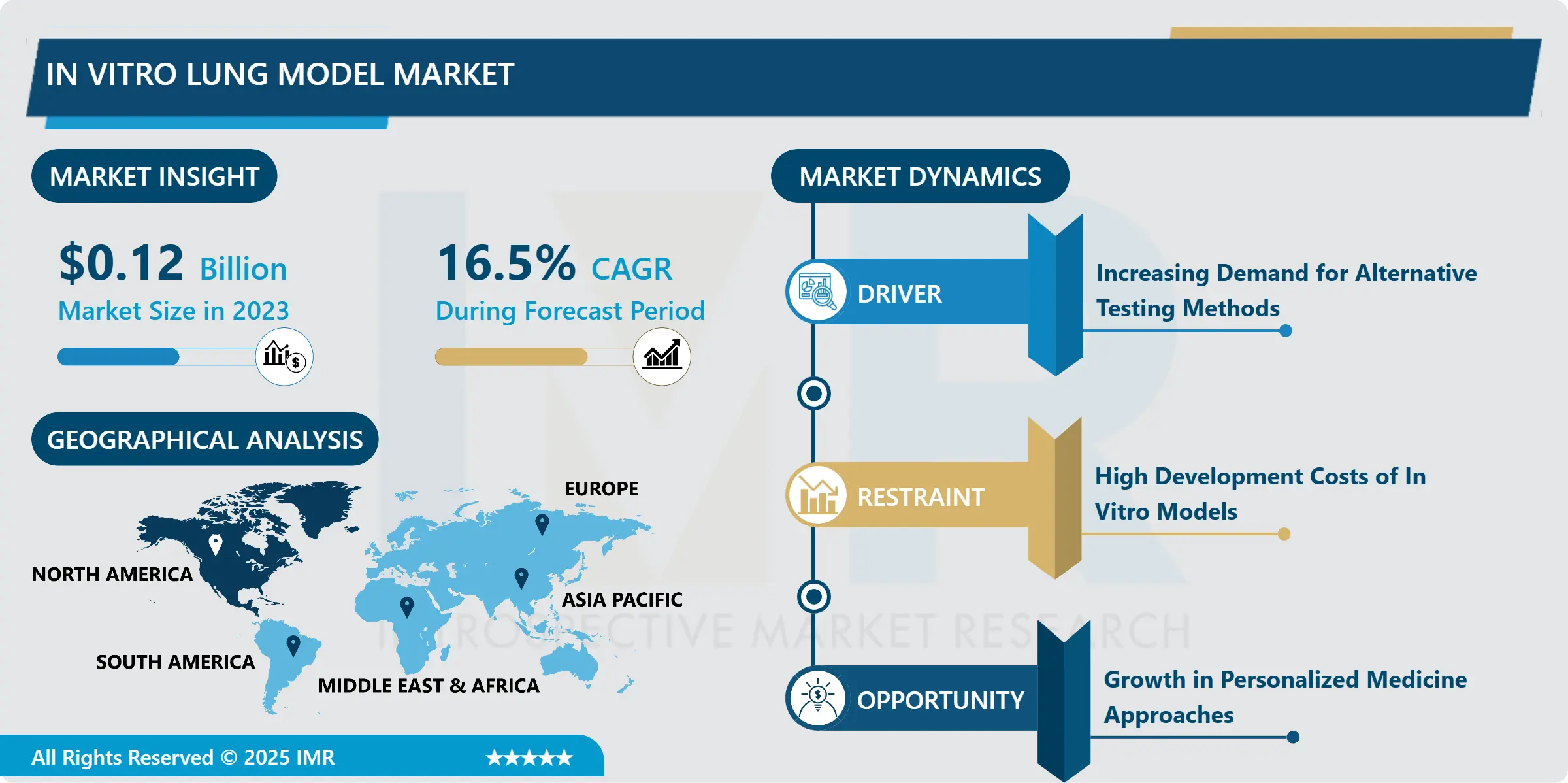
In Vitro Lung Model Market Size Was Valued at USD 0.12 Billion in 2023, and is Projected to Reach USD 0.47 Billion by 2032, Growing at a CAGR of 16.50% From 2024-2032.
This industry comprises novel systems utilized to mimic lung physiology in human beings primarily in research and development processes. These models are more used in drug Discovery, toxicity evaluation and disease modeling especially lung diseases since they emulate organs of human body to allow scientists or researchers to determine the impact of a given chemical compound without having to use animals. Since traditional investigation methods are less ethical, less efficient and less accurate than animal testing, in vitro human lung models are applied.
The major factor that has contributed towards the growth of the In Vitro Lung Model Market is the demand for a better and effective solution to toxicity testing in the pharmaceuticals and biotechnology sectors. Members of government around the world are increasingly placing pressure on companies to carry out fewer tests on animals, as there are methods out there which are more effective and legal. Using the in vitro models has advantages such as better replication, accurate human response replication than most other research methods making it acceptable in most research and development procedures.
Other important factors are increasing incidences of respiratory disorders such as asthma, COPD and lung cancer. And as these conditions become more common, there is more demand for sophisticated approaches to treatment. Lung models based in cell culture work are essential in investigating the causes and effects of particular diseases and the mechanisms by which treatments can counteract them. Such an increase in disease incidence is expected to create additional incentive for ongoing investments in the growth of lung models.
In Vitro Lung Model Market Trend Analysis:
the shift towards 3D lung models.
- A current trend likely present in In Vitro Lung Model Market is the use of 3D lung models compared to the traditional 2D ones as the former do a better job of mimicking the lung tissue of human beings. These advanced systems allow scientists to investigate cellular signaling, pharmacologic effects and diseases pathologies in a more physiological manner. The advancing methods in bioengineering like the organ on a chip are also perfecting the creation of lung models tailored towards environmentally sensitive diseases.
- One more new development is the use of artificial intelligence and machine learning in the work with lung models. Such technologies are making analysis and interpretations of the data easier, making the drug discovery and development process easier. Subsequently, artificial intelligence lets them study heaps of information collected from in vitro studies, find new therapeutic approaches, and simplify the creation of new medications to change the current situation in the sphere of inter alia lung research.
The growing focus on personalized medicine.
- The development of a subjective approach to therapeutic application also has vast prospects for the In Vitro Lung Model Market. Where treatments for patient populations is increasingly driving healthcare, in vitro lung models can also be used to analyze the responses of certain patient demographics to treatments. This capability can fast-track the current extent of treatment individualization in respiratory diseases, thus result in enhanced treatment outcomes.
- Addition to that, there will be increased collaboration opportunities between academia and industries for the development of new ideas within this in vitro lung model. Since many research institutions collaborate with biotech companies, new models and methodologies are created which improves the research on lung diseases. The studies in respiratory diseases will receive greater funding and investment in the future, which will also benefit these collaborations and, consequently, the market.
In Vitro Lung Model Market Segment Analysis:
In Vitro Lung Model Market is Segmented on the basis of Type, Application, End User, and Region.
By Type, 2D Lung Models segment is expected to dominate the market during the forecast period
- The In Vitro Lung Model Market is primarily segmented into two types: 2D lung models and 3D lung models. These are traditional cell cultures, where the cells are arranged in two dimensions; while they are easy to manage and observe they lack the structural and functional complexity of the human lungs. By comparison, 3D lung models are specifically intended to exhibit improved physiological relevance and therefore contain multiple cell types and ECMs that will offer a closer representation of the in vivo reality of lung structure. These models aid in comprehending the characteristics of cell, the effects of drugs and the mechanisms of diseases, for that reason are more in the use of drug discovery, toxicity test and disease modeling.
By Application, Drug Discovery segment expected to held the largest share
- The In Vitro Lung Model Market is mainly classified by application into drug discovery and development, toxicity testing, disease modeling and Regenerative medicine. These models are used to detect potential therapeutics, to evaluate the effectiveness of compounds and to modulate the drug delivery system before testing on animals or using human subjects, thus considerably lowering the usage of animals in the testing process. Toxicity testing aims at using lung models to assess the effects of any toxic chemical or pharmacological compound on human lung tissues profitably to detect adverse effects on lung cells and meet set heath regulations. There is strategy known as disease modeling where researchers aim to mimic certain lung diseases, e.g. asthma or COPD in order to be able to study or test new treatments for these ailments. Lastly, by using these models, regenerative medicine applications focus on possible treatments for lung restoration which is helpful in searching for new treatment for respiratory diseases.
In Vitro Lung Model Market Regional Insights:
North America is Expected to Dominate the Market Over the Forecast period
- North America leads the In Vitro Lung Model Market mostly influenced by well-established pharmaceutical and biotechnology industries present in the region. The region enjoys good healthcare standard and has made a huge investment in research and development hence leading this market. Also, the various rules and regulations in carrying out experiments as well as the emphasis on ethical practices promote the use of in vitro lung models among research conducting institutions and firms.
- In addition, North America enjoys a strong base of academic/research institutions and organizations that are engaged in promoting lung research knowledge. Such institutions are usually in an enabling position to coordinate with key players to create unique solutions and ideas for change and growth. A high incidence of respiratory diseases in the given area also fuels the need for efficient therapeutic treatments, confirming North America’s leadership in the market.
Active Key Players in the In Vitro Lung Model Market:
- MatTek Life Sciences (United States)
- Emulate, Inc. (United States)
- InSphero AG (Switzerland)
- AxoGen, Inc. (United States)
- TissUse GmbH (Germany)
- EMD Millipore (United States)
- Charles River Laboratories (United States)
- Corning Incorporated (United States)
- QIAGEN (Netherlands)
- Lonza Group (Switzerland)
- Other Active Players
|
Global In Vitro Lung Model Market |
|||
|
Base Year: |
2023 |
Forecast Period: |
2024-2032 |
|
Historical Data: |
2017 to 2023 |
Market Size in 2023: |
USD 0.12 Billion |
|
Forecast Period 2024-32 CAGR: |
16.50% |
Market Size in 2032: |
USD 0.47 Billion |
|
Segments Covered: |
By Type |
|
|
|
By Application |
|
||
|
End User |
|
||
|
By Region |
|
||
|
Key Market Drivers: |
|
||
|
Key Market Restraints: |
|
||
|
Key Opportunities: |
|
||
|
Companies Covered in the report: |
|
||
Chapter 1: Introduction
1.1 Scope and Coverage
Chapter 2:Executive Summary
Chapter 3: Market Landscape
3.1 Market Dynamics
3.1.1 Drivers
3.1.2 Restraints
3.1.3 Opportunities
3.1.4 Challenges
3.2 Market Trend Analysis
3.3 PESTLE Analysis
3.4 Porter's Five Forces Analysis
3.5 Industry Value Chain Analysis
3.6 Ecosystem
3.7 Regulatory Landscape
3.8 Price Trend Analysis
3.9 Patent Analysis
3.10 Technology Evolution
3.11 Investment Pockets
3.12 Import-Export Analysis
Chapter 4: In Vitro Lung Model Market by Type
4.1 In Vitro Lung Model Market Snapshot and Growth Engine
4.2 In Vitro Lung Model Market Overview
4.3 2D Lung Models
4.3.1 Introduction and Market Overview
4.3.2 Historic and Forecasted Market Size in Value USD and Volume Units (2017-2032F)
4.3.3 Key Market Trends, Growth Factors and Opportunities
4.3.4 2D Lung Models: Geographic Segmentation Analysis
4.4 3D Lung Models
4.4.1 Introduction and Market Overview
4.4.2 Historic and Forecasted Market Size in Value USD and Volume Units (2017-2032F)
4.4.3 Key Market Trends, Growth Factors and Opportunities
4.4.4 3D Lung Models: Geographic Segmentation Analysis
Chapter 5: In Vitro Lung Model Market by Application
5.1 In Vitro Lung Model Market Snapshot and Growth Engine
5.2 In Vitro Lung Model Market Overview
5.3 Drug Discovery
5.3.1 Introduction and Market Overview
5.3.2 Historic and Forecasted Market Size in Value USD and Volume Units (2017-2032F)
5.3.3 Key Market Trends, Growth Factors and Opportunities
5.3.4 Drug Discovery: Geographic Segmentation Analysis
5.4 Toxicity Testing
5.4.1 Introduction and Market Overview
5.4.2 Historic and Forecasted Market Size in Value USD and Volume Units (2017-2032F)
5.4.3 Key Market Trends, Growth Factors and Opportunities
5.4.4 Toxicity Testing: Geographic Segmentation Analysis
5.5 Disease Modeling
5.5.1 Introduction and Market Overview
5.5.2 Historic and Forecasted Market Size in Value USD and Volume Units (2017-2032F)
5.5.3 Key Market Trends, Growth Factors and Opportunities
5.5.4 Disease Modeling: Geographic Segmentation Analysis
5.6 Regenerative Medicine
5.6.1 Introduction and Market Overview
5.6.2 Historic and Forecasted Market Size in Value USD and Volume Units (2017-2032F)
5.6.3 Key Market Trends, Growth Factors and Opportunities
5.6.4 Regenerative Medicine: Geographic Segmentation Analysis
Chapter 6: In Vitro Lung Model Market by End User
6.1 In Vitro Lung Model Market Snapshot and Growth Engine
6.2 In Vitro Lung Model Market Overview
6.3 Pharmaceutical Companies
6.3.1 Introduction and Market Overview
6.3.2 Historic and Forecasted Market Size in Value USD and Volume Units (2017-2032F)
6.3.3 Key Market Trends, Growth Factors and Opportunities
6.3.4 Pharmaceutical Companies: Geographic Segmentation Analysis
6.4 Biotechnology Companies
6.4.1 Introduction and Market Overview
6.4.2 Historic and Forecasted Market Size in Value USD and Volume Units (2017-2032F)
6.4.3 Key Market Trends, Growth Factors and Opportunities
6.4.4 Biotechnology Companies: Geographic Segmentation Analysis
6.5 Academic and Research Institutions
6.5.1 Introduction and Market Overview
6.5.2 Historic and Forecasted Market Size in Value USD and Volume Units (2017-2032F)
6.5.3 Key Market Trends, Growth Factors and Opportunities
6.5.4 Academic and Research Institutions: Geographic Segmentation Analysis
6.6 Contract Research Organizations (CROs))
6.6.1 Introduction and Market Overview
6.6.2 Historic and Forecasted Market Size in Value USD and Volume Units (2017-2032F)
6.6.3 Key Market Trends, Growth Factors and Opportunities
6.6.4 Contract Research Organizations (CROs)) : Geographic Segmentation Analysis
Chapter 7: Company Profiles and Competitive Analysis
7.1 Competitive Landscape
7.1.1 Competitive Benchmarking
7.1.2 In Vitro Lung Model Market Share by Manufacturer (2023)
7.1.3 Industry BCG Matrix
7.1.4 Heat Map Analysis
7.1.5 Mergers and Acquisitions
7.2 MATTEK LIFE SCIENCES (UNITED STATES)
7.2.1 Company Overview
7.2.2 Key Executives
7.2.3 Company Snapshot
7.2.4 Role of the Company in the Market
7.2.5 Sustainability and Social Responsibility
7.2.6 Operating Business Segments
7.2.7 Product Portfolio
7.2.8 Business Performance
7.2.9 Key Strategic Moves and Recent Developments
7.2.10 SWOT Analysis
7.3 EMULATE INC. (UNITED STATES)
7.4 INSPHERO AG (SWITZERLAND)
7.5 AXOGEN INC. (UNITED STATES)
7.6 TISSUSE GMBH (GERMANY)
7.7 EMD MILLIPORE (UNITED STATES)
7.8 CHARLES RIVER LABORATORIES (UNITED STATES)
7.9 CORNING INCORPORATED (UNITED STATES)
7.10 QIAGEN (NETHERLANDS)
7.11 LONZA GROUP (SWITZERLAND)
7.12 OTHER ACTIVE PLAYERS
Chapter 8: Global In Vitro Lung Model Market By Region
8.1 Overview
8.2. North America In Vitro Lung Model Market
8.2.1 Key Market Trends, Growth Factors and Opportunities
8.2.2 Top Key Companies
8.2.3 Historic and Forecasted Market Size by Segments
8.2.4 Historic and Forecasted Market Size By Type
8.2.4.1 2D Lung Models
8.2.4.2 3D Lung Models
8.2.5 Historic and Forecasted Market Size By Application
8.2.5.1 Drug Discovery
8.2.5.2 Toxicity Testing
8.2.5.3 Disease Modeling
8.2.5.4 Regenerative Medicine
8.2.6 Historic and Forecasted Market Size By End User
8.2.6.1 Pharmaceutical Companies
8.2.6.2 Biotechnology Companies
8.2.6.3 Academic and Research Institutions
8.2.6.4 Contract Research Organizations (CROs))
8.2.7 Historic and Forecast Market Size by Country
8.2.7.1 US
8.2.7.2 Canada
8.2.7.3 Mexico
8.3. Eastern Europe In Vitro Lung Model Market
8.3.1 Key Market Trends, Growth Factors and Opportunities
8.3.2 Top Key Companies
8.3.3 Historic and Forecasted Market Size by Segments
8.3.4 Historic and Forecasted Market Size By Type
8.3.4.1 2D Lung Models
8.3.4.2 3D Lung Models
8.3.5 Historic and Forecasted Market Size By Application
8.3.5.1 Drug Discovery
8.3.5.2 Toxicity Testing
8.3.5.3 Disease Modeling
8.3.5.4 Regenerative Medicine
8.3.6 Historic and Forecasted Market Size By End User
8.3.6.1 Pharmaceutical Companies
8.3.6.2 Biotechnology Companies
8.3.6.3 Academic and Research Institutions
8.3.6.4 Contract Research Organizations (CROs))
8.3.7 Historic and Forecast Market Size by Country
8.3.7.1 Russia
8.3.7.2 Bulgaria
8.3.7.3 The Czech Republic
8.3.7.4 Hungary
8.3.7.5 Poland
8.3.7.6 Romania
8.3.7.7 Rest of Eastern Europe
8.4. Western Europe In Vitro Lung Model Market
8.4.1 Key Market Trends, Growth Factors and Opportunities
8.4.2 Top Key Companies
8.4.3 Historic and Forecasted Market Size by Segments
8.4.4 Historic and Forecasted Market Size By Type
8.4.4.1 2D Lung Models
8.4.4.2 3D Lung Models
8.4.5 Historic and Forecasted Market Size By Application
8.4.5.1 Drug Discovery
8.4.5.2 Toxicity Testing
8.4.5.3 Disease Modeling
8.4.5.4 Regenerative Medicine
8.4.6 Historic and Forecasted Market Size By End User
8.4.6.1 Pharmaceutical Companies
8.4.6.2 Biotechnology Companies
8.4.6.3 Academic and Research Institutions
8.4.6.4 Contract Research Organizations (CROs))
8.4.7 Historic and Forecast Market Size by Country
8.4.7.1 Germany
8.4.7.2 UK
8.4.7.3 France
8.4.7.4 The Netherlands
8.4.7.5 Italy
8.4.7.6 Spain
8.4.7.7 Rest of Western Europe
8.5. Asia Pacific In Vitro Lung Model Market
8.5.1 Key Market Trends, Growth Factors and Opportunities
8.5.2 Top Key Companies
8.5.3 Historic and Forecasted Market Size by Segments
8.5.4 Historic and Forecasted Market Size By Type
8.5.4.1 2D Lung Models
8.5.4.2 3D Lung Models
8.5.5 Historic and Forecasted Market Size By Application
8.5.5.1 Drug Discovery
8.5.5.2 Toxicity Testing
8.5.5.3 Disease Modeling
8.5.5.4 Regenerative Medicine
8.5.6 Historic and Forecasted Market Size By End User
8.5.6.1 Pharmaceutical Companies
8.5.6.2 Biotechnology Companies
8.5.6.3 Academic and Research Institutions
8.5.6.4 Contract Research Organizations (CROs))
8.5.7 Historic and Forecast Market Size by Country
8.5.7.1 China
8.5.7.2 India
8.5.7.3 Japan
8.5.7.4 South Korea
8.5.7.5 Malaysia
8.5.7.6 Thailand
8.5.7.7 Vietnam
8.5.7.8 The Philippines
8.5.7.9 Australia
8.5.7.10 New Zealand
8.5.7.11 Rest of APAC
8.6. Middle East & Africa In Vitro Lung Model Market
8.6.1 Key Market Trends, Growth Factors and Opportunities
8.6.2 Top Key Companies
8.6.3 Historic and Forecasted Market Size by Segments
8.6.4 Historic and Forecasted Market Size By Type
8.6.4.1 2D Lung Models
8.6.4.2 3D Lung Models
8.6.5 Historic and Forecasted Market Size By Application
8.6.5.1 Drug Discovery
8.6.5.2 Toxicity Testing
8.6.5.3 Disease Modeling
8.6.5.4 Regenerative Medicine
8.6.6 Historic and Forecasted Market Size By End User
8.6.6.1 Pharmaceutical Companies
8.6.6.2 Biotechnology Companies
8.6.6.3 Academic and Research Institutions
8.6.6.4 Contract Research Organizations (CROs))
8.6.7 Historic and Forecast Market Size by Country
8.6.7.1 Turkiye
8.6.7.2 Bahrain
8.6.7.3 Kuwait
8.6.7.4 Saudi Arabia
8.6.7.5 Qatar
8.6.7.6 UAE
8.6.7.7 Israel
8.6.7.8 South Africa
8.7. South America In Vitro Lung Model Market
8.7.1 Key Market Trends, Growth Factors and Opportunities
8.7.2 Top Key Companies
8.7.3 Historic and Forecasted Market Size by Segments
8.7.4 Historic and Forecasted Market Size By Type
8.7.4.1 2D Lung Models
8.7.4.2 3D Lung Models
8.7.5 Historic and Forecasted Market Size By Application
8.7.5.1 Drug Discovery
8.7.5.2 Toxicity Testing
8.7.5.3 Disease Modeling
8.7.5.4 Regenerative Medicine
8.7.6 Historic and Forecasted Market Size By End User
8.7.6.1 Pharmaceutical Companies
8.7.6.2 Biotechnology Companies
8.7.6.3 Academic and Research Institutions
8.7.6.4 Contract Research Organizations (CROs))
8.7.7 Historic and Forecast Market Size by Country
8.7.7.1 Brazil
8.7.7.2 Argentina
8.7.7.3 Rest of SA
Chapter 9 Analyst Viewpoint and Conclusion
9.1 Recommendations and Concluding Analysis
9.2 Potential Market Strategies
Chapter 10 Research Methodology
10.1 Research Process
10.2 Primary Research
10.3 Secondary Research
|
Global In Vitro Lung Model Market |
|||
|
Base Year: |
2023 |
Forecast Period: |
2024-2032 |
|
Historical Data: |
2017 to 2023 |
Market Size in 2023: |
USD 0.12 Billion |
|
Forecast Period 2024-32 CAGR: |
16.50% |
Market Size in 2032: |
USD 0.47 Billion |
|
Segments Covered: |
By Type |
|
|
|
By Application |
|
||
|
End User |
|
||
|
By Region |
|
||
|
Key Market Drivers: |
|
||
|
Key Market Restraints: |
|
||
|
Key Opportunities: |
|
||
|
Companies Covered in the report: |
|
||


