Key Market Highlights
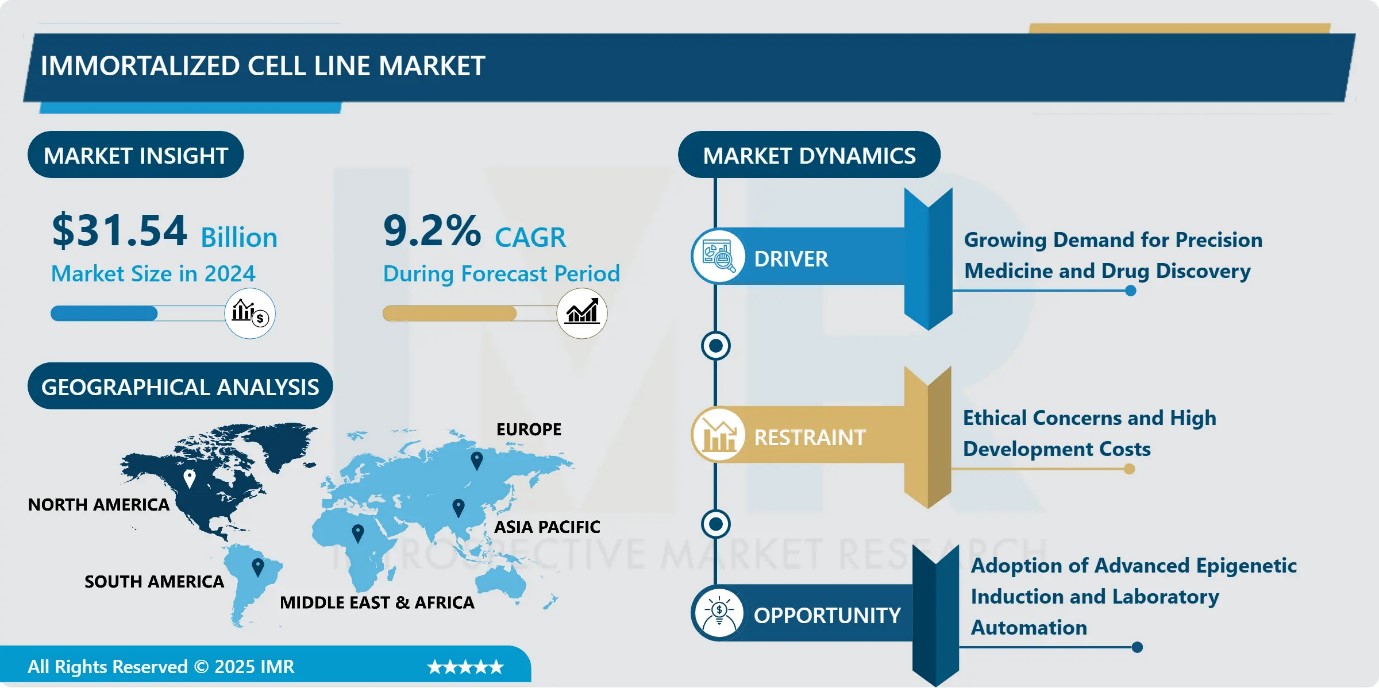
Immortalized Cell Line Market Size Was Valued at USD 31.54 Billion in 2024, and is Projected to Reach USD 83.04 Billion by 2035, Growing at a CAGR of 9.2% from 2025-2035.
- Market Size in 2024: USD 31.54 Billion
- Projected Market Size by 2035: USD 83.04 Billion
- CAGR (2025–2035): 9.2%
- Leading Market in 2024: North America
- Fastest-Growing Market: Asia-Pacific
- By End User: The Pharmaceutical & Biopharmaceutical Companies segment is anticipated to lead the market by accounting for 27.98% of the market share throughout the forecast period.
- By Application: The Drug Discovery & Development segment is expected to capture 25.8% of the market share, thereby maintaining its dominance over the forecast period.
- By Region: North America region is projected to hold 27.8% of the market share during the forecast period.
- Active Players: American Type Culture Collection (ATCC) (United States), Berkeley Lights (United States), Charles River Laboratories (United States), Corning Incorporated (United States), Danaher Corporation (United States), and Other Active Players.
Immortalized Cell Line Market Synopsis:
The immortalized cell line market refers to the global industry engaged in the development, manufacturing, and application of genetically modified or spontaneously mutated cell lines capable of indefinite proliferation. These cell lines are essential tools in drug discovery, vaccine production, cancer research, regenerative medicine, and toxicity testing due to their reproducibility, scalability, and cost efficiency. Market growth is driven by expanding biopharmaceutical R&D, rising demand for high-throughput in vitro models, and increasing stem-cell and gene-therapy research. Technological advances such as serum-free media, automated bioprocessing, and AI-enabled analytics are improving consistency and lowering production costs. Additionally, regulatory pressure, sustainability concerns, and global capacity expansion are accelerating adoption of standardized, ethically compliant immortalized cell line systems across research and commercial manufacturing environments.
Immortalized Cell Line Market Dynamics and Trend Analysis:
Immortalized Cell Line Market Growth Driver-Growing Demand for Precision Medicine and Drug Discovery
- The rising emphasis on precision medicine and innovative drug discovery is a major driver of the global immortalized cell line market. Increasing prevalence of cancer, neurological disorders, and chronic diseases has intensified the need for accurate disease models and high-throughput screening platforms. Immortalized cell lines offer reproducibility, scalability, and cost efficiency, enabling faster evaluation of drug candidates and vaccine development compared to primary cells. Their ability to support genetically defined models enhances targeted therapy development and personalized treatment strategies.
- Strong government funding for biomedical research and expanding industry collaborations further accelerate adoption. Partnerships leveraging advanced immortalized cell lines for personalized cancer vaccines and gene-edited therapies underscore their growing importance in modern biopharmaceutical research.
Immortalized Cell Line Market Limiting Factor-Ethical Concerns and High Development Costs
- Ethical issues related to the sourcing and use of human- and animal-derived cell lines remain a key restraint in the immortalized cell line market, particularly in regions with strict bioethical and consent regulations. Concerns surrounding genetic manipulation and tissue origin can limit acceptance and slow research adoption. Additionally, the high cost of developing advanced immortalized cell lines especially those involving gene editing, specialized bioprocessing, and extensive validation poses a significant barrier for small research institutions and emerging biotech companies. Regulatory complexity further increases development timelines and commercialization expenses. These challenges collectively restrict market accessibility, slow innovation, and hinder broader adoption, highlighting the need for ethical sourcing practices, cost-efficient technologies, and streamlined regulatory frameworks.
Immortalized Cell Line Market Expansion Opportunity-Adoption of Advanced Epigenetic Induction and Laboratory Automation
- The growing adoption of advanced epigenetic induction presents a significant opportunity in the immortalized cell line market. Unlike traditional genetic modification, epigenetic approaches enable cell immortalization without altering DNA sequences, preserving native cell characteristics and improving safety and reliability for research and therapeutic use.
- This innovation aligns with rising demand for physiologically relevant and regulatory-friendly cell models. In parallel, increasing laboratory automation and high-throughput cell culture systems are enhancing efficiency, reproducibility, and scalability. Automated workflows, AI-driven process control, and single-use bioreactors reduce contamination risks and development timelines while lowering operational costs. Together, these advancements create new growth avenues by enabling faster, safer, and more cost-effective cell line development for precision medicine and biopharmaceutical applications.
Immortalized Cell Line Market Challenge and Risk-Key Operational and Regulatory Challenges
- The immortalized cell line market faces multiple operational and structural challenges that impact development efficiency and cost. Stringent and regionally varied regulatory requirements demand extensive documentation and validation, increasing development timelines and compliance expenses.
- Intellectual property protections around proprietary cell lines often require costly licensing, limiting access for smaller players. Maintaining stable, high-yield protein expression during scale-up remains technically complex, affecting manufacturing consistency. Cell cultures are also highly susceptible to microbial and viral contamination, necessitating rigorous quality controls. Additionally, the shortage of skilled professionals in cell biology and bioprocessing constrains innovation. Prolonged development timelines further conflict with the biopharmaceutical industry’s need for faster drug commercialization.
Immortalized Cell Line Market Trend
Advancements in Gene Editing and Bioprocessing Technologies
- A key trend shaping the global immortalized cell line market is the rapid adoption of advanced gene-editing tools, such as CRISPR/Cas9, alongside next-generation bioprocessing technologies. These innovations enable precise genetic modification, improved disease modeling, and enhanced drug screening efficiency, particularly in oncology and personalized medicine.
- The expanding global cell- and gene-therapy clinical pipeline is driving demand for high-quality, scalable cell lines, especially among contract manufacturers supporting outsourced GMP production. Concurrently, automated culture systems, serum-free media, and high-yield bioreactors are improving reproducibility while reducing production costs. Leading players, including Thermo Fisher Scientific and Lonza Group, are leveraging these technologies to develop customized, scalable cell line platforms for advanced biopharmaceutical applications.
Immortalized Cell Line Market Segment Analysis
Immortalized Cell Line Market is segmented based on Product, Component, Technology, Cell Type, Application, End User and Region.
By End User, Pharmaceutical & Biopharmaceutical Companies segment is expected to dominate the market with around 27.98% share during the forecast period.
- Pharmaceutical & Biopharmaceutical Companies dominate the immortalized cell line market due to their extensive investment in drug discovery, development, and biologics manufacturing, where standardized and reproducible cell models are critical. Immortalized cell lines are widely used for screening, mechanism studies, and large-scale therapeutic production.
- Biotechnology firms represent an emerging segment, leveraging these cell lines for innovative therapies and personalized medicine. Together, strong research infrastructure, high investment capacity, and adoption of advanced technologies reinforce their market leadership. Collaborations like Evercyte and AIM Biotech’s organ-on-a-chip initiative illustrate how these End users drive innovation, efficiency, and sustained demand across both research and commercial applications.
By Application, drug discovery and development is expected to dominate with close to 25.8% market share during the forecast period.
- The drug discovery and development segment is the dominant application in the immortalized cell line market, driven by its essential role in early-stage research, compound screening, and toxicity testing. Immortalized cell lines provide consistent and reproducible biological responses, enabling faster evaluation of drug efficacy and safety while reducing costs and timelines. Their widespread adoption supports the growing demand for innovative therapeutics and accelerates pharmaceutical pipeline development. Cancer research is an emerging application, benefiting from advanced cell lines and collaborative efforts between academia and biotech firms. Milestones like ProBioGen’s AGE1.CRpIX cell line for cancer vaccine development highlight their critical role in enabling scalable, efficient drug and vaccine production.
Immortalized Cell Line Market Regional Insights:
North America region is estimated to lead the market with around 27.8% share during the forecast period.
- North America dominates the immortalized cell line market, accounting for over 38% of global revenue in 2024, driven by a mature biotechnology ecosystem and strong pharmaceutical R&D investment. The region benefits from advanced research infrastructure, early adoption of innovative cell-based technologies, and a highly skilled scientific workforce. Supportive regulatory oversight from agencies such as the U.S. FDA accelerates product approvals while ensuring quality and safety. The presence of major industry players, including Thermo Fisher Scientific, Merck KGaA, Lonza Group, and Danaher, further strengthens innovation and commercialization. Significant government funding, large-scale biomanufacturing expansions, and rising demand for biologics, cell therapies, and regenerative medicines continue to reinforce North America’s leadership. The U.S. remains the primary growth engine due to its strong clinical pipeline and regulatory clarity.
Immortalized Cell Line Market Active Players:
- American Type Culture Collection (ATCC) (United States)
- Berkeley Lights (United States)
- Charles River Laboratories (United States)
- Corning Incorporated (United States)
- Danaher Corporation (United States)
- Eurofins Scientific (Luxembourg)
- FUJIFILM Corporation (Japan)
- GenScript Biotech (China)
- Lonza Group AG (Switzerland)
- Merck KGaA (Sigma-Aldrich) (Germany)
- PromoCell GmbH (Germany)
- Sartorius AG (Germany)
- STEMCELL Technologies (Canada)
- Thermo Fisher Scientific Inc. (United States)
- WuXi AppTec (China)
- Other Active Players
Key Industry Developments in the Immortalized Cell Line Market:
- In April 2025: Thermo Fisher Scientific launched a new CHO K-1 cell line and platform that reduced IND timelines from 13 to 9 months, delivering up to 8 g/L protein expression with improved stability across development stages. The integrated offering enhances productivity while simplifying development and procurement for biopharma companies.
- In January 2025: Danaher announced a USD 1.5 billion investment to expand Cytiva and Pall manufacturing capacity. The initiative supports growing global demand for cell culture media, chromatography resins, and single-use bioprocessing technologies.
Technical Framework, Development Methodologies, and Bioprocessing Innovations Shaping the Global Immortalized Cell Line Market
- Immortalized cell lines are developed by enabling cells to bypass normal senescence and proliferate indefinitely through controlled biological interventions. Technically, immortalization is achieved using methods such as viral oncogene insertion (e.g., SV40 large T antigen), telomerase reverse transcriptase (hTERT) expression, inactivation of tumor suppressor pathways (p53, Rb), or advanced gene-editing technologies like CRISPR/Cas9. These approaches stabilize cell cycles while preserving functional characteristics.
- Modern development workflows incorporate serum-free and chemically defined media, automated cell culture platforms, and single-use bioreactors to enhance scalability and reproducibility. Rigorous cell line characterization including identity verification, genomic stability testing, and contamination screening is mandatory to meet regulatory standards. Advanced analytics, AI-driven clone selection, and high-throughput screening systems further optimize productivity and consistency. Collectively, these technical advancements enable reliable, cost-efficient cell line platforms that support drug discovery, biologics manufacturing, vaccine production, and regenerative medicine applications across global biopharmaceutical markets.
|
Immortalized Cell Line Market |
|||
|
Base Year: |
2024 |
Forecast Period: |
2025-2035 |
|
Historical Data: |
2018 to 2023 |
Market Size in 2024: |
USD 31.54 Bn. |
|
Forecast Period 2025-35 CAGR: |
9.2 % |
Market Size in 2035: |
USD 83.04 Bn. |
|
Segments Covered: |
By Product |
|
|
|
By Component |
|
||
|
By Technology |
|
||
|
By Cell Type |
|
||
|
By End User |
|
||
|
By Application
|
|
||
|
By Region |
|
||
|
Growth Driver: |
|
||
|
Limiting Factor |
|
||
|
Expansion Opportunity |
|
||
|
Challenge and Risk |
|
||
|
Companies Covered in the Report: |
|
||
Chapter 1: Introduction
1.1 Scope and Coverage
Chapter 2:Executive Summary
Chapter 3: Market Landscape
3.1 Market Dynamics and Opportunity Analysis
3.1.1 Growth Drivers
3.1.2 Limiting Factors
3.1.3 Growth Opportunities
3.1.4 Challenges and Risks
3.2 Market Trend Analysis
3.3 Industry Ecosystem
3.4 Industry Value Chain Mapping
3.5 Strategic PESTLE Overview
3.6 Porter's Five Forces Framework
3.7 Regulatory Framework
3.8 Pricing Trend Analysis
3.9 Intellectual Property Review
3.10 Technology Evolution
3.11 Import-Export Analysis
3.12 Consumer Behavior Analysis
3.13 Investment Pocket Analysis
3.14 Go-To Market Strategy
Chapter 4: Immortalized Cell Line Market by Product Type (2018-2035)
4.1 Immortalized Cell Line Market Snapshot and Growth Engine
4.2 Market Overview
4.3 Human Cell Lines
4.3.1 Introduction and Market Overview
4.3.2 Historic and Forecasted Market Size in Value USD and Volume Units
4.3.3 Key Market Trends, Growth Factors, and Opportunities
4.3.4 Geographic Segmentation Analysis
4.4 Animal Cell Lines
4.5 Plant Cell Lines
4.6 Others
Chapter 5: Immortalized Cell Line Market by Component (2018-2035)
5.1 Immortalized Cell Line Market Snapshot and Growth Engine
5.2 Market Overview
5.3 Cell Culture Media
5.3.1 Introduction and Market Overview
5.3.2 Historic and Forecasted Market Size in Value USD and Volume Units
5.3.3 Key Market Trends, Growth Factors, and Opportunities
5.3.4 Geographic Segmentation Analysis
5.4 Reagents
5.5 Cell Line Products
Chapter 6: Immortalized Cell Line Market by Technology (2018-2035)
6.1 Immortalized Cell Line Market Snapshot and Growth Engine
6.2 Market Overview
6.3 Bioreactor
6.3.1 Introduction and Market Overview
6.3.2 Historic and Forecasted Market Size in Value USD and Volume Units
6.3.3 Key Market Trends, Growth Factors, and Opportunities
6.3.4 Geographic Segmentation Analysis
6.4 Lyophilization
6.5 Electrospinning
6.6 Control Flow Centrifugation
6.7 Ultrasonic Lysis
6.8 Genome Editing Technology
6.9 Cell Immortalization Technology
6.10 Viral Vector Technology
Chapter 7: Immortalized Cell Line Market by Cell Type (2018-2035)
7.1 Immortalized Cell Line Market Snapshot and Growth Engine
7.2 Market Overview
7.3 Mammalian Cells
7.3.1 Introduction and Market Overview
7.3.2 Historic and Forecasted Market Size in Value USD and Volume Units
7.3.3 Key Market Trends, Growth Factors, and Opportunities
7.3.4 Geographic Segmentation Analysis
7.4 Stem Cells
7.5 Immune Cells
7.6 Human Embryonic Stem Cells
7.7 Pluripotent Stem Cells
7.8 Hematopoietic Stem Cells
Chapter 8: Immortalized Cell Line Market by Application (2018-2035)
8.1 Immortalized Cell Line Market Snapshot and Growth Engine
8.2 Market Overview
8.3 Drug Discovery & Development
8.3.1 Introduction and Market Overview
8.3.2 Historic and Forecasted Market Size in Value USD and Volume Units
8.3.3 Key Market Trends, Growth Factors, and Opportunities
8.3.4 Geographic Segmentation Analysis
8.4 Regenerative Medicine
8.5 Vaccine Production
8.6 Cancer Research
8.7 Toxicity Testing
8.8 Diagnostics
8.9 Tissue Engineering
8.10 Biopharmaceutical Production
8.11 Others
Chapter 9: Immortalized Cell Line Market by End User (2018-2035)
9.1 Immortalized Cell Line Market Snapshot and Growth Engine
9.2 Market Overview
9.3 Pharmaceutical & Biopharmaceutical Companies
9.3.1 Introduction and Market Overview
9.3.2 Historic and Forecasted Market Size in Value USD and Volume Units
9.3.3 Key Market Trends, Growth Factors, and Opportunities
9.3.4 Geographic Segmentation Analysis
9.4 Contract Research Organizations
9.5 Hospitals & Clinics
9.6 Diagnostic Centers
9.7 Regenerative Medicine Centers
9.8 Academic & Research Institutes
Chapter 10: Company Profiles and Competitive Analysis
10.1 Competitive Landscape
10.1.1 Competitive Benchmarking
10.1.2 Immortalized Cell Line Market Share by Manufacturer/Service Provider(2024)
10.1.3 Industry BCG Matrix
10.1.4 PArtnerships, Mergers & Acquisitions
10.2 AMERICAN TYPE CULTURE COLLECTION (ATCC) (UNITED STATES)
10.2.1 Company Overview
10.2.2 Key Executives
10.2.3 Company Snapshot
10.2.4 Role of the Company in the Market
10.2.5 Sustainability and Social Responsibility
10.2.6 Operating Business Segments
10.2.7 Product Portfolio
10.2.8 Business Performance
10.2.9 Recent News & Developments
10.2.10 SWOT Analysis
10.3 BERKELEY LIGHTS (UNITED STATES)
10.4 CHARLES RIVER LABORATORIES (UNITED STATES)
10.5 CORNING INCORPORATED (UNITED STATES)
10.6 DANAHER CORPORATION (UNITED STATES)
10.7 EUROFINS SCIENTIFIC (LUXEMBOURG)
10.8 FUJIFILM CORPORATION (JAPAN)
10.9 GENSCRIPT BIOTECH (CHINA)
10.10 LONZA GROUP AG (SWITZERLAND)
10.11 MERCK KGAA (SIGMA-ALDRICH) (GERMANY)
10.12 PROMOCELL GMBH (GERMANY)
10.13 SARTORIUS AG (GERMANY)
10.14 STEMCELL TECHNOLOGIES (CANADA)
10.15 THERMO FISHER SCIENTIFIC INC. (UNITED STATES)
10.16 WUXI APPTEC (CHINA)
10.17 AND OTHER ACTIVE PLAYERS.
Chapter 11: Global Immortalized Cell Line Market By Region
11.1 Overview
11.2. North America Immortalized Cell Line Market
11.2.1 Key Market Trends, Growth Factors and Opportunities
11.2.2 Top Key Companies
11.2.3 Historic and Forecasted Market Size by Segments
11.2.4 Historic and Forecast Market Size by Country
11.2.4.1 US
11.2.4.2 Canada
11.2.4.3 Mexico
11.3. Eastern Europe Immortalized Cell Line Market
11.3.1 Key Market Trends, Growth Factors and Opportunities
11.3.2 Top Key Companies
11.3.3 Historic and Forecasted Market Size by Segments
11.3.4 Historic and Forecast Market Size by Country
11.3.4.1 Russia
11.3.4.2 Bulgaria
11.3.4.3 The Czech Republic
11.3.4.4 Hungary
11.3.4.5 Poland
11.3.4.6 Romania
11.3.4.7 Rest of Eastern Europe
11.4. Western Europe Immortalized Cell Line Market
11.4.1 Key Market Trends, Growth Factors and Opportunities
11.4.2 Top Key Companies
11.4.3 Historic and Forecasted Market Size by Segments
11.4.4 Historic and Forecast Market Size by Country
11.4.4.1 Germany
11.4.4.2 UK
11.4.4.3 France
11.4.4.4 The Netherlands
11.4.4.5 Italy
11.4.4.6 Spain
11.4.4.7 Rest of Western Europe
11.5. Asia Pacific Immortalized Cell Line Market
11.5.1 Key Market Trends, Growth Factors and Opportunities
11.5.2 Top Key Companies
11.5.3 Historic and Forecasted Market Size by Segments
11.5.4 Historic and Forecast Market Size by Country
11.5.4.1 China
11.5.4.2 India
11.5.4.3 Japan
11.5.4.4 South Korea
11.5.4.5 Malaysia
11.5.4.6 Thailand
11.5.4.7 Vietnam
11.5.4.8 The Philippines
11.5.4.9 Australia
11.5.4.10 New Zealand
11.5.4.11 Rest of APAC
11.6. Middle East & Africa Immortalized Cell Line Market
11.6.1 Key Market Trends, Growth Factors and Opportunities
11.6.2 Top Key Companies
11.6.3 Historic and Forecasted Market Size by Segments
11.6.4 Historic and Forecast Market Size by Country
11.6.4.1 Turkiye
11.6.4.2 Bahrain
11.6.4.3 Kuwait
11.6.4.4 Saudi Arabia
11.6.4.5 Qatar
11.6.4.6 UAE
11.6.4.7 Israel
11.6.4.8 South Africa
11.7. South America Immortalized Cell Line Market
11.7.1 Key Market Trends, Growth Factors and Opportunities
11.7.2 Top Key Companies
11.7.3 Historic and Forecasted Market Size by Segments
11.7.4 Historic and Forecast Market Size by Country
11.7.4.1 Brazil
11.7.4.2 Argentina
11.7.4.3 Rest of SA
Chapter 12 Analyst Viewpoint and Conclusion
Chapter 13 Our Thematic Research Methodology
13.1 Research Process
13.2 Primary Research
13.3 Secondary Research
Chapter 14 Case Study
Chapter 15 Appendix
15.1 Sources
15.2 List of Tables and figures
15.3 Short Forms and Citations
15.4 Assumption and Conversion
15.5 Disclaimer
|
Immortalized Cell Line Market |
|||
|
Base Year: |
2024 |
Forecast Period: |
2025-2035 |
|
Historical Data: |
2018 to 2023 |
Market Size in 2024: |
USD 31.54 Bn. |
|
Forecast Period 2025-35 CAGR: |
9.2 % |
Market Size in 2035: |
USD 83.04 Bn. |
|
Segments Covered: |
By Product |
|
|
|
By Component |
|
||
|
By Technology |
|
||
|
By Cell Type |
|
||
|
By End User |
|
||
|
By Application
|
|
||
|
By Region |
|
||
|
Growth Driver: |
|
||
|
Limiting Factor |
|
||
|
Expansion Opportunity |
|
||
|
Challenge and Risk |
|
||
|
Companies Covered in the Report: |
|
||