




Imaging Services Market Synopsis:
Imaging Services Market Size Was Valued at USD 144.8 Billion in 2023, and is Projected to Reach USD 210.59 Billion by 2032, Growing at a CAGR of 4.25% From 2024-2032.
Imaging Services Market as defined here is the industry which offers diagnostic imaging services by the use of x-rays, CT, MRI, ultrasound, nuclear medicine and others. Most of them are applied in the clinical point of view to assess, screen and manage diseases or afflictions affecting individuals. The market encompasses the services that are provided by the hospitals, outpatient imaging centres, diagnostic laboratories, specialised imaging clinics and involve diagnostic tests that centres on facets that are significant for the healthcare workers to evaluate patient’s condition and treatment.
The Imaging Services Market has been an important signifier of the health care market for many years as the latter is focused on using the right equipment to diagnose and further track various diseases and conditions. It has for instance X-ray, MRI (Magnetic Resonance Imaging), CT scans, ultrasound and Nuclear medicine which diagnosis almost everything right from fracture cases, internal injuries to cancers, neurological disorders among others. In recent years there has been an increase in the consumption of diagnostic imaging due to increased occurrence of diseases that can be detected through imaging, improvement in technology on imaging systems and increased life expectancy of the population hence frequent imaging.
Advancements and development in the technology and the imaging equipment have been key drivers to the market’s growth. Hence, improvements in recent technologies such as 3D imaging, artificial integration and imaging through clouds have relieved the process and made it more effective as well as efficient. In addition, the increase in non-invasive diagnostic techniques and the shift towards increased patient centered care, has also further contributed to the increases in demand for imaging services. There is a steady trend in the healthcare industry where imaging is becoming a standard tool in annual health check-ups, early disease detection, and chronic disease management practices, which have in turn help in growing the market at both developed and developing regions.
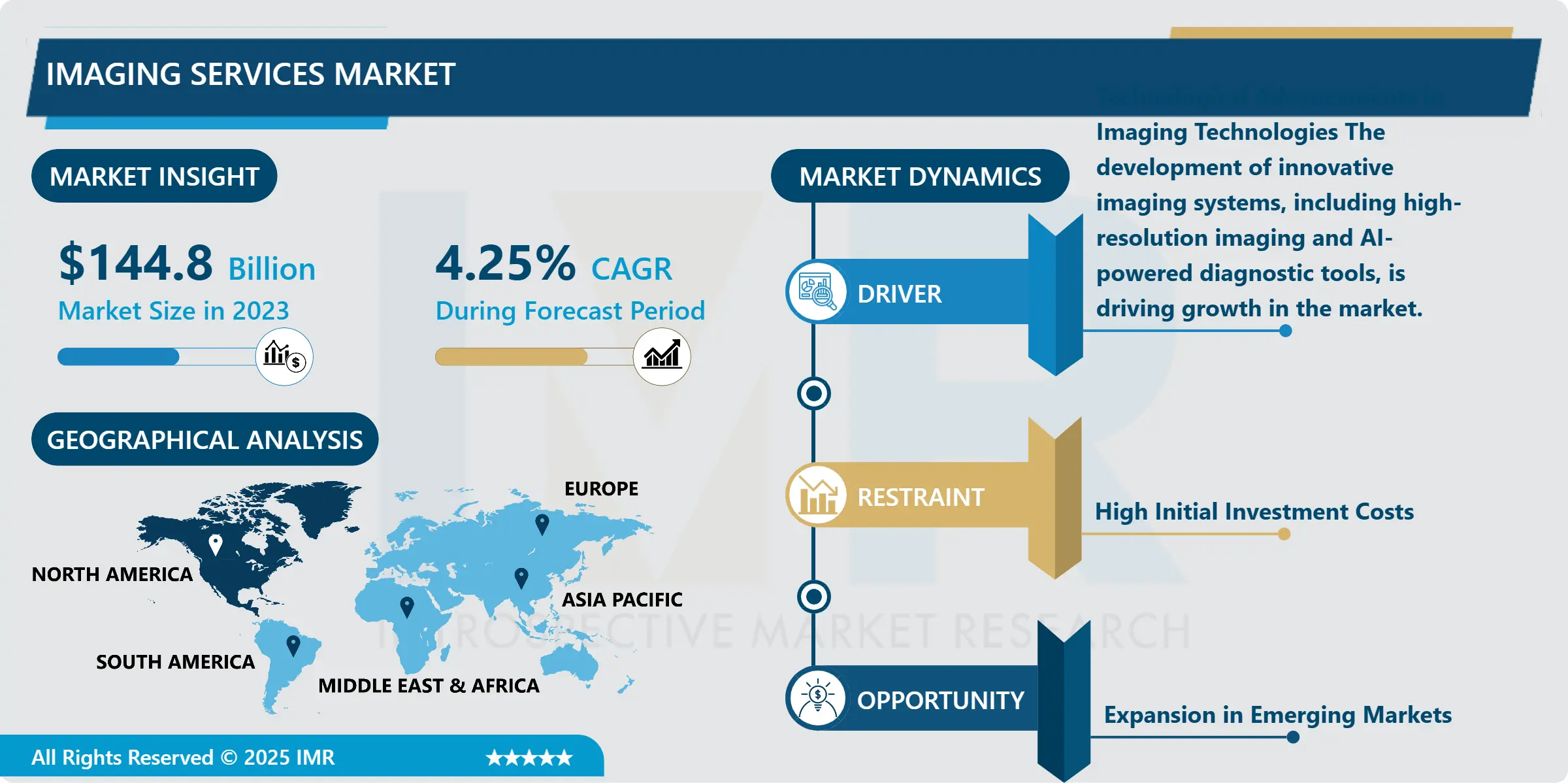
Imaging Services Market Trend Analysis:
Growth of AI and Machine Learning in Imaging
-
One key factor significantly impacting growth in the Imaging Services Market is the combination of artificial intelligence and machine learning with imaging solutions. Many current solutions can be linked to artificial intelligence as it impacts the analysis of medical imaging data and helps in making efficient diagnosis. The use of big data can help teach machines to read scans, identify diseases, including tumours or fractures, or even signs of neurological diseases, as accurately and efficiently as possible with minimal margin for error. These tools are enhancing the competence of work within imaging centers and hospitals as many scans, images and data have to be analysed to diagnose different conditions with higher speed and precision.
- Apart from the increased accuracy of diagnoses, AI also leads to better prognosis of the patient, fine tuning of imaging protocols and even help with post image processing to gain a better view. The periodic technological improvements in Artificial Intelligence and Machine Learning will enhance diagnostic imaging with improved efficacies, reduced costs and greater accessibility. What we may witness in the future, is more significant incorporation of these technologies into clinical workstation, equipping care givers with better means of decision making, decrease a diagnostic turnaround time and improvement of overall care.
Expanding Access to Imaging Services in Emerging Markets
-
Out of various factors, development of the Imaging Services Market on the basis of growth of imaging services in new frontiers and increase in the globalization of the healthcare industry, education, and prevention sectors. There are several developed and developing countries in Asia-Pacific, Latin America, and Middle-East that are increasingly focusing on their healthcare budget, and is affecting the utilization of updated medical imaging equipment and health care industry. While the need for superior and more accurate diagnostic tools is ever on the rise, clinicians in these regions are upping their camera game and adopting better form of imaging in order to provide enhanced service delivery to patients.
- This opportunity also mean that industry player can capture new market share for imaging solutions and /or Mobile imaging services or opening diagnostic centres in area which the imaging services were inaccessible. Consequently, there is increased need for diagnosing diseases at an early stage and the routine check-up, most especially in the regions with fast aging population which is a potential for this market. Since these regions will be better equipped with latest diagnostic tools it is anticipated that a massive demand for imaging services will be observed over the global market since domestic and international investments a strategic collaborations are being made towards enhancing better healthcare availability and delivery.
Imaging Services Market Segment Analysis:
Imaging Services Market is Segmented on the basis of Technology, Application, End User, and Region.
By Technology, Digital Imaging segment is expected to dominate the market during the forecast period
-
It has emerged as the market leader in the Imaging Services Market because of the many benefits it has over the traditional analog Imaging Systems. Digital imaging has increase accuracy, resolution and image processing as compared to the conventional techniques hence the common use in diagnostics imaging. Imaging techniques such as DR, Digital Mammography and CT incorporate digital detectors in capturing the mean images which can then be stored electronically, transmitted, as well as analysed. This has in turn improved resolving power, shorter image acquisition time, and improved flow of information in the health care sector. Moreover, they are most advantageous in terms of the cost because they do not need the frequent purchase of the physical film, and image storage is possible electronically.
- In contrast, Analog Imaging is phased out by digital systems or technologies, yet it is used in some diagnostic procedures. Traditional X-ray and Film-based Mammography are generative in nature and create their picture on a film, which then requires chemical processing. Generally, analog systems cost less money initially, but they are inferior when it comes to resolving power, speed, or capacity of archiving in comparison with digital ones. The upgrade from conventional analog film to digital imagery is prompted by the desire to obtain higher diagnostic acuity and optimise clinical throughput processes. Nonetheless, analog imaging is still implemented in some instances because of low acquisition costs besides the existing structures in specific geographical locations.
By Application, oncology segment expected to held the largest share
-
Oncology is a significant and voluminous domain of the application of imaging services because imaging methods are used frequently within the course of diagnosis and treatment of cancer. All these [, such as magnetic resonance imaging (MRI), computed tomography (CT), positron emission tomography combined with CT (PET–CT), and x-rays] are useful for tumour detection, measurement of their size, localization and invasiveness, and determination of the operation or radiation therapy plan. Imaging services also assist oncologists to monitor response to treatment, disease relapse and individual management. Because cancer prevalence continues to rise worldwide, there are opportunities for growth in this imaging market application.
- Cardiology, neurology, orthopaedics, gynaecology were other main sections where expanded usage of imaging services was noted. In cardiology, imaging helps in evaluating the state of heart disease, to look for blockage and general health of heart and blood vessels using echocardiography, CT coronary angiography, MRI. Imaging provide neurology with means to diagnose conditions such as stroke, tumours and degenerative diseases and MRI’s and CT scans are essential to the brain image. Imaging forms the cornerstone of service provision with X-rays and MRI being popular for diagnosing fractures, joint problems and bone diseases among orthopedic patients. Imaging plays a central role in diagnosing various gynecological conditions and in assessing early pregnancy; most commonly used is ultrasound. Besides, imaging is useful in other forms of sub-specializations including pediatric imaging, urological imaging and several others where imaging is applied to diagnose certain diseases unique to these regions.
Imaging Services Market Regional Insights:
North America is Expected to Dominate the Market Over the Forecast period
-
North America continues to be the largest player in the Imaging Services Market until 2023 due to the availability of developed healthcare facilities, high health care spending and adoption of sophisticated imaging services. Currently, the United States is still one of the largest consumers, which takes approximately one-third of the total revenue of the imaging services market. As per latest information North America has captured about 40/45 % of the global market. This dominance is further buttressed by a steady demand for diagnostic imaging given the increasing cases of chronic diseases, an ageing population, and innovation particularly in artificial intelligence, machine learning and what have it, cloud solutions etc.
- The US health care facility and constant emphasizing on early diagnosis, preventive care put more demands for the imaging services. Furthermore, the country has market players involved in Diagnostic Imaging that assist the market development and creativity. Furthermore, health cover offered in the region helps fund adequate and access to imagines for as many patients as possible. Due to a continuously growing market in North America and improving technologies, high healthcare spending, and growing implementation of cross-sectional imaging modalities across practices, it is anticipated that North America market will retain its commanding share in the future.
Active Key Players in the Imaging Services Market:
-
Agfa-Gevaert Group (Belgium)
- Canon Medical Systems (Japan)
- Carestream Health (USA)
- GE Healthcare (USA)
- Hitachi Medical Systems (Japan)
- Hologic, Inc. (USA)
- Koninklijke Philips N.V. (Netherlands)
- Medtronic (Ireland)
- MRI (Siemens Healthiness) (Germany)
- Neusoft Medical Systems Co., Ltd. (China)
- Nikon Corporation (Japan)
- Samsung Medison (South Korea)
- Shimadzu Corporation (Japan)
- Toshiba Medical Systems Corporation (Japan)
- Varian Medical Systems, Inc. (USA)
- Other Active Players
|
Global Imaging Services Market |
|||
|
Base Year: |
2023 |
Forecast Period: |
2024-2032 |
|
Historical Data: |
2017 to 2023 |
Market Size in 2023: |
USD 144.8 Billion |
|
Forecast Period 2024-32 CAGR: |
4.25 % |
Market Size in 2032: |
USD 210.59 Billion |
|
Segments Covered: |
By Technology |
|
|
|
By Modality |
|
||
|
By Application |
|
||
|
By End User |
|
||
|
By Region |
|
||
|
Key Market Drivers: |
|
||
|
Key Market Restraints: |
|
||
|
Key Opportunities: |
|
||
|
Companies Covered in the report: |
|
||
Chapter 1: Introduction
1.1 Scope and Coverage
Chapter 2:Executive Summary
Chapter 3: Market Landscape
3.1 Market Dynamics
3.1.1 Drivers
3.1.2 Restraints
3.1.3 Opportunities
3.1.4 Challenges
3.2 Market Trend Analysis
3.3 PESTLE Analysis
3.4 Porter's Five Forces Analysis
3.5 Industry Value Chain Analysis
3.6 Ecosystem
3.7 Regulatory Landscape
3.8 Price Trend Analysis
3.9 Patent Analysis
3.10 Technology Evolution
3.11 Investment Pockets
3.12 Import-Export Analysis
Chapter 4: Imaging Services Market by Technology
4.1 Imaging Services Market Snapshot and Growth Engine
4.2 Imaging Services Market Overview
4.3 Digital Imaging
4.3.1 Introduction and Market Overview
4.3.2 Historic and Forecasted Market Size in Value USD and Volume Units (2017-2032F)
4.3.3 Key Market Trends, Growth Factors and Opportunities
4.3.4 Digital Imaging: Geographic Segmentation Analysis
4.4 Analog Imaging
4.4.1 Introduction and Market Overview
4.4.2 Historic and Forecasted Market Size in Value USD and Volume Units (2017-2032F)
4.4.3 Key Market Trends, Growth Factors and Opportunities
4.4.4 Analog Imaging: Geographic Segmentation Analysis
Chapter 5: Imaging Services Market by Application
5.1 Imaging Services Market Snapshot and Growth Engine
5.2 Imaging Services Market Overview
5.3 Oncology
5.3.1 Introduction and Market Overview
5.3.2 Historic and Forecasted Market Size in Value USD and Volume Units (2017-2032F)
5.3.3 Key Market Trends, Growth Factors and Opportunities
5.3.4 Oncology: Geographic Segmentation Analysis
5.4 Cardiology
5.4.1 Introduction and Market Overview
5.4.2 Historic and Forecasted Market Size in Value USD and Volume Units (2017-2032F)
5.4.3 Key Market Trends, Growth Factors and Opportunities
5.4.4 Cardiology: Geographic Segmentation Analysis
5.5 Neurology
5.5.1 Introduction and Market Overview
5.5.2 Historic and Forecasted Market Size in Value USD and Volume Units (2017-2032F)
5.5.3 Key Market Trends, Growth Factors and Opportunities
5.5.4 Neurology: Geographic Segmentation Analysis
5.6 Orthopaedics
5.6.1 Introduction and Market Overview
5.6.2 Historic and Forecasted Market Size in Value USD and Volume Units (2017-2032F)
5.6.3 Key Market Trends, Growth Factors and Opportunities
5.6.4 Orthopaedics: Geographic Segmentation Analysis
5.7 Gynaecology
5.7.1 Introduction and Market Overview
5.7.2 Historic and Forecasted Market Size in Value USD and Volume Units (2017-2032F)
5.7.3 Key Market Trends, Growth Factors and Opportunities
5.7.4 Gynaecology: Geographic Segmentation Analysis
5.8 Others (Pediatrics
5.8.1 Introduction and Market Overview
5.8.2 Historic and Forecasted Market Size in Value USD and Volume Units (2017-2032F)
5.8.3 Key Market Trends, Growth Factors and Opportunities
5.8.4 Others (Pediatrics: Geographic Segmentation Analysis
5.9 Urology
5.9.1 Introduction and Market Overview
5.9.2 Historic and Forecasted Market Size in Value USD and Volume Units (2017-2032F)
5.9.3 Key Market Trends, Growth Factors and Opportunities
5.9.4 Urology: Geographic Segmentation Analysis
5.10 etc.))
5.10.1 Introduction and Market Overview
5.10.2 Historic and Forecasted Market Size in Value USD and Volume Units (2017-2032F)
5.10.3 Key Market Trends, Growth Factors and Opportunities
5.10.4 etc.)): Geographic Segmentation Analysis
Chapter 6: Imaging Services Market by End User
6.1 Imaging Services Market Snapshot and Growth Engine
6.2 Imaging Services Market Overview
6.3 Hospitals
6.3.1 Introduction and Market Overview
6.3.2 Historic and Forecasted Market Size in Value USD and Volume Units (2017-2032F)
6.3.3 Key Market Trends, Growth Factors and Opportunities
6.3.4 Hospitals: Geographic Segmentation Analysis
6.4 Diagnostic Imaging Centers
6.4.1 Introduction and Market Overview
6.4.2 Historic and Forecasted Market Size in Value USD and Volume Units (2017-2032F)
6.4.3 Key Market Trends, Growth Factors and Opportunities
6.4.4 Diagnostic Imaging Centers: Geographic Segmentation Analysis
6.5 Clinics
6.5.1 Introduction and Market Overview
6.5.2 Historic and Forecasted Market Size in Value USD and Volume Units (2017-2032F)
6.5.3 Key Market Trends, Growth Factors and Opportunities
6.5.4 Clinics: Geographic Segmentation Analysis
6.6 Research & Academic Institutes
6.6.1 Introduction and Market Overview
6.6.2 Historic and Forecasted Market Size in Value USD and Volume Units (2017-2032F)
6.6.3 Key Market Trends, Growth Factors and Opportunities
6.6.4 Research & Academic Institutes: Geographic Segmentation Analysis
6.7 Others (Outpatient Care Centers
6.7.1 Introduction and Market Overview
6.7.2 Historic and Forecasted Market Size in Value USD and Volume Units (2017-2032F)
6.7.3 Key Market Trends, Growth Factors and Opportunities
6.7.4 Others (Outpatient Care Centers: Geographic Segmentation Analysis
6.8 etc.)
6.8.1 Introduction and Market Overview
6.8.2 Historic and Forecasted Market Size in Value USD and Volume Units (2017-2032F)
6.8.3 Key Market Trends, Growth Factors and Opportunities
6.8.4 etc.): Geographic Segmentation Analysis
Chapter 7: Company Profiles and Competitive Analysis
7.1 Competitive Landscape
7.1.1 Competitive Benchmarking
7.1.2 Imaging Services Market Share by Manufacturer (2023)
7.1.3 Industry BCG Matrix
7.1.4 Heat Map Analysis
7.1.5 Mergers and Acquisitions
7.2 AGFA-GEVAERT GROUP (BELGIUM)
7.2.1 Company Overview
7.2.2 Key Executives
7.2.3 Company Snapshot
7.2.4 Role of the Company in the Market
7.2.5 Sustainability and Social Responsibility
7.2.6 Operating Business Segments
7.2.7 Product Portfolio
7.2.8 Business Performance
7.2.9 Key Strategic Moves and Recent Developments
7.2.10 SWOT Analysis
7.3 CANON MEDICAL SYSTEMS (JAPAN)
7.4 CARESTREAM HEALTH (USA)
7.5 GE HEALTHCARE (USA)
7.6 HITACHI MEDICAL SYSTEMS (JAPAN)
7.7 HOLOGIC INC. (USA)
7.8 KONINKLIJKE PHILIPS N.V. (NETHERLANDS)
7.9 MEDTRONIC (IRELAND)
7.10 MRI (SIEMENS HEALTHINESS) (GERMANY)
7.11 NEUSOFT MEDICAL SYSTEMS CO. LTD. (CHINA)
7.12 NIKON CORPORATION (JAPAN)
7.13 SAMSUNG MEDISON (SOUTH KOREA)
7.14 SHIMADZU CORPORATION (JAPAN)
7.15 TOSHIBA MEDICAL SYSTEMS CORPORATION (JAPAN)
7.16 VARIAN MEDICAL SYSTEMS INC. (USA).
7.17 OTHER ACTIVE PLAYERS
Chapter 8: Global Imaging Services Market By Region
8.1 Overview
8.2. North America Imaging Services Market
8.2.1 Key Market Trends, Growth Factors and Opportunities
8.2.2 Top Key Companies
8.2.3 Historic and Forecasted Market Size by Segments
8.2.4 Historic and Forecasted Market Size By Technology
8.2.4.1 Digital Imaging
8.2.4.2 Analog Imaging
8.2.5 Historic and Forecasted Market Size By Application
8.2.5.1 Oncology
8.2.5.2 Cardiology
8.2.5.3 Neurology
8.2.5.4 Orthopaedics
8.2.5.5 Gynaecology
8.2.5.6 Others (Pediatrics
8.2.5.7 Urology
8.2.5.8 etc.))
8.2.6 Historic and Forecasted Market Size By End User
8.2.6.1 Hospitals
8.2.6.2 Diagnostic Imaging Centers
8.2.6.3 Clinics
8.2.6.4 Research & Academic Institutes
8.2.6.5 Others (Outpatient Care Centers
8.2.6.6 etc.)
8.2.7 Historic and Forecast Market Size by Country
8.2.7.1 US
8.2.7.2 Canada
8.2.7.3 Mexico
8.3. Eastern Europe Imaging Services Market
8.3.1 Key Market Trends, Growth Factors and Opportunities
8.3.2 Top Key Companies
8.3.3 Historic and Forecasted Market Size by Segments
8.3.4 Historic and Forecasted Market Size By Technology
8.3.4.1 Digital Imaging
8.3.4.2 Analog Imaging
8.3.5 Historic and Forecasted Market Size By Application
8.3.5.1 Oncology
8.3.5.2 Cardiology
8.3.5.3 Neurology
8.3.5.4 Orthopaedics
8.3.5.5 Gynaecology
8.3.5.6 Others (Pediatrics
8.3.5.7 Urology
8.3.5.8 etc.))
8.3.6 Historic and Forecasted Market Size By End User
8.3.6.1 Hospitals
8.3.6.2 Diagnostic Imaging Centers
8.3.6.3 Clinics
8.3.6.4 Research & Academic Institutes
8.3.6.5 Others (Outpatient Care Centers
8.3.6.6 etc.)
8.3.7 Historic and Forecast Market Size by Country
8.3.7.1 Russia
8.3.7.2 Bulgaria
8.3.7.3 The Czech Republic
8.3.7.4 Hungary
8.3.7.5 Poland
8.3.7.6 Romania
8.3.7.7 Rest of Eastern Europe
8.4. Western Europe Imaging Services Market
8.4.1 Key Market Trends, Growth Factors and Opportunities
8.4.2 Top Key Companies
8.4.3 Historic and Forecasted Market Size by Segments
8.4.4 Historic and Forecasted Market Size By Technology
8.4.4.1 Digital Imaging
8.4.4.2 Analog Imaging
8.4.5 Historic and Forecasted Market Size By Application
8.4.5.1 Oncology
8.4.5.2 Cardiology
8.4.5.3 Neurology
8.4.5.4 Orthopaedics
8.4.5.5 Gynaecology
8.4.5.6 Others (Pediatrics
8.4.5.7 Urology
8.4.5.8 etc.))
8.4.6 Historic and Forecasted Market Size By End User
8.4.6.1 Hospitals
8.4.6.2 Diagnostic Imaging Centers
8.4.6.3 Clinics
8.4.6.4 Research & Academic Institutes
8.4.6.5 Others (Outpatient Care Centers
8.4.6.6 etc.)
8.4.7 Historic and Forecast Market Size by Country
8.4.7.1 Germany
8.4.7.2 UK
8.4.7.3 France
8.4.7.4 The Netherlands
8.4.7.5 Italy
8.4.7.6 Spain
8.4.7.7 Rest of Western Europe
8.5. Asia Pacific Imaging Services Market
8.5.1 Key Market Trends, Growth Factors and Opportunities
8.5.2 Top Key Companies
8.5.3 Historic and Forecasted Market Size by Segments
8.5.4 Historic and Forecasted Market Size By Technology
8.5.4.1 Digital Imaging
8.5.4.2 Analog Imaging
8.5.5 Historic and Forecasted Market Size By Application
8.5.5.1 Oncology
8.5.5.2 Cardiology
8.5.5.3 Neurology
8.5.5.4 Orthopaedics
8.5.5.5 Gynaecology
8.5.5.6 Others (Pediatrics
8.5.5.7 Urology
8.5.5.8 etc.))
8.5.6 Historic and Forecasted Market Size By End User
8.5.6.1 Hospitals
8.5.6.2 Diagnostic Imaging Centers
8.5.6.3 Clinics
8.5.6.4 Research & Academic Institutes
8.5.6.5 Others (Outpatient Care Centers
8.5.6.6 etc.)
8.5.7 Historic and Forecast Market Size by Country
8.5.7.1 China
8.5.7.2 India
8.5.7.3 Japan
8.5.7.4 South Korea
8.5.7.5 Malaysia
8.5.7.6 Thailand
8.5.7.7 Vietnam
8.5.7.8 The Philippines
8.5.7.9 Australia
8.5.7.10 New Zealand
8.5.7.11 Rest of APAC
8.6. Middle East & Africa Imaging Services Market
8.6.1 Key Market Trends, Growth Factors and Opportunities
8.6.2 Top Key Companies
8.6.3 Historic and Forecasted Market Size by Segments
8.6.4 Historic and Forecasted Market Size By Technology
8.6.4.1 Digital Imaging
8.6.4.2 Analog Imaging
8.6.5 Historic and Forecasted Market Size By Application
8.6.5.1 Oncology
8.6.5.2 Cardiology
8.6.5.3 Neurology
8.6.5.4 Orthopaedics
8.6.5.5 Gynaecology
8.6.5.6 Others (Pediatrics
8.6.5.7 Urology
8.6.5.8 etc.))
8.6.6 Historic and Forecasted Market Size By End User
8.6.6.1 Hospitals
8.6.6.2 Diagnostic Imaging Centers
8.6.6.3 Clinics
8.6.6.4 Research & Academic Institutes
8.6.6.5 Others (Outpatient Care Centers
8.6.6.6 etc.)
8.6.7 Historic and Forecast Market Size by Country
8.6.7.1 Turkiye
8.6.7.2 Bahrain
8.6.7.3 Kuwait
8.6.7.4 Saudi Arabia
8.6.7.5 Qatar
8.6.7.6 UAE
8.6.7.7 Israel
8.6.7.8 South Africa
8.7. South America Imaging Services Market
8.7.1 Key Market Trends, Growth Factors and Opportunities
8.7.2 Top Key Companies
8.7.3 Historic and Forecasted Market Size by Segments
8.7.4 Historic and Forecasted Market Size By Technology
8.7.4.1 Digital Imaging
8.7.4.2 Analog Imaging
8.7.5 Historic and Forecasted Market Size By Application
8.7.5.1 Oncology
8.7.5.2 Cardiology
8.7.5.3 Neurology
8.7.5.4 Orthopaedics
8.7.5.5 Gynaecology
8.7.5.6 Others (Pediatrics
8.7.5.7 Urology
8.7.5.8 etc.))
8.7.6 Historic and Forecasted Market Size By End User
8.7.6.1 Hospitals
8.7.6.2 Diagnostic Imaging Centers
8.7.6.3 Clinics
8.7.6.4 Research & Academic Institutes
8.7.6.5 Others (Outpatient Care Centers
8.7.6.6 etc.)
8.7.7 Historic and Forecast Market Size by Country
8.7.7.1 Brazil
8.7.7.2 Argentina
8.7.7.3 Rest of SA
Chapter 9 Analyst Viewpoint and Conclusion
9.1 Recommendations and Concluding Analysis
9.2 Potential Market Strategies
Chapter 10 Research Methodology
10.1 Research Process
10.2 Primary Research
10.3 Secondary Research
|
Global Imaging Services Market |
|||
|
Base Year: |
2023 |
Forecast Period: |
2024-2032 |
|
Historical Data: |
2017 to 2023 |
Market Size in 2023: |
USD 144.8 Billion |
|
Forecast Period 2024-32 CAGR: |
4.25 % |
Market Size in 2032: |
USD 210.59 Billion |
|
Segments Covered: |
By Technology |
|
|
|
By Modality |
|
||
|
By Application |
|
||
|
By End User |
|
||
|
By Region |
|
||
|
Key Market Drivers: |
|
||
|
Key Market Restraints: |
|
||
|
Key Opportunities: |
|
||
|
Companies Covered in the report: |
|
||


