




Hyperthyroidism Treatment Market Synopsis:
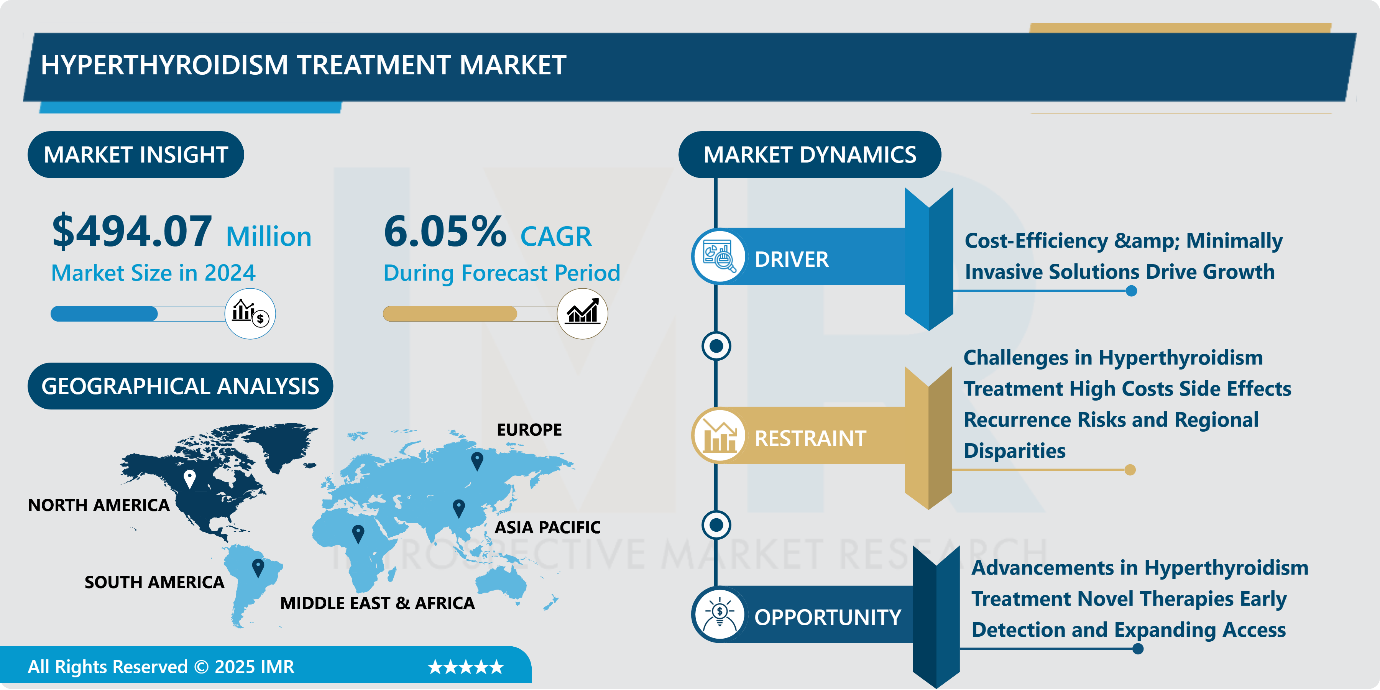
Hyperthyroidism Treatment Market Size Was Valued at USD 494.07 Million in 2024, and is Projected to Reach USD 790.45 Million by 2032, Growing at a CAGR of 6.05% from 2025-2032.
The Hyperthyroidism Treatment Market refers to the global industry focused on developing, producing, and distributing medications, therapies, and surgical interventions for managing hyperthyroidism a condition characterized by excessive thyroid hormone production. The market offers treatment options which include antithyroid drugs (methimazole with propylthiouracil) alongside radioactive iodine therapy together with thyroidectomy as surgical procedure for the thyroid gland.
Market growth occurs because of elevated thyroid disorder rates coupled with diagnostic testing developments and spreading knowledge about prompt illness treatment. Three key sector elements including pharmaceutical organizations and healthcare facilities alongside research facilities work together to create better treatment alternatives and enhanced patient results.
The market for hyperthyroidism treatment expands consistently because thyroid disorders grow in frequency because people modify their lifestyles and cope with stress and consume diverse amounts of iodine. The use of minimally invasive procedures as a disease management method is increasing because of growing medical preference for radioactive iodine therapy. Biologic drugs together with targeted therapies have become emerging treatment choices in the hyperthyroidism field for future potential applications.
AI-based diagnostic solutions together with telemedicine systems help both reduce patient care detection times and enhance treatment administration. Furthermore, a rising geriatric population, coupled with government initiatives for thyroid disease awareness, is expected to boost market growth in the coming years.
Hyperthyroidism Treatment Market Growth and Trend Analysis:
Growth Driver :- Cost-Efficiency & Minimally Invasive Solutions Drive Growth
-
The global hyperthyroidism treatment market is experiencing significant shifts, driven by an increasing prevalence of the condition, particularly in iodine-sufficient regions. Graves’ disease remains the leading cause, disproportionately affecting women. The preference for antithyroid drugs (ATDs) exceeds radioactive iodine (RAI) therapy because these drugs are more cost-effective ($300–400 per year) and convenient than thyroidectomy which costs ($30,000–40,000). Different targeted treatment approaches that use biologics and small molecules show promise for achieving better treatment results.
- The demand is increasing for radiofrequency ablation as a minimally invasive treatment because scientific studies demonstrate thyroid nodule volume decreases from 52% to 86%. Treatment strategies for subclinical hyperthyroidism evolve due to its high probability of developing into overt disease which affects 26% of patients within five years. Different healthcare institutions use contrasting strategies for handling subclinical cases since some choose prompt treatment but others choose to wait and observe. The market transforms its direction towards cost-efficient treatment solutions along with minimally invasive procedures.
Challenges in Hyperthyroidism Treatment High Costs Side Effects Recurrence Risks and Regional Disparities
-
High treatment costs, particularly for thyroidectomy and RAI therapy, make accessibility challenging for many patients. ATDs, while effective, come with side effects such as hepatotoxicity and agranulocytosis, reducing their long-term viability. Furthermore, recurrence risks in Graves’ disease necessitate continuous follow-ups, posing a challenge for sustained remission. Additionally, regional disparities in iodine intake influence both disease prevalence and treatment efficacy, creating inconsistencies in patient outcomes.
Advancements in Hyperthyroidism Treatment Novel Therapies Early Detection and Expanding Access
-
The novel biologics and immunomodulatory drugs, which offer promising new treatment options. Increased awareness and screening programs may enhance early detection and improve patient outcomes. The adoption of minimally invasive procedures like radiofrequency ablation is gaining traction, providing non-surgical alternatives with reduced complications. Moreover, improving healthcare infrastructure in emerging markets presents a significant opportunity to expand access to hyperthyroidism treatments.
Inconsistent Guidelines Treatment Complications and Limited Access Challenge Hyperthyroidism Management
-
Variability in treatment guidelines across different regions leads to inconsistencies in patient management, making it difficult to standardize care. Additionally, some treatments, such as RAI, can lead to complications like thyroid eye disease, limiting their adoption. The need for lifelong monitoring due to the potential recurrence of hyperthyroidism adds to the patient burden. Lastly, the limited availability of advanced treatment options in developing regions restricts the market’s overall growth potential.
Hyperthyroidism Treatment Market Segment Analysis:
Hyperthyroidism Treatment Market is segmented based on Type, Application, and Region
By Type, Methimazole Segment is Expected to Dominate the Market During the Forecast Period
-
Methimazole has established itself as the dominant drug in the global hyperthyroidism treatment market due to its effectiveness, safety profile, and widespread clinical use. Hyperthyroidism treatment starts with Methimazole as the main oral medication for patients who cannot receive surgical or radioactive iodine therapy. The key mechanism of Methimazole works through blocking thyroperoxidase activity which results in limiting T4 and T3 hormone production. Extensive trials have proven its effectiveness when patients take methimazole long-term because it helps achieve remission particularly for Graves' disease patients.
- Resorting to continuous methimazole therapy for five years led to remission effects that remained after stopping treatment in 84% of patients according to randomized trial findings. NCBI research shows that methimazole maintains euthyroid state effectively and stops relapse in toxic multinodular goiter patients. High biocompatibility and reduced protein adhesion characteristics of methimazole treatment support this drug's choice over propylthiouracil because it poses less risk to the liver compared to other alternatives.
By Application, Hospital Segment Held the Largest Share in the projected period
-
The hospital segment is dominating the global hyperthyroidism treatment market. Hospitals play a crucial role in hyperthyroidism management due to their advanced medical infrastructure, availability of specialized endocrinologists, and access to comprehensive diagnostic and treatment options, including radioactive iodine therapy, surgery, and intravenous medications for severe cases like thyroid storm.
- Hospitals handle a significant volume of severe and complicated hyperthyroidism cases, requiring continuous monitoring and emergency interventions, making them the preferred choice for both patients and healthcare providers. The dominance of hospitals is further driven by the increasing prevalence of hyperthyroidism, rising healthcare expenditures, and the availability of government-funded healthcare programs that support advanced treatments in hospital settings.
Hyperthyroidism Treatment Market Regional Insights:
North America is Expected to Dominate the Market Over the Forecast Period
-
North America is anticipated to dominate the hyperthyroidism treatment market during the forecast period, driven by a combination of high disease prevalence, well-established healthcare infrastructure, and continuous advancements in treatment options. Hyperthyroidism affects approximately 1 in 100 Americans aged 12 and older, with women and older adults being more susceptible. The increasing number of cases, coupled with growing awareness about thyroid disorders, has led to a rise in early diagnosis and treatment, further fueling market expansion.
- The region is home to some of the world’s leading pharmaceutical and biotechnology companies that invest heavily in research and development, resulting in innovative therapies such as radiofrequency ablation (RFA) and improved radioiodine treatments. Additionally, government initiatives and funding for endocrine disease research, including hyperthyroidism, have contributed to advancements in diagnosis and treatment options. The availability of cutting-edge medical technologies, along with a strong network of endocrinologists and specialized treatment centers, ensures patients have access to high-quality care.
Hyperthyroidism Treatment Market Active Players:
- Abbott Laboratories (USA)
- AbbVie Inc. (USA)
- Acella Pharmaceuticals, LLC (USA)
- Allergan plc (Ireland)
- Amgen Inc. (USA)
- Aspen Pharmacare Holdings Limited (South Africa)
- Bausch Health Companies Inc. (Canada)
- Eisai Co., Ltd. (Japan)
- Endo International plc (Ireland)
- Gemini Laboratories, LLC (USA)
- GlaxoSmithKline plc (UK)
- Jubilant Pharmova Limited (India)
- Lannett Company, Inc. (USA)
- Merck & Co., Inc. (USA)
- Mylan N.V. (USA)
- Novartis AG (Switzerland)
- Pfizer Inc. (USA)
- RLC Labs, Inc. (USA)
- Takeda Pharmaceutical Company Limited (Japan)
- Viridian Therapeutics, Inc. (USA)
- Other Active Players
Key Industry Developments in the Hyperthyroidism Treatment Market:
-
In November 2024, this investigational monoclonal antibody targets the neonatal fragment crystallizable receptor (FcRn), aiming to reduce immunoglobulin G (IgG) levels and thyrotropin receptor antibodies (TRAb) associated with Graves' disease. In a phase 2a study, batoclimab demonstrated rapid normalization of thyroid hormone levels within two weeks and was well-tolerated by patients.
- In November 2023, Kauvery Hospital, Salem, which is part of a leading multi-specialty healthcare chain in Tamil Nadu, performed its first Scarless, Minimally Invasive Thyroid Surgery.
|
Hyperthyroidism Treatment Market |
|||
|
Base Year: |
2024 |
Forecast Period: |
2025-2032 |
|
Historical Data: |
2018 to 2024 |
Market Size in 2024: |
USD 494.07 Mn. |
|
Forecast Period 2025-32 CAGR: |
6.05 % |
Market Size in 2032: |
USD 790.45 Mn. |
|
Segments Covered: |
By Type |
|
|
|
By Application |
|
||
|
By Region |
|
||
|
Growth Driver: |
|
||
|
Limiting Factor |
|
||
|
Expansion Opportunity |
|
||
|
Challenge Barrier |
|
||
|
Companies Covered in the Report: |
|
||
Chapter 1: Introduction
1.1 Scope and Coverage
Chapter 2:Executive Summary
Chapter 3: Market Landscape
3.1 Market Dynamics
3.1.1 Drivers
3.1.2 Restraints
3.1.3 Opportunities
3.1.4 Challenges
3.2 Market Trend Analysis
3.3 PESTLE Analysis
3.4 Porter's Five Forces Analysis
3.5 Industry Value Chain Analysis
3.6 Ecosystem
3.7 Regulatory Landscape
3.8 Price Trend Analysis
3.9 Patent Analysis
3.10 Technology Evolution
3.11 Investment Pockets
3.12 Import-Export Analysis
Chapter 4: Hyperthyroidism Treatment Market by Type
4.1 Hyperthyroidism Treatment Market Snapshot and Growth Engine
4.2 Hyperthyroidism Treatment Market Overview
4.3 Methimazole
4.3.1 Introduction and Market Overview
4.3.2 Historic and Forecasted Market Size in Value USD and Volume Units (2017-2032F)
4.3.3 Key Market Trends, Growth Factors and Opportunities
4.3.4 Methimazole: Geographic Segmentation Analysis
4.4 Propylthiouracil
4.4.1 Introduction and Market Overview
4.4.2 Historic and Forecasted Market Size in Value USD and Volume Units (2017-2032F)
4.4.3 Key Market Trends, Growth Factors and Opportunities
4.4.4 Propylthiouracil: Geographic Segmentation Analysis
4.5 and Other
4.5.1 Introduction and Market Overview
4.5.2 Historic and Forecasted Market Size in Value USD and Volume Units (2017-2032F)
4.5.3 Key Market Trends, Growth Factors and Opportunities
4.5.4 and Other: Geographic Segmentation Analysis
Chapter 5: Hyperthyroidism Treatment Market by Application
5.1 Hyperthyroidism Treatment Market Snapshot and Growth Engine
5.2 Hyperthyroidism Treatment Market Overview
5.3 Hospital
5.3.1 Introduction and Market Overview
5.3.2 Historic and Forecasted Market Size in Value USD and Volume Units (2017-2032F)
5.3.3 Key Market Trends, Growth Factors and Opportunities
5.3.4 Hospital: Geographic Segmentation Analysis
5.4 Clinic
5.4.1 Introduction and Market Overview
5.4.2 Historic and Forecasted Market Size in Value USD and Volume Units (2017-2032F)
5.4.3 Key Market Trends, Growth Factors and Opportunities
5.4.4 Clinic: Geographic Segmentation Analysis
5.5 and Other
5.5.1 Introduction and Market Overview
5.5.2 Historic and Forecasted Market Size in Value USD and Volume Units (2017-2032F)
5.5.3 Key Market Trends, Growth Factors and Opportunities
5.5.4 and Other: Geographic Segmentation Analysis
Chapter 6: Company Profiles and Competitive Analysis
6.1 Competitive Landscape
6.1.1 Competitive Benchmarking
6.1.2 Hyperthyroidism Treatment Market Share by Manufacturer (2023)
6.1.3 Industry BCG Matrix
6.1.4 Heat Map Analysis
6.1.5 Mergers and Acquisitions
6.2 ABBOTT LABORATORIES (USA)
6.2.1 Company Overview
6.2.2 Key Executives
6.2.3 Company Snapshot
6.2.4 Role of the Company in the Market
6.2.5 Sustainability and Social Responsibility
6.2.6 Operating Business Segments
6.2.7 Product Portfolio
6.2.8 Business Performance
6.2.9 Key Strategic Moves and Recent Developments
6.2.10 SWOT Analysis
6.3 ABBVIE INC. (USA)
6.4 ACELLA PHARMACEUTICALS LLC (USA)
6.5 ALLERGAN PLC (IRELAND)
6.6 AMGEN INC. (USA)
6.7 ASPEN PHARMACARE HOLDINGS LIMITED (SOUTH AFRICA)
6.8 BAUSCH HEALTH COMPANIES INC. (CANADA)
6.9 EISAI CO. LTD. (JAPAN)
6.10 ENDO INTERNATIONAL PLC (IRELAND)
6.11 GEMINI LABORATORIES LLC (USA)
6.12 GLAXOSMITHKLINE PLC (UK)
6.13 JUBILANT PHARMOVA LIMITED (INDIA)
6.14 LANNETT COMPANY INC. (USA)
6.15 MERCK & CO. INC. (USA)
6.16 MYLAN N.V. (USA)
6.17 NOVARTIS AG (SWITZERLAND)
6.18 PFIZER INC. (USA)
6.19 RLC LABS INC. (USA)
6.20 TAKEDA PHARMACEUTICAL COMPANY LIMITED (JAPAN)
6.21 VIRIDIAN THERAPEUTICS INC. (USA)
6.22 AND OTHER ACTIVE PLAYERS.
Chapter 7: Global Hyperthyroidism Treatment Market By Region
7.1 Overview
7.2. North America Hyperthyroidism Treatment Market
7.2.1 Key Market Trends, Growth Factors and Opportunities
7.2.2 Top Key Companies
7.2.3 Historic and Forecasted Market Size by Segments
7.2.4 Historic and Forecasted Market Size By Type
7.2.4.1 Methimazole
7.2.4.2 Propylthiouracil
7.2.4.3 and Other
7.2.5 Historic and Forecasted Market Size By Application
7.2.5.1 Hospital
7.2.5.2 Clinic
7.2.5.3 and Other
7.2.6 Historic and Forecast Market Size by Country
7.2.6.1 US
7.2.6.2 Canada
7.2.6.3 Mexico
7.3. Eastern Europe Hyperthyroidism Treatment Market
7.3.1 Key Market Trends, Growth Factors and Opportunities
7.3.2 Top Key Companies
7.3.3 Historic and Forecasted Market Size by Segments
7.3.4 Historic and Forecasted Market Size By Type
7.3.4.1 Methimazole
7.3.4.2 Propylthiouracil
7.3.4.3 and Other
7.3.5 Historic and Forecasted Market Size By Application
7.3.5.1 Hospital
7.3.5.2 Clinic
7.3.5.3 and Other
7.3.6 Historic and Forecast Market Size by Country
7.3.6.1 Russia
7.3.6.2 Bulgaria
7.3.6.3 The Czech Republic
7.3.6.4 Hungary
7.3.6.5 Poland
7.3.6.6 Romania
7.3.6.7 Rest of Eastern Europe
7.4. Western Europe Hyperthyroidism Treatment Market
7.4.1 Key Market Trends, Growth Factors and Opportunities
7.4.2 Top Key Companies
7.4.3 Historic and Forecasted Market Size by Segments
7.4.4 Historic and Forecasted Market Size By Type
7.4.4.1 Methimazole
7.4.4.2 Propylthiouracil
7.4.4.3 and Other
7.4.5 Historic and Forecasted Market Size By Application
7.4.5.1 Hospital
7.4.5.2 Clinic
7.4.5.3 and Other
7.4.6 Historic and Forecast Market Size by Country
7.4.6.1 Germany
7.4.6.2 UK
7.4.6.3 France
7.4.6.4 The Netherlands
7.4.6.5 Italy
7.4.6.6 Spain
7.4.6.7 Rest of Western Europe
7.5. Asia Pacific Hyperthyroidism Treatment Market
7.5.1 Key Market Trends, Growth Factors and Opportunities
7.5.2 Top Key Companies
7.5.3 Historic and Forecasted Market Size by Segments
7.5.4 Historic and Forecasted Market Size By Type
7.5.4.1 Methimazole
7.5.4.2 Propylthiouracil
7.5.4.3 and Other
7.5.5 Historic and Forecasted Market Size By Application
7.5.5.1 Hospital
7.5.5.2 Clinic
7.5.5.3 and Other
7.5.6 Historic and Forecast Market Size by Country
7.5.6.1 China
7.5.6.2 India
7.5.6.3 Japan
7.5.6.4 South Korea
7.5.6.5 Malaysia
7.5.6.6 Thailand
7.5.6.7 Vietnam
7.5.6.8 The Philippines
7.5.6.9 Australia
7.5.6.10 New Zealand
7.5.6.11 Rest of APAC
7.6. Middle East & Africa Hyperthyroidism Treatment Market
7.6.1 Key Market Trends, Growth Factors and Opportunities
7.6.2 Top Key Companies
7.6.3 Historic and Forecasted Market Size by Segments
7.6.4 Historic and Forecasted Market Size By Type
7.6.4.1 Methimazole
7.6.4.2 Propylthiouracil
7.6.4.3 and Other
7.6.5 Historic and Forecasted Market Size By Application
7.6.5.1 Hospital
7.6.5.2 Clinic
7.6.5.3 and Other
7.6.6 Historic and Forecast Market Size by Country
7.6.6.1 Turkiye
7.6.6.2 Bahrain
7.6.6.3 Kuwait
7.6.6.4 Saudi Arabia
7.6.6.5 Qatar
7.6.6.6 UAE
7.6.6.7 Israel
7.6.6.8 South Africa
7.7. South America Hyperthyroidism Treatment Market
7.7.1 Key Market Trends, Growth Factors and Opportunities
7.7.2 Top Key Companies
7.7.3 Historic and Forecasted Market Size by Segments
7.7.4 Historic and Forecasted Market Size By Type
7.7.4.1 Methimazole
7.7.4.2 Propylthiouracil
7.7.4.3 and Other
7.7.5 Historic and Forecasted Market Size By Application
7.7.5.1 Hospital
7.7.5.2 Clinic
7.7.5.3 and Other
7.7.6 Historic and Forecast Market Size by Country
7.7.6.1 Brazil
7.7.6.2 Argentina
7.7.6.3 Rest of SA
Chapter 8 Analyst Viewpoint and Conclusion
8.1 Recommendations and Concluding Analysis
8.2 Potential Market Strategies
Chapter 9 Research Methodology
9.1 Research Process
9.2 Primary Research
9.3 Secondary Research
|
Hyperthyroidism Treatment Market |
|||
|
Base Year: |
2024 |
Forecast Period: |
2025-2032 |
|
Historical Data: |
2018 to 2024 |
Market Size in 2024: |
USD 494.07 Mn. |
|
Forecast Period 2025-32 CAGR: |
6.05 % |
Market Size in 2032: |
USD 790.45 Mn. |
|
Segments Covered: |
By Type |
|
|
|
By Application |
|
||
|
By Region |
|
||
|
Growth Driver: |
|
||
|
Limiting Factor |
|
||
|
Expansion Opportunity |
|
||
|
Challenge Barrier |
|
||
|
Companies Covered in the Report: |
|
||


