




Hepatic Encephalopathy Market Synopsis:
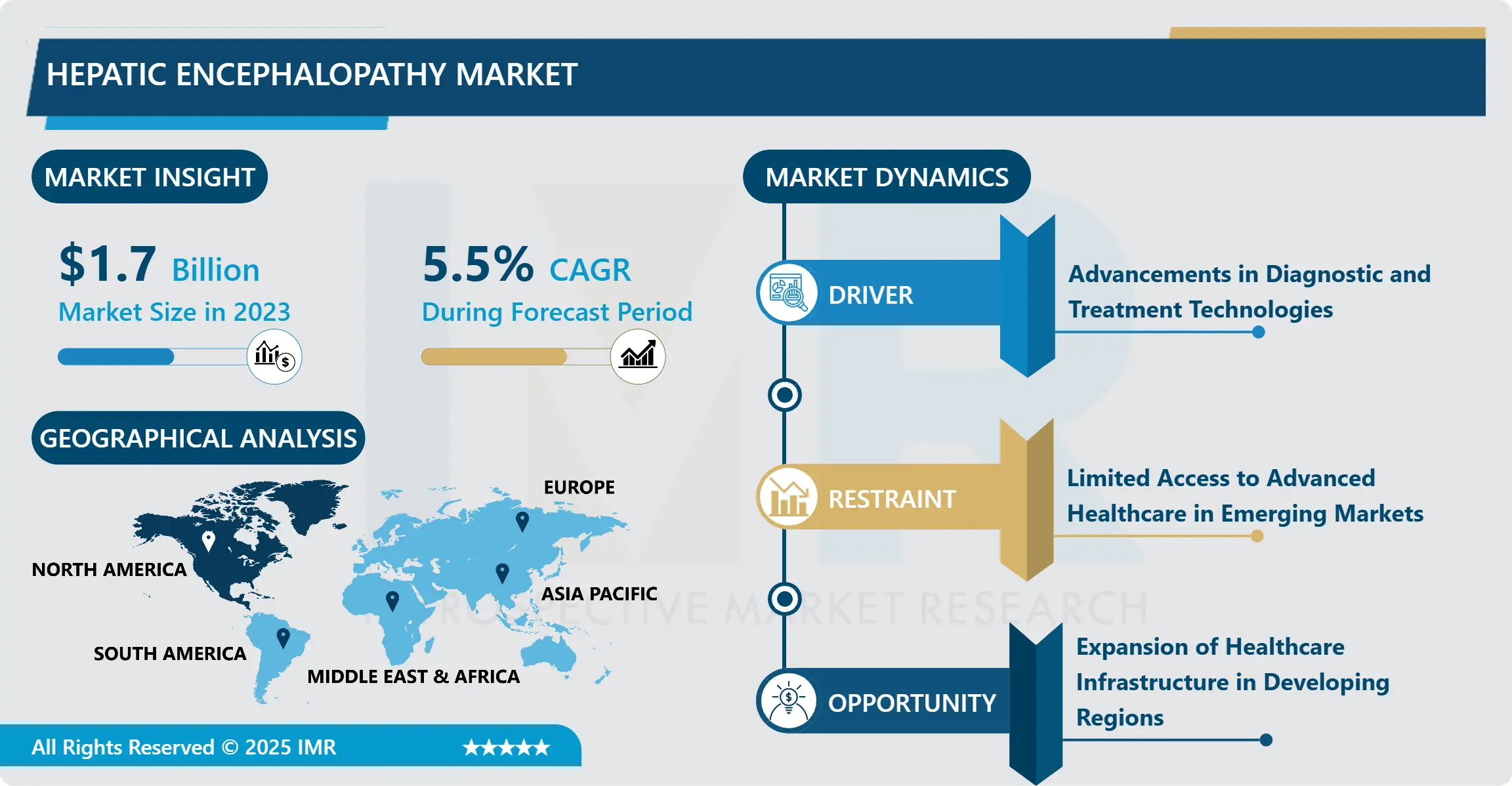
Hepatic Encephalopathy Market Size Was Valued at USD 1.70 Billion in 2023, and is Projected to Reach USD 2.75 Billion by 2032, Growing at a CAGR of 5.50% From 2024-2032.
Hepatic Encephalopathy (HE) is a complex neuropsychiatric syndrome resulting from liver Hepatic encephalopathy is a confusional state that occurs because of liver disease particularly cirrhosis. It comes in different forms; the least form is that which affects the cognitive part of the body and the severest form is that which causes a coma. This condition is associated with encephalopathy, and if left untreated results in coma and death. HE develops gradually in most cases and may be precipitated by factors such as gastrointestinal bleeding, infection and electrolyte disturbances thus, the need for early recognition and intervention.
Based on the many factors discussed in this report, the hepatic encephalopathy market is set to grow as the incidences of liver diseases rise, especially cirrhosis. Due to the increasing number of patients with chronic liver diseases, cases of hepatic encephalopathy grow, and consequently, need for treatments elevates as well. Due to the technological development in diagnostic methods with better imaging and more comprehensive screening of blood tests, early diagnosis of HE would be possible, therefore reducing the mortality related to the complication.
Other are numerous patients and healthcare providers are achieving enhanced awareness of managing hepatic encephalopathy. This has resulted to further concentrated study, government endorsement of the treatments and research funds for interventions. As the global healthcare systems aim at enhancing the plight of the patients with chronic liver disease a breakthrough in more complex treatments and therapy will enhance the market growth.
Hepatic Encephalopathy Market Trend Analysis:
Increasing adoption of non-invasive diagnostic techniques
-
However, one key highlight in the hepatic encephalopathy market is that there is steadily rising trend towards the usage of non-invasive diagnostic procedures. SERUM BIOMARKERS as well as experimental imaging are becoming more accepted because they are faster and more accurate than other forms of diagnosing illnesses. The trend away from more invasive methods is benefiting patients and the general efficiency of the system and, accordingly, stimulating market growth.
- Besides, the therapeutic advance is another apparent trend; both the novel targeted therapy and the immune check point inhibitors are well established in this category. Studies of new drugs, especially those that influence the gut-liver-brain axis, have intensified in the last few years. Many organizations are aiming at producing more efficient and tailored approaches towards combating and curing HE. Addressing the escalating rates of chronic liver diseases is exerting pressure on pharma industries to come up with new products; thus expanding the portfolio of improved therapies in hepatic encephalopathy.
The demand for advanced diagnostics and effective treatments
-
The hepatic encephalopathy market is fundamental and has promising potential for the emerging markets. High occurrences of liver diseases in the Asia-Pacific and Latin America areas because of dietary changes, alcoholism, and viral hepatitis are expanding the patient base. The availability and necessity for enhanced diagnostics and useful therapies in these regions will increase the market growth and open new prospects for enterprise development.
- Lastly, increasing awareness of the need to upgrade the quality of healthcare facilities and related services in developing countries is also stimulating new opportunities for some actors in the market. Potential increase of patients’ survival rates and adequacy of HE management will enhance the needs for protection, diagnosis and treatment of HE. This growth potential is most significant in those nations with a high number of liver diseases patients which in return means a good future market for pharmaceutical and biotechnology firms.
Hepatic Encephalopathy Market Segment Analysis:
Hepatic Encephalopathy Market is Segmented on the basis of type, Treatment, Route of administration, end user, and Region
By Type, Overt Hepatic Encephalopathy segment is expected to dominate the market during the forecast period
-
Overt hepatic encephalopathy (OHE) on the other hand is severe and involves focal neurological abnormalities including confusion, disorientation and coma. OHE is usually diagnosed after history and examination of the patient, especially if he/she has features of advanced liver disease. The overt hepatic encephalopathy is a severe form of the condition in which patent may only exhibit some form of neurological abnormalities including confusion profound somnolence or coma. It is much harder to detect since it does not have clinical symptoms and can only be diagnosed using neuropsychological tests and methods or another method.
By Treatment, Lactulose segment expected to held the largest share
-
Lactulose is a synthetic disaccharide that is used to decreased ammonia level in the blood by increasing its elimination through the large intestine. It is one of the most common interventions for hepatic encephalopathy and of particular benefit in managing overt HE. Rifaximin is an antibiotic that can decrease intestinal end products, which are dangerous for HE patients, ammonia included. It may be prescribed in combination with lactulose, or the doctor may use it as your primary treatment if your condition is that severe. Therefore, broad–spectrum antibiotics may be applied for treatment of infections that can cause or exacerbate hepatic encephalopathy. Such infections as spontaneous bacterial peritonitis for instance, are capable of making the liver worse or worse off. Bacteria in the gut tend to produce ammonia, which harms the liver and affects cognition; thus, probiotics help in controlling helpful bacteria in the gut. They have been found useful in the prevention or optimisation of mild forms of HE. Other treatments include treatments such as ammonia scavengers as ammonia interferes with HE development and some new experimental drugs designed for certain aspects of the development of HE.
Hepatic Encephalopathy Market Regional Insights:
North America is Expected to Dominate the Market Over the Forecast period
-
North America holds the highest market share for hepatic encephalopathy due to the better health care facilities, availability of advanced treatment, and higher rate of liver disease – particularly in the USA. This market segment is already developed due to the availability of developed healthcare facilities in the region; as well as the growing concern of people with liver diseases and their complications. Therefore, with leading pharmaceutical companies and leading healthcare service providers in North America the market will undoubtedly continue to be in the leading position.
- The hepatic encephalopathy market in North America holds the largest share due to increasing R&D activities coupled with government efforts for better management of liver disorders. This has led to better access to better equipment and effective treatments of diseases hence playing a big role in the regions market leadership.
Active Key Players in the Hepatic Encephalopathy Market:
- AbbVie (USA)
- Boehringer Ingelheim (Germany)
- Cosmo Pharmaceuticals (Italy)
- Eisai Co., Ltd. (Japan)
- Fresenius Kabi (Germany)
- Hepion Pharmaceuticals (USA)
- Mallinckrodt Pharmaceuticals (Ireland)
- Mylan (USA)
- Salix Pharmaceuticals (USA)
- Zydus Lifesciences (India)
- Other Active Players
|
Hepatic Encephalopathy Market |
|||
|
Base Year: |
2023 |
Forecast Period: |
2024-2032 |
|
Historical Data: |
2017 to 2023 |
Market Size in 2023: |
USD 1.70 Billion |
|
Forecast Period 2024-32 CAGR: |
5.50 % |
Market Size in 2032: |
USD 2.75 Billion |
|
Segments Covered: |
By Type |
|
|
|
By Treatments |
|
||
|
By Route of Administration |
|
||
|
By End User |
|
||
|
By Region |
|
||
|
Key Market Drivers: |
|
||
|
Key Market Restraints: |
|
||
|
Key Opportunities: |
|
||
|
Companies Covered in the report: |
|
||
Chapter 1: Introduction
1.1 Scope and Coverage
Chapter 2:Executive Summary
Chapter 3: Market Landscape
3.1 Market Dynamics
3.1.1 Drivers
3.1.2 Restraints
3.1.3 Opportunities
3.1.4 Challenges
3.2 Market Trend Analysis
3.3 PESTLE Analysis
3.4 Porter's Five Forces Analysis
3.5 Industry Value Chain Analysis
3.6 Ecosystem
3.7 Regulatory Landscape
3.8 Price Trend Analysis
3.9 Patent Analysis
3.10 Technology Evolution
3.11 Investment Pockets
3.12 Import-Export Analysis
Chapter 4: Hepatic Encephalopathy Market by Type
4.1 Hepatic Encephalopathy Market Snapshot and Growth Engine
4.2 Hepatic Encephalopathy Market Overview
4.3 Overt Hepatic Encephalopathy
4.3.1 Introduction and Market Overview
4.3.2 Historic and Forecasted Market Size in Value USD and Volume Units (2017-2032F)
4.3.3 Key Market Trends, Growth Factors and Opportunities
4.3.4 Overt Hepatic Encephalopathy: Geographic Segmentation Analysis
4.4 Covert Hepatic Encephalopathy
4.4.1 Introduction and Market Overview
4.4.2 Historic and Forecasted Market Size in Value USD and Volume Units (2017-2032F)
4.4.3 Key Market Trends, Growth Factors and Opportunities
4.4.4 Covert Hepatic Encephalopathy: Geographic Segmentation Analysis
Chapter 5: Hepatic Encephalopathy Market by Treatment
5.1 Hepatic Encephalopathy Market Snapshot and Growth Engine
5.2 Hepatic Encephalopathy Market Overview
5.3 Lactulose
5.3.1 Introduction and Market Overview
5.3.2 Historic and Forecasted Market Size in Value USD and Volume Units (2017-2032F)
5.3.3 Key Market Trends, Growth Factors and Opportunities
5.3.4 Lactulose: Geographic Segmentation Analysis
5.4 Rifaximin
5.4.1 Introduction and Market Overview
5.4.2 Historic and Forecasted Market Size in Value USD and Volume Units (2017-2032F)
5.4.3 Key Market Trends, Growth Factors and Opportunities
5.4.4 Rifaximin: Geographic Segmentation Analysis
5.5 Antibiotics
5.5.1 Introduction and Market Overview
5.5.2 Historic and Forecasted Market Size in Value USD and Volume Units (2017-2032F)
5.5.3 Key Market Trends, Growth Factors and Opportunities
5.5.4 Antibiotics: Geographic Segmentation Analysis
5.6 Probiotics
5.6.1 Introduction and Market Overview
5.6.2 Historic and Forecasted Market Size in Value USD and Volume Units (2017-2032F)
5.6.3 Key Market Trends, Growth Factors and Opportunities
5.6.4 Probiotics: Geographic Segmentation Analysis
5.7 Others
5.7.1 Introduction and Market Overview
5.7.2 Historic and Forecasted Market Size in Value USD and Volume Units (2017-2032F)
5.7.3 Key Market Trends, Growth Factors and Opportunities
5.7.4 Others: Geographic Segmentation Analysis
Chapter 6: Hepatic Encephalopathy Market by Route of Administration
6.1 Hepatic Encephalopathy Market Snapshot and Growth Engine
6.2 Hepatic Encephalopathy Market Overview
6.3 Oral
6.3.1 Introduction and Market Overview
6.3.2 Historic and Forecasted Market Size in Value USD and Volume Units (2017-2032F)
6.3.3 Key Market Trends, Growth Factors and Opportunities
6.3.4 Oral: Geographic Segmentation Analysis
6.4 Injectable
6.4.1 Introduction and Market Overview
6.4.2 Historic and Forecasted Market Size in Value USD and Volume Units (2017-2032F)
6.4.3 Key Market Trends, Growth Factors and Opportunities
6.4.4 Injectable: Geographic Segmentation Analysis
Chapter 7: Hepatic Encephalopathy Market by End User
7.1 Hepatic Encephalopathy Market Snapshot and Growth Engine
7.2 Hepatic Encephalopathy Market Overview
7.3 Hospitals
7.3.1 Introduction and Market Overview
7.3.2 Historic and Forecasted Market Size in Value USD and Volume Units (2017-2032F)
7.3.3 Key Market Trends, Growth Factors and Opportunities
7.3.4 Hospitals: Geographic Segmentation Analysis
7.4 Clinics
7.4.1 Introduction and Market Overview
7.4.2 Historic and Forecasted Market Size in Value USD and Volume Units (2017-2032F)
7.4.3 Key Market Trends, Growth Factors and Opportunities
7.4.4 Clinics: Geographic Segmentation Analysis
7.5 Homecare Settings
7.5.1 Introduction and Market Overview
7.5.2 Historic and Forecasted Market Size in Value USD and Volume Units (2017-2032F)
7.5.3 Key Market Trends, Growth Factors and Opportunities
7.5.4 Homecare Settings: Geographic Segmentation Analysis
Chapter 8: Company Profiles and Competitive Analysis
8.1 Competitive Landscape
8.1.1 Competitive Benchmarking
8.1.2 Hepatic Encephalopathy Market Share by Manufacturer (2023)
8.1.3 Industry BCG Matrix
8.1.4 Heat Map Analysis
8.1.5 Mergers and Acquisitions
8.2 ABBVIE (USA)
8.2.1 Company Overview
8.2.2 Key Executives
8.2.3 Company Snapshot
8.2.4 Role of the Company in the Market
8.2.5 Sustainability and Social Responsibility
8.2.6 Operating Business Segments
8.2.7 Product Portfolio
8.2.8 Business Performance
8.2.9 Key Strategic Moves and Recent Developments
8.2.10 SWOT Analysis
8.3 FRESENIUS KABI (GERMANY)
8.4 MALLINCKRODT PHARMACEUTICALS (IRELAND)
8.5 MYLAN (USA)
8.6 COSMO PHARMACEUTICALS (ITALY)
8.7 EISAI CO. LTD. (JAPAN)
8.8 SALIX PHARMACEUTICALS (USA)
8.9 BOEHRINGER INGELHEIM (GERMANY)
8.10 HEPION PHARMACEUTICALS (USA)
8.11 ZYDUS LIFESCIENCES (INDIA)
8.12 OTHER ACTIVE PLAYERS
Chapter 9: Global Hepatic Encephalopathy Market By Region
9.1 Overview
9.2. North America Hepatic Encephalopathy Market
9.2.1 Key Market Trends, Growth Factors and Opportunities
9.2.2 Top Key Companies
9.2.3 Historic and Forecasted Market Size by Segments
9.2.4 Historic and Forecasted Market Size By Type
9.2.4.1 Overt Hepatic Encephalopathy
9.2.4.2 Covert Hepatic Encephalopathy
9.2.5 Historic and Forecasted Market Size By Treatment
9.2.5.1 Lactulose
9.2.5.2 Rifaximin
9.2.5.3 Antibiotics
9.2.5.4 Probiotics
9.2.5.5 Others
9.2.6 Historic and Forecasted Market Size By Route of Administration
9.2.6.1 Oral
9.2.6.2 Injectable
9.2.7 Historic and Forecasted Market Size By End User
9.2.7.1 Hospitals
9.2.7.2 Clinics
9.2.7.3 Homecare Settings
9.2.8 Historic and Forecast Market Size by Country
9.2.8.1 US
9.2.8.2 Canada
9.2.8.3 Mexico
9.3. Eastern Europe Hepatic Encephalopathy Market
9.3.1 Key Market Trends, Growth Factors and Opportunities
9.3.2 Top Key Companies
9.3.3 Historic and Forecasted Market Size by Segments
9.3.4 Historic and Forecasted Market Size By Type
9.3.4.1 Overt Hepatic Encephalopathy
9.3.4.2 Covert Hepatic Encephalopathy
9.3.5 Historic and Forecasted Market Size By Treatment
9.3.5.1 Lactulose
9.3.5.2 Rifaximin
9.3.5.3 Antibiotics
9.3.5.4 Probiotics
9.3.5.5 Others
9.3.6 Historic and Forecasted Market Size By Route of Administration
9.3.6.1 Oral
9.3.6.2 Injectable
9.3.7 Historic and Forecasted Market Size By End User
9.3.7.1 Hospitals
9.3.7.2 Clinics
9.3.7.3 Homecare Settings
9.3.8 Historic and Forecast Market Size by Country
9.3.8.1 Russia
9.3.8.2 Bulgaria
9.3.8.3 The Czech Republic
9.3.8.4 Hungary
9.3.8.5 Poland
9.3.8.6 Romania
9.3.8.7 Rest of Eastern Europe
9.4. Western Europe Hepatic Encephalopathy Market
9.4.1 Key Market Trends, Growth Factors and Opportunities
9.4.2 Top Key Companies
9.4.3 Historic and Forecasted Market Size by Segments
9.4.4 Historic and Forecasted Market Size By Type
9.4.4.1 Overt Hepatic Encephalopathy
9.4.4.2 Covert Hepatic Encephalopathy
9.4.5 Historic and Forecasted Market Size By Treatment
9.4.5.1 Lactulose
9.4.5.2 Rifaximin
9.4.5.3 Antibiotics
9.4.5.4 Probiotics
9.4.5.5 Others
9.4.6 Historic and Forecasted Market Size By Route of Administration
9.4.6.1 Oral
9.4.6.2 Injectable
9.4.7 Historic and Forecasted Market Size By End User
9.4.7.1 Hospitals
9.4.7.2 Clinics
9.4.7.3 Homecare Settings
9.4.8 Historic and Forecast Market Size by Country
9.4.8.1 Germany
9.4.8.2 UK
9.4.8.3 France
9.4.8.4 The Netherlands
9.4.8.5 Italy
9.4.8.6 Spain
9.4.8.7 Rest of Western Europe
9.5. Asia Pacific Hepatic Encephalopathy Market
9.5.1 Key Market Trends, Growth Factors and Opportunities
9.5.2 Top Key Companies
9.5.3 Historic and Forecasted Market Size by Segments
9.5.4 Historic and Forecasted Market Size By Type
9.5.4.1 Overt Hepatic Encephalopathy
9.5.4.2 Covert Hepatic Encephalopathy
9.5.5 Historic and Forecasted Market Size By Treatment
9.5.5.1 Lactulose
9.5.5.2 Rifaximin
9.5.5.3 Antibiotics
9.5.5.4 Probiotics
9.5.5.5 Others
9.5.6 Historic and Forecasted Market Size By Route of Administration
9.5.6.1 Oral
9.5.6.2 Injectable
9.5.7 Historic and Forecasted Market Size By End User
9.5.7.1 Hospitals
9.5.7.2 Clinics
9.5.7.3 Homecare Settings
9.5.8 Historic and Forecast Market Size by Country
9.5.8.1 China
9.5.8.2 India
9.5.8.3 Japan
9.5.8.4 South Korea
9.5.8.5 Malaysia
9.5.8.6 Thailand
9.5.8.7 Vietnam
9.5.8.8 The Philippines
9.5.8.9 Australia
9.5.8.10 New Zealand
9.5.8.11 Rest of APAC
9.6. Middle East & Africa Hepatic Encephalopathy Market
9.6.1 Key Market Trends, Growth Factors and Opportunities
9.6.2 Top Key Companies
9.6.3 Historic and Forecasted Market Size by Segments
9.6.4 Historic and Forecasted Market Size By Type
9.6.4.1 Overt Hepatic Encephalopathy
9.6.4.2 Covert Hepatic Encephalopathy
9.6.5 Historic and Forecasted Market Size By Treatment
9.6.5.1 Lactulose
9.6.5.2 Rifaximin
9.6.5.3 Antibiotics
9.6.5.4 Probiotics
9.6.5.5 Others
9.6.6 Historic and Forecasted Market Size By Route of Administration
9.6.6.1 Oral
9.6.6.2 Injectable
9.6.7 Historic and Forecasted Market Size By End User
9.6.7.1 Hospitals
9.6.7.2 Clinics
9.6.7.3 Homecare Settings
9.6.8 Historic and Forecast Market Size by Country
9.6.8.1 Turkiye
9.6.8.2 Bahrain
9.6.8.3 Kuwait
9.6.8.4 Saudi Arabia
9.6.8.5 Qatar
9.6.8.6 UAE
9.6.8.7 Israel
9.6.8.8 South Africa
9.7. South America Hepatic Encephalopathy Market
9.7.1 Key Market Trends, Growth Factors and Opportunities
9.7.2 Top Key Companies
9.7.3 Historic and Forecasted Market Size by Segments
9.7.4 Historic and Forecasted Market Size By Type
9.7.4.1 Overt Hepatic Encephalopathy
9.7.4.2 Covert Hepatic Encephalopathy
9.7.5 Historic and Forecasted Market Size By Treatment
9.7.5.1 Lactulose
9.7.5.2 Rifaximin
9.7.5.3 Antibiotics
9.7.5.4 Probiotics
9.7.5.5 Others
9.7.6 Historic and Forecasted Market Size By Route of Administration
9.7.6.1 Oral
9.7.6.2 Injectable
9.7.7 Historic and Forecasted Market Size By End User
9.7.7.1 Hospitals
9.7.7.2 Clinics
9.7.7.3 Homecare Settings
9.7.8 Historic and Forecast Market Size by Country
9.7.8.1 Brazil
9.7.8.2 Argentina
9.7.8.3 Rest of SA
Chapter 10 Analyst Viewpoint and Conclusion
10.1 Recommendations and Concluding Analysis
10.2 Potential Market Strategies
Chapter 11 Research Methodology
11.1 Research Process
11.2 Primary Research
11.3 Secondary Research
|
Hepatic Encephalopathy Market |
|||
|
Base Year: |
2023 |
Forecast Period: |
2024-2032 |
|
Historical Data: |
2017 to 2023 |
Market Size in 2023: |
USD 1.70 Billion |
|
Forecast Period 2024-32 CAGR: |
5.50 % |
Market Size in 2032: |
USD 2.75 Billion |
|
Segments Covered: |
By Type |
|
|
|
By Treatments |
|
||
|
By Route of Administration |
|
||
|
By End User |
|
||
|
By Region |
|
||
|
Key Market Drivers: |
|
||
|
Key Market Restraints: |
|
||
|
Key Opportunities: |
|
||
|
Companies Covered in the report: |
|
||


