




Helicobacter Pylori Diagnostics Market Synopsis:
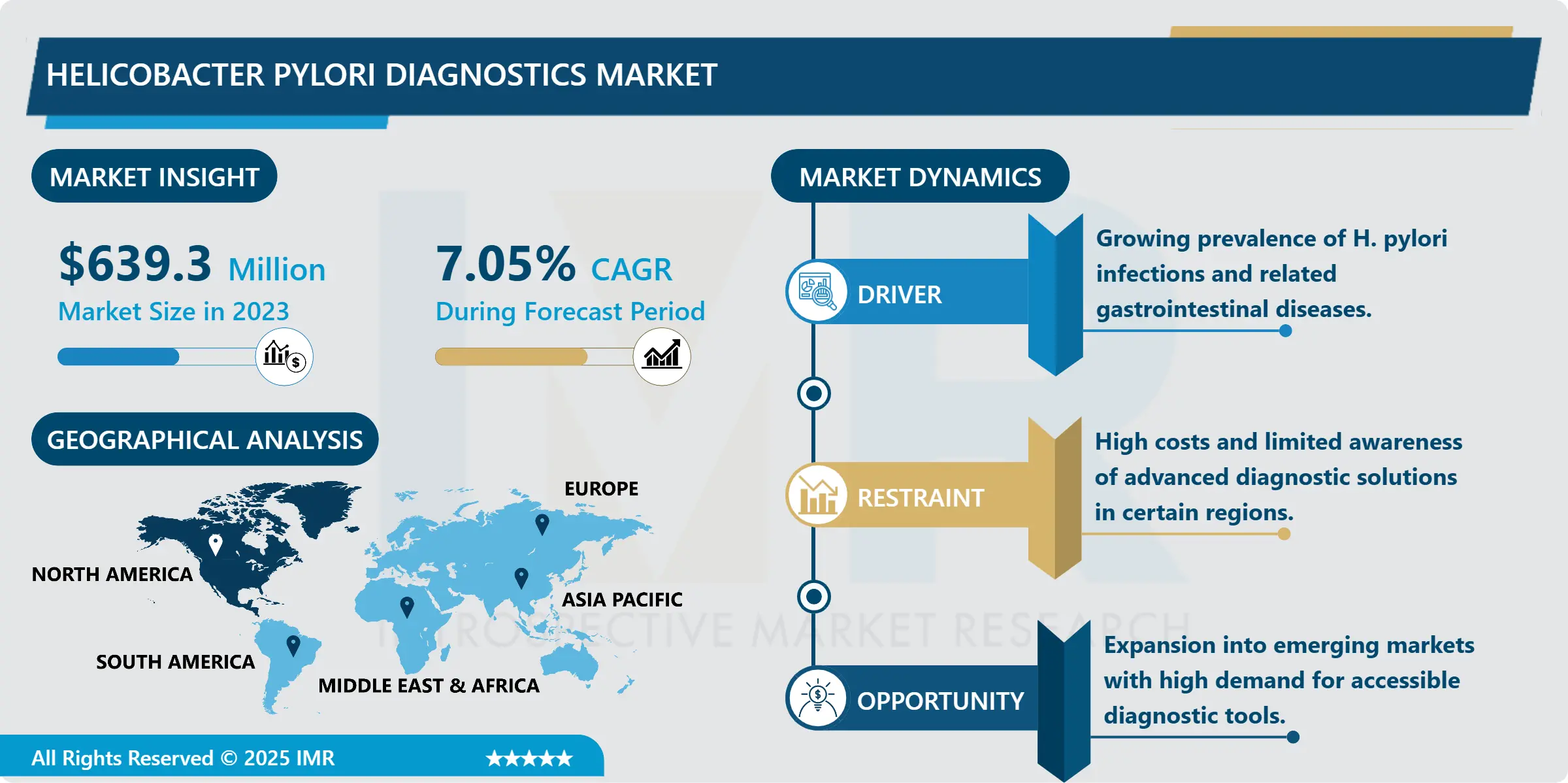
Helicobacter Pylori Diagnostics Market Size Was Valued at USD 639.30 Million in 2023, and is Projected to Reach USD 1,180.28 Million by 2032, Growing at a CAGR of 7.05 % From 2024-2032.
Generally covering all the diagnostics that help in the identification of H. pylori which is associated with diseases including gastritis, peptic ulcers and even gastric cancer, the Helicobacter Pylori (H. pylori) Diagnostics Market is expected to grow in the nearest future. This market has a broad range of invasive and non-invasive tests which encompass: The first is the Urea breath test which is used in diagnosis of H. pylori and informs treatment of many gastric and peptic complaints worldwide the second method is the Stool antigen test Serologic test Histology test H. pylori testing is an essential diagnostic tool for evaluating infection in cases of gastrointestinal diseases.
The market for H. pylori diagnostics is expanding to a greater extent by the higher prevalence of H. pylori infection around the world. Acute infections are common among the population in the low socio-economic bracket and up-to 80% of the population hence it anticipates increased use of efficient and cheap diagnostic methods. Since early detection of the H. pylori drastically minimizes the probability of severe GI diseases including gastric cancer, there is high demand for the diagnostic tests in hospital, diagnostic laboratories and other point of care centres. The market is fuelled by early detection since government and healthcare systems are encouraging people to seek treatment for untreated H. pylori infection as its repercussions are now closer to the public’s awareness.
Other factors affecting market growth includes increase in technological advancement in the range of diagnostics methods. Clients for instance consider the urea breath test (UBT) as sensitive and non intrusive There is thus a need for better and more efficient non invasive tests. Likewise, serological, biochemical, molecular diagnostic and other diagnostic tests essential in the re-orientation of the conclusions derived from the diagnostic testing particularly where the patients present signs that resemble other diseases have also recorded improvement in diagnostic service provision. That which forms this kind of growth of diagnosis is patient-centered, seeking to advance diagnostic capacity as well as treatment efficacy without the inconvenience to the patient. But here are some drawbacks of this market; it has low awareness in certain regions and high expenses in complex techniques.
Helicobacter Pylori Diagnostics Market Trend Analysis:
Rising Preference for Non-Invasive Testing
- The second trend also stands on the fact that the shift from invasive diagnostics of H. pylori is taking place in the using of UBT and Stool antigen test. As discussed earlier there are very few negatives about non-invasive tests that include: Ease of the tests, comfort of the patient and high degree of specificity for first stage detection and post treatment review. Among all the newly developed techniques the UBT has been found popular due to the fact that; it does not even consume so much time to administer and does not in any way infringe on the comfort of the patients. I mage renders the visual presentation of the existence of urease enzyme of H=pylori which is highly sensitive and specific than other enhanced diagnostic procedures frequently applied. The better diagnostic tests that are non invasive are recommended by the healthcare professionals as first line of diagnostic tests thus reducing on invasive endoscopy. This is especially correct in the context of the possibility to extend the large scale campaigns of population examination in the outpatient setting, as this type of examination becomes less resource demanding
Growing Demand in Emerging Markets
- The expansion to new markets is the main future outlook for diagnostics of H. pylori around the globe. While the developed world has known better, or has probably minimized incidences of H. pylori infection, the developing countries are still lagging behind very badly because of high population densities, poor hygiene, no access to clean water and generally low standards of health care. As more people in these areas learn that H. pylori is also linked to other severe gastrointestinal diseases, there is an increased need for better diagnostic techniques. Governments and health care organizations of these areas are straining to develop access to health care system, this has provided the opportunity to the firms to provide affordable diagnostic products. Manufacturers who supplied recognized, accurate, and yet relatively low-cost products for the diagnosis of H. pylori are anticipated to outweigh a fair proportion of the markets mentioned above, for early detection and elimination of the bacterium will incalculably value to the population.
Helicobacter Pylori Diagnostics Market Segment Analysis:
Helicobacter Pylori Diagnostics Market is Segmented on the basis of Test Type, Method, End User, and Region
By Test Type, Urea Breath Test segment is expected to dominate the market during the forecast period
- However, it is estimated that the UBT segment is likely to occupy the largest share of this market due to its accuracy, non-invasiveness and the convenience of the diagnostic test over other market segments where there is an upsurge of utilization of the HP diagnostics in primary diagnosis and relapse testing. This is because it is a polymerase chain reaction to show active or at least current H. Pylori infection, by testing for urease enzyme as opposed to antigens which would indicate past infection with this bacterium. To perform the tests, we administrate to the patients a urea solution containing a carbon isotope, if H. pylori are present the urea is metabolized and transforms in carbon dioxide containing the labelled carbon. This is then succeeded by analysis of breath sample which will paint a further picture of H. pylori infection. Endoscopy has limitations in that patients and care givers seek less invasive procedures and this is where UBT steps in and is comfortable. Therefore, a combination of increased GI problems associated with H. pylori, along with the opportunity to obtain easy access to UBT in a clinical practitioner are all expected to extend the demand for this segment significantly and, thereby, enhance market position.
By Method, the Laboratory-based Testing segment expected to held the largest share
- The Laboratory-Based Testing segment should account for maximum size in the H. pylori diagnostics market because the accurate and extensive testing exam in the hospital and diagnostic laboratory. For histological examination, culture, and rapid urease tests are deemed highly valuable because it is believed these tests are probably the most accurate and obvious among all the diagnostic tools available often used to confirm a diagnosis and to determine the antibiotics resistance of H. pylori strains. They are very crucial in determining of down_solr treatment especially in instance where they contain comprehensive information. These hours may at times be longer than the non-invasive procedures but the rapid tests’ effectiveness and abundance of the data exhibited in the outcome make the care providers find it more appealing than utilizing invasions to diagnose chronic or repeated infections. It is able to drive the segment forward because the incidences of H. pylori associated diseases are on the rise and the need for better diagnostic tests that will help improve treatment results also exists.
Helicobacter Pylori Diagnostics Market Regional Insights:
North America is Expected to Dominate the Market Over the Forecast period
- North America is anticipated to dominate the global H. pylori diagnostics market throughout the forecast period due to its strong & well-developed healthcare sector, high infected rate of H. pylori, and increasing use of diagnostics technologies. In the United States, where most health care practitioners value correct identification of the ailment and timely identification of bacterium, there is a strong market for non-invasive end nonlaboratory H. pylori testing. The U.S. also has a penchant for insurance coverage of diagnostic procedures thus placing the emphasis on patient diagnosis
- Canada also takes a large share of the North America market due to the rising number of public health programs and the early and wide acceptance of innovative diagnostic tools. Majority of the existing and potential H pylori related risks to the health of Canadians are actively being communicated to the people by the healthcare providers and there is active advocacy for appropriate diagnostic procedures for early H pylori screening. As both the U.S. and Canada progress in improving their healthcare facilities and focusing on more preventive medicine there will be the continuous need for H. pylori diagnostics.
Active Key Players in the Helicobacter Pylori Diagnostics Market:
- Abbott Laboratories (USA)
- ARUP Laboratories (USA)
- Beckman Coulter, Inc. (USA)
- bioMérieux SA (France)
- Cardinal Health, Inc. (USA)
- Diasorin S.p.A. (Italy)
- Epitope Diagnostics, Inc. (USA)
- Exalenz Bioscience Ltd. (Israel)
- F. Hoffmann-La Roche AG (Switzerland)
- Halyard Health, Inc. (USA)
- Medline Industries, Inc. (USA)
- Meridian Bioscience, Inc. (USA)
- Quest Diagnostics, Inc. (USA)
- Quidel Corporation (USA)
- Thermo Fisher Scientific, Inc. (USA)
- Other Active Players
|
Global Helicobacter Pylori Diagnostics Market |
|||
|
Base Year: |
2023 |
Forecast Period: |
2024-2032 |
|
Historical Data: |
2017 to 2023 |
Market Size in 2023: |
USD 639.30 Million |
|
Forecast Period 2024-32 CAGR: |
7.05 % |
Market Size in 2032: |
USD 1,180.28 Million |
|
Segments Covered: |
By TestType |
|
|
|
By Method |
|
||
|
By End User |
|
||
|
By Region |
|
||
|
Key Market Drivers: |
|
||
|
Key Market Restraints: |
|
||
|
Key Opportunities: |
|
||
|
Companies Covered in the report: |
|
||
Chapter 1: Introduction
1.1 Scope and Coverage
Chapter 2:Executive Summary
Chapter 3: Market Landscape
3.1 Market Dynamics
3.1.1 Drivers
3.1.2 Restraints
3.1.3 Opportunities
3.1.4 Challenges
3.2 Market Trend Analysis
3.3 PESTLE Analysis
3.4 Porter's Five Forces Analysis
3.5 Industry Value Chain Analysis
3.6 Ecosystem
3.7 Regulatory Landscape
3.8 Price Trend Analysis
3.9 Patent Analysis
3.10 Technology Evolution
3.11 Investment Pockets
3.12 Import-Export Analysis
Chapter 4: Helicobacter Pylori Diagnostics Market by Test Type
4.1 Helicobacter Pylori Diagnostics Market Snapshot and Growth Engine
4.2 Helicobacter Pylori Diagnostics Market Overview
4.3 Invasive
4.3.1 Introduction and Market Overview
4.3.2 Historic and Forecasted Market Size in Value USD and Volume Units (2017-2032F)
4.3.3 Key Market Trends, Growth Factors and Opportunities
4.3.4 Invasive: Geographic Segmentation Analysis
4.4 Histology Rapid Urease Test
4.4.1 Introduction and Market Overview
4.4.2 Historic and Forecasted Market Size in Value USD and Volume Units (2017-2032F)
4.4.3 Key Market Trends, Growth Factors and Opportunities
4.4.4 Histology Rapid Urease Test: Geographic Segmentation Analysis
4.5 HP Culture
4.5.1 Introduction and Market Overview
4.5.2 Historic and Forecasted Market Size in Value USD and Volume Units (2017-2032F)
4.5.3 Key Market Trends, Growth Factors and Opportunities
4.5.4 HP Culture: Geographic Segmentation Analysis
4.6 Non-Invasive
4.6.1 Introduction and Market Overview
4.6.2 Historic and Forecasted Market Size in Value USD and Volume Units (2017-2032F)
4.6.3 Key Market Trends, Growth Factors and Opportunities
4.6.4 Non-Invasive: Geographic Segmentation Analysis
4.7 Serologic Test
4.7.1 Introduction and Market Overview
4.7.2 Historic and Forecasted Market Size in Value USD and Volume Units (2017-2032F)
4.7.3 Key Market Trends, Growth Factors and Opportunities
4.7.4 Serologic Test: Geographic Segmentation Analysis
4.8 Urea Breath Test
4.8.1 Introduction and Market Overview
4.8.2 Historic and Forecasted Market Size in Value USD and Volume Units (2017-2032F)
4.8.3 Key Market Trends, Growth Factors and Opportunities
4.8.4 Urea Breath Test: Geographic Segmentation Analysis
4.9 Stool Antigen Test
4.9.1 Introduction and Market Overview
4.9.2 Historic and Forecasted Market Size in Value USD and Volume Units (2017-2032F)
4.9.3 Key Market Trends, Growth Factors and Opportunities
4.9.4 Stool Antigen Test: Geographic Segmentation Analysis
Chapter 5: Helicobacter Pylori Diagnostics Market by Method
5.1 Helicobacter Pylori Diagnostics Market Snapshot and Growth Engine
5.2 Helicobacter Pylori Diagnostics Market Overview
5.3 Point care of testing
5.3.1 Introduction and Market Overview
5.3.2 Historic and Forecasted Market Size in Value USD and Volume Units (2017-2032F)
5.3.3 Key Market Trends, Growth Factors and Opportunities
5.3.4 Point care of testing: Geographic Segmentation Analysis
5.4 Laboratory-based testing
5.4.1 Introduction and Market Overview
5.4.2 Historic and Forecasted Market Size in Value USD and Volume Units (2017-2032F)
5.4.3 Key Market Trends, Growth Factors and Opportunities
5.4.4 Laboratory-based testing: Geographic Segmentation Analysis
Chapter 6: Helicobacter Pylori Diagnostics Market by End User
6.1 Helicobacter Pylori Diagnostics Market Snapshot and Growth Engine
6.2 Helicobacter Pylori Diagnostics Market Overview
6.3 Hospitals
6.3.1 Introduction and Market Overview
6.3.2 Historic and Forecasted Market Size in Value USD and Volume Units (2017-2032F)
6.3.3 Key Market Trends, Growth Factors and Opportunities
6.3.4 Hospitals: Geographic Segmentation Analysis
6.4 Clinics
6.4.1 Introduction and Market Overview
6.4.2 Historic and Forecasted Market Size in Value USD and Volume Units (2017-2032F)
6.4.3 Key Market Trends, Growth Factors and Opportunities
6.4.4 Clinics: Geographic Segmentation Analysis
6.5 Diagnostics labs
6.5.1 Introduction and Market Overview
6.5.2 Historic and Forecasted Market Size in Value USD and Volume Units (2017-2032F)
6.5.3 Key Market Trends, Growth Factors and Opportunities
6.5.4 Diagnostics labs: Geographic Segmentation Analysis
6.6 others
6.6.1 Introduction and Market Overview
6.6.2 Historic and Forecasted Market Size in Value USD and Volume Units (2017-2032F)
6.6.3 Key Market Trends, Growth Factors and Opportunities
6.6.4 others: Geographic Segmentation Analysis
Chapter 7: Company Profiles and Competitive Analysis
7.1 Competitive Landscape
7.1.1 Competitive Benchmarking
7.1.2 Helicobacter Pylori Diagnostics Market Share by Manufacturer (2023)
7.1.3 Industry BCG Matrix
7.1.4 Heat Map Analysis
7.1.5 Mergers and Acquisitions
7.2 ABBOTT LABORATORIES (USA)
7.2.1 Company Overview
7.2.2 Key Executives
7.2.3 Company Snapshot
7.2.4 Role of the Company in the Market
7.2.5 Sustainability and Social Responsibility
7.2.6 Operating Business Segments
7.2.7 Product Portfolio
7.2.8 Business Performance
7.2.9 Key Strategic Moves and Recent Developments
7.2.10 SWOT Analysis
7.3 ARUP LABORATORIES (USA)
7.4 BECKMAN COULTER INC. (USA)
7.5 BIOMÉRIEUX SA (FRANCE)
7.6 CARDINAL HEALTH INC. (USA)
7.7 DIASORIN S.P.A. (ITALY)
7.8 EPITOPE DIAGNOSTICS INC. (USA)
7.9 EXALENZ BIOSCIENCE LTD. (ISRAEL)
7.10 F. HOFFMANN-LA ROCHE AG (SWITZERLAND)
7.11 HALYARD HEALTH INC. (USA)
7.12 MEDLINE INDUSTRIES INC. (USA)
7.13 MERIDIAN BIOSCIENCE INC. (USA)
7.14 QUEST DIAGNOSTICS INC. (USA)
7.15 QUIDEL CORPORATION (USA)
7.16 THERMO FISHER SCIENTIFIC INC. (USA)
7.17 OTHER ACTIVE PLAYERS
Chapter 8: Global Helicobacter Pylori Diagnostics Market By Region
8.1 Overview
8.2. North America Helicobacter Pylori Diagnostics Market
8.2.1 Key Market Trends, Growth Factors and Opportunities
8.2.2 Top Key Companies
8.2.3 Historic and Forecasted Market Size by Segments
8.2.4 Historic and Forecasted Market Size By Test Type
8.2.4.1 Invasive
8.2.4.2 Histology Rapid Urease Test
8.2.4.3 HP Culture
8.2.4.4 Non-Invasive
8.2.4.5 Serologic Test
8.2.4.6 Urea Breath Test
8.2.4.7 Stool Antigen Test
8.2.5 Historic and Forecasted Market Size By Method
8.2.5.1 Point care of testing
8.2.5.2 Laboratory-based testing
8.2.6 Historic and Forecasted Market Size By End User
8.2.6.1 Hospitals
8.2.6.2 Clinics
8.2.6.3 Diagnostics labs
8.2.6.4 others
8.2.7 Historic and Forecast Market Size by Country
8.2.7.1 US
8.2.7.2 Canada
8.2.7.3 Mexico
8.3. Eastern Europe Helicobacter Pylori Diagnostics Market
8.3.1 Key Market Trends, Growth Factors and Opportunities
8.3.2 Top Key Companies
8.3.3 Historic and Forecasted Market Size by Segments
8.3.4 Historic and Forecasted Market Size By Test Type
8.3.4.1 Invasive
8.3.4.2 Histology Rapid Urease Test
8.3.4.3 HP Culture
8.3.4.4 Non-Invasive
8.3.4.5 Serologic Test
8.3.4.6 Urea Breath Test
8.3.4.7 Stool Antigen Test
8.3.5 Historic and Forecasted Market Size By Method
8.3.5.1 Point care of testing
8.3.5.2 Laboratory-based testing
8.3.6 Historic and Forecasted Market Size By End User
8.3.6.1 Hospitals
8.3.6.2 Clinics
8.3.6.3 Diagnostics labs
8.3.6.4 others
8.3.7 Historic and Forecast Market Size by Country
8.3.7.1 Russia
8.3.7.2 Bulgaria
8.3.7.3 The Czech Republic
8.3.7.4 Hungary
8.3.7.5 Poland
8.3.7.6 Romania
8.3.7.7 Rest of Eastern Europe
8.4. Western Europe Helicobacter Pylori Diagnostics Market
8.4.1 Key Market Trends, Growth Factors and Opportunities
8.4.2 Top Key Companies
8.4.3 Historic and Forecasted Market Size by Segments
8.4.4 Historic and Forecasted Market Size By Test Type
8.4.4.1 Invasive
8.4.4.2 Histology Rapid Urease Test
8.4.4.3 HP Culture
8.4.4.4 Non-Invasive
8.4.4.5 Serologic Test
8.4.4.6 Urea Breath Test
8.4.4.7 Stool Antigen Test
8.4.5 Historic and Forecasted Market Size By Method
8.4.5.1 Point care of testing
8.4.5.2 Laboratory-based testing
8.4.6 Historic and Forecasted Market Size By End User
8.4.6.1 Hospitals
8.4.6.2 Clinics
8.4.6.3 Diagnostics labs
8.4.6.4 others
8.4.7 Historic and Forecast Market Size by Country
8.4.7.1 Germany
8.4.7.2 UK
8.4.7.3 France
8.4.7.4 The Netherlands
8.4.7.5 Italy
8.4.7.6 Spain
8.4.7.7 Rest of Western Europe
8.5. Asia Pacific Helicobacter Pylori Diagnostics Market
8.5.1 Key Market Trends, Growth Factors and Opportunities
8.5.2 Top Key Companies
8.5.3 Historic and Forecasted Market Size by Segments
8.5.4 Historic and Forecasted Market Size By Test Type
8.5.4.1 Invasive
8.5.4.2 Histology Rapid Urease Test
8.5.4.3 HP Culture
8.5.4.4 Non-Invasive
8.5.4.5 Serologic Test
8.5.4.6 Urea Breath Test
8.5.4.7 Stool Antigen Test
8.5.5 Historic and Forecasted Market Size By Method
8.5.5.1 Point care of testing
8.5.5.2 Laboratory-based testing
8.5.6 Historic and Forecasted Market Size By End User
8.5.6.1 Hospitals
8.5.6.2 Clinics
8.5.6.3 Diagnostics labs
8.5.6.4 others
8.5.7 Historic and Forecast Market Size by Country
8.5.7.1 China
8.5.7.2 India
8.5.7.3 Japan
8.5.7.4 South Korea
8.5.7.5 Malaysia
8.5.7.6 Thailand
8.5.7.7 Vietnam
8.5.7.8 The Philippines
8.5.7.9 Australia
8.5.7.10 New Zealand
8.5.7.11 Rest of APAC
8.6. Middle East & Africa Helicobacter Pylori Diagnostics Market
8.6.1 Key Market Trends, Growth Factors and Opportunities
8.6.2 Top Key Companies
8.6.3 Historic and Forecasted Market Size by Segments
8.6.4 Historic and Forecasted Market Size By Test Type
8.6.4.1 Invasive
8.6.4.2 Histology Rapid Urease Test
8.6.4.3 HP Culture
8.6.4.4 Non-Invasive
8.6.4.5 Serologic Test
8.6.4.6 Urea Breath Test
8.6.4.7 Stool Antigen Test
8.6.5 Historic and Forecasted Market Size By Method
8.6.5.1 Point care of testing
8.6.5.2 Laboratory-based testing
8.6.6 Historic and Forecasted Market Size By End User
8.6.6.1 Hospitals
8.6.6.2 Clinics
8.6.6.3 Diagnostics labs
8.6.6.4 others
8.6.7 Historic and Forecast Market Size by Country
8.6.7.1 Turkiye
8.6.7.2 Bahrain
8.6.7.3 Kuwait
8.6.7.4 Saudi Arabia
8.6.7.5 Qatar
8.6.7.6 UAE
8.6.7.7 Israel
8.6.7.8 South Africa
8.7. South America Helicobacter Pylori Diagnostics Market
8.7.1 Key Market Trends, Growth Factors and Opportunities
8.7.2 Top Key Companies
8.7.3 Historic and Forecasted Market Size by Segments
8.7.4 Historic and Forecasted Market Size By Test Type
8.7.4.1 Invasive
8.7.4.2 Histology Rapid Urease Test
8.7.4.3 HP Culture
8.7.4.4 Non-Invasive
8.7.4.5 Serologic Test
8.7.4.6 Urea Breath Test
8.7.4.7 Stool Antigen Test
8.7.5 Historic and Forecasted Market Size By Method
8.7.5.1 Point care of testing
8.7.5.2 Laboratory-based testing
8.7.6 Historic and Forecasted Market Size By End User
8.7.6.1 Hospitals
8.7.6.2 Clinics
8.7.6.3 Diagnostics labs
8.7.6.4 others
8.7.7 Historic and Forecast Market Size by Country
8.7.7.1 Brazil
8.7.7.2 Argentina
8.7.7.3 Rest of SA
Chapter 9 Analyst Viewpoint and Conclusion
9.1 Recommendations and Concluding Analysis
9.2 Potential Market Strategies
Chapter 10 Research Methodology
10.1 Research Process
10.2 Primary Research
10.3 Secondary Research
|
Global Helicobacter Pylori Diagnostics Market |
|||
|
Base Year: |
2023 |
Forecast Period: |
2024-2032 |
|
Historical Data: |
2017 to 2023 |
Market Size in 2023: |
USD 639.30 Million |
|
Forecast Period 2024-32 CAGR: |
7.05 % |
Market Size in 2032: |
USD 1,180.28 Million |
|
Segments Covered: |
By TestType |
|
|
|
By Method |
|
||
|
By End User |
|
||
|
By Region |
|
||
|
Key Market Drivers: |
|
||
|
Key Market Restraints: |
|
||
|
Key Opportunities: |
|
||
|
Companies Covered in the report: |
|
||


