




Foldable Container House Market Synopsis:
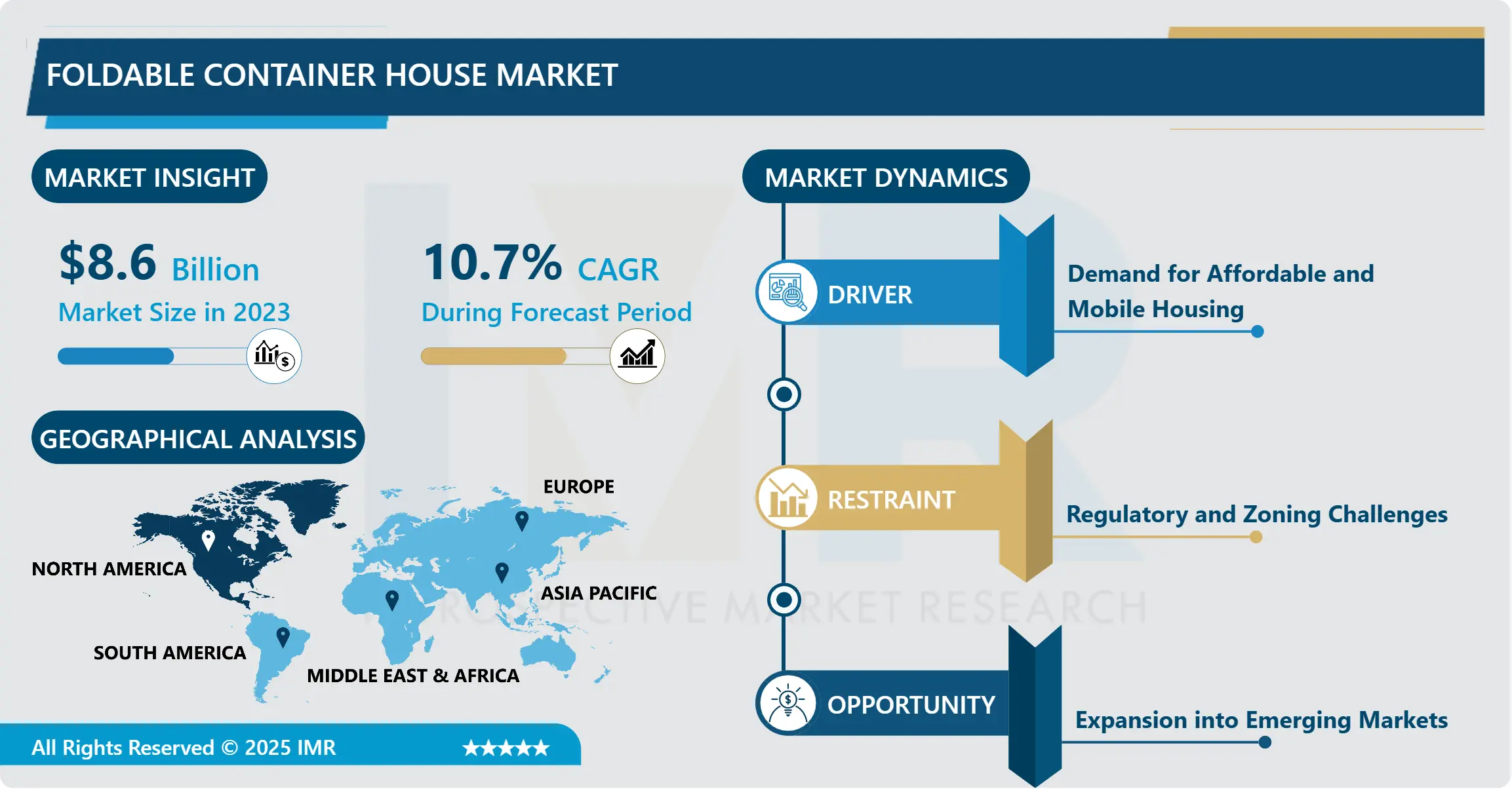
Foldable Container House Market Size Was Valued at USD 8.6 Billion in 2023, and is Projected to Reach USD 21.5 Billion by 2032, Growing at a CAGR of 10.7% From 2024-2032.
The foldable container house market involves designing, manufacturing, and marketing portable housing solutions made of folded shipping containers. The home can be built with customizable options that are both durable and environmentally sustainable for use in residential, commercial, industrial, or emergency applications.
Foldable container house offers great opportunities due to a hike in demand for affordable, environment-friendly, and portable housing. Due to its use of recycled materials such as shipping containers and versatile cost-effective means by which they are designed for portable transportability, easy assembling, and disassembling, it is found favorable for multiple uses. In addition, growing awareness of the environment has sparked an interest in eco-friendly and modular dwelling options, where foldable container houses are highly relevant to minimal environmental impact.
Increasing demand for affordable housing is the most significant driving force of this market. The rapid rate of urbanization and increasing construction costs make foldable container houses an ideal choice for low-cost housing in cities and villages. Additionally, they offer flexibility in design and size to be custom-designed to meet the specific needs of the consumer. They can easily be moved and transformed. Their popularity for mobile living, short-term accommodation, and vacation let is further amplified.
Foldable container houses also show their value for the market growth as these houses are suitable for most sectors like residential, commercial, industrial, and emergency situations. These modular houses can be easily changed into any form of layout that will make them fit for any form of use, from a small home to a larger, multi-unit community. Its usability of repurposed shipping containers also attracts the eyes of sustainable consumers, because it minimizes waste and utilizes what already exists.
Temporary or emergency housing needs also influence the demand for foldable container houses. Natural disasters, humanitarian crises, and refugee situations have all identified an urgent need for deployable, economical, and durable housing. A foldable container house answers this need because it can easily be transported, assembled, and is long-lived without much environmental impact. Again, as global climate change gives rise to more frequent and intensified weather events, the demand for temporary housing solutions is anticipated to increase.
Foldable Container House Market Trend Analysis:
Growing Adoption of Modular and Sustainable Housing Solutions
- The leading trend in foldable container house market is the modular and sustainable housing solutions that have become more prominent. More consumers and businesses alike are getting more conscious of the environment and thus a higher demand for energy-efficient and eco-friendly housing options. Foldable container houses, mainly composed of recycled shipping containers, perfectly match this demand with their sustainability in offering an eco-friendly housing solution with minimal new construction material use. For example, a solar panel might power their house, an energy-saving machine for appliances and, for sure, plenty of 'green' technology may just attract people with plans on lowering their carbon foot print.
- This development especially relates well in urbanized locations whereby the need to develop alternative solutions for low cost house hold is huge and high. Modular homes could always be increased or diminished by a person to fulfill specific needs. These qualities may surpass traditional brick and mortar housing structures. As the world population keeps on increasing, especially in urban areas, modular and foldable container homes will help fill the gap by growing along with the needs and reducing environmental impacts. In that regard, the growth is expected to continue because most people are now looking towards a sustainable lifestyle.
Expansion into Emerging Markets
- One of the great opportunities in the foldable container house market is in the expansion into emerging markets, especially in developing regions where urbanization is rapidly increasing. Here, demand for affordable housing is increasing, and foldable container homes are a great solution because they are cheaper and easier to build. These homes are suitable for the diverse conditions found in emerging economies because they can expand and adapt to various needs, from small family homes to large-scale commercial developments.
- Furthermore, emerging markets often face a shortage of traditional building materials, increasing construction costs, and the need for quick-to-assemble housing solutions due to population growth or natural disasters. Foldable container houses can then become an effective solution for such issues, providing affordability and sustainability in housing techniques. With such an opportunity at hand, manufacturers will be able to cash in on the growing trend of modular houses and gain solid ground in developing countries where infrastructure development and house requirements are being done rapidly.
Foldable Container House Market Segment Analysis:
Foldable Container House Market is Segmented on the basis of type, material, size, deployment type, end user, and Region.
By Type, Single-Story segment is expected to dominate the market during the forecast period
- The foldable container house market is segmented by type into single-story and multi-story units, each catering to different customer needs and applications. Single-story foldable container houses are popular because of their simplicity and affordability. These homes are usually used in residential settings, especially for small families or individuals looking for low-cost housing options. The design of single-story homes makes it fast for assembling and relocation and ideally used in rural or remote areas where traditional housing may be impractical.
- On the other hand, multi-story foldable container houses are becoming very popular in urban areas where space is limited and vertical construction is required. These units provide more living space on a smaller footprint, making them perfect for high-density residential areas, office buildings, and even commercial or industrial purposes. Multi-story container houses can also be more customizable: they can have bigger floor plans and more flexible lay-out. As the levels of urbanization are also on the rise, then demand for multi-story foldable container houses is set to increase, thus bringing a more scalable solution to housing shortages.
By End User, Residential segment expected to held the largest share
- This market covers foldable container houses with various end-use sectors in the form of residential, commercial, industrial, and emergency housing. Residential applications dominate because of the increasing need for low-cost and sustainable housing. Foldable container houses have also been popular among individuals requiring affordable housing, including those requiring temporary or mobile spaces to live. These foldable container houses can serve as single-family houses, multi-unit communities, or even vacation homes.
- There are also increasing commercial and industrial applications of foldable container houses, which are being used as offices, retail shops, or storage. Foldable container houses can be customized to meet the needs of businesses. Industrial sectors are also increasingly adopting foldable container houses, especially in construction and mining, as temporary housing for workers or mobile offices. Another major end-use is emergency housing, especially in disaster-affected regions, since foldable container homes are quick-to-deploy, robust, and relatively inexpensive options for displaced people.
Foldable Container House Market Regional Insights:
North America is Expected to Dominate the Market Over the Forecast period
- North America leads the current global market of foldable container houses due to increased demand for affordable and sustainable housing solutions. Such a situation has been fueled by higher rates of urbanization and increasing population in the region, coupled with increasing interests in environmental friendly construction strategies. Further, increased interests in mobile and temporary housing have also created higher demand for foldable container houses in North America.
- In the United States, foldable container houses are being increasingly adopted by cities and municipalities as a solution to housing shortages and construction costs. The regulatory environment for modular homes in North America has also become more supportive, with more regions modifying their zoning laws to allow such structures. This trend is expected to continue, as foldable container houses will become an integral part of the housing solution in North America, especially in high-density urban areas where space is at a premium.
Active Key Players in the Foldable Container House Market:
- Big Box Containers – Australia
- Container Homes USA – United States
- Giant Containers – Canada
- Kubed Living – United States
- Muji – Japan
- Patriot Containers – United States
- Rebel Walls – Sweden
- Royal Container Group – United States
- SG Blocks, Inc. – United States
- YZY Modular – China
- Other Active Players
Key Industry Developments in the Foldable Container House Market:
- In November 2023, Rhino Cubed, a Colorado company, approaches the tiny house trend differently. The company uses Corten steel shipping containers that have been recycled to create creative dwellings.
|
Foldable Container House Market |
|||
|
Base Year: |
2023 |
Forecast Period: |
2024-2032 |
|
Historical Data: |
2017 to 2023 |
Market Size in 2023: |
USD 8.6 Billion |
|
Forecast Period 2024-32 CAGR: |
10.7% |
Market Size in 2032: |
USD 21.5 Billion |
|
Segments Covered: |
By Type |
|
|
|
By Material |
|
||
|
By End-Use |
|
||
|
By Size |
|
||
|
By Deployment |
|
||
|
By Region |
|
||
|
Key Market Drivers: |
|
||
|
Key Market Restraints: |
|
||
|
Key Opportunities: |
|
||
|
Companies Covered in the report: |
|
||
Chapter 1: Introduction
1.1 Scope and Coverage
Chapter 2:Executive Summary
Chapter 3: Market Landscape
3.1 Market Dynamics
3.1.1 Drivers
3.1.2 Restraints
3.1.3 Opportunities
3.1.4 Challenges
3.2 Market Trend Analysis
3.3 PESTLE Analysis
3.4 Porter's Five Forces Analysis
3.5 Industry Value Chain Analysis
3.6 Ecosystem
3.7 Regulatory Landscape
3.8 Price Trend Analysis
3.9 Patent Analysis
3.10 Technology Evolution
3.11 Investment Pockets
3.12 Import-Export Analysis
Chapter 4: Foldable Container House Market by Type
4.1 Foldable Container House Market Snapshot and Growth Engine
4.2 Foldable Container House Market Overview
4.3 Single-Story
4.3.1 Introduction and Market Overview
4.3.2 Historic and Forecasted Market Size in Value USD and Volume Units (2017-2032F)
4.3.3 Key Market Trends, Growth Factors and Opportunities
4.3.4 Single-Story: Geographic Segmentation Analysis
4.4 Multi-Story
4.4.1 Introduction and Market Overview
4.4.2 Historic and Forecasted Market Size in Value USD and Volume Units (2017-2032F)
4.4.3 Key Market Trends, Growth Factors and Opportunities
4.4.4 Multi-Story: Geographic Segmentation Analysis
Chapter 5: Foldable Container House Market by Material
5.1 Foldable Container House Market Snapshot and Growth Engine
5.2 Foldable Container House Market Overview
5.3 Steel
5.3.1 Introduction and Market Overview
5.3.2 Historic and Forecasted Market Size in Value USD and Volume Units (2017-2032F)
5.3.3 Key Market Trends, Growth Factors and Opportunities
5.3.4 Steel: Geographic Segmentation Analysis
5.4 Aluminum
5.4.1 Introduction and Market Overview
5.4.2 Historic and Forecasted Market Size in Value USD and Volume Units (2017-2032F)
5.4.3 Key Market Trends, Growth Factors and Opportunities
5.4.4 Aluminum: Geographic Segmentation Analysis
5.5 Wood
5.5.1 Introduction and Market Overview
5.5.2 Historic and Forecasted Market Size in Value USD and Volume Units (2017-2032F)
5.5.3 Key Market Trends, Growth Factors and Opportunities
5.5.4 Wood: Geographic Segmentation Analysis
5.6 Plastic
5.6.1 Introduction and Market Overview
5.6.2 Historic and Forecasted Market Size in Value USD and Volume Units (2017-2032F)
5.6.3 Key Market Trends, Growth Factors and Opportunities
5.6.4 Plastic: Geographic Segmentation Analysis
Chapter 6: Foldable Container House Market by End-Use
6.1 Foldable Container House Market Snapshot and Growth Engine
6.2 Foldable Container House Market Overview
6.3 Residential
6.3.1 Introduction and Market Overview
6.3.2 Historic and Forecasted Market Size in Value USD and Volume Units (2017-2032F)
6.3.3 Key Market Trends, Growth Factors and Opportunities
6.3.4 Residential: Geographic Segmentation Analysis
6.4 Commercial
6.4.1 Introduction and Market Overview
6.4.2 Historic and Forecasted Market Size in Value USD and Volume Units (2017-2032F)
6.4.3 Key Market Trends, Growth Factors and Opportunities
6.4.4 Commercial: Geographic Segmentation Analysis
6.5 Industrial
6.5.1 Introduction and Market Overview
6.5.2 Historic and Forecasted Market Size in Value USD and Volume Units (2017-2032F)
6.5.3 Key Market Trends, Growth Factors and Opportunities
6.5.4 Industrial: Geographic Segmentation Analysis
6.6 Emergency and Temporary Housing
6.6.1 Introduction and Market Overview
6.6.2 Historic and Forecasted Market Size in Value USD and Volume Units (2017-2032F)
6.6.3 Key Market Trends, Growth Factors and Opportunities
6.6.4 Emergency and Temporary Housing: Geographic Segmentation Analysis
Chapter 7: Company Profiles and Competitive Analysis
7.1 Competitive Landscape
7.1.1 Competitive Benchmarking
7.1.2 Foldable Container House Market Share by Manufacturer (2023)
7.1.3 Industry BCG Matrix
7.1.4 Heat Map Analysis
7.1.5 Mergers and Acquisitions
7.2 SG BLOCKS INC. – UNITED STATES
7.2.1 Company Overview
7.2.2 Key Executives
7.2.3 Company Snapshot
7.2.4 Role of the Company in the Market
7.2.5 Sustainability and Social Responsibility
7.2.6 Operating Business Segments
7.2.7 Product Portfolio
7.2.8 Business Performance
7.2.9 Key Strategic Moves and Recent Developments
7.2.10 SWOT Analysis
7.3 CONTAINER HOMES USA – UNITED STATES
7.4 REBEL WALLS – SWEDEN
7.5 ROYAL CONTAINER GROUP – UNITED STATES
7.6 MUJI – JAPAN
7.7 BIG BOX CONTAINERS – AUSTRALIA
7.8 KUBED LIVING – UNITED STATES
7.9 GIANT CONTAINERS – CANADA
7.10 PATRIOT CONTAINERS – UNITED STATES
7.11 YZY MODULAR – CHINA
7.12 OTHER ACTIVE PLAYERS
Chapter 8: Global Foldable Container House Market By Region
8.1 Overview
8.2. North America Foldable Container House Market
8.2.1 Key Market Trends, Growth Factors and Opportunities
8.2.2 Top Key Companies
8.2.3 Historic and Forecasted Market Size by Segments
8.2.4 Historic and Forecasted Market Size By Type
8.2.4.1 Single-Story
8.2.4.2 Multi-Story
8.2.5 Historic and Forecasted Market Size By Material
8.2.5.1 Steel
8.2.5.2 Aluminum
8.2.5.3 Wood
8.2.5.4 Plastic
8.2.6 Historic and Forecasted Market Size By End-Use
8.2.6.1 Residential
8.2.6.2 Commercial
8.2.6.3 Industrial
8.2.6.4 Emergency and Temporary Housing
8.2.7 Historic and Forecast Market Size by Country
8.2.7.1 US
8.2.7.2 Canada
8.2.7.3 Mexico
8.3. Eastern Europe Foldable Container House Market
8.3.1 Key Market Trends, Growth Factors and Opportunities
8.3.2 Top Key Companies
8.3.3 Historic and Forecasted Market Size by Segments
8.3.4 Historic and Forecasted Market Size By Type
8.3.4.1 Single-Story
8.3.4.2 Multi-Story
8.3.5 Historic and Forecasted Market Size By Material
8.3.5.1 Steel
8.3.5.2 Aluminum
8.3.5.3 Wood
8.3.5.4 Plastic
8.3.6 Historic and Forecasted Market Size By End-Use
8.3.6.1 Residential
8.3.6.2 Commercial
8.3.6.3 Industrial
8.3.6.4 Emergency and Temporary Housing
8.3.7 Historic and Forecast Market Size by Country
8.3.7.1 Russia
8.3.7.2 Bulgaria
8.3.7.3 The Czech Republic
8.3.7.4 Hungary
8.3.7.5 Poland
8.3.7.6 Romania
8.3.7.7 Rest of Eastern Europe
8.4. Western Europe Foldable Container House Market
8.4.1 Key Market Trends, Growth Factors and Opportunities
8.4.2 Top Key Companies
8.4.3 Historic and Forecasted Market Size by Segments
8.4.4 Historic and Forecasted Market Size By Type
8.4.4.1 Single-Story
8.4.4.2 Multi-Story
8.4.5 Historic and Forecasted Market Size By Material
8.4.5.1 Steel
8.4.5.2 Aluminum
8.4.5.3 Wood
8.4.5.4 Plastic
8.4.6 Historic and Forecasted Market Size By End-Use
8.4.6.1 Residential
8.4.6.2 Commercial
8.4.6.3 Industrial
8.4.6.4 Emergency and Temporary Housing
8.4.7 Historic and Forecast Market Size by Country
8.4.7.1 Germany
8.4.7.2 UK
8.4.7.3 France
8.4.7.4 The Netherlands
8.4.7.5 Italy
8.4.7.6 Spain
8.4.7.7 Rest of Western Europe
8.5. Asia Pacific Foldable Container House Market
8.5.1 Key Market Trends, Growth Factors and Opportunities
8.5.2 Top Key Companies
8.5.3 Historic and Forecasted Market Size by Segments
8.5.4 Historic and Forecasted Market Size By Type
8.5.4.1 Single-Story
8.5.4.2 Multi-Story
8.5.5 Historic and Forecasted Market Size By Material
8.5.5.1 Steel
8.5.5.2 Aluminum
8.5.5.3 Wood
8.5.5.4 Plastic
8.5.6 Historic and Forecasted Market Size By End-Use
8.5.6.1 Residential
8.5.6.2 Commercial
8.5.6.3 Industrial
8.5.6.4 Emergency and Temporary Housing
8.5.7 Historic and Forecast Market Size by Country
8.5.7.1 China
8.5.7.2 India
8.5.7.3 Japan
8.5.7.4 South Korea
8.5.7.5 Malaysia
8.5.7.6 Thailand
8.5.7.7 Vietnam
8.5.7.8 The Philippines
8.5.7.9 Australia
8.5.7.10 New Zealand
8.5.7.11 Rest of APAC
8.6. Middle East & Africa Foldable Container House Market
8.6.1 Key Market Trends, Growth Factors and Opportunities
8.6.2 Top Key Companies
8.6.3 Historic and Forecasted Market Size by Segments
8.6.4 Historic and Forecasted Market Size By Type
8.6.4.1 Single-Story
8.6.4.2 Multi-Story
8.6.5 Historic and Forecasted Market Size By Material
8.6.5.1 Steel
8.6.5.2 Aluminum
8.6.5.3 Wood
8.6.5.4 Plastic
8.6.6 Historic and Forecasted Market Size By End-Use
8.6.6.1 Residential
8.6.6.2 Commercial
8.6.6.3 Industrial
8.6.6.4 Emergency and Temporary Housing
8.6.7 Historic and Forecast Market Size by Country
8.6.7.1 Turkiye
8.6.7.2 Bahrain
8.6.7.3 Kuwait
8.6.7.4 Saudi Arabia
8.6.7.5 Qatar
8.6.7.6 UAE
8.6.7.7 Israel
8.6.7.8 South Africa
8.7. South America Foldable Container House Market
8.7.1 Key Market Trends, Growth Factors and Opportunities
8.7.2 Top Key Companies
8.7.3 Historic and Forecasted Market Size by Segments
8.7.4 Historic and Forecasted Market Size By Type
8.7.4.1 Single-Story
8.7.4.2 Multi-Story
8.7.5 Historic and Forecasted Market Size By Material
8.7.5.1 Steel
8.7.5.2 Aluminum
8.7.5.3 Wood
8.7.5.4 Plastic
8.7.6 Historic and Forecasted Market Size By End-Use
8.7.6.1 Residential
8.7.6.2 Commercial
8.7.6.3 Industrial
8.7.6.4 Emergency and Temporary Housing
8.7.7 Historic and Forecast Market Size by Country
8.7.7.1 Brazil
8.7.7.2 Argentina
8.7.7.3 Rest of SA
Chapter 9 Analyst Viewpoint and Conclusion
9.1 Recommendations and Concluding Analysis
9.2 Potential Market Strategies
Chapter 10 Research Methodology
10.1 Research Process
10.2 Primary Research
10.3 Secondary Research
|
Foldable Container House Market |
|||
|
Base Year: |
2023 |
Forecast Period: |
2024-2032 |
|
Historical Data: |
2017 to 2023 |
Market Size in 2023: |
USD 8.6 Billion |
|
Forecast Period 2024-32 CAGR: |
10.7% |
Market Size in 2032: |
USD 21.5 Billion |
|
Segments Covered: |
By Type |
|
|
|
By Material |
|
||
|
By End-Use |
|
||
|
By Size |
|
||
|
By Deployment |
|
||
|
By Region |
|
||
|
Key Market Drivers: |
|
||
|
Key Market Restraints: |
|
||
|
Key Opportunities: |
|
||
|
Companies Covered in the report: |
|
||


