




Fluorescence Guided Surgery Systems Market Synopsis:
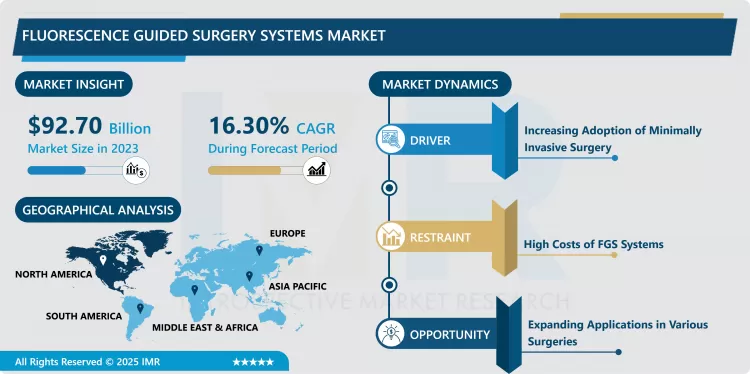
Fluorescence Guided Surgery Systems Market Size Was Valued at USD 92.70 Billion in 2023, and is Projected to Reach USD 360.83 Billion by 2032, Growing at a CAGR of 16.30% From 2024-2032.
FGS Systems are defined as surgical tools and technologies that employ fluorescence imaging to improve tissue visualization during surgeries. These systems use fluorochromes or markers that have affinity for certain tissues that include tumors or vasculature, and so the surgeon is able to distinguish between healthy and malignant tissue during surgery. Due to high contrast images, FGS systems enhance the accuracy of the surgical procedures, minimize the risks of a residual disease, as well as develop better outcomes of patients. The application of FGS technology in surgical practice greatly enhances the area of minimally invasive surgery, oncology, and other areas that need the identification of tissues.
Literature review revealed that growth of the Fluorescence Guided Surgery (FGS) Systems market is on the rise because of the need to achieve high level of accuracy and effectiveness in surgical operations. Currently FGS systems employ fluorescence imaging to improve visibility of the tissues so that the surgeon can distinguish between normal and diseased tissues during operations especially during tumor resection. Refers in particular to oncological surgeries in which the accurate localization of the tumour is highly significant to enhance the patients’ prognosis. FGS systems have a good prospect for growth in the world’s healthcare system, because as medical centres all over the world advance their orientation toward less invasive operations and new generations of surgical equipment, FGS systems can offer fewer risks of complications, quicker rehabilitation, improved accuracy during surgery.
The growth of the FGS systems market is driven by improved features of the imaging systems, a higher incidence of cancer, and raising attention towards the molecular level of treatment. In addition, with the growing number of clinical trials in the investment of new fluorescent agents and the increase in research work on advanced engineering systems, the market grows exponentially. Other advancements including the continuous improvement of both artificial intelligence and machine learning in imaging systems are also giving FGS systems a lift eventually making them easier to handle for surgeons.
There is both a major and a minor player in this market, which keeps on increasing the competition for innovations. Market analysis: The market is dominated by North America which is due to factors such as enhanced healthcare and better research and development investment and key players are also located in this location. Still, the Asia-Pacific region might prove to have the quickest growth as healthcare spending, better access to such technologies, and the generally growing population can boost ‘the need for surgery market’. In the coming years, sales of FGS systems will increase significantly because stakeholders continue to ascertain the value of fluorescence-guided procedures to revolutionize surgical practices positively and improve patient outcomes worldwide.
Fluorescence Guided Surgery Systems Market Trend Analysis:
Trends Shaping the Fluorescence Guided Surgery Systems Market
- One of the emerging factors that can be mapped to the ongoing growth of the fluorescence-guided surgery (FGS) systems market is the rise of cancer and chronic diseases, which all translate into more surgeries across the world. As cancer types and numbers grow, the health care stakeholders have no option than to look for better surgical equipment and innovative strategies for optimal performance. Using such principles as real-time imaging, FGS systems allow the differentiation of pathological /normal tissue during surgeries. This added capacity is important especially in oncological surgeries where an aim is to remove the tumours while minimising damage to healthy tissue which leads to better patient outcomes.
- In addition, the recent industry trend toward individualized diagnosis and therapies or target therapies is exerting considerable impact on the design of FGS systems. They have been increasingly incorporating these systems so as to be unique for particular types of cancers and being able to offer correct surgical solutions in accordance with key patient profiles. Partnerships between technology suppliers, drug manufacturers, and healthcare organizations are driving development and enhancing the adoption of enhanced fluorescence-guided systems in numerous surgical disciplines. These collaborations are essential in defining and developing new technologies of FGS that are to lead on intra operative accuracy and efficiency, and hence improve patient’s outcome and thus increase the size of the market.
Advancements in the Fluorescence Guided Surgery Systems Market
- The first emerging opportunity is driven by the high growth rate in the Fluorescence Guided Surgery (FGS) systems market in terms of technology especially involving AI and Machine Learning. These technologies can greatly improve image processing procedures, and can give immediate analysis in operations. Incorporating AI algorithms will reallocate the image clarity as well as the precision enabling the surgeons to make improved decisions during the operations. In addition, surgical benefits are enhanced while the rate of complications reduced, enhancing the general recovery period to fulfillment with the results of surgery. AI can also be used in organizing the general working processes in the operating room, thereby increase productivity and decrease time on operations.
- Also, new fluorescent agents promising a brighter idea of the FGS market’s potential also act as a massive opportunity to the market. These advanced agents can provide better delineation of tumor and important tissues and this helps the surgeons to distinguish between the healthy and the unhealthy tissue better. Of all the classes of drugs involved in cancer surgery, these agents are particularly important in oncology, where it is crucial to remove a tumour as accurately and completely as possible. Because discoveries of more powerful fluorophores are still being made, their integration into FGS systems can extend the reach of surgical uses, up from oncology applications into neurosurgery or cardiac surgery. This diversification will probably lead to increased use of FGS technologies in a variety of surgical fields, thus enhancing market growth prospects.
Fluorescence Guided Surgery Systems Market Segment Analysis:
Fluorescence Guided Surgery Systems Market is Segmented on the basis of Type, Surgery, Application, and Region
By Type, SPY system segment is expected to dominate the market during the forecast period
- The SPY system is a new generation of surgical imaging technology that utilizes fluorescent imaging to realize blood flow and tissue perfusion during surgery. Comprising a dye which emits light at certain wavelengths, this system allows surgeons to evaluate the quality of blood supply within tissues immediately during the surgery. This capability is most relevant in cases that involve extended surgery, including breast reconstructions and flap surgeries by helping to maintain tissue vitality that is inevitable in surgery. Since blood supply can be depicted, the surgeon can locate the areas that have been starved of blood prior to making the vital surgical decisions, and thus provide more accurate and efficient resections.
- It is clear that the inclusion of the SPY system in surgery has contributed to the decrease of complications and improvement of the total surgical performance. The system presents images of tissue perfusion and viability to the surgeons in real time and, thus, prevents postoperative complications such as necrosis or insufficient healing. This active approach not only contributes to patient’s safety but also to shorter recovery time, and better surgical outcomes, especially in cases of reconstructive surgery. For this reason, the SPY system has emerged as a standard gadget in the today’s surgical theater and procedures as it provides surgeons with an elaborate map while dealing with patients.
By Application, Cancer surgeries segment expected to held the largest share
- In cancer surgeries, the general aim is to accomplish proper view and examination of the tumor boundary. As for technologies, a method using the SPY and VS3 iridium systems helps the surgeons to distinguish between malignant and healthy tissues during operations. Because of these features, these systems enable surgeons to define the margins of a tumor during operations, thus enabling them to remove all the affected tissues while avoiding damage to other parts of the body. This is especially gets important when performing surgeries that call for high levels of precision; if the surgeon leaves remnant malignant cells on the tissue, it may lead to recurrence of the disease.
- Furthermore, these imaging systems, when integrated, reliably prime the safety and effectiveness of cancer operations. Changes in tissue perfusion need to be evaluated in real-time, particularly in flap surgeries that are commonly performed in conjunction with tumor resection, as perfusion of reconstructed areas is critical to the healing process. From these enhanced tools, surgeons are then able to make the right decisions during the surgery so that enhanced results may be achieved. In turn, a patient has lesser complications, improved healing and, therefore, an increased chance of survival where imaging has proved a game changer in combating the disease.
Fluorescence Guided Surgery Systems Market Regional Insights:
North America is Expected to Dominate the Market Over the Forecast period
- North America, especially the United States, leads the world in the FGS Systems Market due to well-developed healthcare technology and increased focus on R & D. The region is predisposed to a strong medical environment that supports the quick adoption of new surgical technologies. Because of technology advancement especially in health facilities, intensive investments are being made in fluorescence imaging during surgeries in hospitals and surgical centers. Such a transition is particularly important because America is one of the countries with the highest rates of cancer and neurological conditions; the former where accurate tumor volumes and the latter where proper surgery matters for better patients’ prognosis.
- Furthermore, market leaders in the North American market have especially been keen on entering into partnerships and collaboration deals to improve their product portfolios as well as penetration into the market. Open moments of cooperation facilitate the implementation of advanced technologies and extend companies’ presence in new healthcare centers, enabling more wide-spread application of fluorescence-assisted procedures. Moreover, it is equally important to consider the current enthusiastic position in clinical trials and researches concerning fluorescence imaging technologies in the scope of improving the accuracy of the surgeries conducted in this region. Thus, it will be possible to maintain the dominant market share of North America in the sector of FGS systems, focusing on the setting of new standards in terms of innovation and surgical care work.
Active Key Players in the Fluorescence Guided Surgery Systems Market:
- Stryker Corporation
- Olympus Corporation
- KARL STORZ SE & Co. KG
- Medtronic plc
- Carl Zeiss Meditec AG
- Danaher Corporation (Leica Microsystems)
- Hamamatsu Photonics K.K.
- Shimadzu Corporation
- LI-COR, Inc.
- PerkinElmer Inc.
- Getinge (Fluoptics)
- OnLume Inc.
- Irillic Pvt. Ltd.
- Curadel, LLC
- Other Active Players
|
Fluorescence Guided Surgery Systems Market |
|||
|
Base Year: |
2023 |
Forecast Period: |
2024-2032 |
|
Historical Data: |
2017 to 2023 |
Market Size in 2023: |
USD 92.70 Billion |
|
Forecast Period 2024-32 CAGR: |
16.30% |
Market Size in 2032: |
USD 360.83 Billion |
|
Segments Covered: |
By Type |
|
|
|
By Surgery |
|
||
|
By Application |
|
||
|
By Region |
|
||
|
Key Market Drivers: |
|
||
|
Key Market Restraints: |
|
||
|
Key Opportunities: |
|
||
|
Companies Covered in the report: |
|
||
1.1 Scope and Coverage
Chapter 2:Executive Summary
Chapter 3: Market Landscape
3.1 Market Dynamics
3.1.1 Drivers
3.1.2 Restraints
3.1.3 Opportunities
3.1.4 Challenges
3.2 Market Trend Analysis
3.3 PESTLE Analysis
3.4 Porter's Five Forces Analysis
3.5 Industry Value Chain Analysis
3.6 Ecosystem
3.7 Regulatory Landscape
3.8 Price Trend Analysis
3.9 Patent Analysis
3.10 Technology Evolution
3.11 Investment Pockets
3.12 Import-Export Analysis
Chapter 4: Fluorescence Guided Surgery Systems Market by Type (2018-2032)
4.1 Fluorescence Guided Surgery Systems Market Snapshot and Growth Engine
4.2 Market Overview
4.3 SPY system
4.3.1 Introduction and Market Overview
4.3.2 Historic and Forecasted Market Size in Value USD and Volume Units
4.3.3 Key Market Trends, Growth Factors, and Opportunities
4.3.4 Geographic Segmentation Analysis
4.4 PDE system
4.5 VS3 iridium system
4.6 Other types
Chapter 5: Fluorescence Guided Surgery Systems Market by Surgery (2018-2032)
5.1 Fluorescence Guided Surgery Systems Market Snapshot and Growth Engine
5.2 Market Overview
5.3 Open surgery
5.3.1 Introduction and Market Overview
5.3.2 Historic and Forecasted Market Size in Value USD and Volume Units
5.3.3 Key Market Trends, Growth Factors, and Opportunities
5.3.4 Geographic Segmentation Analysis
5.4 Laparoscopic/endoscopic surgery
Chapter 6: Fluorescence Guided Surgery Systems Market by Application (2018-2032)
6.1 Fluorescence Guided Surgery Systems Market Snapshot and Growth Engine
6.2 Market Overview
6.3 Cancer surgeries
6.3.1 Introduction and Market Overview
6.3.2 Historic and Forecasted Market Size in Value USD and Volume Units
6.3.3 Key Market Trends, Growth Factors, and Opportunities
6.3.4 Geographic Segmentation Analysis
6.4 Cardiovascular surgeries
6.5 Other applications
Chapter 7: Company Profiles and Competitive Analysis
7.1 Competitive Landscape
7.1.1 Competitive Benchmarking
7.1.2 Fluorescence Guided Surgery Systems Market Share by Manufacturer (2024)
7.1.3 Industry BCG Matrix
7.1.4 Heat Map Analysis
7.1.5 Mergers and Acquisitions
7.2 STRYKER CORPORATION (USA)
7.2.1 Company Overview
7.2.2 Key Executives
7.2.3 Company Snapshot
7.2.4 Role of the Company in the Market
7.2.5 Sustainability and Social Responsibility
7.2.6 Operating Business Segments
7.2.7 Product Portfolio
7.2.8 Business Performance
7.2.9 Key Strategic Moves and Recent Developments
7.2.10 SWOT Analysis
7.3 OLYMPUS CORPORATION (JAPAN)
7.4 KARL STORZ SE & CO. KG (GERMANY)
7.5 MEDTRONIC PLC (IRELAND)
7.6 CARL ZEISS MEDITEC AG (GERMANY)
7.7 DANAHER CORPORATION (USA) (LEICA MICROSYSTEMS)
7.8 HAMAMATSU PHOTONICS K.K. (JAPAN)
7.9 SHIMADZU CORPORATION (JAPAN)
7.10 LI-COR INC. (USA)
7.11 PERKINELMER INC. (USA)
7.12 GETINGE (FLUOPTICS) (SWEDEN)
7.13 ONLUME INC. (USA)
7.14 IRILLIC PVT. LTD. (INDIA)
7.15 CURADEL LLC (USA)
7.16 OTHER ACTIVE PLAYERS
Chapter 8: Global Fluorescence Guided Surgery Systems Market By Region
8.1 Overview
8.2. North America Fluorescence Guided Surgery Systems Market
8.2.1 Key Market Trends, Growth Factors and Opportunities
8.2.2 Top Key Companies
8.2.3 Historic and Forecasted Market Size by Segments
8.2.4 Historic and Forecasted Market Size by Type
8.2.4.1 SPY system
8.2.4.2 PDE system
8.2.4.3 VS3 iridium system
8.2.4.4 Other types
8.2.5 Historic and Forecasted Market Size by Surgery
8.2.5.1 Open surgery
8.2.5.2 Laparoscopic/endoscopic surgery
8.2.6 Historic and Forecasted Market Size by Application
8.2.6.1 Cancer surgeries
8.2.6.2 Cardiovascular surgeries
8.2.6.3 Other applications
8.2.7 Historic and Forecast Market Size by Country
8.2.7.1 US
8.2.7.2 Canada
8.2.7.3 Mexico
8.3. Eastern Europe Fluorescence Guided Surgery Systems Market
8.3.1 Key Market Trends, Growth Factors and Opportunities
8.3.2 Top Key Companies
8.3.3 Historic and Forecasted Market Size by Segments
8.3.4 Historic and Forecasted Market Size by Type
8.3.4.1 SPY system
8.3.4.2 PDE system
8.3.4.3 VS3 iridium system
8.3.4.4 Other types
8.3.5 Historic and Forecasted Market Size by Surgery
8.3.5.1 Open surgery
8.3.5.2 Laparoscopic/endoscopic surgery
8.3.6 Historic and Forecasted Market Size by Application
8.3.6.1 Cancer surgeries
8.3.6.2 Cardiovascular surgeries
8.3.6.3 Other applications
8.3.7 Historic and Forecast Market Size by Country
8.3.7.1 Russia
8.3.7.2 Bulgaria
8.3.7.3 The Czech Republic
8.3.7.4 Hungary
8.3.7.5 Poland
8.3.7.6 Romania
8.3.7.7 Rest of Eastern Europe
8.4. Western Europe Fluorescence Guided Surgery Systems Market
8.4.1 Key Market Trends, Growth Factors and Opportunities
8.4.2 Top Key Companies
8.4.3 Historic and Forecasted Market Size by Segments
8.4.4 Historic and Forecasted Market Size by Type
8.4.4.1 SPY system
8.4.4.2 PDE system
8.4.4.3 VS3 iridium system
8.4.4.4 Other types
8.4.5 Historic and Forecasted Market Size by Surgery
8.4.5.1 Open surgery
8.4.5.2 Laparoscopic/endoscopic surgery
8.4.6 Historic and Forecasted Market Size by Application
8.4.6.1 Cancer surgeries
8.4.6.2 Cardiovascular surgeries
8.4.6.3 Other applications
8.4.7 Historic and Forecast Market Size by Country
8.4.7.1 Germany
8.4.7.2 UK
8.4.7.3 France
8.4.7.4 The Netherlands
8.4.7.5 Italy
8.4.7.6 Spain
8.4.7.7 Rest of Western Europe
8.5. Asia Pacific Fluorescence Guided Surgery Systems Market
8.5.1 Key Market Trends, Growth Factors and Opportunities
8.5.2 Top Key Companies
8.5.3 Historic and Forecasted Market Size by Segments
8.5.4 Historic and Forecasted Market Size by Type
8.5.4.1 SPY system
8.5.4.2 PDE system
8.5.4.3 VS3 iridium system
8.5.4.4 Other types
8.5.5 Historic and Forecasted Market Size by Surgery
8.5.5.1 Open surgery
8.5.5.2 Laparoscopic/endoscopic surgery
8.5.6 Historic and Forecasted Market Size by Application
8.5.6.1 Cancer surgeries
8.5.6.2 Cardiovascular surgeries
8.5.6.3 Other applications
8.5.7 Historic and Forecast Market Size by Country
8.5.7.1 China
8.5.7.2 India
8.5.7.3 Japan
8.5.7.4 South Korea
8.5.7.5 Malaysia
8.5.7.6 Thailand
8.5.7.7 Vietnam
8.5.7.8 The Philippines
8.5.7.9 Australia
8.5.7.10 New Zealand
8.5.7.11 Rest of APAC
8.6. Middle East & Africa Fluorescence Guided Surgery Systems Market
8.6.1 Key Market Trends, Growth Factors and Opportunities
8.6.2 Top Key Companies
8.6.3 Historic and Forecasted Market Size by Segments
8.6.4 Historic and Forecasted Market Size by Type
8.6.4.1 SPY system
8.6.4.2 PDE system
8.6.4.3 VS3 iridium system
8.6.4.4 Other types
8.6.5 Historic and Forecasted Market Size by Surgery
8.6.5.1 Open surgery
8.6.5.2 Laparoscopic/endoscopic surgery
8.6.6 Historic and Forecasted Market Size by Application
8.6.6.1 Cancer surgeries
8.6.6.2 Cardiovascular surgeries
8.6.6.3 Other applications
8.6.7 Historic and Forecast Market Size by Country
8.6.7.1 Turkiye
8.6.7.2 Bahrain
8.6.7.3 Kuwait
8.6.7.4 Saudi Arabia
8.6.7.5 Qatar
8.6.7.6 UAE
8.6.7.7 Israel
8.6.7.8 South Africa
8.7. South America Fluorescence Guided Surgery Systems Market
8.7.1 Key Market Trends, Growth Factors and Opportunities
8.7.2 Top Key Companies
8.7.3 Historic and Forecasted Market Size by Segments
8.7.4 Historic and Forecasted Market Size by Type
8.7.4.1 SPY system
8.7.4.2 PDE system
8.7.4.3 VS3 iridium system
8.7.4.4 Other types
8.7.5 Historic and Forecasted Market Size by Surgery
8.7.5.1 Open surgery
8.7.5.2 Laparoscopic/endoscopic surgery
8.7.6 Historic and Forecasted Market Size by Application
8.7.6.1 Cancer surgeries
8.7.6.2 Cardiovascular surgeries
8.7.6.3 Other applications
8.7.7 Historic and Forecast Market Size by Country
8.7.7.1 Brazil
8.7.7.2 Argentina
8.7.7.3 Rest of SA
Chapter 9 Analyst Viewpoint and Conclusion
9.1 Recommendations and Concluding Analysis
9.2 Potential Market Strategies
Chapter 10 Research Methodology
10.1 Research Process
10.2 Primary Research
10.3 Secondary Research
|
Fluorescence Guided Surgery Systems Market |
|||
|
Base Year: |
2023 |
Forecast Period: |
2024-2032 |
|
Historical Data: |
2017 to 2023 |
Market Size in 2023: |
USD 92.70 Billion |
|
Forecast Period 2024-32 CAGR: |
16.30% |
Market Size in 2032: |
USD 360.83 Billion |
|
Segments Covered: |
By Type |
|
|
|
By Surgery |
|
||
|
By Application |
|
||
|
By Region |
|
||
|
Key Market Drivers: |
|
||
|
Key Market Restraints: |
|
||
|
Key Opportunities: |
|
||
|
Companies Covered in the report: |
|
||
Frequently Asked Questions :
The forecast period in the Fluorescence Guided Surgery Systems Market research report is 2024-2032.
Stryker Corporation, Olympus Corporation, KARL STORZ SE & Co. KG, Medtronic plc, Carl Zeiss Meditec AG, Danaher Corporation (Leica Microsystems), Hamamatsu Photonics K.K., Shimadzu Corporation, LI-COR, Inc., PerkinElmer Inc., Getinge (Fluoptics), OnLume Inc., Irillic Pvt. Ltd., Curadel, LLC, and Other Active Players.
The Fluorescence Guided Surgery Systems Market is segmented into By Type, By Surgery, By Application and region. By Type, the market is categorized into SPY system, PDE system, VS3 iridium system and other types. By Surgery, the market is categorized into Open surgery and Laparoscopic/endoscopic surgery. By Application, the market is categorized into Cancer surgeries, Cardiovascular surgeries and other applications. By region, it is analyzed across North America (U.S., Canada, Mexico), Eastern Europe (Russia, Bulgaria, The Czech Republic, Hungary, Poland, Romania, Rest of Eastern Europe), Western Europe (Germany, UK, France, The Netherlands, Italy, Spain, Rest of Western Europe), Asia Pacific (China, India, Japan, South Korea, Malaysia, Thailand, Vietnam, The Philippines, Australia, New-Zealand, Rest of APAC), Middle East & Africa (Turkiye, Bahrain, Kuwait, Saudi Arabia, Qatar, UAE, Israel, South Africa), South America (Brazil, Argentina, Rest of SA).
Fluorescence Guided Surgery (FGS) Systems refer to advanced surgical tools and technologies that utilize fluorescence imaging to enhance the visualization of tissues during surgical procedures. These systems employ fluorescent dyes or markers that bind selectively to specific tissues, such as tumors or vascular structures, allowing surgeons to identify and differentiate between healthy and diseased tissues in real time. By providing high-contrast images, FGS systems improve the precision of surgical interventions, reduce the likelihood of residual disease, and facilitate better patient outcomes. The integration of FGS technology into surgical practice represents a significant advancement in minimally invasive surgery, oncology, and other fields requiring precise tissue identification.
Fluorescence Guided Surgery Systems Market Size Was Valued at USD 92.70 Billion in 2023, and is Projected to Reach USD 360.83 Billion by 2032, Growing at a CAGR of 16.30% From 2024-2032.


