




Female Infertility Treatment Drugs Market Synopsis:
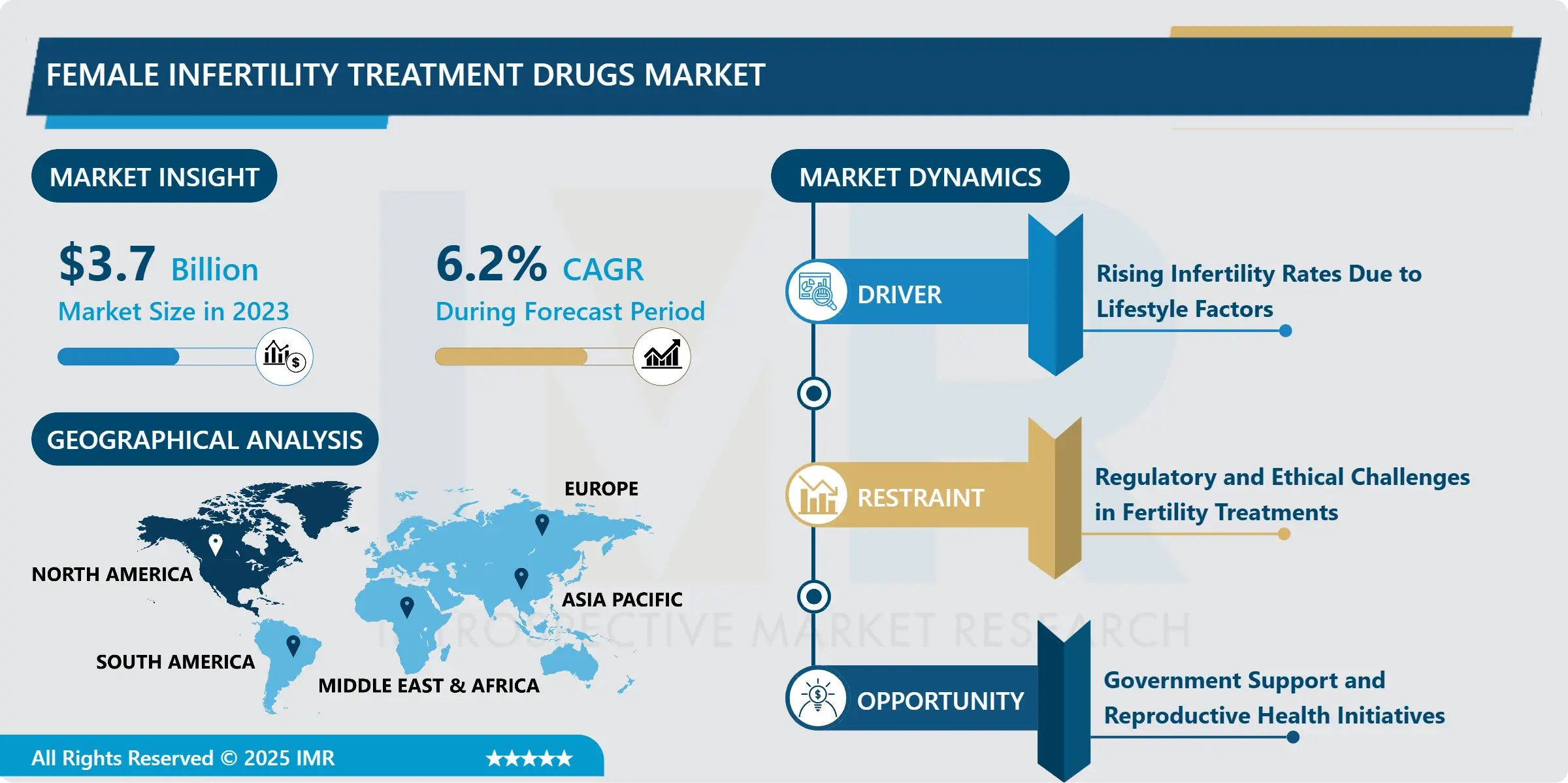
Female Infertility Treatment Drugs Market Size Was Valued at USD 3.7 Billion in 2023, and is Projected to Reach USD 6.35 Billion by 2032, Growing at a CAGR of 6.20% From 2024-2032.
The Female Infertility Treatment Drugs Market refers to drugs which are taken by women with fertility problems such as ovulatory dysfunctions, PCOS and other related complications. Such treatments range from ovulation enhancing agents, gonadotropins, GnRH analogs to progestins and some of the other drugs used to increase the fertility rate, regulate ovulation and complement procedures like IVF and IUI.
The infertility treatment drugs market is mainly driven by the growing incidences of infertility among women through unhealthy lifestyles, hormonal changes, and or early child bearing. The women of this generation are now more conscious about their choice of child bearing and this could be perceived in lack of time due to personal development, job promotions hence the need for fetility has increased hence the need for infertility drugs.
Improvements in the techniques of infertility treatments for instance the IVF and IUI have raised the success rate of the treatments. The possibility of obtaining new firstly-class drugs has also affected patient demand for intervention, thus boosting the market’s expansion. Governments and organizations are also availing their support to fertility treatments that have made infertility drugs available in the market.
Female Infertility Treatment Drugs Market Trend Analysis:
Technological Advancements in Drug Development
-
Another active trend of the market is based on the further development of ART procedures such as IVF, especially the demand for women over 30 years of age. It has led to a rising inclination toward drugs that are used to enable these treatments. Since IVF has been embraced as the most suitable for women who have complications with fertility, there has been increased use of gonadotropins and ovulation inducers to create the right conditions for implantation and pregnancy in the female Fallopian tubes.
- Another is the ongoing progressive advance in regimens of new infertility medications that will further provide bespoke therapy bearing minimal side effects. Improvements in biotechnology and genetic engineering have made it possible for patients to be provided with appropriate medication that suits them thereby enhancing improved treatment result rates among patients.
Government Support and Reproductive Health Policies
-
Market of female infertility treatment drugs is promising in the conditions of newly industrialized economies where the infertility treatments are beginning to be available. Like Asia-Pacific and Latin America regions also have factors of rising affordability of fertility clinics and drugs to constitute a customer base. These regions are benefiting from development of better healthcare system pundits, it is believed that demand for infertility treatments will increase.
- Promotive policies related to reproductive health and infertility treatments services also offer potential market development prospects. As national infertility rates continue to rise, state-supported fertility utilities and policies for assisted reproduction technologies would increase the potential customer base of infertility drugs.
Female Infertility Treatment Drugs Market Segment Analysis:
Female Infertility Treatment Drugs Market is Segmented on the basis of Drug Type, Treatments Type, End User, and Region
By Type, Ovulation Stimulants segment is expected to dominate the market during the forecast period
-
These drugs assist in the performance of ovulation in women who have issues with ovulation on their own. They are usually prescribed for women with PCOS or other issues with ovulation which include irregular or abnormal ovulation. These hormones are used to help swell the ovaries because, in women receiving ART treatment such as IVF or IUI, they cause the release of eggs.
- These drugs control the secretion of certain hormones which play a role on menstruation and fertility. As mentioned, they are employed in assisted reproductive technologies to regulate ovulation. These are hormones used to make the lining that is in the uterus to thicken after ovulation or after fertilization has taken place. This category is composed of other diverse drugs that assist fertility treatment, including aromatase inhibitors, and anti- estrogens.
By Treatment Type, In Vitro Fertilization (IVF) segment expected to held the largest share
-
IVF is one of several methods in assisted reproductive technology whereby eggs and sperm are combined outside the body and then transferred into the uterus. Medications taken during IVF are for purposes of inducing ovulation and for controlling the same to improve fecundity. IUI means that sperm is placed directly into the uterus to allow for the occurrence of fertilization outcome.
- Hospital-acquired IUI medications make ovulation better and enhance the chances of conceiving. The purpose of this form of treatment is normally to induce ovulation in women who do not ovulate often. Any other treatment that may involve drugs and procedures and which may be packaged in a manner suitable to a specific patient falls under this category.
Female Infertility Treatment Drugs Market Regional Insights:
North America is Expected to Dominate the Market Over the Forecast period
-
The female infertility treatment drugs are widely used in North America region only because North American continent has high rate of infertility, well-developed healthcare system, and presence of a large number of fertility clinics and ART centers. The region enjoys very positive healthcare indicators together with high level of awareness to fertility treatments making this region a key market. Moreover, reimbursement policies and supportive regulatory environment in some countries including the United States also creates this demand of infertility treatment drugs.
- Also, the facts that the region holds key pharmaceutical players and novelties in the drug manufacturing rank play the role of North America’s dominance. Thanks to the increasing levels of concentration and understanding of the consumption of fertility treatments, North America will remain a large buyer of services in the future.
Active Key Players in the Female Infertility Treatment Drugs Market
- AbbVie Inc. (USA)
- EMD Serono (Germany)
- Ferring Pharmaceuticals (Switzerland)
- Lupin Pharmaceuticals (India)
- Merck Group (Germany)
- Mylan N.V. (USA)
- Novartis International AG (Switzerland)
- Pfizer Inc. (USA)
- Sanofi (France)
- Sun Pharmaceutical Industries Ltd. (India)
- Other Active Players
|
Global Female Infertility Treatment Drugs Market |
|||
|
Base Year: |
2023 |
Forecast Period: |
2024-2032 |
|
Historical Data: |
2017 to 2023 |
Market Size in 2023: |
USD 3.70 Billion |
|
Forecast Period 2024-32 CAGR: |
6.20% |
Market Size in 2032: |
USD 6.35 Billion |
|
Segments Covered: |
By Drug Type |
|
|
|
By Treatment Type |
|
||
|
By End User |
|
||
|
By Region |
|
||
|
Key Market Drivers: |
|
||
|
Key Market Restraints: |
|
||
|
Key Opportunities: |
|
||
|
Companies Covered in the Report: |
|
||
Chapter 1: Introduction
1.1 Scope and Coverage
Chapter 2:Executive Summary
Chapter 3: Market Landscape
3.1 Market Dynamics
3.1.1 Drivers
3.1.2 Restraints
3.1.3 Opportunities
3.1.4 Challenges
3.2 Market Trend Analysis
3.3 PESTLE Analysis
3.4 Porter's Five Forces Analysis
3.5 Industry Value Chain Analysis
3.6 Ecosystem
3.7 Regulatory Landscape
3.8 Price Trend Analysis
3.9 Patent Analysis
3.10 Technology Evolution
3.11 Investment Pockets
3.12 Import-Export Analysis
Chapter 4: Female Infertility Treatment Drugs Market by Drug Type
4.1 Female Infertility Treatment Drugs Market Snapshot and Growth Engine
4.2 Female Infertility Treatment Drugs Market Overview
4.3 Ovulation Stimulants
4.3.1 Introduction and Market Overview
4.3.2 Historic and Forecasted Market Size in Value USD and Volume Units (2017-2032F)
4.3.3 Key Market Trends, Growth Factors and Opportunities
4.3.4 Ovulation Stimulants: Geographic Segmentation Analysis
4.4 Gonadotropins
4.4.1 Introduction and Market Overview
4.4.2 Historic and Forecasted Market Size in Value USD and Volume Units (2017-2032F)
4.4.3 Key Market Trends, Growth Factors and Opportunities
4.4.4 Gonadotropins: Geographic Segmentation Analysis
4.5 GnRH Analogues
4.5.1 Introduction and Market Overview
4.5.2 Historic and Forecasted Market Size in Value USD and Volume Units (2017-2032F)
4.5.3 Key Market Trends, Growth Factors and Opportunities
4.5.4 GnRH Analogues: Geographic Segmentation Analysis
4.6 Progestins
4.6.1 Introduction and Market Overview
4.6.2 Historic and Forecasted Market Size in Value USD and Volume Units (2017-2032F)
4.6.3 Key Market Trends, Growth Factors and Opportunities
4.6.4 Progestins: Geographic Segmentation Analysis
4.7 Others
4.7.1 Introduction and Market Overview
4.7.2 Historic and Forecasted Market Size in Value USD and Volume Units (2017-2032F)
4.7.3 Key Market Trends, Growth Factors and Opportunities
4.7.4 Others: Geographic Segmentation Analysis
Chapter 5: Female Infertility Treatment Drugs Market by Treatment
5.1 Female Infertility Treatment Drugs Market Snapshot and Growth Engine
5.2 Female Infertility Treatment Drugs Market Overview
5.3 Type
5.3.1 Introduction and Market Overview
5.3.2 Historic and Forecasted Market Size in Value USD and Volume Units (2017-2032F)
5.3.3 Key Market Trends, Growth Factors and Opportunities
5.3.4 Type: Geographic Segmentation Analysis
Chapter 6: Female Infertility Treatment Drugs Market by End User
6.1 Female Infertility Treatment Drugs Market Snapshot and Growth Engine
6.2 Female Infertility Treatment Drugs Market Overview
6.3 Hospitals
6.3.1 Introduction and Market Overview
6.3.2 Historic and Forecasted Market Size in Value USD and Volume Units (2017-2032F)
6.3.3 Key Market Trends, Growth Factors and Opportunities
6.3.4 Hospitals: Geographic Segmentation Analysis
6.4 Fertility Clinics
6.4.1 Introduction and Market Overview
6.4.2 Historic and Forecasted Market Size in Value USD and Volume Units (2017-2032F)
6.4.3 Key Market Trends, Growth Factors and Opportunities
6.4.4 Fertility Clinics: Geographic Segmentation Analysis
6.5 Ambulatory Surgical Centers
6.5.1 Introduction and Market Overview
6.5.2 Historic and Forecasted Market Size in Value USD and Volume Units (2017-2032F)
6.5.3 Key Market Trends, Growth Factors and Opportunities
6.5.4 Ambulatory Surgical Centers: Geographic Segmentation Analysis
6.6 Others
6.6.1 Introduction and Market Overview
6.6.2 Historic and Forecasted Market Size in Value USD and Volume Units (2017-2032F)
6.6.3 Key Market Trends, Growth Factors and Opportunities
6.6.4 Others: Geographic Segmentation Analysis
Chapter 7: Company Profiles and Competitive Analysis
7.1 Competitive Landscape
7.1.1 Competitive Benchmarking
7.1.2 Female Infertility Treatment Drugs Market Share by Manufacturer (2023)
7.1.3 Industry BCG Matrix
7.1.4 Heat Map Analysis
7.1.5 Mergers and Acquisitions
7.2 MERCK GROUP (GERMANY)
7.2.1 Company Overview
7.2.2 Key Executives
7.2.3 Company Snapshot
7.2.4 Role of the Company in the Market
7.2.5 Sustainability and Social Responsibility
7.2.6 Operating Business Segments
7.2.7 Product Portfolio
7.2.8 Business Performance
7.2.9 Key Strategic Moves and Recent Developments
7.2.10 SWOT Analysis
7.3 FERRING PHARMACEUTICALS (SWITZERLAND)
7.4 ABBVIE INC. (USA)
7.5 EMD SERONO (GERMANY)
7.6 PFIZER INC. (USA)
7.7 SANOFI (FRANCE)
7.8 LUPIN PHARMACEUTICALS (INDIA)
7.9 NOVARTIS INTERNATIONAL AG (SWITZERLAND)
7.10 SUN PHARMACEUTICAL INDUSTRIES LTD. (INDIA)
7.11 MYLAN N.V. (USA)
7.12 OTHER ACTIVE PLAYERS
Chapter 8: Global Female Infertility Treatment Drugs Market By Region
8.1 Overview
8.2. North America Female Infertility Treatment Drugs Market
8.2.1 Key Market Trends, Growth Factors and Opportunities
8.2.2 Top Key Companies
8.2.3 Historic and Forecasted Market Size by Segments
8.2.4 Historic and Forecasted Market Size By Drug Type
8.2.4.1 Ovulation Stimulants
8.2.4.2 Gonadotropins
8.2.4.3 GnRH Analogues
8.2.4.4 Progestins
8.2.4.5 Others
8.2.5 Historic and Forecasted Market Size By Treatment
8.2.5.1 Type
8.2.6 Historic and Forecasted Market Size By End User
8.2.6.1 Hospitals
8.2.6.2 Fertility Clinics
8.2.6.3 Ambulatory Surgical Centers
8.2.6.4 Others
8.2.7 Historic and Forecast Market Size by Country
8.2.7.1 US
8.2.7.2 Canada
8.2.7.3 Mexico
8.3. Eastern Europe Female Infertility Treatment Drugs Market
8.3.1 Key Market Trends, Growth Factors and Opportunities
8.3.2 Top Key Companies
8.3.3 Historic and Forecasted Market Size by Segments
8.3.4 Historic and Forecasted Market Size By Drug Type
8.3.4.1 Ovulation Stimulants
8.3.4.2 Gonadotropins
8.3.4.3 GnRH Analogues
8.3.4.4 Progestins
8.3.4.5 Others
8.3.5 Historic and Forecasted Market Size By Treatment
8.3.5.1 Type
8.3.6 Historic and Forecasted Market Size By End User
8.3.6.1 Hospitals
8.3.6.2 Fertility Clinics
8.3.6.3 Ambulatory Surgical Centers
8.3.6.4 Others
8.3.7 Historic and Forecast Market Size by Country
8.3.7.1 Russia
8.3.7.2 Bulgaria
8.3.7.3 The Czech Republic
8.3.7.4 Hungary
8.3.7.5 Poland
8.3.7.6 Romania
8.3.7.7 Rest of Eastern Europe
8.4. Western Europe Female Infertility Treatment Drugs Market
8.4.1 Key Market Trends, Growth Factors and Opportunities
8.4.2 Top Key Companies
8.4.3 Historic and Forecasted Market Size by Segments
8.4.4 Historic and Forecasted Market Size By Drug Type
8.4.4.1 Ovulation Stimulants
8.4.4.2 Gonadotropins
8.4.4.3 GnRH Analogues
8.4.4.4 Progestins
8.4.4.5 Others
8.4.5 Historic and Forecasted Market Size By Treatment
8.4.5.1 Type
8.4.6 Historic and Forecasted Market Size By End User
8.4.6.1 Hospitals
8.4.6.2 Fertility Clinics
8.4.6.3 Ambulatory Surgical Centers
8.4.6.4 Others
8.4.7 Historic and Forecast Market Size by Country
8.4.7.1 Germany
8.4.7.2 UK
8.4.7.3 France
8.4.7.4 The Netherlands
8.4.7.5 Italy
8.4.7.6 Spain
8.4.7.7 Rest of Western Europe
8.5. Asia Pacific Female Infertility Treatment Drugs Market
8.5.1 Key Market Trends, Growth Factors and Opportunities
8.5.2 Top Key Companies
8.5.3 Historic and Forecasted Market Size by Segments
8.5.4 Historic and Forecasted Market Size By Drug Type
8.5.4.1 Ovulation Stimulants
8.5.4.2 Gonadotropins
8.5.4.3 GnRH Analogues
8.5.4.4 Progestins
8.5.4.5 Others
8.5.5 Historic and Forecasted Market Size By Treatment
8.5.5.1 Type
8.5.6 Historic and Forecasted Market Size By End User
8.5.6.1 Hospitals
8.5.6.2 Fertility Clinics
8.5.6.3 Ambulatory Surgical Centers
8.5.6.4 Others
8.5.7 Historic and Forecast Market Size by Country
8.5.7.1 China
8.5.7.2 India
8.5.7.3 Japan
8.5.7.4 South Korea
8.5.7.5 Malaysia
8.5.7.6 Thailand
8.5.7.7 Vietnam
8.5.7.8 The Philippines
8.5.7.9 Australia
8.5.7.10 New Zealand
8.5.7.11 Rest of APAC
8.6. Middle East & Africa Female Infertility Treatment Drugs Market
8.6.1 Key Market Trends, Growth Factors and Opportunities
8.6.2 Top Key Companies
8.6.3 Historic and Forecasted Market Size by Segments
8.6.4 Historic and Forecasted Market Size By Drug Type
8.6.4.1 Ovulation Stimulants
8.6.4.2 Gonadotropins
8.6.4.3 GnRH Analogues
8.6.4.4 Progestins
8.6.4.5 Others
8.6.5 Historic and Forecasted Market Size By Treatment
8.6.5.1 Type
8.6.6 Historic and Forecasted Market Size By End User
8.6.6.1 Hospitals
8.6.6.2 Fertility Clinics
8.6.6.3 Ambulatory Surgical Centers
8.6.6.4 Others
8.6.7 Historic and Forecast Market Size by Country
8.6.7.1 Turkiye
8.6.7.2 Bahrain
8.6.7.3 Kuwait
8.6.7.4 Saudi Arabia
8.6.7.5 Qatar
8.6.7.6 UAE
8.6.7.7 Israel
8.6.7.8 South Africa
8.7. South America Female Infertility Treatment Drugs Market
8.7.1 Key Market Trends, Growth Factors and Opportunities
8.7.2 Top Key Companies
8.7.3 Historic and Forecasted Market Size by Segments
8.7.4 Historic and Forecasted Market Size By Drug Type
8.7.4.1 Ovulation Stimulants
8.7.4.2 Gonadotropins
8.7.4.3 GnRH Analogues
8.7.4.4 Progestins
8.7.4.5 Others
8.7.5 Historic and Forecasted Market Size By Treatment
8.7.5.1 Type
8.7.6 Historic and Forecasted Market Size By End User
8.7.6.1 Hospitals
8.7.6.2 Fertility Clinics
8.7.6.3 Ambulatory Surgical Centers
8.7.6.4 Others
8.7.7 Historic and Forecast Market Size by Country
8.7.7.1 Brazil
8.7.7.2 Argentina
8.7.7.3 Rest of SA
Chapter 9 Analyst Viewpoint and Conclusion
9.1 Recommendations and Concluding Analysis
9.2 Potential Market Strategies
Chapter 10 Research Methodology
10.1 Research Process
10.2 Primary Research
10.3 Secondary Research
|
Global Female Infertility Treatment Drugs Market |
|||
|
Base Year: |
2023 |
Forecast Period: |
2024-2032 |
|
Historical Data: |
2017 to 2023 |
Market Size in 2023: |
USD 3.70 Billion |
|
Forecast Period 2024-32 CAGR: |
6.20% |
Market Size in 2032: |
USD 6.35 Billion |
|
Segments Covered: |
By Drug Type |
|
|
|
By Treatment Type |
|
||
|
By End User |
|
||
|
By Region |
|
||
|
Key Market Drivers: |
|
||
|
Key Market Restraints: |
|
||
|
Key Opportunities: |
|
||
|
Companies Covered in the Report: |
|
||


