Facial Injectables Market Synopsis:
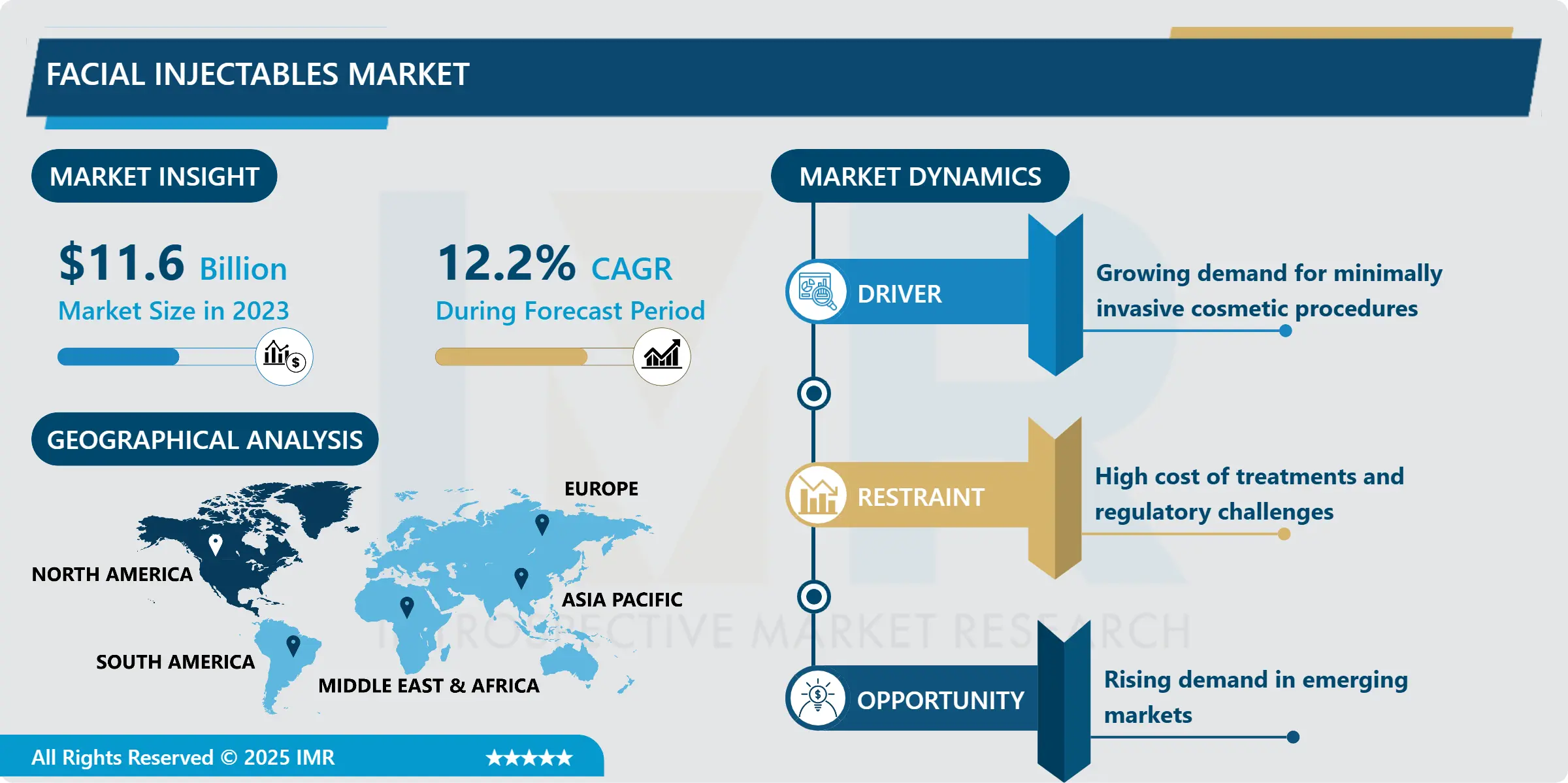
Facial Injectables Market Size Was Valued at USD 11.6 Billion in 2023, and is Projected to Reach USD 32.6 Billion by 2032, Growing at a CAGR of 12.2% From 2024-2032.
The facial injectables market refers to the sector focused on non-surgical treatments using substances like Botox, dermal fillers, and other injectables to reduce wrinkles, restore volume, and enhance facial appearance. These treatments are popular for their ability to provide aesthetic improvements with minimal downtime, serving a growing demand driven by beauty, anti-aging trends, and cosmetic advancements.
The facial injectables segment has been one of the fastest-growing segments over the past decade based on the trends that consumer continues to seek safer and minimally invasive interventions. These treatments have become popular around the world due to increased use of social media and body image worries. Through education, advancement in formulation techniques of the injectables has enhanced their safety, efficiency, and durability to cut across the large population of patients.
The availability of these treatments in hospitals and medical spas has largely popularized beauty fixes, and many people incorporate them in their normal regime. The increase in regulatory approvals and availability of products specially designed for different areas including under-eye hollows, lips and cheeks have added increased the market. Thanks to celebrities and increasing awareness, facial injectables have spread across all ages and cultural backgrounds, and will remain an essential segment in the aesthetic medicine field.
Facial Injectables Market Trend Analysis:
Growing Demand for Minimally Invasive Cosmetic Procedures
-
The Facial Injectables Market is experiencing rapid growth, with increasing demand for minimally invasive cosmetic treatments. This trend is influenced by a rising preference for non-surgical procedures that offer effective and quick results with minimal downtime. As consumers seek less invasive alternatives to traditional surgery, injectables such as botulinum toxin and dermal fillers are becoming popular choices for enhancing facial aesthetics.
- The growing acceptance of these treatments is also reflected in expanding market opportunities, as more healthcare professionals and clinics incorporate injectables into their service offerings. With advancements in injectable technology and techniques, the market continues to evolve, attracting a broader consumer base. As disposable incomes rise and awareness of aesthetic options increases, the market is positioned for sustained growth in the coming years. The increasing focus on self-care and beauty enhancement contributes to the expanding reach of the facial injectables industry across various demographics
Expanding Applications in Emerging Markets
-
The expanding facial injectables market presents a key opportunity for businesses looking to capitalize on emerging markets. The rising demand for non-invasive aesthetic treatments is contributing to the market's growth, particularly in regions such as Asia-Pacific, where a shift toward beauty and wellness is gaining momentum. This growth is fueled by increasing disposable incomes and a growing awareness of cosmetic treatments among consumers. As these markets evolve, the demand for facial injectables is expected to intensify, especially with younger populations becoming more inclined to seek preventive solutions for aging.
- In these expanding markets, the entry of local players and partnerships with established brands can unlock untapped potential. The ease of access and affordability of injectable treatments are improving market penetration. As consumer preferences lean toward minimally invasive procedures with shorter recovery times, businesses in the facial injectables sector have a unique chance to enhance their product offerings and expand their reach within these rapidly growing economies.
Facial Injectables Market Segment Analysis:
Facial Injectables Market Segmented on the basis of Product, Application, End User, and Region
By Product, Collagen & PMMA Microspheres segment is expected to dominate the market during the forecast period
-
Collagen and PMMA microspheres derivative is expected to take the largest market share of facial injectables within the period of forecast due to attribute flexibility and efficiency in addressing the majority of facial areas. These fillers are preferred since they are almost natural, they treat fine lines and wrinkles and fill hollowness in the face. Poly(methyl methacrylate) (PMMA)microspheres which is long lasting but not permanent is fast becoming popular amongst the patient in their mid twenties and above who want the implant to last longer without having to undergo surgery.
- Collagen and PMMA microspheres have also received more attention due to improvement of side effects on formulation technologies. The fact that they have the potential to naturally promote collagen production in the human body makes collagen improvements for the skin more long-lasting. As consumers look for products that are both beautiful and could be used to regenerate this segment is expected to continue dominating the market.
By Application, Facial Line Correction segment expected to held the largest share
-
Facial line correction is expected to garner a lion’s share amongst all the application types in the facial injectables market. This segment is most popular thanks to high incidence of wrinkles and other fine lines among middle-aged and elderly people. facial line correction injectables are mainly used hyaluronic acid based products used for treatment of nasolabial folds, marionette lines, and crow’s feet “instant and natural looking.
- Furthermore, increased requests for line correction procedures across all client ages, particularly the younger population, have reflected on its preventive nature. This has in addition been compounded by the segment’s ability to offer better convectional product effectiveness, longer lasting effects on human skin and shedding of time proportionate to the procedures that needed to be done in a unit of time. Therefore, the facial line correction segment is going to remain robust in the future because of patients’ preference for avoidance of invasive treatments for facial revitalization.
Facial Injectables Market Regional Insights:
North America is Expected to Dominate the Market Over the Forecast period
-
The facial injectables market in North America is poised for strong growth as increasing consumer demand for non-surgical cosmetic procedures continues to rise. With a growing preference for quick, minimally invasive treatments, the market is benefiting from advancements in injectable technologies. High awareness of aesthetic enhancements among consumers, along with a rise in disposable income, has supported a wider acceptance of facial injectables, particularly Botox and dermal fillers.
- The region’s robust healthcare infrastructure, alongside the presence of leading manufacturers and research institutions, plays a key role in market expansion. North America is witnessing a surge in both the availability of advanced injectable solutions and the number of skilled practitioners, making it an attractive market for both local and international players. The demand for facial injectables is further stimulated by the increasing emphasis on personal appearance and the growing popularity of beauty treatments among a broad demographic, ranging from millennials to older adults seeking rejuvenation.
Active Key Players in the Facial Injectables Market
-
AbbVie Inc. (United States)
- Anika Therapeutics, Inc. (United States)
- Croma-Pharma GmbH (Austria)
- Daewoong Pharmaceutical Co., Ltd. (South Korea)
- Evolus, Inc. (United States)
- Galderma S.A. (Switzerland)
- Hugel, Inc. (South Korea)
- Ipsen (France)
- Medytox, Inc. (South Korea)
- Prollenium Medical Technologies (Canada)
- Revance Therapeutics, Inc. (United States)
- Sanofi (France)
- SciVision Biotech Inc. (Taiwan)
- Sinclair Pharma (United Kingdom)
- Suneva Medical, Inc. (United States)
- Other Active Players
|
Global Facial Injectables Market |
|||
|
Base Year: |
2023 |
Forecast Period: |
2024-2032 |
|
Historical Data: |
2017 to 2023 |
Market Size in 2023: |
USD 11.6 Billion |
|
Forecast Period 2024-32 CAGR: |
12.2% |
Market Size in 2032: |
USD 32.6 Billion |
|
Segments Covered: |
By Product |
|
|
|
By Application |
|
||
|
By End User |
|
||
|
By Region |
|
||
|
Key Market Drivers: |
|
||
|
Key Market Restraints: |
|
||
|
Key Opportunities: |
|
||
|
Companies Covered in the report: |
|
||
Chapter 1: Introduction
1.1 Scope and Coverage
Chapter 2:Executive Summary
Chapter 3: Market Landscape
3.1 Market Dynamics
3.1.1 Drivers
3.1.2 Restraints
3.1.3 Opportunities
3.1.4 Challenges
3.2 Market Trend Analysis
3.3 PESTLE Analysis
3.4 Porter's Five Forces Analysis
3.5 Industry Value Chain Analysis
3.6 Ecosystem
3.7 Regulatory Landscape
3.8 Price Trend Analysis
3.9 Patent Analysis
3.10 Technology Evolution
3.11 Investment Pockets
3.12 Import-Export Analysis
Chapter 4: Facial Injectables Market by Product
4.1 Facial Injectables Market Snapshot and Growth Engine
4.2 Facial Injectables Market Overview
4.3 Collagen & PMMA Microspheres
4.3.1 Introduction and Market Overview
4.3.2 Historic and Forecasted Market Size in Value USD and Volume Units (2017-2032F)
4.3.3 Key Market Trends, Growth Factors and Opportunities
4.3.4 Collagen & PMMA Microspheres: Geographic Segmentation Analysis
4.4 Hyaluronic Acid (HA)
4.4.1 Introduction and Market Overview
4.4.2 Historic and Forecasted Market Size in Value USD and Volume Units (2017-2032F)
4.4.3 Key Market Trends, Growth Factors and Opportunities
4.4.4 Hyaluronic Acid (HA): Geographic Segmentation Analysis
4.5 Botulinum Toxin Product A
4.5.1 Introduction and Market Overview
4.5.2 Historic and Forecasted Market Size in Value USD and Volume Units (2017-2032F)
4.5.3 Key Market Trends, Growth Factors and Opportunities
4.5.4 Botulinum Toxin Product A: Geographic Segmentation Analysis
4.6 Calcium Hydroxylapatite (CaHA)
4.6.1 Introduction and Market Overview
4.6.2 Historic and Forecasted Market Size in Value USD and Volume Units (2017-2032F)
4.6.3 Key Market Trends, Growth Factors and Opportunities
4.6.4 Calcium Hydroxylapatite (CaHA): Geographic Segmentation Analysis
4.7 Poly-L-lactic Acid (PLLA)
4.7.1 Introduction and Market Overview
4.7.2 Historic and Forecasted Market Size in Value USD and Volume Units (2017-2032F)
4.7.3 Key Market Trends, Growth Factors and Opportunities
4.7.4 Poly-L-lactic Acid (PLLA): Geographic Segmentation Analysis
4.8 ]Others
4.8.1 Introduction and Market Overview
4.8.2 Historic and Forecasted Market Size in Value USD and Volume Units (2017-2032F)
4.8.3 Key Market Trends, Growth Factors and Opportunities
4.8.4 ]Others: Geographic Segmentation Analysis
Chapter 5: Facial Injectables Market by Application
5.1 Facial Injectables Market Snapshot and Growth Engine
5.2 Facial Injectables Market Overview
5.3 Facial Line Correction
5.3.1 Introduction and Market Overview
5.3.2 Historic and Forecasted Market Size in Value USD and Volume Units (2017-2032F)
5.3.3 Key Market Trends, Growth Factors and Opportunities
5.3.4 Facial Line Correction: Geographic Segmentation Analysis
5.4 Lip Augmentation
5.4.1 Introduction and Market Overview
5.4.2 Historic and Forecasted Market Size in Value USD and Volume Units (2017-2032F)
5.4.3 Key Market Trends, Growth Factors and Opportunities
5.4.4 Lip Augmentation: Geographic Segmentation Analysis
5.5 Face Lift
5.5.1 Introduction and Market Overview
5.5.2 Historic and Forecasted Market Size in Value USD and Volume Units (2017-2032F)
5.5.3 Key Market Trends, Growth Factors and Opportunities
5.5.4 Face Lift: Geographic Segmentation Analysis
5.6 Acne Scar Treatment
5.6.1 Introduction and Market Overview
5.6.2 Historic and Forecasted Market Size in Value USD and Volume Units (2017-2032F)
5.6.3 Key Market Trends, Growth Factors and Opportunities
5.6.4 Acne Scar Treatment: Geographic Segmentation Analysis
5.7 Lipoatrophy Treatment
5.7.1 Introduction and Market Overview
5.7.2 Historic and Forecasted Market Size in Value USD and Volume Units (2017-2032F)
5.7.3 Key Market Trends, Growth Factors and Opportunities
5.7.4 Lipoatrophy Treatment: Geographic Segmentation Analysis
5.8 Others
5.8.1 Introduction and Market Overview
5.8.2 Historic and Forecasted Market Size in Value USD and Volume Units (2017-2032F)
5.8.3 Key Market Trends, Growth Factors and Opportunities
5.8.4 Others: Geographic Segmentation Analysis
Chapter 6: Facial Injectables Market by End User
6.1 Facial Injectables Market Snapshot and Growth Engine
6.2 Facial Injectables Market Overview
6.3 MedSpas
6.3.1 Introduction and Market Overview
6.3.2 Historic and Forecasted Market Size in Value USD and Volume Units (2017-2032F)
6.3.3 Key Market Trends, Growth Factors and Opportunities
6.3.4 MedSpas: Geographic Segmentation Analysis
6.4 Dermatology Clinics
6.4.1 Introduction and Market Overview
6.4.2 Historic and Forecasted Market Size in Value USD and Volume Units (2017-2032F)
6.4.3 Key Market Trends, Growth Factors and Opportunities
6.4.4 Dermatology Clinics: Geographic Segmentation Analysis
6.5 Hospitals
6.5.1 Introduction and Market Overview
6.5.2 Historic and Forecasted Market Size in Value USD and Volume Units (2017-2032F)
6.5.3 Key Market Trends, Growth Factors and Opportunities
6.5.4 Hospitals: Geographic Segmentation Analysis
Chapter 7: Company Profiles and Competitive Analysis
7.1 Competitive Landscape
7.1.1 Competitive Benchmarking
7.1.2 Facial Injectables Market Share by Manufacturer (2023)
7.1.3 Industry BCG Matrix
7.1.4 Heat Map Analysis
7.1.5 Mergers and Acquisitions
7.2 ABBVIE INC. (UNITED STATES)
7.2.1 Company Overview
7.2.2 Key Executives
7.2.3 Company Snapshot
7.2.4 Role of the Company in the Market
7.2.5 Sustainability and Social Responsibility
7.2.6 Operating Business Segments
7.2.7 Product Portfolio
7.2.8 Business Performance
7.2.9 Key Strategic Moves and Recent Developments
7.2.10 SWOT Analysis
7.3 ANIKA THERAPEUTICS INC. (UNITED STATES)
7.4 CROMA-PHARMA GMBH (AUSTRIA)
7.5 DAEWOONG PHARMACEUTICAL CO. LTD. (SOUTH KOREA)
7.6 EVOLUS INC. (UNITED STATES)
7.7 GALDERMA S.A. (SWITZERLAND)
7.8 HUGEL INC. (SOUTH KOREA)
7.9 IPSEN (FRANCE)
7.10 MEDYTOX INC. (SOUTH KOREA)
7.11 PROLLENIUM MEDICAL TECHNOLOGIES (CANADA)
7.12 REVANCE THERAPEUTICS INC. (UNITED STATES)
7.13 SANOFI (FRANCE)
7.14 SCIVISION BIOTECH INC. (TAIWAN)
7.15 SINCLAIR PHARMA (UNITED KINGDOM)
7.16 SUNEVA MEDICAL INC. (UNITED STATES)
7.17 OTHER ACTIVE PLAYERS
Chapter 8: Global Facial Injectables Market By Region
8.1 Overview
8.2. North America Facial Injectables Market
8.2.1 Key Market Trends, Growth Factors and Opportunities
8.2.2 Top Key Companies
8.2.3 Historic and Forecasted Market Size by Segments
8.2.4 Historic and Forecasted Market Size By Product
8.2.4.1 Collagen & PMMA Microspheres
8.2.4.2 Hyaluronic Acid (HA)
8.2.4.3 Botulinum Toxin Product A
8.2.4.4 Calcium Hydroxylapatite (CaHA)
8.2.4.5 Poly-L-lactic Acid (PLLA)
8.2.4.6 ]Others
8.2.5 Historic and Forecasted Market Size By Application
8.2.5.1 Facial Line Correction
8.2.5.2 Lip Augmentation
8.2.5.3 Face Lift
8.2.5.4 Acne Scar Treatment
8.2.5.5 Lipoatrophy Treatment
8.2.5.6 Others
8.2.6 Historic and Forecasted Market Size By End User
8.2.6.1 MedSpas
8.2.6.2 Dermatology Clinics
8.2.6.3 Hospitals
8.2.7 Historic and Forecast Market Size by Country
8.2.7.1 US
8.2.7.2 Canada
8.2.7.3 Mexico
8.3. Eastern Europe Facial Injectables Market
8.3.1 Key Market Trends, Growth Factors and Opportunities
8.3.2 Top Key Companies
8.3.3 Historic and Forecasted Market Size by Segments
8.3.4 Historic and Forecasted Market Size By Product
8.3.4.1 Collagen & PMMA Microspheres
8.3.4.2 Hyaluronic Acid (HA)
8.3.4.3 Botulinum Toxin Product A
8.3.4.4 Calcium Hydroxylapatite (CaHA)
8.3.4.5 Poly-L-lactic Acid (PLLA)
8.3.4.6 ]Others
8.3.5 Historic and Forecasted Market Size By Application
8.3.5.1 Facial Line Correction
8.3.5.2 Lip Augmentation
8.3.5.3 Face Lift
8.3.5.4 Acne Scar Treatment
8.3.5.5 Lipoatrophy Treatment
8.3.5.6 Others
8.3.6 Historic and Forecasted Market Size By End User
8.3.6.1 MedSpas
8.3.6.2 Dermatology Clinics
8.3.6.3 Hospitals
8.3.7 Historic and Forecast Market Size by Country
8.3.7.1 Russia
8.3.7.2 Bulgaria
8.3.7.3 The Czech Republic
8.3.7.4 Hungary
8.3.7.5 Poland
8.3.7.6 Romania
8.3.7.7 Rest of Eastern Europe
8.4. Western Europe Facial Injectables Market
8.4.1 Key Market Trends, Growth Factors and Opportunities
8.4.2 Top Key Companies
8.4.3 Historic and Forecasted Market Size by Segments
8.4.4 Historic and Forecasted Market Size By Product
8.4.4.1 Collagen & PMMA Microspheres
8.4.4.2 Hyaluronic Acid (HA)
8.4.4.3 Botulinum Toxin Product A
8.4.4.4 Calcium Hydroxylapatite (CaHA)
8.4.4.5 Poly-L-lactic Acid (PLLA)
8.4.4.6 ]Others
8.4.5 Historic and Forecasted Market Size By Application
8.4.5.1 Facial Line Correction
8.4.5.2 Lip Augmentation
8.4.5.3 Face Lift
8.4.5.4 Acne Scar Treatment
8.4.5.5 Lipoatrophy Treatment
8.4.5.6 Others
8.4.6 Historic and Forecasted Market Size By End User
8.4.6.1 MedSpas
8.4.6.2 Dermatology Clinics
8.4.6.3 Hospitals
8.4.7 Historic and Forecast Market Size by Country
8.4.7.1 Germany
8.4.7.2 UK
8.4.7.3 France
8.4.7.4 The Netherlands
8.4.7.5 Italy
8.4.7.6 Spain
8.4.7.7 Rest of Western Europe
8.5. Asia Pacific Facial Injectables Market
8.5.1 Key Market Trends, Growth Factors and Opportunities
8.5.2 Top Key Companies
8.5.3 Historic and Forecasted Market Size by Segments
8.5.4 Historic and Forecasted Market Size By Product
8.5.4.1 Collagen & PMMA Microspheres
8.5.4.2 Hyaluronic Acid (HA)
8.5.4.3 Botulinum Toxin Product A
8.5.4.4 Calcium Hydroxylapatite (CaHA)
8.5.4.5 Poly-L-lactic Acid (PLLA)
8.5.4.6 ]Others
8.5.5 Historic and Forecasted Market Size By Application
8.5.5.1 Facial Line Correction
8.5.5.2 Lip Augmentation
8.5.5.3 Face Lift
8.5.5.4 Acne Scar Treatment
8.5.5.5 Lipoatrophy Treatment
8.5.5.6 Others
8.5.6 Historic and Forecasted Market Size By End User
8.5.6.1 MedSpas
8.5.6.2 Dermatology Clinics
8.5.6.3 Hospitals
8.5.7 Historic and Forecast Market Size by Country
8.5.7.1 China
8.5.7.2 India
8.5.7.3 Japan
8.5.7.4 South Korea
8.5.7.5 Malaysia
8.5.7.6 Thailand
8.5.7.7 Vietnam
8.5.7.8 The Philippines
8.5.7.9 Australia
8.5.7.10 New Zealand
8.5.7.11 Rest of APAC
8.6. Middle East & Africa Facial Injectables Market
8.6.1 Key Market Trends, Growth Factors and Opportunities
8.6.2 Top Key Companies
8.6.3 Historic and Forecasted Market Size by Segments
8.6.4 Historic and Forecasted Market Size By Product
8.6.4.1 Collagen & PMMA Microspheres
8.6.4.2 Hyaluronic Acid (HA)
8.6.4.3 Botulinum Toxin Product A
8.6.4.4 Calcium Hydroxylapatite (CaHA)
8.6.4.5 Poly-L-lactic Acid (PLLA)
8.6.4.6 ]Others
8.6.5 Historic and Forecasted Market Size By Application
8.6.5.1 Facial Line Correction
8.6.5.2 Lip Augmentation
8.6.5.3 Face Lift
8.6.5.4 Acne Scar Treatment
8.6.5.5 Lipoatrophy Treatment
8.6.5.6 Others
8.6.6 Historic and Forecasted Market Size By End User
8.6.6.1 MedSpas
8.6.6.2 Dermatology Clinics
8.6.6.3 Hospitals
8.6.7 Historic and Forecast Market Size by Country
8.6.7.1 Turkiye
8.6.7.2 Bahrain
8.6.7.3 Kuwait
8.6.7.4 Saudi Arabia
8.6.7.5 Qatar
8.6.7.6 UAE
8.6.7.7 Israel
8.6.7.8 South Africa
8.7. South America Facial Injectables Market
8.7.1 Key Market Trends, Growth Factors and Opportunities
8.7.2 Top Key Companies
8.7.3 Historic and Forecasted Market Size by Segments
8.7.4 Historic and Forecasted Market Size By Product
8.7.4.1 Collagen & PMMA Microspheres
8.7.4.2 Hyaluronic Acid (HA)
8.7.4.3 Botulinum Toxin Product A
8.7.4.4 Calcium Hydroxylapatite (CaHA)
8.7.4.5 Poly-L-lactic Acid (PLLA)
8.7.4.6 ]Others
8.7.5 Historic and Forecasted Market Size By Application
8.7.5.1 Facial Line Correction
8.7.5.2 Lip Augmentation
8.7.5.3 Face Lift
8.7.5.4 Acne Scar Treatment
8.7.5.5 Lipoatrophy Treatment
8.7.5.6 Others
8.7.6 Historic and Forecasted Market Size By End User
8.7.6.1 MedSpas
8.7.6.2 Dermatology Clinics
8.7.6.3 Hospitals
8.7.7 Historic and Forecast Market Size by Country
8.7.7.1 Brazil
8.7.7.2 Argentina
8.7.7.3 Rest of SA
Chapter 9 Analyst Viewpoint and Conclusion
9.1 Recommendations and Concluding Analysis
9.2 Potential Market Strategies
Chapter 10 Research Methodology
10.1 Research Process
10.2 Primary Research
10.3 Secondary Research
|
Global Facial Injectables Market |
|||
|
Base Year: |
2023 |
Forecast Period: |
2024-2032 |
|
Historical Data: |
2017 to 2023 |
Market Size in 2023: |
USD 11.6 Billion |
|
Forecast Period 2024-32 CAGR: |
12.2% |
Market Size in 2032: |
USD 32.6 Billion |
|
Segments Covered: |
By Product |
|
|
|
By Application |
|
||
|
By End User |
|
||
|
By Region |
|
||
|
Key Market Drivers: |
|
||
|
Key Market Restraints: |
|
||
|
Key Opportunities: |
|
||
|
Companies Covered in the report: |
|
||