




Environmental Technology Market Synopsis:
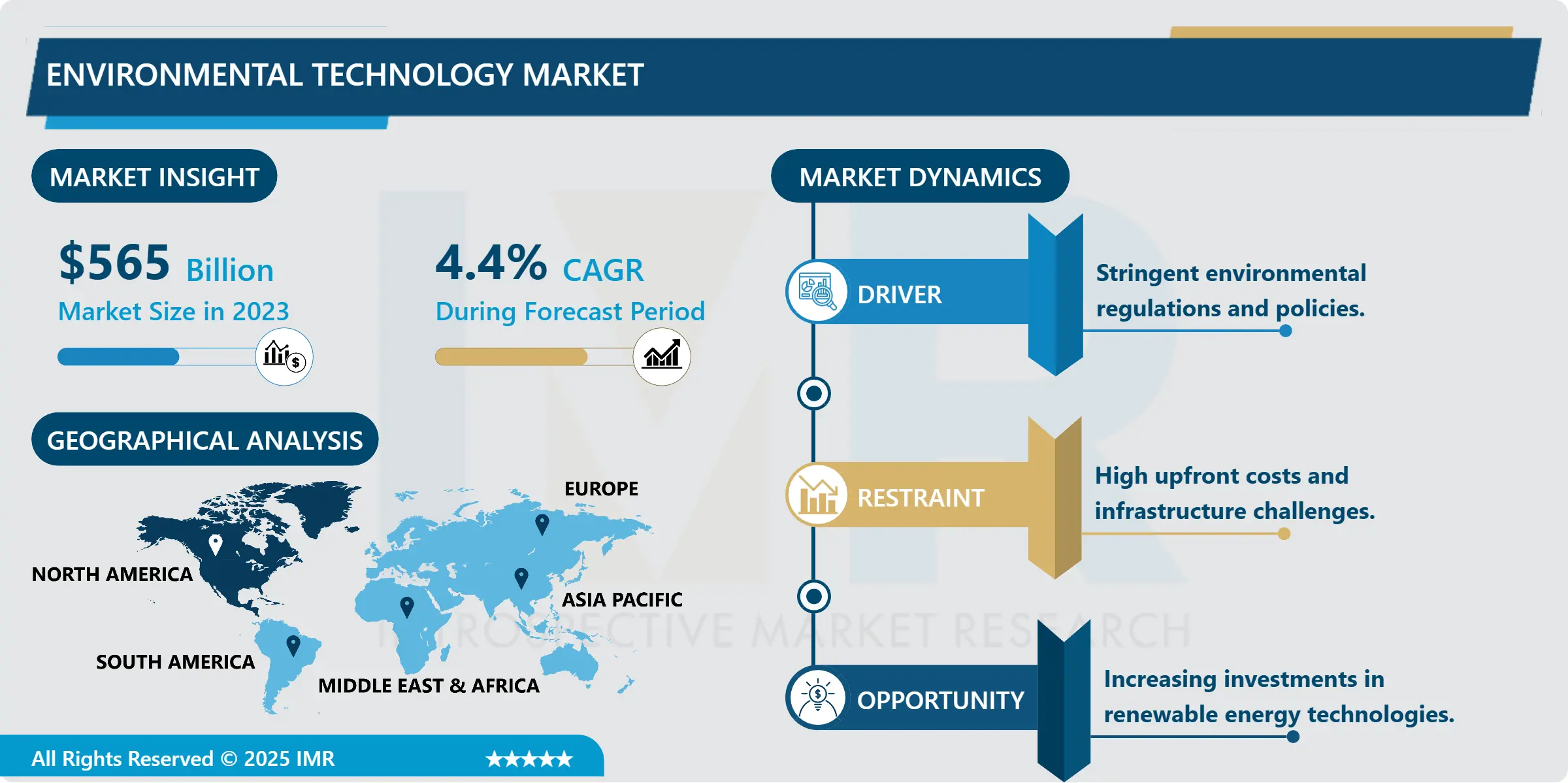
Environmental Technology Market Size Was Valued at USD 565 Billion in 2023, and is Projected to Reach USD 880 Billion by 2032, Growing at a CAGR of 4.40% From 2024-2032.
They include a wide range of technology products and services covering climate change, environmental degradation effective, resource efficiency, emissions reduction, and waste disposal. These technologies strive to enhance post-crisis sustainability, energy, and environmental management, and the usage of renewable resources to sectors such as energy, construction, agriculture, water management, and waste treatment.
The market for environmental technology products has experienced great growth within the past few years due to higher levels of concern with environmental issues and the imposition of strict standards meant to reduce green-house emissions and pollution. There is a continuing social demand for technologies that minimize carbon footprint, help conserve and preserve the environment, resources and minimize pollution. These drivers include polices, emerging technologies, increased incorporating of renewable energy, the development of new electric vehicles, and the need for new and efficient water treatment.
Public awareness as well as the lifting of the lid on what is required when it comes to environmental technology investment has boosted the growth of environmental technologies. The developed countries are spearheading hi-technology in R&D; the developing and the newly industrialized countries are equally … embracing them as they search for solutions to their environmental problems as they strive to conform to international standards. The market covers many sectors such as air and water pollution control, waste treatment, renewable energy power systems, and energy-conserving products. All these segments have a crucial role in development as well, and truly denotes the huge and dynamic market.
Environmental Technology Market Trend Analysis:
The Rise of Circular Economy Solutions
- The environmental technology market, the circular economy trend is one of the most visible. The circular economy is defined by the targeted recycling, reuse and reduction of waste to lengthen the usable lifespan of resources. Environmental technologies are thus key to this change, by supporting the creation of systems where wastes are turned into resources.
- For example, sequence extraction methods are currently utilized in the separation of rare earth metals from e-waste, whilst the organic waste is used in the creation of biogas through the use of the anaerobic digestion system. This trend not only solves a problem of resource scarcity but also stimulates the emergence of new business for circular economy by minimization of using brand new materials and expenses for operation. There is new investment in circular economy objectives across both governments and companies including waste-to-energy innovations, MRFs, and sustainable product development.
Expansion of Renewable Energy Technologies
- The renewable energy technologies are identified as offering considerable growth potential. In their effort to reduce dependence on carbon and ultimately decarbonize their energy mix, countries are now increasingly looking to renewable energy sources such as solar, wind, and hydroelectric power. New systems including floating solar farms, new batteries, and offshore wind turbines, are adding appeal and offering the industry attractive opportunities.
- Microgrid and community solar plants and other decentralized energy sources are improving energy availability especially at the rural level, especially in the developing nations. Promising clean energy carrier known as green hydrogen is another area of investments in which the sector remains bullish. Promising fiscal gains, decline in costs and innovations, renewable energy technologies are expected to become the leaders of the environmental technology market and help drive economic progress towards environmental goals.
Environmental Technology Market Segment Analysis:
Environmental Technology Market is Segmented on the basis of Technology, Application, End User, and Region
By Technology, Air Pollution Control segment is expected to dominate the market during the forecast period
- The market for environmental technology is divided according to technology to several important areas that respond to various environmental concerns. Renewable energy technologies which include solar, wind and hydropower are leading in the transition towards the green energy world. These technologies are critical for lowering carbon emission and the use of fossil-based energy resources. In the same manner, water and wastewater treatment technologies are used in providing clean water and controlling water that are used in the industries and municipalities. There is the use of high efficiency separation, purification, and disinfection equipment to supplement supply and mitigate water shortages.
- Industrial and urban pollution control technologies are essential components in maintaining air quality and containing emission pollutants. Besides, waste management and recycling technologies solve the problem of increasing waste production by offering methods for effective material recovery, use of wastes to produce energy, and decreasing the usage of landfills. Energy efficient solutions such as smart grids, and building automation systems are recommended tools for better efficiency of energy systems, and reduced effects on the environment. Technological advancement in monitoring of the environment augments sensor technologies and data analytical components that allow industries and governments to protect the environment through the application of timely interventions. These technologies constitute the framework of the ETM concerning environmental technology market progress and sustainable development.
By Application, Commercial segment expected to held the largest share
- Environmental technologies can be used in many industries, for example in manufacturing, energy generation, and in mining. In manufacturing technologies are used more in the areas of emissions reduction, energy management and efficient waste material handling. It tackles technologies for clean energy generation by the use of renewable resources such as solar, wind and hydro power as well as for the stabilization and optimization of power distribution. In mining, they act as a tool of moderating the harm done on the environment in the course of extraction such as water treatment technologies, and air pollution control system that can make resource extraction more environmentally friendly.
- These environmental technologies exist in residential and commercial structures as energy saving, water saving and waste management technologies. In residential applications, consumers apply devices like smart home, solar energy mood, and energy-efficient reticule to save on carbon emissions and costs. New approaches to safe and efficient lighting, heating, ventilations and air conditioning (HVAC) systems and efficient waste management solutions are being implemented in the commercial segment. It is acknowledged that both sectors gain from the emerging technologies such as green building technologies and in the adoption of renewable energies for fulfilling the emerging sustainability objectives and satisfying the regulatory aspects while at the same time reducing operating costs.
Environmental Technology Market Regional Insights:
North America is Expected to Dominate the Market Over the Forecast period
- The geographical domicile of the environmental technology market showed much prominence of North America in the This leadership is grounded in robust political support, a scale-up of green infrastructure, and strong networks of innovation firms and research organizations. The United States has specifically led this progress by launching projects like the IRA, tax credits, and subsidies to clean energy and environment technology investments.
- The challenge has gained much support in the region due to its emphasis on the use of renewable energy, energy efficiency and management of sustainable waste. In like manner, more efforts in decarbonization and environmental conservation in Canada also play a role to the dominance of North America. All this goes a long way in enhancing the ecological outlook of the region and asserting its place as the technological wet dream of sustainable development in the contemporary global scenario.
Active Key Players in the Environmental Technology Market:
- ABB Ltd (Switzerland)
- AECOM (United States)
- Alstom (France)
- Babcock & Wilcox Enterprises, Inc. (United States)
- Ballard Power Systems (Canada)
- Clearfleau Ltd. (United Kingdom)
- Cummins Inc. (United States)
- Danaher Corporation (United States)
- GE Renewable Energy (United States)
- Honeywell International Inc. (United States)
- John Wood Group PLC (United Kingdom)
- Johnson Matthey (United Kingdom)
- Schneider Electric (France)
- Siemens AG (Germany)
- Veolia Environment S.A. (France)
- Other Active Players
|
Global Environmental Technology Market |
|||
|
Base Year: |
2023 |
Forecast Period: |
2024-2032 |
|
Historical Data: |
2017 to 2023 |
Market Size in 2023: |
USD 565 Billion |
|
Forecast Period 2024-32 CAGR: |
4.40% |
Market Size in 2032: |
USD 880 Billion |
|
Segments Covered: |
By Technology |
|
|
|
By Application |
|
||
|
By End User |
|
||
|
By Region |
|
||
|
Key Market Drivers: |
|
||
|
Key Market Restraints: |
|
||
|
Key Opportunities: |
|
||
|
Companies Covered in the report: |
|
||
Chapter 1: Introduction
1.1 Scope and Coverage
Chapter 2:Executive Summary
Chapter 3: Market Landscape
3.1 Market Dynamics
3.1.1 Drivers
3.1.2 Restraints
3.1.3 Opportunities
3.1.4 Challenges
3.2 Market Trend Analysis
3.3 PESTLE Analysis
3.4 Porter's Five Forces Analysis
3.5 Industry Value Chain Analysis
3.6 Ecosystem
3.7 Regulatory Landscape
3.8 Price Trend Analysis
3.9 Patent Analysis
3.10 Technology Evolution
3.11 Investment Pockets
3.12 Import-Export Analysis
Chapter 4: Environmental Technology Market by Technology
4.1 Environmental Technology Market Snapshot and Growth Engine
4.2 Environmental Technology Market Overview
4.3 Renewable Energy (Solar
4.3.1 Introduction and Market Overview
4.3.2 Historic and Forecasted Market Size in Value USD and Volume Units (2017-2032F)
4.3.3 Key Market Trends, Growth Factors and Opportunities
4.3.4 Renewable Energy (Solar: Geographic Segmentation Analysis
4.4 Wind
4.4.1 Introduction and Market Overview
4.4.2 Historic and Forecasted Market Size in Value USD and Volume Units (2017-2032F)
4.4.3 Key Market Trends, Growth Factors and Opportunities
4.4.4 Wind: Geographic Segmentation Analysis
4.5 Hydro
4.5.1 Introduction and Market Overview
4.5.2 Historic and Forecasted Market Size in Value USD and Volume Units (2017-2032F)
4.5.3 Key Market Trends, Growth Factors and Opportunities
4.5.4 Hydro: Geographic Segmentation Analysis
4.6 etc.)
4.6.1 Introduction and Market Overview
4.6.2 Historic and Forecasted Market Size in Value USD and Volume Units (2017-2032F)
4.6.3 Key Market Trends, Growth Factors and Opportunities
4.6.4 etc.): Geographic Segmentation Analysis
4.7 Water and Wastewater Treatment
4.7.1 Introduction and Market Overview
4.7.2 Historic and Forecasted Market Size in Value USD and Volume Units (2017-2032F)
4.7.3 Key Market Trends, Growth Factors and Opportunities
4.7.4 Water and Wastewater Treatment: Geographic Segmentation Analysis
4.8 Air Pollution Control
4.8.1 Introduction and Market Overview
4.8.2 Historic and Forecasted Market Size in Value USD and Volume Units (2017-2032F)
4.8.3 Key Market Trends, Growth Factors and Opportunities
4.8.4 Air Pollution Control: Geographic Segmentation Analysis
4.9 Waste Management and Recycling
4.9.1 Introduction and Market Overview
4.9.2 Historic and Forecasted Market Size in Value USD and Volume Units (2017-2032F)
4.9.3 Key Market Trends, Growth Factors and Opportunities
4.9.4 Waste Management and Recycling: Geographic Segmentation Analysis
4.10 Energy Efficiency
4.10.1 Introduction and Market Overview
4.10.2 Historic and Forecasted Market Size in Value USD and Volume Units (2017-2032F)
4.10.3 Key Market Trends, Growth Factors and Opportunities
4.10.4 Energy Efficiency: Geographic Segmentation Analysis
4.11 Environmental Monitoring
4.11.1 Introduction and Market Overview
4.11.2 Historic and Forecasted Market Size in Value USD and Volume Units (2017-2032F)
4.11.3 Key Market Trends, Growth Factors and Opportunities
4.11.4 Environmental Monitoring: Geographic Segmentation Analysis
Chapter 5: Environmental Technology Market by Application
5.1 Environmental Technology Market Snapshot and Growth Engine
5.2 Environmental Technology Market Overview
5.3 Industrial (Manufacturing
5.3.1 Introduction and Market Overview
5.3.2 Historic and Forecasted Market Size in Value USD and Volume Units (2017-2032F)
5.3.3 Key Market Trends, Growth Factors and Opportunities
5.3.4 Industrial (Manufacturing: Geographic Segmentation Analysis
5.4 Energy
5.4.1 Introduction and Market Overview
5.4.2 Historic and Forecasted Market Size in Value USD and Volume Units (2017-2032F)
5.4.3 Key Market Trends, Growth Factors and Opportunities
5.4.4 Energy: Geographic Segmentation Analysis
5.5 Mining
5.5.1 Introduction and Market Overview
5.5.2 Historic and Forecasted Market Size in Value USD and Volume Units (2017-2032F)
5.5.3 Key Market Trends, Growth Factors and Opportunities
5.5.4 Mining: Geographic Segmentation Analysis
5.6 etc.
5.6.1 Introduction and Market Overview
5.6.2 Historic and Forecasted Market Size in Value USD and Volume Units (2017-2032F)
5.6.3 Key Market Trends, Growth Factors and Opportunities
5.6.4 etc.: Geographic Segmentation Analysis
5.7 Residential
5.7.1 Introduction and Market Overview
5.7.2 Historic and Forecasted Market Size in Value USD and Volume Units (2017-2032F)
5.7.3 Key Market Trends, Growth Factors and Opportunities
5.7.4 Residential: Geographic Segmentation Analysis
5.8 Commercial
5.8.1 Introduction and Market Overview
5.8.2 Historic and Forecasted Market Size in Value USD and Volume Units (2017-2032F)
5.8.3 Key Market Trends, Growth Factors and Opportunities
5.8.4 Commercial: Geographic Segmentation Analysis
Chapter 6: Environmental Technology Market by End User
6.1 Environmental Technology Market Snapshot and Growth Engine
6.2 Environmental Technology Market Overview
6.3 Energy and Utilities
6.3.1 Introduction and Market Overview
6.3.2 Historic and Forecasted Market Size in Value USD and Volume Units (2017-2032F)
6.3.3 Key Market Trends, Growth Factors and Opportunities
6.3.4 Energy and Utilities: Geographic Segmentation Analysis
6.4 Construction and Building
6.4.1 Introduction and Market Overview
6.4.2 Historic and Forecasted Market Size in Value USD and Volume Units (2017-2032F)
6.4.3 Key Market Trends, Growth Factors and Opportunities
6.4.4 Construction and Building: Geographic Segmentation Analysis
6.5 Agriculture
6.5.1 Introduction and Market Overview
6.5.2 Historic and Forecasted Market Size in Value USD and Volume Units (2017-2032F)
6.5.3 Key Market Trends, Growth Factors and Opportunities
6.5.4 Agriculture: Geographic Segmentation Analysis
6.6 Transportation
6.6.1 Introduction and Market Overview
6.6.2 Historic and Forecasted Market Size in Value USD and Volume Units (2017-2032F)
6.6.3 Key Market Trends, Growth Factors and Opportunities
6.6.4 Transportation: Geographic Segmentation Analysis
6.7 Healthcare
6.7.1 Introduction and Market Overview
6.7.2 Historic and Forecasted Market Size in Value USD and Volume Units (2017-2032F)
6.7.3 Key Market Trends, Growth Factors and Opportunities
6.7.4 Healthcare: Geographic Segmentation Analysis
6.8 Chemicals
6.8.1 Introduction and Market Overview
6.8.2 Historic and Forecasted Market Size in Value USD and Volume Units (2017-2032F)
6.8.3 Key Market Trends, Growth Factors and Opportunities
6.8.4 Chemicals: Geographic Segmentation Analysis
Chapter 7: Company Profiles and Competitive Analysis
7.1 Competitive Landscape
7.1.1 Competitive Benchmarking
7.1.2 Environmental Technology Market Share by Manufacturer (2023)
7.1.3 Industry BCG Matrix
7.1.4 Heat Map Analysis
7.1.5 Mergers and Acquisitions
7.2 ABB LTD (SWITZERLAND)
7.2.1 Company Overview
7.2.2 Key Executives
7.2.3 Company Snapshot
7.2.4 Role of the Company in the Market
7.2.5 Sustainability and Social Responsibility
7.2.6 Operating Business Segments
7.2.7 Product Portfolio
7.2.8 Business Performance
7.2.9 Key Strategic Moves and Recent Developments
7.2.10 SWOT Analysis
7.3 AECOM (UNITED STATES)
7.4 ALSTOM (FRANCE)
7.5 BABCOCK & WILCOX ENTERPRISES INC. (UNITED STATES)
7.6 BALLARD POWER SYSTEMS (CANADA)
7.7 CLEARFLEAU LTD. (UNITED KINGDOM)
7.8 CUMMINS INC. (UNITED STATES)
7.9 DANAHER CORPORATION (UNITED STATES)
7.10 GE RENEWABLE ENERGY (UNITED STATES)
7.11 HONEYWELL INTERNATIONAL INC. (UNITED STATES)
7.12 JOHN WOOD GROUP PLC (UNITED KINGDOM)
7.13 JOHNSON MATTHEY (UNITED KINGDOM)
7.14 SCHNEIDER ELECTRIC (FRANCE)
7.15 SIEMENS AG (GERMANY)
7.16 VEOLIA ENVIRONMENT S.A. (FRANCE)
7.17 OTHER ACTIVE PLAYERS
Chapter 8: Global Environmental Technology Market By Region
8.1 Overview
8.2. North America Environmental Technology Market
8.2.1 Key Market Trends, Growth Factors and Opportunities
8.2.2 Top Key Companies
8.2.3 Historic and Forecasted Market Size by Segments
8.2.4 Historic and Forecasted Market Size By Technology
8.2.4.1 Renewable Energy (Solar
8.2.4.2 Wind
8.2.4.3 Hydro
8.2.4.4 etc.)
8.2.4.5 Water and Wastewater Treatment
8.2.4.6 Air Pollution Control
8.2.4.7 Waste Management and Recycling
8.2.4.8 Energy Efficiency
8.2.4.9 Environmental Monitoring
8.2.5 Historic and Forecasted Market Size By Application
8.2.5.1 Industrial (Manufacturing
8.2.5.2 Energy
8.2.5.3 Mining
8.2.5.4 etc.
8.2.5.5 Residential
8.2.5.6 Commercial
8.2.6 Historic and Forecasted Market Size By End User
8.2.6.1 Energy and Utilities
8.2.6.2 Construction and Building
8.2.6.3 Agriculture
8.2.6.4 Transportation
8.2.6.5 Healthcare
8.2.6.6 Chemicals
8.2.7 Historic and Forecast Market Size by Country
8.2.7.1 US
8.2.7.2 Canada
8.2.7.3 Mexico
8.3. Eastern Europe Environmental Technology Market
8.3.1 Key Market Trends, Growth Factors and Opportunities
8.3.2 Top Key Companies
8.3.3 Historic and Forecasted Market Size by Segments
8.3.4 Historic and Forecasted Market Size By Technology
8.3.4.1 Renewable Energy (Solar
8.3.4.2 Wind
8.3.4.3 Hydro
8.3.4.4 etc.)
8.3.4.5 Water and Wastewater Treatment
8.3.4.6 Air Pollution Control
8.3.4.7 Waste Management and Recycling
8.3.4.8 Energy Efficiency
8.3.4.9 Environmental Monitoring
8.3.5 Historic and Forecasted Market Size By Application
8.3.5.1 Industrial (Manufacturing
8.3.5.2 Energy
8.3.5.3 Mining
8.3.5.4 etc.
8.3.5.5 Residential
8.3.5.6 Commercial
8.3.6 Historic and Forecasted Market Size By End User
8.3.6.1 Energy and Utilities
8.3.6.2 Construction and Building
8.3.6.3 Agriculture
8.3.6.4 Transportation
8.3.6.5 Healthcare
8.3.6.6 Chemicals
8.3.7 Historic and Forecast Market Size by Country
8.3.7.1 Russia
8.3.7.2 Bulgaria
8.3.7.3 The Czech Republic
8.3.7.4 Hungary
8.3.7.5 Poland
8.3.7.6 Romania
8.3.7.7 Rest of Eastern Europe
8.4. Western Europe Environmental Technology Market
8.4.1 Key Market Trends, Growth Factors and Opportunities
8.4.2 Top Key Companies
8.4.3 Historic and Forecasted Market Size by Segments
8.4.4 Historic and Forecasted Market Size By Technology
8.4.4.1 Renewable Energy (Solar
8.4.4.2 Wind
8.4.4.3 Hydro
8.4.4.4 etc.)
8.4.4.5 Water and Wastewater Treatment
8.4.4.6 Air Pollution Control
8.4.4.7 Waste Management and Recycling
8.4.4.8 Energy Efficiency
8.4.4.9 Environmental Monitoring
8.4.5 Historic and Forecasted Market Size By Application
8.4.5.1 Industrial (Manufacturing
8.4.5.2 Energy
8.4.5.3 Mining
8.4.5.4 etc.
8.4.5.5 Residential
8.4.5.6 Commercial
8.4.6 Historic and Forecasted Market Size By End User
8.4.6.1 Energy and Utilities
8.4.6.2 Construction and Building
8.4.6.3 Agriculture
8.4.6.4 Transportation
8.4.6.5 Healthcare
8.4.6.6 Chemicals
8.4.7 Historic and Forecast Market Size by Country
8.4.7.1 Germany
8.4.7.2 UK
8.4.7.3 France
8.4.7.4 The Netherlands
8.4.7.5 Italy
8.4.7.6 Spain
8.4.7.7 Rest of Western Europe
8.5. Asia Pacific Environmental Technology Market
8.5.1 Key Market Trends, Growth Factors and Opportunities
8.5.2 Top Key Companies
8.5.3 Historic and Forecasted Market Size by Segments
8.5.4 Historic and Forecasted Market Size By Technology
8.5.4.1 Renewable Energy (Solar
8.5.4.2 Wind
8.5.4.3 Hydro
8.5.4.4 etc.)
8.5.4.5 Water and Wastewater Treatment
8.5.4.6 Air Pollution Control
8.5.4.7 Waste Management and Recycling
8.5.4.8 Energy Efficiency
8.5.4.9 Environmental Monitoring
8.5.5 Historic and Forecasted Market Size By Application
8.5.5.1 Industrial (Manufacturing
8.5.5.2 Energy
8.5.5.3 Mining
8.5.5.4 etc.
8.5.5.5 Residential
8.5.5.6 Commercial
8.5.6 Historic and Forecasted Market Size By End User
8.5.6.1 Energy and Utilities
8.5.6.2 Construction and Building
8.5.6.3 Agriculture
8.5.6.4 Transportation
8.5.6.5 Healthcare
8.5.6.6 Chemicals
8.5.7 Historic and Forecast Market Size by Country
8.5.7.1 China
8.5.7.2 India
8.5.7.3 Japan
8.5.7.4 South Korea
8.5.7.5 Malaysia
8.5.7.6 Thailand
8.5.7.7 Vietnam
8.5.7.8 The Philippines
8.5.7.9 Australia
8.5.7.10 New Zealand
8.5.7.11 Rest of APAC
8.6. Middle East & Africa Environmental Technology Market
8.6.1 Key Market Trends, Growth Factors and Opportunities
8.6.2 Top Key Companies
8.6.3 Historic and Forecasted Market Size by Segments
8.6.4 Historic and Forecasted Market Size By Technology
8.6.4.1 Renewable Energy (Solar
8.6.4.2 Wind
8.6.4.3 Hydro
8.6.4.4 etc.)
8.6.4.5 Water and Wastewater Treatment
8.6.4.6 Air Pollution Control
8.6.4.7 Waste Management and Recycling
8.6.4.8 Energy Efficiency
8.6.4.9 Environmental Monitoring
8.6.5 Historic and Forecasted Market Size By Application
8.6.5.1 Industrial (Manufacturing
8.6.5.2 Energy
8.6.5.3 Mining
8.6.5.4 etc.
8.6.5.5 Residential
8.6.5.6 Commercial
8.6.6 Historic and Forecasted Market Size By End User
8.6.6.1 Energy and Utilities
8.6.6.2 Construction and Building
8.6.6.3 Agriculture
8.6.6.4 Transportation
8.6.6.5 Healthcare
8.6.6.6 Chemicals
8.6.7 Historic and Forecast Market Size by Country
8.6.7.1 Turkiye
8.6.7.2 Bahrain
8.6.7.3 Kuwait
8.6.7.4 Saudi Arabia
8.6.7.5 Qatar
8.6.7.6 UAE
8.6.7.7 Israel
8.6.7.8 South Africa
8.7. South America Environmental Technology Market
8.7.1 Key Market Trends, Growth Factors and Opportunities
8.7.2 Top Key Companies
8.7.3 Historic and Forecasted Market Size by Segments
8.7.4 Historic and Forecasted Market Size By Technology
8.7.4.1 Renewable Energy (Solar
8.7.4.2 Wind
8.7.4.3 Hydro
8.7.4.4 etc.)
8.7.4.5 Water and Wastewater Treatment
8.7.4.6 Air Pollution Control
8.7.4.7 Waste Management and Recycling
8.7.4.8 Energy Efficiency
8.7.4.9 Environmental Monitoring
8.7.5 Historic and Forecasted Market Size By Application
8.7.5.1 Industrial (Manufacturing
8.7.5.2 Energy
8.7.5.3 Mining
8.7.5.4 etc.
8.7.5.5 Residential
8.7.5.6 Commercial
8.7.6 Historic and Forecasted Market Size By End User
8.7.6.1 Energy and Utilities
8.7.6.2 Construction and Building
8.7.6.3 Agriculture
8.7.6.4 Transportation
8.7.6.5 Healthcare
8.7.6.6 Chemicals
8.7.7 Historic and Forecast Market Size by Country
8.7.7.1 Brazil
8.7.7.2 Argentina
8.7.7.3 Rest of SA
Chapter 9 Analyst Viewpoint and Conclusion
9.1 Recommendations and Concluding Analysis
9.2 Potential Market Strategies
Chapter 10 Research Methodology
10.1 Research Process
10.2 Primary Research
10.3 Secondary Research
|
Global Environmental Technology Market |
|||
|
Base Year: |
2023 |
Forecast Period: |
2024-2032 |
|
Historical Data: |
2017 to 2023 |
Market Size in 2023: |
USD 565 Billion |
|
Forecast Period 2024-32 CAGR: |
4.40% |
Market Size in 2032: |
USD 880 Billion |
|
Segments Covered: |
By Technology |
|
|
|
By Application |
|
||
|
By End User |
|
||
|
By Region |
|
||
|
Key Market Drivers: |
|
||
|
Key Market Restraints: |
|
||
|
Key Opportunities: |
|
||
|
Companies Covered in the report: |
|
||


