




Electro Hydraulic Servo Valve Market Synopsis:
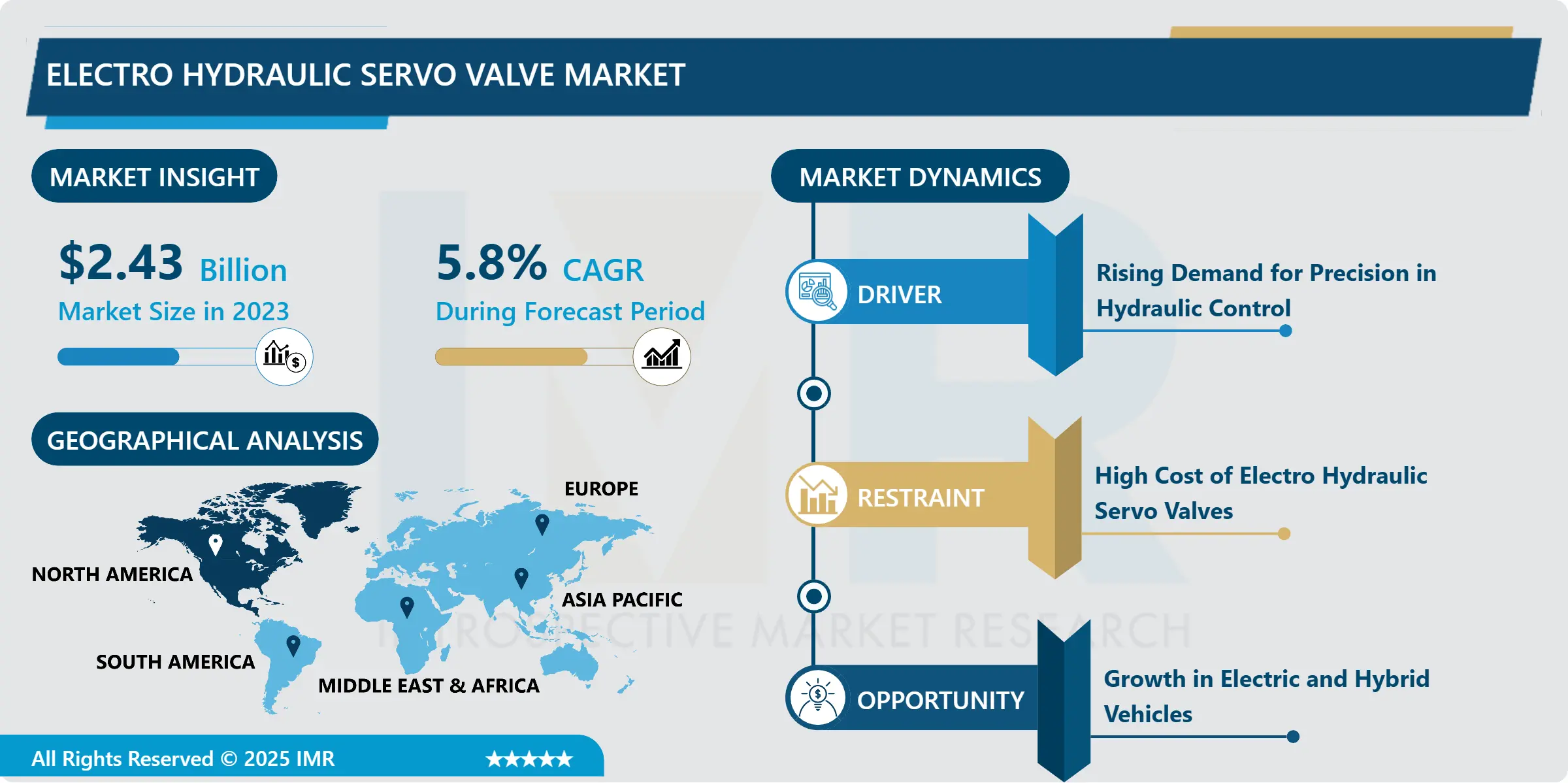
Electro Hydraulic Servo Valve Market Size Was Valued at USD 2.43 Billion in 2023, and is Projected to Reach USD 4.04 Billion by 2032, Growing at a CAGR of 5.8% From 2024-2032.
The Electro Hydraulic Servo Valve Market involves precision control devices that regulate hydraulic fluid flow in response to electrical signals. Widely used in aerospace, defense, industrial, and mobile equipment, these valves enhance system performance through accurate pressure and flow control, supporting automation and high-speed, high-force applications globally.
The Electro Hydraulic Servo Valve (EHSV) market is highly stimulated by the rising market for accurate and responsive motion control equipment in diverse fields. These valves are ideal where tight control, speed of response and accuracy of operation are key attributes of the operation. EHSVs are incorporated in various technologies and used in aerospace, industrial automotive applications, and energy industries to control movement of hydraulic fluids and transform electric signals to appropriate hydraulic responses.
It is also growing as a result of enhancement of various sensor technologies and other manufacturing methods and there is also rising need for automation and robotics. Hydraulic control has thus been introduced because as the process of industries become more technical, closed loop control is required. Further, increase in the sales of electric and hybrid vehicles and the increase in renewable energy sources would also likely to demand EHSV technology. Hydraulics are being developed in this manner to have very precise control and are even being fitted with artificial intelligence and machine learning to control hydraulic function in real-time.
Electro Hydraulic Servo Valve has high intensity of competition with the strategic involves the enhancement of the technological aspects. Manufacturers are constantly improving the performance of the valves, creating new better models, and diversifying fields they are used in such as marine and automotive. The market is further divided by type and application and while some industries have similar requirements for their valves, others have special demands. The significant concern for manufacturing industries lies in achieving an optimal combination of power density, efficiency and costs for designed power electronics while concurrently satisfying the increasing demand for energy efficient technologies.
Electro Hydraulic Servo Valve Market Trend Analysis:
Increased Adoption of Automation and Robotics
- The features of the Electro Hydraulic Servo Valve market that can be seen as trends are automation and robotics. Due to evolution in industries where physical processes are shifting to automation, the market for such control systems like the servo valves has been boosted. The increase of application for high precision movement and high reliable components in industries like industrial automation, aerospace, and automobile manufacturing, servo valves are gradually turning into a necessity. Robotics, for providing precise control in hydraulic systems, is another application area in which servo valves are being gradually employed in processes of robotics.
- Servo valve technology has received a boost because of the ability of automation in improving performance, minimizing the impact of human error and general optimization of operations. As customer industries look further for enhanced specifications in actuation solutions, Electro Hydraulic Servo Valves – being the hydraulic fluid control gears will remain in high demand. This trend is not only dominated by the large-scale manufacturing industry but also the increase in the usage of automation by small and medium enterprises, which is increasing the(sprite) market for the servo valves.
Growth in Electric and Hybrid Vehicles
- The threat posed by electric plus hybrid automobiles to the Electro Hydraulic Servo Valve market is considerable. The control of these vehicles demands intricate control of hydraulic applications including the braking, suspension as well as steering systems in which servo values prove crucial. The change from internal combustion engine or conventional automobiles to electric and hybrid automobiles adds to the call for control systems that are effective, flexible, and, indeed, energy conserving.
- With the automotive industry constantly seeking ways to increase efficiency, effective emissions, as well as better performance of the vehicles, there has been growing interest in higher hydraulic controlling systems. This change already has potential for manufacturers of electro hydraulic servo valves to address the specific needs of electric and hybrid cars. Through compact product designs, one can also invest on developing specific servo valves meant for the market and build a more comprehensive portfolio to address the growing automotive industry.
Electro Hydraulic Servo Valve Market Segment Analysis:
Electro Hydraulic Servo Valve Market is Segmented on the basis of Type, Application, and Region
By Type, Single Stage Servo Valves segment is expected to dominate the market during the forecast period
- Single stage servo valves are used in those application that require less flow and pressure control. Compared to two-stage valves, these valves are compact, and less complex in structure; therefore, cheaper and easy to maintain. These are most widely employed with a single stage being adequately sufficient for the application, where required is the degree of control rather than specificity.
- Two-stage servo valves have a better control action and should be used in application that require high flow and high pressure. These kinds of valves have the two operation stages to enhance the accuracy and flexibility to be useful in serious sectors as aircraft and military. These are intended to offer better performance in areas where very close control of hydraulic spurt rate is desired.
By Application, Aerospace segment expected to held the largest share
- In the aerospace field various applications involve Electro Hydraulic Servo Valves which are used in the flow control of flight, landing gears and other hydraulic systems. Serroadibility that servo valves observe is paramount; particularly in aerospace applications that require high qualiy and safety. These valves make it possible to achieve positive control over hydraulic systems and therefore flight control surfaces as well as other critical systems.
- Electro Hydraulic Servo Valves also finds its use in another important application area which is the industrial automation systems. This is because as many manufacturing and production processes are being computerized, the need for hydraulic systems that provide accurate control is rising. These valves assist in some of the key operations including; Material flow, positioning and assembly in automation in order to offer the best standard quality.
Electro Hydraulic Servo Valve Market Regional Insights:
North America is Expected to Dominate the Market Over the Forecast period
- North America is well ahead of the other regional markets of the Electro Hydraulic Servo Valve. There is a realistic starting point for development till in the given area, the presence of such branches of the economy as aerospace engineering, automotive industry and energy Read have supplemented demand for accuracy in hydraulic systems. Besides, the well-established players and greater focus on the R&D investment enhance this market in the region. The escalation of manufacturing automation and robotics in North America contributes to the growth of the Electro Hydraulic Servo Valve market.
- North American has a sound regulation that supports the utilization of the enhanced hydraulic control system in several sectors. The high demand for improving performance, accuracy, and development of advanced technologies in various industries such as aerospace and automotive industry propels more growth in Electro Hydraulic Servo Valve market and thus benefits North America region most.
Active Key Players in the Electro Hydraulic Servo Valve Market
- Parker Hannifin Corporation (USA)
- Moog Inc. (USA)
- Bosch Rexroth AG (Germany)
- Honeywell International Inc. (USA)
- Emerson Electric Co. (USA)
- Schneider Electric SE (France)
- Bucher Hydraulics (Switzerland)
- Hydac International GmbH (Germany)
- Daikin Industries Ltd. (Japan)
- Rotork Plc (UK)
- Kracht GmbH (Germany)
- Vickers (Eaton Corporation) (USA)
Other Active Players
|
Global Electro Hydraulic Servo Valve Market |
|||
|
Base Year: |
2023 |
Forecast Period: |
2024-2032 |
|
Historical Data: |
2017 to 2023 |
Market Size in 2023: |
USD 2.43 Billion |
|
Forecast Period 2024-32 CAGR: |
5.8% |
Market Size in 2032: |
USD 4.04 Billion |
|
Segments Covered: |
By Type |
|
|
|
By Application |
|
||
|
By Region |
|
||
|
Key Market Drivers: |
|
||
|
Key Market Restraints: |
|
||
|
Key Opportunities: |
|
||
|
Companies Covered in the report: |
|
||
Chapter 1: Introduction
1.1 Scope and Coverage
Chapter 2:Executive Summary
Chapter 3: Market Landscape
3.1 Market Dynamics
3.1.1 Drivers
3.1.2 Restraints
3.1.3 Opportunities
3.1.4 Challenges
3.2 Market Trend Analysis
3.3 PESTLE Analysis
3.4 Porter's Five Forces Analysis
3.5 Industry Value Chain Analysis
3.6 Ecosystem
3.7 Regulatory Landscape
3.8 Price Trend Analysis
3.9 Patent Analysis
3.10 Technology Evolution
3.11 Investment Pockets
3.12 Import-Export Analysis
Chapter 4: Electro Hydraulic Servo Valve Market by Type
4.1 Electro Hydraulic Servo Valve Market Snapshot and Growth Engine
4.2 Electro Hydraulic Servo Valve Market Overview
4.3 Single Stage Servo Valves
4.3.1 Introduction and Market Overview
4.3.2 Historic and Forecasted Market Size in Value USD and Volume Units (2017-2032F)
4.3.3 Key Market Trends, Growth Factors and Opportunities
4.3.4 Single Stage Servo Valves: Geographic Segmentation Analysis
4.4 Two Stage Servo Valves
4.4.1 Introduction and Market Overview
4.4.2 Historic and Forecasted Market Size in Value USD and Volume Units (2017-2032F)
4.4.3 Key Market Trends, Growth Factors and Opportunities
4.4.4 Two Stage Servo Valves: Geographic Segmentation Analysis
4.5 Direct Operated Servo Valves
4.5.1 Introduction and Market Overview
4.5.2 Historic and Forecasted Market Size in Value USD and Volume Units (2017-2032F)
4.5.3 Key Market Trends, Growth Factors and Opportunities
4.5.4 Direct Operated Servo Valves: Geographic Segmentation Analysis
Chapter 5: Electro Hydraulic Servo Valve Market by Application
5.1 Electro Hydraulic Servo Valve Market Snapshot and Growth Engine
5.2 Electro Hydraulic Servo Valve Market Overview
5.3 Aerospace
5.3.1 Introduction and Market Overview
5.3.2 Historic and Forecasted Market Size in Value USD and Volume Units (2017-2032F)
5.3.3 Key Market Trends, Growth Factors and Opportunities
5.3.4 Aerospace: Geographic Segmentation Analysis
5.4 Industrial Automation
5.4.1 Introduction and Market Overview
5.4.2 Historic and Forecasted Market Size in Value USD and Volume Units (2017-2032F)
5.4.3 Key Market Trends, Growth Factors and Opportunities
5.4.4 Industrial Automation: Geographic Segmentation Analysis
5.5 Marine
5.5.1 Introduction and Market Overview
5.5.2 Historic and Forecasted Market Size in Value USD and Volume Units (2017-2032F)
5.5.3 Key Market Trends, Growth Factors and Opportunities
5.5.4 Marine: Geographic Segmentation Analysis
5.6 Automotive
5.6.1 Introduction and Market Overview
5.6.2 Historic and Forecasted Market Size in Value USD and Volume Units (2017-2032F)
5.6.3 Key Market Trends, Growth Factors and Opportunities
5.6.4 Automotive: Geographic Segmentation Analysis
5.7 Energy & Power
5.7.1 Introduction and Market Overview
5.7.2 Historic and Forecasted Market Size in Value USD and Volume Units (2017-2032F)
5.7.3 Key Market Trends, Growth Factors and Opportunities
5.7.4 Energy & Power: Geographic Segmentation Analysis
5.8 Others
5.8.1 Introduction and Market Overview
5.8.2 Historic and Forecasted Market Size in Value USD and Volume Units (2017-2032F)
5.8.3 Key Market Trends, Growth Factors and Opportunities
5.8.4 Others: Geographic Segmentation Analysis
Chapter 6: Company Profiles and Competitive Analysis
6.1 Competitive Landscape
6.1.1 Competitive Benchmarking
6.1.2 Electro Hydraulic Servo Valve Market Share by Manufacturer (2023)
6.1.3 Industry BCG Matrix
6.1.4 Heat Map Analysis
6.1.5 Mergers and Acquisitions
6.2 PARKER HANNIFIN CORPORATION (USA)
6.2.1 Company Overview
6.2.2 Key Executives
6.2.3 Company Snapshot
6.2.4 Role of the Company in the Market
6.2.5 Sustainability and Social Responsibility
6.2.6 Operating Business Segments
6.2.7 Product Portfolio
6.2.8 Business Performance
6.2.9 Key Strategic Moves and Recent Developments
6.2.10 SWOT Analysis
6.3 MOOG INC. (USA)
6.4 BOSCH REXROTH AG (GERMANY)
6.5 HONEYWELL INTERNATIONAL INC. (USA)
6.6 EMERSON ELECTRIC CO. (USA)
6.7 SCHNEIDER ELECTRIC SE (FRANCE)
6.8 BUCHER HYDRAULICS (SWITZERLAND)
6.9 HYDAC INTERNATIONAL GMBH (GERMANY)
6.10 DAIKIN INDUSTRIES LTD. (JAPAN)
6.11 ROTORK PLC (UK)
6.12 KRACHT GMBH (GERMANY)
6.13 VICKERS (EATON CORPORATION) (USA)
6.14 OTHER ACTIVE PLAYERS
Chapter 7: Global Electro Hydraulic Servo Valve Market By Region
7.1 Overview
7.2. North America Electro Hydraulic Servo Valve Market
7.2.1 Key Market Trends, Growth Factors and Opportunities
7.2.2 Top Key Companies
7.2.3 Historic and Forecasted Market Size by Segments
7.2.4 Historic and Forecasted Market Size By Type
7.2.4.1 Single Stage Servo Valves
7.2.4.2 Two Stage Servo Valves
7.2.4.3 Direct Operated Servo Valves
7.2.5 Historic and Forecasted Market Size By Application
7.2.5.1 Aerospace
7.2.5.2 Industrial Automation
7.2.5.3 Marine
7.2.5.4 Automotive
7.2.5.5 Energy & Power
7.2.5.6 Others
7.2.6 Historic and Forecast Market Size by Country
7.2.6.1 US
7.2.6.2 Canada
7.2.6.3 Mexico
7.3. Eastern Europe Electro Hydraulic Servo Valve Market
7.3.1 Key Market Trends, Growth Factors and Opportunities
7.3.2 Top Key Companies
7.3.3 Historic and Forecasted Market Size by Segments
7.3.4 Historic and Forecasted Market Size By Type
7.3.4.1 Single Stage Servo Valves
7.3.4.2 Two Stage Servo Valves
7.3.4.3 Direct Operated Servo Valves
7.3.5 Historic and Forecasted Market Size By Application
7.3.5.1 Aerospace
7.3.5.2 Industrial Automation
7.3.5.3 Marine
7.3.5.4 Automotive
7.3.5.5 Energy & Power
7.3.5.6 Others
7.3.6 Historic and Forecast Market Size by Country
7.3.6.1 Russia
7.3.6.2 Bulgaria
7.3.6.3 The Czech Republic
7.3.6.4 Hungary
7.3.6.5 Poland
7.3.6.6 Romania
7.3.6.7 Rest of Eastern Europe
7.4. Western Europe Electro Hydraulic Servo Valve Market
7.4.1 Key Market Trends, Growth Factors and Opportunities
7.4.2 Top Key Companies
7.4.3 Historic and Forecasted Market Size by Segments
7.4.4 Historic and Forecasted Market Size By Type
7.4.4.1 Single Stage Servo Valves
7.4.4.2 Two Stage Servo Valves
7.4.4.3 Direct Operated Servo Valves
7.4.5 Historic and Forecasted Market Size By Application
7.4.5.1 Aerospace
7.4.5.2 Industrial Automation
7.4.5.3 Marine
7.4.5.4 Automotive
7.4.5.5 Energy & Power
7.4.5.6 Others
7.4.6 Historic and Forecast Market Size by Country
7.4.6.1 Germany
7.4.6.2 UK
7.4.6.3 France
7.4.6.4 The Netherlands
7.4.6.5 Italy
7.4.6.6 Spain
7.4.6.7 Rest of Western Europe
7.5. Asia Pacific Electro Hydraulic Servo Valve Market
7.5.1 Key Market Trends, Growth Factors and Opportunities
7.5.2 Top Key Companies
7.5.3 Historic and Forecasted Market Size by Segments
7.5.4 Historic and Forecasted Market Size By Type
7.5.4.1 Single Stage Servo Valves
7.5.4.2 Two Stage Servo Valves
7.5.4.3 Direct Operated Servo Valves
7.5.5 Historic and Forecasted Market Size By Application
7.5.5.1 Aerospace
7.5.5.2 Industrial Automation
7.5.5.3 Marine
7.5.5.4 Automotive
7.5.5.5 Energy & Power
7.5.5.6 Others
7.5.6 Historic and Forecast Market Size by Country
7.5.6.1 China
7.5.6.2 India
7.5.6.3 Japan
7.5.6.4 South Korea
7.5.6.5 Malaysia
7.5.6.6 Thailand
7.5.6.7 Vietnam
7.5.6.8 The Philippines
7.5.6.9 Australia
7.5.6.10 New Zealand
7.5.6.11 Rest of APAC
7.6. Middle East & Africa Electro Hydraulic Servo Valve Market
7.6.1 Key Market Trends, Growth Factors and Opportunities
7.6.2 Top Key Companies
7.6.3 Historic and Forecasted Market Size by Segments
7.6.4 Historic and Forecasted Market Size By Type
7.6.4.1 Single Stage Servo Valves
7.6.4.2 Two Stage Servo Valves
7.6.4.3 Direct Operated Servo Valves
7.6.5 Historic and Forecasted Market Size By Application
7.6.5.1 Aerospace
7.6.5.2 Industrial Automation
7.6.5.3 Marine
7.6.5.4 Automotive
7.6.5.5 Energy & Power
7.6.5.6 Others
7.6.6 Historic and Forecast Market Size by Country
7.6.6.1 Turkiye
7.6.6.2 Bahrain
7.6.6.3 Kuwait
7.6.6.4 Saudi Arabia
7.6.6.5 Qatar
7.6.6.6 UAE
7.6.6.7 Israel
7.6.6.8 South Africa
7.7. South America Electro Hydraulic Servo Valve Market
7.7.1 Key Market Trends, Growth Factors and Opportunities
7.7.2 Top Key Companies
7.7.3 Historic and Forecasted Market Size by Segments
7.7.4 Historic and Forecasted Market Size By Type
7.7.4.1 Single Stage Servo Valves
7.7.4.2 Two Stage Servo Valves
7.7.4.3 Direct Operated Servo Valves
7.7.5 Historic and Forecasted Market Size By Application
7.7.5.1 Aerospace
7.7.5.2 Industrial Automation
7.7.5.3 Marine
7.7.5.4 Automotive
7.7.5.5 Energy & Power
7.7.5.6 Others
7.7.6 Historic and Forecast Market Size by Country
7.7.6.1 Brazil
7.7.6.2 Argentina
7.7.6.3 Rest of SA
Chapter 8 Analyst Viewpoint and Conclusion
8.1 Recommendations and Concluding Analysis
8.2 Potential Market Strategies
Chapter 9 Research Methodology
9.1 Research Process
9.2 Primary Research
9.3 Secondary Research
|
Global Electro Hydraulic Servo Valve Market |
|||
|
Base Year: |
2023 |
Forecast Period: |
2024-2032 |
|
Historical Data: |
2017 to 2023 |
Market Size in 2023: |
USD 2.43 Billion |
|
Forecast Period 2024-32 CAGR: |
5.8% |
Market Size in 2032: |
USD 4.04 Billion |
|
Segments Covered: |
By Type |
|
|
|
By Application |
|
||
|
By Region |
|
||
|
Key Market Drivers: |
|
||
|
Key Market Restraints: |
|
||
|
Key Opportunities: |
|
||
|
Companies Covered in the report: |
|
||


