




Educational Tourism Market Synopsis:
Educational Tourism Market Size Was Valued at USD 375.6 Billion in 2023, and is Projected to Reach USD 1,150.1 Billion by 2032, Growing at a CAGR of 13.24% From 2024-2032.
Educational Tourism, hence the Educational Tourism Market, falls under travel that is consummately tied to learning, or inculcation of skills, or acquiring educational experiences. It includes group and individual tours for learners, business people or interested people to have professional exposure which may involve attending learning sessions as workshops, training, cultural/training interchange programs, language classes or professional/academic conferences. This market is especially built around the concept of promoting or experimenting and learning with an intent of career or self-development.
Educational tourism is a constantly developing segment of the international tourism determined by the tendency of utilizing travelling as a way to get knowledge and acquire some experience. As mentioned earlier, different typologies involve this sector whereby there are students who study different languages in other countries, professional persons who pursue certain training and others going for culture learning intensives. Some segments within the market of interest are the domestic and international travel by academics, study tours, and exchange actively. Bureaus and ministries of education and other universities and private organizations are identifying educational tourism as an important means of international understanding, income generation and learning.
Increased use of digital technology and globalization factors have boosted this market than it was before. Schools work with travel companies to develop programs required to fulfill the learning goals of the participants. Also, the need for continuous learning and constant improvement underpinning by different corporate organizations and individuals likewise fuels the market growth. The market also interlinks virtual and hybrid educational travel experiences especially in the post COVID-19 period in expanding its market frontiers as it offers wider market frontiers with few traveling restrictions.
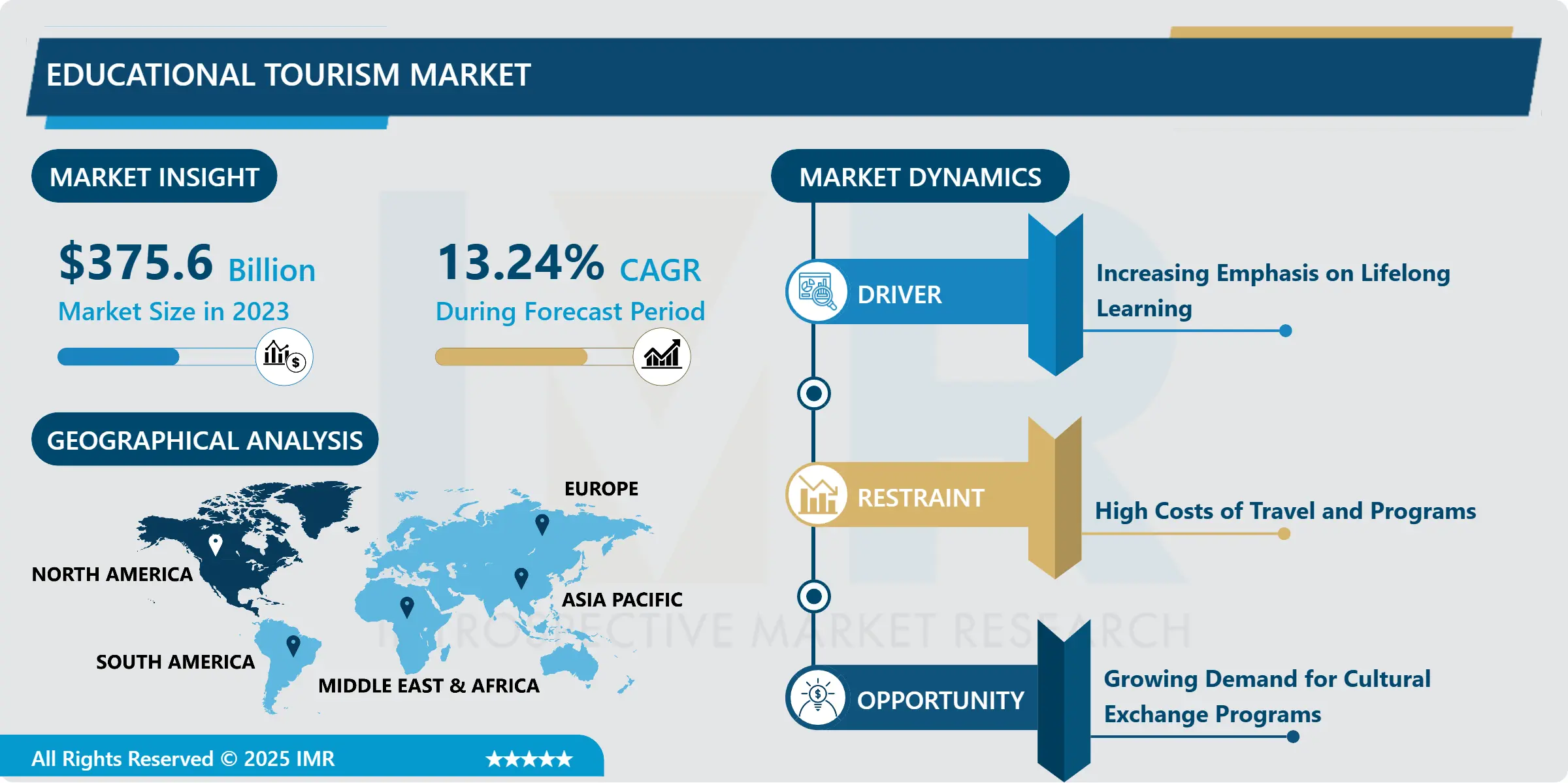
Educational Tourism Market Trend Analysis
Integration of Technology in Educational Tourism
- The application of information technologies is changing the educational tourism model significantly. Technologies such as the World Wide Web and virtual reality or abbreviated VR are applied to develop experiential learning alternatives, which might act as the physical bases for conventional training in person. For example, cultural site visits and live learning can be a convenient way to guide learners through or let them attend historical sites or global events through technology and without physical cost.
- Trend has wide implications for overcoming constraints in access for users coming from remote or low socio-economic status areas. There is an observed trend where education institutions are using technology to plan and develop tailored learning solutions using hybrid delivery of these programs. The outcome is a less exclusive and evenly sized market that accommodates the small to large player and low to high mobility or financially challenged competitors.
Growing Demand for Cultural Exchange Programs
- Increased demand for cultural exchange programs becomes an important opportunity in educational tourism. Cultural exchange programs would expose participants to different ways of life, thus building awareness of other cultures and human relations at their personal level. Governments, on most occasions, support them since they help in the expansion of diplomatic and cultural bonds between nations.
- Further increased by rising scholarship and funding opportunities towards the participants of cultural exchanges, especially students and young professionals. The education systems are shifting their focus on global citizenship and intercultural competencies, increasing the demand even more. With increasing individuals realizing the importance of exposure to cultures for professional as well as personal development, service providers of educational tourism may develop more services to gain that profitable segment.
Educational Tourism Market Segment Analysis:
Educational Tourism Market is Segmented on the basis of Type, Age Group, Mode of Booking, Purpose, End User, and Region.
By Type, Domestic Educational Tourism segment is expected to dominate the market during the forecast period
- Domestic Educational Tourism refers to traveling within one’s own country to engage in educational or cultural experiences, which often includes visits to museums, historical landmarks, nature reserves, or traditional festivals. This type of tourism is typically more affordable and easily accessible compared to international travel, making it a great choice for local students or individuals seeking to expand their knowledge while staying close to home.
- By fostering an understanding of regional customs, traditions, and history, it helps preserve a nation’s heritage and instills pride in the local culture. Moreover, it plays a crucial role in stimulating local economies, as it boosts tourism-related businesses such as accommodations, transportation, and retail. As a result, domestic educational tourism benefits both the community and the nation, encouraging cultural exchange and strengthening economic ties.
By End User, Individual Learners segment expected to held the largest share
- Individual learners encompass a wide variety of people, including students, professionals, hobbyists, and anyone seeking personal or professional development. This diverse group drives a significant demand for educational programs, from short-term workshops to long-term language courses. Professionals often seek specialized workshops to gain industry-specific skills, while students may pursue supplementary learning or certifications to enhance their academic credentials.
- Hobbyists, on the other hand, may engage in courses for personal fulfillment, whether learning a new language, acquiring a craft, or developing a technical skill. Moreover, exchange programs and international learning experiences are highly sought after, offering immersive learning opportunities and cultural exposure. This broad range of interests and goals ensures that the market for individualized learning options continues to expand, providing growth opportunities for educational providers.
Educational Tourism Market Regional Insights:
North America is Expected to Dominate the Market Over the Forecast period
- North America is the leading educational tourism destination because of its advanced infrastructure, high-prestige institutions, and diverse learning opportunities. The U.S. and Canada are the most attractive countries to millions of international students for academic courses, cultural exchange programs, and professional training.
- Government initiatives and massive funding for educational tourism further strengthen the leadership of the region. Institutions use the latest technology and global partnerships to provide quality learning experiences, making North America a favorite destination for educational tourism participants from all over the world.
Active Key Players in the Educational Tourism Market:
- EF Education First (Switzerland)
- Kaplan International (United Kingdom)
- Education Travel & Culture (United States)
- WorldStrides (United States)
- AIFS Educational Travel (United States)
- Cultural Vistas (United States)
- CIEE (United States)
- GoAbroad.com (United States)
- Youth for Understanding (YFU) (United States)
- G Adventures (Canada)
- IES Abroad (United States)
- Rustic Pathways (United States), and Other Active Players
Key Industry Developments in the Educational Tourism Market:
- In February 2024, STIC Travel and Mastereign Group partnered to offer educational tours in Singapore for Indian students. The program, called "Red Dot Green City," focuses on Singapore's sustainability efforts, technological advancements, and cultural heritage.
- In October 2023, the World Tourism Organization (UNWTO) launched an education toolkit to help incorporate tourism as a subject in high schools around the world.
|
Educational Tourism Market |
|||
|
Base Year: |
2023 |
Forecast Period: |
2024-2032 |
|
Historical Data: |
2017 to 2023 |
Market Size in 2023: |
USD 375.6 Billion |
|
Forecast Period 2024-32 CAGR: |
13.24% |
Market Size in 2032: |
USD 1,150.1 Billion |
|
Segments Covered: |
By Type |
|
|
|
By Age Group |
|
||
|
By Mode of Booking |
|
||
|
By Purpose |
|
||
|
By End User |
|
||
|
By Region |
|
||
|
Key Market Drivers: |
|
||
|
Key Market Restraints: |
|
||
|
Key Opportunities: |
|
||
|
Companies Covered in the report: |
|
||
Chapter 1: Introduction
1.1 Scope and Coverage
Chapter 2:Executive Summary
Chapter 3: Market Landscape
3.1 Market Dynamics
3.1.1 Drivers
3.1.2 Restraints
3.1.3 Opportunities
3.1.4 Challenges
3.2 Market Trend Analysis
3.3 PESTLE Analysis
3.4 Porter's Five Forces Analysis
3.5 Industry Value Chain Analysis
3.6 Ecosystem
3.7 Regulatory Landscape
3.8 Price Trend Analysis
3.9 Patent Analysis
3.10 Technology Evolution
3.11 Investment Pockets
3.12 Import-Export Analysis
Chapter 4: Educational Tourism Market by Type
4.1 Educational Tourism Market Snapshot and Growth Engine
4.2 Educational Tourism Market Overview
4.3 Domestic Educational Tourism
4.3.1 Introduction and Market Overview
4.3.2 Historic and Forecasted Market Size in Value USD and Volume Units (2017-2032F)
4.3.3 Key Market Trends, Growth Factors and Opportunities
4.3.4 Domestic Educational Tourism: Geographic Segmentation Analysis
4.4 International Educational Tourism
4.4.1 Introduction and Market Overview
4.4.2 Historic and Forecasted Market Size in Value USD and Volume Units (2017-2032F)
4.4.3 Key Market Trends, Growth Factors and Opportunities
4.4.4 International Educational Tourism: Geographic Segmentation Analysis
Chapter 5: Educational Tourism Market by Age Group
5.1 Educational Tourism Market Snapshot and Growth Engine
5.2 Educational Tourism Market Overview
5.3 Primary School Students
5.3.1 Introduction and Market Overview
5.3.2 Historic and Forecasted Market Size in Value USD and Volume Units (2017-2032F)
5.3.3 Key Market Trends, Growth Factors and Opportunities
5.3.4 Primary School Students: Geographic Segmentation Analysis
5.4 Secondary School Students
5.4.1 Introduction and Market Overview
5.4.2 Historic and Forecasted Market Size in Value USD and Volume Units (2017-2032F)
5.4.3 Key Market Trends, Growth Factors and Opportunities
5.4.4 Secondary School Students: Geographic Segmentation Analysis
5.5 College/University Students
5.5.1 Introduction and Market Overview
5.5.2 Historic and Forecasted Market Size in Value USD and Volume Units (2017-2032F)
5.5.3 Key Market Trends, Growth Factors and Opportunities
5.5.4 College/University Students: Geographic Segmentation Analysis
5.6 Adults/Lifelong Learners
5.6.1 Introduction and Market Overview
5.6.2 Historic and Forecasted Market Size in Value USD and Volume Units (2017-2032F)
5.6.3 Key Market Trends, Growth Factors and Opportunities
5.6.4 Adults/Lifelong Learners: Geographic Segmentation Analysis
Chapter 6: Educational Tourism Market by Mode of Booking
6.1 Educational Tourism Market Snapshot and Growth Engine
6.2 Educational Tourism Market Overview
6.3 Online
6.3.1 Introduction and Market Overview
6.3.2 Historic and Forecasted Market Size in Value USD and Volume Units (2017-2032F)
6.3.3 Key Market Trends, Growth Factors and Opportunities
6.3.4 Online: Geographic Segmentation Analysis
6.4 Offline
6.4.1 Introduction and Market Overview
6.4.2 Historic and Forecasted Market Size in Value USD and Volume Units (2017-2032F)
6.4.3 Key Market Trends, Growth Factors and Opportunities
6.4.4 Offline: Geographic Segmentation Analysis
Chapter 7: Educational Tourism Market by Purpose
7.1 Educational Tourism Market Snapshot and Growth Engine
7.2 Educational Tourism Market Overview
7.3 Academic Study Tours
7.3.1 Introduction and Market Overview
7.3.2 Historic and Forecasted Market Size in Value USD and Volume Units (2017-2032F)
7.3.3 Key Market Trends, Growth Factors and Opportunities
7.3.4 Academic Study Tours: Geographic Segmentation Analysis
7.4 Skills Development Programs
7.4.1 Introduction and Market Overview
7.4.2 Historic and Forecasted Market Size in Value USD and Volume Units (2017-2032F)
7.4.3 Key Market Trends, Growth Factors and Opportunities
7.4.4 Skills Development Programs: Geographic Segmentation Analysis
7.5 Cultural Exchange Programs
7.5.1 Introduction and Market Overview
7.5.2 Historic and Forecasted Market Size in Value USD and Volume Units (2017-2032F)
7.5.3 Key Market Trends, Growth Factors and Opportunities
7.5.4 Cultural Exchange Programs: Geographic Segmentation Analysis
7.6 Language Learning Programs
7.6.1 Introduction and Market Overview
7.6.2 Historic and Forecasted Market Size in Value USD and Volume Units (2017-2032F)
7.6.3 Key Market Trends, Growth Factors and Opportunities
7.6.4 Language Learning Programs: Geographic Segmentation Analysis
7.7 Eco-Tourism and Conservation Education
7.7.1 Introduction and Market Overview
7.7.2 Historic and Forecasted Market Size in Value USD and Volume Units (2017-2032F)
7.7.3 Key Market Trends, Growth Factors and Opportunities
7.7.4 Eco-Tourism and Conservation Education: Geographic Segmentation Analysis
Chapter 8: Educational Tourism Market by End User
8.1 Educational Tourism Market Snapshot and Growth Engine
8.2 Educational Tourism Market Overview
8.3 Individual Learners
8.3.1 Introduction and Market Overview
8.3.2 Historic and Forecasted Market Size in Value USD and Volume Units (2017-2032F)
8.3.3 Key Market Trends, Growth Factors and Opportunities
8.3.4 Individual Learners: Geographic Segmentation Analysis
8.4 Educational Institutions
8.4.1 Introduction and Market Overview
8.4.2 Historic and Forecasted Market Size in Value USD and Volume Units (2017-2032F)
8.4.3 Key Market Trends, Growth Factors and Opportunities
8.4.4 Educational Institutions: Geographic Segmentation Analysis
8.5 Corporate Organizations
8.5.1 Introduction and Market Overview
8.5.2 Historic and Forecasted Market Size in Value USD and Volume Units (2017-2032F)
8.5.3 Key Market Trends, Growth Factors and Opportunities
8.5.4 Corporate Organizations: Geographic Segmentation Analysis
Chapter 9: Company Profiles and Competitive Analysis
9.1 Competitive Landscape
9.1.1 Competitive Benchmarking
9.1.2 Educational Tourism Market Share by Manufacturer (2023)
9.1.3 Industry BCG Matrix
9.1.4 Heat Map Analysis
9.1.5 Mergers and Acquisitions
9.2 EF EDUCATION FIRST (SWITZERLAND)
9.2.1 Company Overview
9.2.2 Key Executives
9.2.3 Company Snapshot
9.2.4 Role of the Company in the Market
9.2.5 Sustainability and Social Responsibility
9.2.6 Operating Business Segments
9.2.7 Product Portfolio
9.2.8 Business Performance
9.2.9 Key Strategic Moves and Recent Developments
9.2.10 SWOT Analysis
9.3 KAPLAN INTERNATIONAL (UNITED KINGDOM)
9.4 EDUCATION TRAVEL & CULTURE (UNITED STATES)
9.5 WORLDSTRIDES (UNITED STATES)
9.6 AIFS EDUCATIONAL TRAVEL (UNITED STATES)
9.7 CULTURAL VISTAS (UNITED STATES)
9.8 CIEE (UNITED STATES)
9.9 GOABROAD.COM (UNITED STATES)
9.10 YOUTH FOR UNDERSTANDING (YFU) (UNITED STATES)
9.11 G ADVENTURES (CANADA)
9.12 IES ABROAD (UNITED STATES)
9.13 RUSTIC PATHWAYS (UNITED STATES)
9.14 OTHER ACTIVE PLAYERS
Chapter 10: Global Educational Tourism Market By Region
10.1 Overview
10.2. North America Educational Tourism Market
10.2.1 Key Market Trends, Growth Factors and Opportunities
10.2.2 Top Key Companies
10.2.3 Historic and Forecasted Market Size by Segments
10.2.4 Historic and Forecasted Market Size By Type
10.2.4.1 Domestic Educational Tourism
10.2.4.2 International Educational Tourism
10.2.5 Historic and Forecasted Market Size By Age Group
10.2.5.1 Primary School Students
10.2.5.2 Secondary School Students
10.2.5.3 College/University Students
10.2.5.4 Adults/Lifelong Learners
10.2.6 Historic and Forecasted Market Size By Mode of Booking
10.2.6.1 Online
10.2.6.2 Offline
10.2.7 Historic and Forecasted Market Size By Purpose
10.2.7.1 Academic Study Tours
10.2.7.2 Skills Development Programs
10.2.7.3 Cultural Exchange Programs
10.2.7.4 Language Learning Programs
10.2.7.5 Eco-Tourism and Conservation Education
10.2.8 Historic and Forecasted Market Size By End User
10.2.8.1 Individual Learners
10.2.8.2 Educational Institutions
10.2.8.3 Corporate Organizations
10.2.9 Historic and Forecast Market Size by Country
10.2.9.1 US
10.2.9.2 Canada
10.2.9.3 Mexico
10.3. Eastern Europe Educational Tourism Market
10.3.1 Key Market Trends, Growth Factors and Opportunities
10.3.2 Top Key Companies
10.3.3 Historic and Forecasted Market Size by Segments
10.3.4 Historic and Forecasted Market Size By Type
10.3.4.1 Domestic Educational Tourism
10.3.4.2 International Educational Tourism
10.3.5 Historic and Forecasted Market Size By Age Group
10.3.5.1 Primary School Students
10.3.5.2 Secondary School Students
10.3.5.3 College/University Students
10.3.5.4 Adults/Lifelong Learners
10.3.6 Historic and Forecasted Market Size By Mode of Booking
10.3.6.1 Online
10.3.6.2 Offline
10.3.7 Historic and Forecasted Market Size By Purpose
10.3.7.1 Academic Study Tours
10.3.7.2 Skills Development Programs
10.3.7.3 Cultural Exchange Programs
10.3.7.4 Language Learning Programs
10.3.7.5 Eco-Tourism and Conservation Education
10.3.8 Historic and Forecasted Market Size By End User
10.3.8.1 Individual Learners
10.3.8.2 Educational Institutions
10.3.8.3 Corporate Organizations
10.3.9 Historic and Forecast Market Size by Country
10.3.9.1 Russia
10.3.9.2 Bulgaria
10.3.9.3 The Czech Republic
10.3.9.4 Hungary
10.3.9.5 Poland
10.3.9.6 Romania
10.3.9.7 Rest of Eastern Europe
10.4. Western Europe Educational Tourism Market
10.4.1 Key Market Trends, Growth Factors and Opportunities
10.4.2 Top Key Companies
10.4.3 Historic and Forecasted Market Size by Segments
10.4.4 Historic and Forecasted Market Size By Type
10.4.4.1 Domestic Educational Tourism
10.4.4.2 International Educational Tourism
10.4.5 Historic and Forecasted Market Size By Age Group
10.4.5.1 Primary School Students
10.4.5.2 Secondary School Students
10.4.5.3 College/University Students
10.4.5.4 Adults/Lifelong Learners
10.4.6 Historic and Forecasted Market Size By Mode of Booking
10.4.6.1 Online
10.4.6.2 Offline
10.4.7 Historic and Forecasted Market Size By Purpose
10.4.7.1 Academic Study Tours
10.4.7.2 Skills Development Programs
10.4.7.3 Cultural Exchange Programs
10.4.7.4 Language Learning Programs
10.4.7.5 Eco-Tourism and Conservation Education
10.4.8 Historic and Forecasted Market Size By End User
10.4.8.1 Individual Learners
10.4.8.2 Educational Institutions
10.4.8.3 Corporate Organizations
10.4.9 Historic and Forecast Market Size by Country
10.4.9.1 Germany
10.4.9.2 UK
10.4.9.3 France
10.4.9.4 The Netherlands
10.4.9.5 Italy
10.4.9.6 Spain
10.4.9.7 Rest of Western Europe
10.5. Asia Pacific Educational Tourism Market
10.5.1 Key Market Trends, Growth Factors and Opportunities
10.5.2 Top Key Companies
10.5.3 Historic and Forecasted Market Size by Segments
10.5.4 Historic and Forecasted Market Size By Type
10.5.4.1 Domestic Educational Tourism
10.5.4.2 International Educational Tourism
10.5.5 Historic and Forecasted Market Size By Age Group
10.5.5.1 Primary School Students
10.5.5.2 Secondary School Students
10.5.5.3 College/University Students
10.5.5.4 Adults/Lifelong Learners
10.5.6 Historic and Forecasted Market Size By Mode of Booking
10.5.6.1 Online
10.5.6.2 Offline
10.5.7 Historic and Forecasted Market Size By Purpose
10.5.7.1 Academic Study Tours
10.5.7.2 Skills Development Programs
10.5.7.3 Cultural Exchange Programs
10.5.7.4 Language Learning Programs
10.5.7.5 Eco-Tourism and Conservation Education
10.5.8 Historic and Forecasted Market Size By End User
10.5.8.1 Individual Learners
10.5.8.2 Educational Institutions
10.5.8.3 Corporate Organizations
10.5.9 Historic and Forecast Market Size by Country
10.5.9.1 China
10.5.9.2 India
10.5.9.3 Japan
10.5.9.4 South Korea
10.5.9.5 Malaysia
10.5.9.6 Thailand
10.5.9.7 Vietnam
10.5.9.8 The Philippines
10.5.9.9 Australia
10.5.9.10 New Zealand
10.5.9.11 Rest of APAC
10.6. Middle East & Africa Educational Tourism Market
10.6.1 Key Market Trends, Growth Factors and Opportunities
10.6.2 Top Key Companies
10.6.3 Historic and Forecasted Market Size by Segments
10.6.4 Historic and Forecasted Market Size By Type
10.6.4.1 Domestic Educational Tourism
10.6.4.2 International Educational Tourism
10.6.5 Historic and Forecasted Market Size By Age Group
10.6.5.1 Primary School Students
10.6.5.2 Secondary School Students
10.6.5.3 College/University Students
10.6.5.4 Adults/Lifelong Learners
10.6.6 Historic and Forecasted Market Size By Mode of Booking
10.6.6.1 Online
10.6.6.2 Offline
10.6.7 Historic and Forecasted Market Size By Purpose
10.6.7.1 Academic Study Tours
10.6.7.2 Skills Development Programs
10.6.7.3 Cultural Exchange Programs
10.6.7.4 Language Learning Programs
10.6.7.5 Eco-Tourism and Conservation Education
10.6.8 Historic and Forecasted Market Size By End User
10.6.8.1 Individual Learners
10.6.8.2 Educational Institutions
10.6.8.3 Corporate Organizations
10.6.9 Historic and Forecast Market Size by Country
10.6.9.1 Turkiye
10.6.9.2 Bahrain
10.6.9.3 Kuwait
10.6.9.4 Saudi Arabia
10.6.9.5 Qatar
10.6.9.6 UAE
10.6.9.7 Israel
10.6.9.8 South Africa
10.7. South America Educational Tourism Market
10.7.1 Key Market Trends, Growth Factors and Opportunities
10.7.2 Top Key Companies
10.7.3 Historic and Forecasted Market Size by Segments
10.7.4 Historic and Forecasted Market Size By Type
10.7.4.1 Domestic Educational Tourism
10.7.4.2 International Educational Tourism
10.7.5 Historic and Forecasted Market Size By Age Group
10.7.5.1 Primary School Students
10.7.5.2 Secondary School Students
10.7.5.3 College/University Students
10.7.5.4 Adults/Lifelong Learners
10.7.6 Historic and Forecasted Market Size By Mode of Booking
10.7.6.1 Online
10.7.6.2 Offline
10.7.7 Historic and Forecasted Market Size By Purpose
10.7.7.1 Academic Study Tours
10.7.7.2 Skills Development Programs
10.7.7.3 Cultural Exchange Programs
10.7.7.4 Language Learning Programs
10.7.7.5 Eco-Tourism and Conservation Education
10.7.8 Historic and Forecasted Market Size By End User
10.7.8.1 Individual Learners
10.7.8.2 Educational Institutions
10.7.8.3 Corporate Organizations
10.7.9 Historic and Forecast Market Size by Country
10.7.9.1 Brazil
10.7.9.2 Argentina
10.7.9.3 Rest of SA
Chapter 11 Analyst Viewpoint and Conclusion
11.1 Recommendations and Concluding Analysis
11.2 Potential Market Strategies
Chapter 12 Research Methodology
12.1 Research Process
12.2 Primary Research
12.3 Secondary Research
|
Educational Tourism Market |
|||
|
Base Year: |
2023 |
Forecast Period: |
2024-2032 |
|
Historical Data: |
2017 to 2023 |
Market Size in 2023: |
USD 375.6 Billion |
|
Forecast Period 2024-32 CAGR: |
13.24% |
Market Size in 2032: |
USD 1,150.1 Billion |
|
Segments Covered: |
By Type |
|
|
|
By Age Group |
|
||
|
By Mode of Booking |
|
||
|
By Purpose |
|
||
|
By End User |
|
||
|
By Region |
|
||
|
Key Market Drivers: |
|
||
|
Key Market Restraints: |
|
||
|
Key Opportunities: |
|
||
|
Companies Covered in the report: |
|
||


