




Dysphagia Management Market Synopsis:
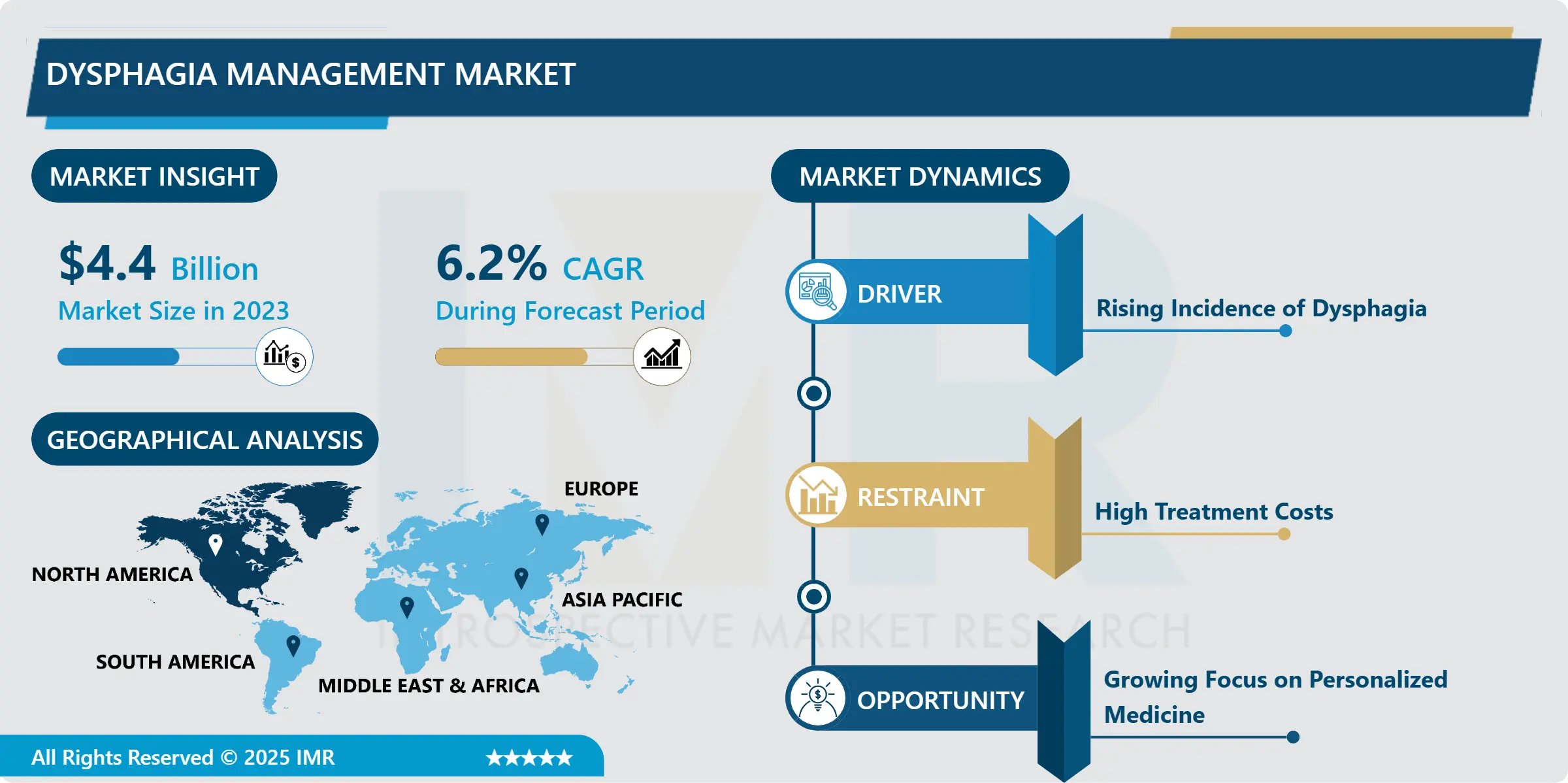
Dysphagia Management Market Size Was Valued at USD 4.40 Billion in 2023, and is Projected to Reach USD 4.40 Billion by 2032, Growing at a CAGR of 6.20% From 2024-2032.
Dysphagia Management Market means the industry that deals with service delivery concerning dysphagia, which is a medical condition involving swallowing disorders. This market consists of dysphagia dietary aids products and services including thickened fluids, supplements, and oral care products to assist PWS with swallowing disorders in achieving adequate nutrition, swallowing sécurit and quality of life. Examples of products include for specific diets, thickening products, feeding tubes, swallow therapy products and diagnostics. There are also especial services for instance; speech-language therapy, clinical services etc. Growing incidence of dysphagia tied to aging, neurological disorders and long-term conditions, and emerging medical technologies are key factors boosting this market.
The dysphagia management market is growing, particularly because of higher rates of dysphagia, related to old age, neurological disorders, and other chronic diseases. Swallowing disorders, otherwise known as dysphagia, are prevalent in approximately thirty percent of the elderly and those with conditions such as; stroke, Parkinsonism, multiple sclerosis, head and neck cancers, neurological diseases, and degenerative diseases of the central nervous system. This, together with the aging population described above, and increased awareness of the risks associated with dysphagia have created a demand for effective treatment solutions. Therapies in the dysphagia management market include communicating equipment such as speech therapy, diet adjustments, swallowing techniques, or equipment and medical products like feeding pipes that assist patients to take food safely.
Adding to the category factors, innovative swallowing assistance devices, and novel diagnostic tools to better evaluate and manage the condition have also given further boost to the market. Market is also growing due to increased health care facilities that lead towards effective diagnosis and good management of dysphagia patients. The market has some challenges including high costs of treatment and lack of specialised treatment centres in some areas; however, the trend towards development of individual treatment and rehabilitation services will remain promising. The market’s growth is also backed by activities that would enhance patients’ consciousness for dysphagia and the need to enhance patients’ quality of life Initiative geared towards dysphagia care, together with a significant focus on early detection and intervention of swallowing difficulties.
Dysphagia Management Market Trend Analysis:
Advancements in Diagnostic Technologies and Personalized Treatment Plans Driving Growth in the Dysphagia Management Market
-
Medical device technology is considered as one of the major growth propellers of the dysphagia management market, particularly video fluoroscopic swallow studies (VFSS) and fiberoptic endoscopic evaluation of swallowing (FEES). These tools enable the health care providers to get precise and real time information of a patients swallowing ability and this puts the diagnostic procedures and even the management plans to another level. VFSS and FEES not only give the clinician an idea about the extent of dysphagia but also enable measurement of changes in the extent of dysphagia of a patient and extent of modification in the intervention programme. The visualization of the swallowing enables identification of causes of dysphagia in individuals hence it provides for an enhanced method of handling patients with dysphagia.
- There is recent transition towards the practice of combining the above diagnostic technologies with therapy based positive solutions, which has improved handling of dysphagia patients. Specialists are currently paying much attention to the idea of individualized approaches to patients employing accurate diagnostic tools together with individual therapy interventions like specific dysphagia exercises and specific diets have yield high results. This integration is highly fertile and driving the need for such dysphagia management products in an attempt to eradicate the fact that care providers are offering overall solutions which integrate both the physiologic and nutritional sides of the dysphagia. Hence, innovations in therapeutic products available in the market are increasing drastically, so it presents a unique prospect for the internal health professionals as well as patients encountering dysphagia to enhance the quality of their treatment and care physical rehabilitative therapy.
Advancements in the Dysphagia Management Market
-
Dysphagia is slowly becoming a prevalent issue since the world’s population is aging rapidly, and elderly patients are most affected. This demographic shift of patients is particularly accompanied by other medical conditions such as stroke, neurological disorders and many other chronic illnesses that lead to swallowing problems. Therefore, there is a need for dysphagia management products, therapies, devices, nutritional products, and diagnosis products among patients around the world. The constant increase in the number of newly discovered dysphagia cases among patients and healthcare providers is also increasing demand for timely diagnosis or treatment for dysphagia thus creating a large market for devices or services. This, in turn, lays down a substantial possibility for crafting and delivery of holistic care management services which can effectively meet the patients’ needs.
- Dysphagia is also a common malady in the modern world, the awareness of which and understanding of which have expanded opportunities for improving care and treatment of the disease, including drug and non-drug therapies that could be developed individually tailored to address the needs of a patient. As smart devices continue to emerge, and capabilities in diagnostics with the use of artificial Intelligence friendly infrastructure expand, health Tab Management is likely to progress, diagnosis precision is certain to rise and the outcome of the treatment programs are bound to be optimized. Furthermore, as organization look to offer value care to patients and lower the costs of hospitalization, technologies facilitating home or outpatient processes are in demand. The changes in their delivery models combined with a push for long term reform in the costs of healthcare bring many opportunities for innovative products and services in the dysphagia management market.
Dysphagia Management Market Segment Analysis:
Dysphagia Management Market is Segmented on the basis of Product Type, Distribution Channel, and Region.
By Product Type, Drug, feeding tube segment is expected to dominate the market during the forecast period
-
One segment in the nutritional support market is the drug segment, which refers to substance that are intended to be used with patients who have certain illnesses and are unable to take food or nutrients in a normal manner. These drugs are mostly solutions given as parenteral (intravenous) or enteral (through feeding tubes) nutrition support. They comprise of nutrient factors like amino acids, vitamins, minerals, electrolytes and other requisite ingredients that are required in nursing the health of a patient. For instance, parenteral nutrition is most appropriate to clients that cannot take food orally due to gastrointestinal complications, while enteral nutrition can be recommended only for clients with functional GI tracts only but who cannot meet their nutrient requirements independently.
- The advancement in drug segment in the nutritional support market is directly proportional to the rising incidence of conditions like cancer, gastrointestinal diseases, neurological disorders, and surgeries which affect the capability of the human body to absorb or metabolize nutrients. As such diseases increase in prevalence, there increasingly becomes a demand for medical nutrition therapy. New and enhanced nutrients and drugs formulated have also helped in enhancing patient compliance to recommended nutrients and drug doses. All these innovations are expected to fuel continued growth of this market especially given the fact that health care providers are looking to devise individualized nutrition plans based on the needs of their clients.
By Distribution Channel, Hospital pharmacies segment expected to held the largest share
-
They are central in the distribution of nutritional support products among hospitals especially to the intensive care unit and patient who have been operated. These are the drugs that these pharmacies need to deliver specialized feeding tubes and nutritional needs of the hospitalized individuals that may include terminal illnesses for instance. For patients who cannot regularly take food intercessions orally, they are in critical conditions, insisting on ICU or undergoing tough operations or treatments, therefore, they require PN and EN with the management of specialized pharmacists and clinicians. These products are ordered in accord with patient’s needs and delivered through hospital pharmacies with the degree of safeness and tenderness.
- Given that patient care is gradually improving across different facilities in the healthcare industry: hospital pharmacies will therefore constantly enjoy a market stream for nutritional support products. Due to the complexity of the patients’ conditions, better forms of nutrition therapies are required to help patients gain better health, especially those in intensive care. These facilities include the hospital pharmacies which play a major role of seeing to it that patients in the hospital receive adequate nutritious meals. In addition, the new focus on and commitment to decreasing rates of rehospitalization and enhancing health outcomes in patients has resulted in increased dependence on the hospital pharmacy for necessary nutritional therapies to facilitate recovery and enhance the well-being of the patient.
Dysphagia Management Market Regional Insights:
North America is Expected to Dominate the Market Over the Forecast period
-
The Dysphagia Management Market of North America, specially the United States, is growing rapidly due to the growth in neurological disorders including stroke and Parkinson’s disease. These proposals lead to difficulties in swallowing and thus cause high need for effective dysphagia management instruments. There is a growing need for assist tools and therapies to people with swallowing disability as the population ages and more individuals develop such chronic conditions. The advances in diagnostic and therapeutic tools like video fluoroscopy and fiberoptic endoscopic evaluation of swallowing (FEES) has added to market growth by improving the diagnostic gold standard and additionally by offering specific treatments for patients with dysphagia thus enhancing their quality of life.
- North America has developed healthcare facilities, which help in the growth of the dysphagia management market. The healthcare system of that region has the proper instrumentation, and reimbursement policies for dysphagia treatments are gradually becoming more tolerant, so the therapy which is necessary for the patients is available for a lower cost. The global dysphagia market is also benefited from a complete perspective on the healthcare industry and an increasing trend of individualized treatment approach meeting the demands of dysphagia patients. Currently, patients and:%.health care providers continue to prioritize the need for better outcomes for patients after acquired brain injury and other conditions that impact swallowing and the quality of life of affected individuals, the market in North America is anticipated to grow tremendously.
Active Key Players in the Dysphagia Management Market:
- Eisai Co. Ltd,
- C.R. Bard Inc. (Becton, Dickinson and Company),
- Hormel Health Labs,
- AstraZeneca,
- Cipla Ltd,
- Nestle Health Science,
- Kent Precision Food Group Inc.,
- Bracco Diagnostics Inc.,
- Phagenesis Ltd,
- Nutricia Advanced Medical Nutrition,
- Cook medical Inc., and Other Active Players
|
Global Dysphagia Management Market |
|||
|
Base Year: |
2023 |
Forecast Period: |
2024-2032 |
|
Historical Data: |
2017 to 2023 |
Market Size in 2023: |
USD 4.40 Billion |
|
Forecast Period 2024-32 CAGR: |
6.20% |
Market Size in 2032: |
USD 7.56 Billion |
|
Segments Covered: |
By Product Type |
|
|
|
By Distribution Channel |
|
||
|
By Region |
|
||
|
Key Market Drivers: |
|
||
|
Key Market Restraints: |
|
||
|
Key Opportunities: |
|
||
|
Companies Covered in the report: |
|
||
Chapter 1: Introduction
1.1 Scope and Coverage
Chapter 2:Executive Summary
Chapter 3: Market Landscape
3.1 Market Dynamics
3.1.1 Drivers
3.1.2 Restraints
3.1.3 Opportunities
3.1.4 Challenges
3.2 Market Trend Analysis
3.3 PESTLE Analysis
3.4 Porter's Five Forces Analysis
3.5 Industry Value Chain Analysis
3.6 Ecosystem
3.7 Regulatory Landscape
3.8 Price Trend Analysis
3.9 Patent Analysis
3.10 Technology Evolution
3.11 Investment Pockets
3.12 Import-Export Analysis
Chapter 4: Dysphagia Management Market by Product Type
4.1 Dysphagia Management Market Snapshot and Growth Engine
4.2 Dysphagia Management Market Overview
4.3 Drug
4.3.1 Introduction and Market Overview
4.3.2 Historic and Forecasted Market Size in Value USD and Volume Units (2017-2032F)
4.3.3 Key Market Trends, Growth Factors and Opportunities
4.3.4 Drug: Geographic Segmentation Analysis
4.4 Feeding tube
4.4.1 Introduction and Market Overview
4.4.2 Historic and Forecasted Market Size in Value USD and Volume Units (2017-2032F)
4.4.3 Key Market Trends, Growth Factors and Opportunities
4.4.4 Feeding tube: Geographic Segmentation Analysis
4.5 Nutritional solutions
4.5.1 Introduction and Market Overview
4.5.2 Historic and Forecasted Market Size in Value USD and Volume Units (2017-2032F)
4.5.3 Key Market Trends, Growth Factors and Opportunities
4.5.4 Nutritional solutions: Geographic Segmentation Analysis
Chapter 5: Dysphagia Management Market by Distribution Channel
5.1 Dysphagia Management Market Snapshot and Growth Engine
5.2 Dysphagia Management Market Overview
5.3 Hospital pharmacies
5.3.1 Introduction and Market Overview
5.3.2 Historic and Forecasted Market Size in Value USD and Volume Units (2017-2032F)
5.3.3 Key Market Trends, Growth Factors and Opportunities
5.3.4 Hospital pharmacies: Geographic Segmentation Analysis
5.4 Retail pharmacies
5.4.1 Introduction and Market Overview
5.4.2 Historic and Forecasted Market Size in Value USD and Volume Units (2017-2032F)
5.4.3 Key Market Trends, Growth Factors and Opportunities
5.4.4 Retail pharmacies: Geographic Segmentation Analysis
5.5 Drug stores
5.5.1 Introduction and Market Overview
5.5.2 Historic and Forecasted Market Size in Value USD and Volume Units (2017-2032F)
5.5.3 Key Market Trends, Growth Factors and Opportunities
5.5.4 Drug stores: Geographic Segmentation Analysis
5.6 and Specialty Clinics
5.6.1 Introduction and Market Overview
5.6.2 Historic and Forecasted Market Size in Value USD and Volume Units (2017-2032F)
5.6.3 Key Market Trends, Growth Factors and Opportunities
5.6.4 and Specialty Clinics: Geographic Segmentation Analysis
Chapter 6: Company Profiles and Competitive Analysis
6.1 Competitive Landscape
6.1.1 Competitive Benchmarking
6.1.2 Dysphagia Management Market Share by Manufacturer (2023)
6.1.3 Industry BCG Matrix
6.1.4 Heat Map Analysis
6.1.5 Mergers and Acquisitions
6.2 EISAI CO. LTD
6.2.1 Company Overview
6.2.2 Key Executives
6.2.3 Company Snapshot
6.2.4 Role of the Company in the Market
6.2.5 Sustainability and Social Responsibility
6.2.6 Operating Business Segments
6.2.7 Product Portfolio
6.2.8 Business Performance
6.2.9 Key Strategic Moves and Recent Developments
6.2.10 SWOT Analysis
6.3 C.R. BARD INC. (BECTON
6.4 DICKINSON AND COMPANY)
6.5 HORMEL HEALTH LABS
6.6 ASTRAZENECA
6.7 CIPLA LTD
6.8 NESTLE HEALTH SCIENCE
6.9 KENT PRECISION FOOD GROUP INC.
6.10 BRACCO DIAGNOSTICS INC.
6.11 PHAGENESIS LTD
6.12 NUTRICIA ADVANCED MEDICAL NUTRITION
6.13 COOK MEDICAL INC.
6.14 OTHER ACTIVE PLAYERS
Chapter 7: Global Dysphagia Management Market By Region
7.1 Overview
7.2. North America Dysphagia Management Market
7.2.1 Key Market Trends, Growth Factors and Opportunities
7.2.2 Top Key Companies
7.2.3 Historic and Forecasted Market Size by Segments
7.2.4 Historic and Forecasted Market Size By Product Type
7.2.4.1 Drug
7.2.4.2 Feeding tube
7.2.4.3 Nutritional solutions
7.2.5 Historic and Forecasted Market Size By Distribution Channel
7.2.5.1 Hospital pharmacies
7.2.5.2 Retail pharmacies
7.2.5.3 Drug stores
7.2.5.4 and Specialty Clinics
7.2.6 Historic and Forecast Market Size by Country
7.2.6.1 US
7.2.6.2 Canada
7.2.6.3 Mexico
7.3. Eastern Europe Dysphagia Management Market
7.3.1 Key Market Trends, Growth Factors and Opportunities
7.3.2 Top Key Companies
7.3.3 Historic and Forecasted Market Size by Segments
7.3.4 Historic and Forecasted Market Size By Product Type
7.3.4.1 Drug
7.3.4.2 Feeding tube
7.3.4.3 Nutritional solutions
7.3.5 Historic and Forecasted Market Size By Distribution Channel
7.3.5.1 Hospital pharmacies
7.3.5.2 Retail pharmacies
7.3.5.3 Drug stores
7.3.5.4 and Specialty Clinics
7.3.6 Historic and Forecast Market Size by Country
7.3.6.1 Russia
7.3.6.2 Bulgaria
7.3.6.3 The Czech Republic
7.3.6.4 Hungary
7.3.6.5 Poland
7.3.6.6 Romania
7.3.6.7 Rest of Eastern Europe
7.4. Western Europe Dysphagia Management Market
7.4.1 Key Market Trends, Growth Factors and Opportunities
7.4.2 Top Key Companies
7.4.3 Historic and Forecasted Market Size by Segments
7.4.4 Historic and Forecasted Market Size By Product Type
7.4.4.1 Drug
7.4.4.2 Feeding tube
7.4.4.3 Nutritional solutions
7.4.5 Historic and Forecasted Market Size By Distribution Channel
7.4.5.1 Hospital pharmacies
7.4.5.2 Retail pharmacies
7.4.5.3 Drug stores
7.4.5.4 and Specialty Clinics
7.4.6 Historic and Forecast Market Size by Country
7.4.6.1 Germany
7.4.6.2 UK
7.4.6.3 France
7.4.6.4 The Netherlands
7.4.6.5 Italy
7.4.6.6 Spain
7.4.6.7 Rest of Western Europe
7.5. Asia Pacific Dysphagia Management Market
7.5.1 Key Market Trends, Growth Factors and Opportunities
7.5.2 Top Key Companies
7.5.3 Historic and Forecasted Market Size by Segments
7.5.4 Historic and Forecasted Market Size By Product Type
7.5.4.1 Drug
7.5.4.2 Feeding tube
7.5.4.3 Nutritional solutions
7.5.5 Historic and Forecasted Market Size By Distribution Channel
7.5.5.1 Hospital pharmacies
7.5.5.2 Retail pharmacies
7.5.5.3 Drug stores
7.5.5.4 and Specialty Clinics
7.5.6 Historic and Forecast Market Size by Country
7.5.6.1 China
7.5.6.2 India
7.5.6.3 Japan
7.5.6.4 South Korea
7.5.6.5 Malaysia
7.5.6.6 Thailand
7.5.6.7 Vietnam
7.5.6.8 The Philippines
7.5.6.9 Australia
7.5.6.10 New Zealand
7.5.6.11 Rest of APAC
7.6. Middle East & Africa Dysphagia Management Market
7.6.1 Key Market Trends, Growth Factors and Opportunities
7.6.2 Top Key Companies
7.6.3 Historic and Forecasted Market Size by Segments
7.6.4 Historic and Forecasted Market Size By Product Type
7.6.4.1 Drug
7.6.4.2 Feeding tube
7.6.4.3 Nutritional solutions
7.6.5 Historic and Forecasted Market Size By Distribution Channel
7.6.5.1 Hospital pharmacies
7.6.5.2 Retail pharmacies
7.6.5.3 Drug stores
7.6.5.4 and Specialty Clinics
7.6.6 Historic and Forecast Market Size by Country
7.6.6.1 Turkiye
7.6.6.2 Bahrain
7.6.6.3 Kuwait
7.6.6.4 Saudi Arabia
7.6.6.5 Qatar
7.6.6.6 UAE
7.6.6.7 Israel
7.6.6.8 South Africa
7.7. South America Dysphagia Management Market
7.7.1 Key Market Trends, Growth Factors and Opportunities
7.7.2 Top Key Companies
7.7.3 Historic and Forecasted Market Size by Segments
7.7.4 Historic and Forecasted Market Size By Product Type
7.7.4.1 Drug
7.7.4.2 Feeding tube
7.7.4.3 Nutritional solutions
7.7.5 Historic and Forecasted Market Size By Distribution Channel
7.7.5.1 Hospital pharmacies
7.7.5.2 Retail pharmacies
7.7.5.3 Drug stores
7.7.5.4 and Specialty Clinics
7.7.6 Historic and Forecast Market Size by Country
7.7.6.1 Brazil
7.7.6.2 Argentina
7.7.6.3 Rest of SA
Chapter 8 Analyst Viewpoint and Conclusion
8.1 Recommendations and Concluding Analysis
8.2 Potential Market Strategies
Chapter 9 Research Methodology
9.1 Research Process
9.2 Primary Research
9.3 Secondary Research
|
Global Dysphagia Management Market |
|||
|
Base Year: |
2023 |
Forecast Period: |
2024-2032 |
|
Historical Data: |
2017 to 2023 |
Market Size in 2023: |
USD 4.40 Billion |
|
Forecast Period 2024-32 CAGR: |
6.20% |
Market Size in 2032: |
USD 7.56 Billion |
|
Segments Covered: |
By Product Type |
|
|
|
By Distribution Channel |
|
||
|
By Region |
|
||
|
Key Market Drivers: |
|
||
|
Key Market Restraints: |
|
||
|
Key Opportunities: |
|
||
|
Companies Covered in the report: |
|
||


