




Deep Cycle Battery Market Synopsis:
Deep Cycle Battery Market Size Was Valued at USD 2.52 Billion in 2023, and is Projected to Reach USD 4.83 Billion by 2032, Growing at a CAGR of 7.7% From 2024-2032.
The deep cycle battery market is defined to specify the energy storage industry sub-sector that deals with batteries that are capable of delivering relatively constant power for an extended duration, without the power output being interrupted by recharging. The cells are widely employed in various uses such as RE storage, EVs, marine and recreational vehicles, and UPS. Deep cycle batteries are long-lasting and designed for long and high-power sulphuric acid rechargeable batteries. Among them we have the lead-acid, lithium-ion, nickel-cadmium, and flow batteries.
The growth has been witnessed in the deep cycle battery market since there is ramp up for the renewable energy systems and other off-grid energy solutions. These batteries assume great importance with the world transitioning to green energy as they facilitate storage of energy produced from solar and wind power. Governments around the world have resorted to enacting policies with a view to lowering carbon emissions, and as a result, there has been considerable investment in renewable energy systems, the demand for sophisticated deep cycle batteries included. In addition, their dual application for home and commercial use where they may be used for charging electric boats, RVs, ensuring continuous running of industrial plant and other equipment also cements their place in the market.
The technological advancements have been major influential factor in the growth of this market. Lithium-ion deep cycle batteries have recently received the most attention for their high energy density, light weight, and longer cycle life than lead-acid batteries. Moreover, innovations such as the solid-state battery and the flow battery are changing the performance standard of deep cycle batteries for industries that require demanding high-level energy storage. As consumption profiles of energy in global markets change, deep cycle batteries are deemed to be a necessary tool for managing energy production and demand.
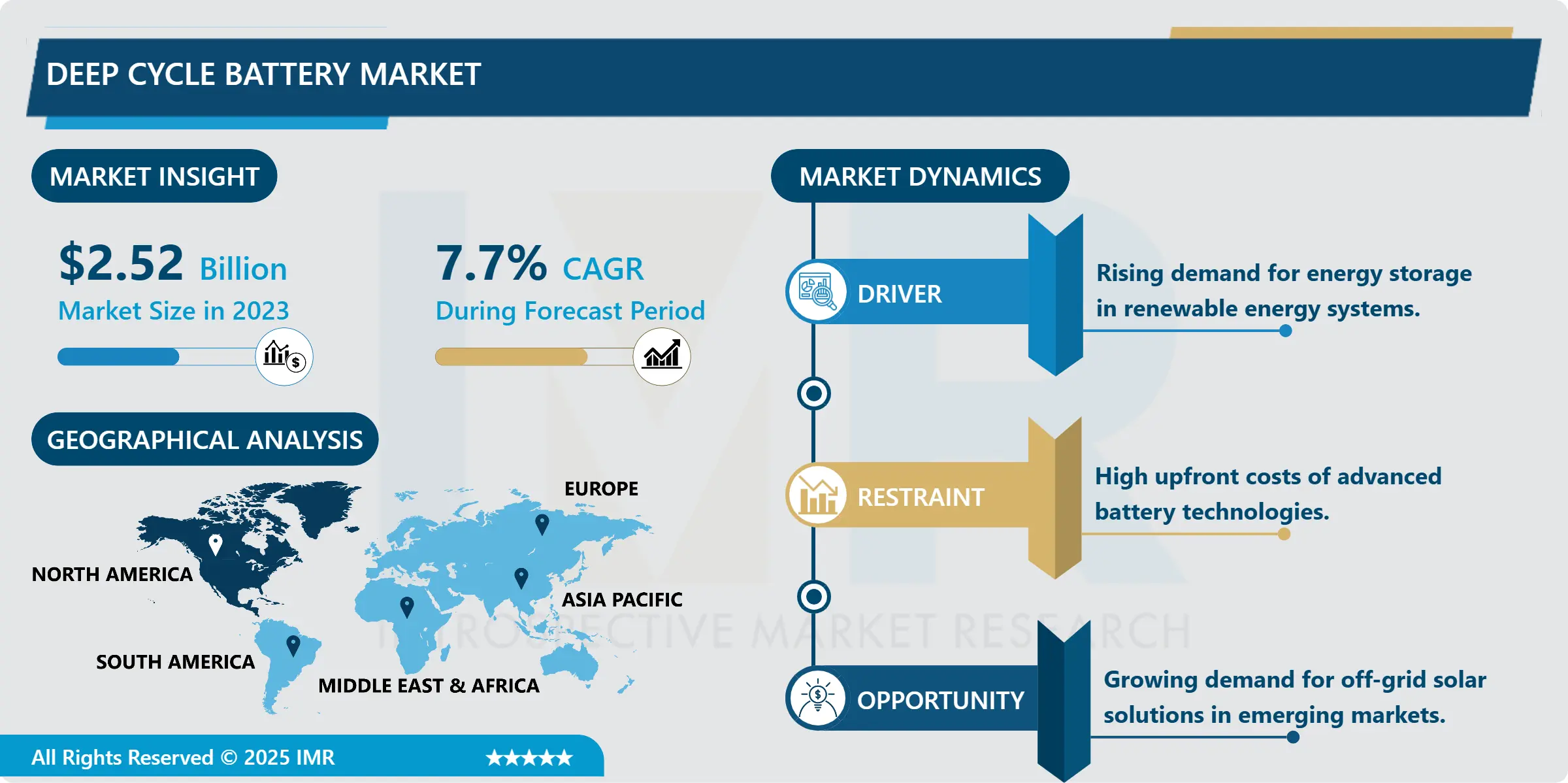
Deep Cycle Battery Market Trend Analysis:
Rising Adoption of Lithium-Ion Batteries
-
The Lithium-ion batteries are quickly replacing the deep cycle batteries with the latter being valued for efficiency, longevity and performance in deep cycle applications. Due to low weight and high energy ratio the Li-ion batteries are used in electric cars, renewable power storage systems and mobile power applications. The lithium-ion options, despite having a higher initial cost, compared to the traditional lead-acid batteries which are more commonplace, offer such benefits as faster charging, deeper discharge ability, and again a much longer length of time during which the battery would last. These enable lithium-ion batteries to exhibit lower long-term costs than other types of batteries for use in commercial as well as residential structures. He more or less corrects this notion, as lithium-ion batteries are expected to be the market leader in the coming years since the global demand for electric vehicles as well as for storage of renewable energy sources such as wind and solar increases.
- As for their inherent advantages in terms of performance the lithium-ion battery is also being improved through the ongoing research and developments that is being carried out continually. Technical enhancements like, better heat dissipation systems and battery safeguarding circuits, which were signalling causes of concern in earlier models, have been fixed. Thus, these innovations when united with increasing interest in lithium-ion batteries from governments and private sectors are driving the lithium-ion battery industry. Various governments are providing incentives and subsidies to improve the use of renewable energy including lithium-ion battery powered energy storage systems which in turns boosting the market. In turn, the future of the deep cycle battery market seems predicated on the growth of lithium-ion technology.
Expanding Renewable Energy Integration
-
The increasing use of renewable energy around the world also presents a good opportunity for deep cycle battery. With countries globally committing to net-zero carbon targets, solar and wind energy producers are increasingly being mainstreamed into the power system. However, these renewable sources are independent sources since they supply power irregularly due to the prevailing meteorological conditions. Deep cycle batteries help offset this challenge, by providing a means of storing the excess energy when production is high and supply the energy shortage when the demand is high. Since governments and major corporations are still increasing their spending on large scale renewable energy systems, it is expected that the demand for high capacity long cycle type batteries will rise significantly.
- Moreover, gross utility-scale RES shares are complemented by on-going mini-grid and stand-alone off-grid solar deployment in emerging markets for rural electrification. These areas, most of which are off the standard electrical power distribution networks, represent a large and unaddressed market for deep cycle batteries. The utilization of solar energy and energy storage is a revolution in terms of renewable, reliable energy services for the regions’ residential and industrial consumers. This growth opportunity is underlined by increased efforts and cooperation between governments, companies, and academic institutions in pushing the use of deep cycle batteries in renewable energy and meeting societal and environmental objectives.
Deep Cycle Battery Market Segment Analysis:
Deep Cycle Battery Market Segmented on the basis of type, application, end user and region.
By Type, lead-acid batteries segment is expected to dominate the market during the forecast period
-
The deep cycle battery market can be categorized mainly based on battery types, where lead-acid batteries continue to dominate. Lead-acid batteries have long been a viable choice of cost-effective, efficient and easily accessible energy storage commodity. These batteries have their use in areas such as renewable energy storage, EV, and backup power systems. Nevertheless, they are confined by energy density, life cycle, and conversion efficiency when compared to contemporaneous technologies.
- Lithium ion batteries are progressively penetrating deep cycle battery market due to their better performance parameters including high energy density, faster charge cycle and longer life cycle. These batteries are gaining increasing usage in electric vehicles and photovoltaic applications, portable power, and other applications. Ni-Cd batteries consumed globally but are less frequently used than lead-acid or lithium-ion batteries, they can be launched in specific niches where endurance in extreme temperatures is essential. To the same note, flow batteries has been described as one of the most promising batteries owing to its scalability and long cycle longevity. The other categories of deep cycle batteries such as sodium-ion and zinc-based batteries are also in the early stages of development to try and produce more environmentally friendly and economical solutions in future.
By Application, electric vehicles (EVs) segment expected to held the largest share
-
The deep cycle battery market is broadly classified by application, especially electric vehicles which is one of the largest and fastest growing segments. Since the world transit moves toward green technology, deep cycle batteries especially lithium-ion are crucial for EVs because of their durability and energy density. This type of batteries allows for steady storing of the energy needed for driving the EVs and also their performance. Further, renewable energy storage has become one of the many popular uses of deep cycle batteries especially in solar and wind generated power systems. They are handy because they capture energy produced, which is in excess during certain production periods, thereby stabilizing the supply from renewable sources due to their intermittency.
- Another area of consistency is the use of marine and recreational vehicles where deep cycle batteries are frequently used to charge boats, yachts, recreational vehicles and many other off course vehicles. Such batteries provide a continuous power source for illumination, location finding, and many other functions. Deep cycle batteries are used in uninterruptible power supply systems; UPS systems are used to deliver backup power when commercial power sources are disrupted; vital facilities and service, including data centers, hospitals and telecommunications networks require UPS systems. In addition, deep cycle batteries market is expanding especially due to manufacturing applications across industries and commerce, including forklift, energy storage etc. There are other uses, such as use in emergency power supplies and off-grid power such as in telecommunication towers which are also fuelling the increased adoption of deep cycle batteries across most industries.
Deep Cycle Battery Market Regional Insights:
North America is Expected to Dominate the Market Over the Forecast period
-
The dominance is mainly because of high investments in renewable energy assets and fast EV and energy storage system uptake across the region. However, the USA in particular has been particularly active supported by powerful programmes and policies together with government funding aimed at increasing RE capacities. As North America continues to make shifts towards solar installations and as people seek a solution for off grid energy storage, especially in hard to reach areas due to readings, this has consequently boosted the demand for deep cycle batteries and has for the same reason affirmed North America’s throne.
- North America continues to dominate the market through technological improvements of batteries. Leading technologies such as lithium-ion batteries and others have enabled the region to satisfy the demand for modern and efficient solutions for energy storage. Deep cycle battery industry in North America has improved its performance, efficiency and safety due to focused innovation and researches on energy storage technologies. This further certifies the North American supremacy in deep cycle battery market with support to renewable energy source and EV charging networks.
Active Key Players in the Deep Cycle Battery Market
- Amara Raja Batteries (India)
- BAE Batterien (Germany)
- C&D Technologies (United States)
- Crown Battery Manufacturing (United States)
- Deka Battery (United States)
- East Penn Manufacturing (United States)
- EnerSys (United States)
- Exide Industries (India)
- Furukawa Battery (Japan)
- GS Yuasa Corporation (Japan)
- Luminous Power Technologies (India)
- Narada Power Source (China)
- Trojan Battery Company (United States)
- Other Active Players
|
Global Deep Cycle Battery Market |
|||
|
Base Year: |
2023 |
Forecast Period: |
2024-2032 |
|
Historical Data: |
2017 to 2023 |
Market Size in 2023: |
USD 2.52 Billion |
|
Forecast Period 2024-32 CAGR: |
7.7 % |
Market Size in 2032: |
USD 4.83 Billion |
|
Segments Covered: |
By Type |
|
|
|
By Application |
|
||
|
By End User |
|
||
|
By Region |
|
||
|
Key Market Drivers: |
|
||
|
Key Market Restraints: |
|
||
|
Key Opportunities: |
|
||
|
Companies Covered in the report: |
|
||
Chapter 1: Introduction
1.1 Scope and Coverage
Chapter 2:Executive Summary
Chapter 3: Market Landscape
3.1 Market Dynamics
3.1.1 Drivers
3.1.2 Restraints
3.1.3 Opportunities
3.1.4 Challenges
3.2 Market Trend Analysis
3.3 PESTLE Analysis
3.4 Porter's Five Forces Analysis
3.5 Industry Value Chain Analysis
3.6 Ecosystem
3.7 Regulatory Landscape
3.8 Price Trend Analysis
3.9 Patent Analysis
3.10 Technology Evolution
3.11 Investment Pockets
3.12 Import-Export Analysis
Chapter 4: Deep Cycle Battery Market by Type
4.1 Deep Cycle Battery Market Snapshot and Growth Engine
4.2 Deep Cycle Battery Market Overview
4.3 Lead-Acid Batteries
4.3.1 Introduction and Market Overview
4.3.2 Historic and Forecasted Market Size in Value USD and Volume Units (2017-2032F)
4.3.3 Key Market Trends, Growth Factors and Opportunities
4.3.4 Lead-Acid Batteries: Geographic Segmentation Analysis
4.4 Lithium-Ion Batteries
4.4.1 Introduction and Market Overview
4.4.2 Historic and Forecasted Market Size in Value USD and Volume Units (2017-2032F)
4.4.3 Key Market Trends, Growth Factors and Opportunities
4.4.4 Lithium-Ion Batteries: Geographic Segmentation Analysis
4.5 Nickel-Cadmium Batteries
4.5.1 Introduction and Market Overview
4.5.2 Historic and Forecasted Market Size in Value USD and Volume Units (2017-2032F)
4.5.3 Key Market Trends, Growth Factors and Opportunities
4.5.4 Nickel-Cadmium Batteries: Geographic Segmentation Analysis
4.6 Flow Batteries
4.6.1 Introduction and Market Overview
4.6.2 Historic and Forecasted Market Size in Value USD and Volume Units (2017-2032F)
4.6.3 Key Market Trends, Growth Factors and Opportunities
4.6.4 Flow Batteries: Geographic Segmentation Analysis
4.7 Others
4.7.1 Introduction and Market Overview
4.7.2 Historic and Forecasted Market Size in Value USD and Volume Units (2017-2032F)
4.7.3 Key Market Trends, Growth Factors and Opportunities
4.7.4 Others: Geographic Segmentation Analysis
Chapter 5: Deep Cycle Battery Market by Application
5.1 Deep Cycle Battery Market Snapshot and Growth Engine
5.2 Deep Cycle Battery Market Overview
5.3 Electric Vehicles (EVs)
5.3.1 Introduction and Market Overview
5.3.2 Historic and Forecasted Market Size in Value USD and Volume Units (2017-2032F)
5.3.3 Key Market Trends, Growth Factors and Opportunities
5.3.4 Electric Vehicles (EVs): Geographic Segmentation Analysis
5.4 Renewable Energy Storage
5.4.1 Introduction and Market Overview
5.4.2 Historic and Forecasted Market Size in Value USD and Volume Units (2017-2032F)
5.4.3 Key Market Trends, Growth Factors and Opportunities
5.4.4 Renewable Energy Storage: Geographic Segmentation Analysis
5.5 Marine & Recreational Vehicles
5.5.1 Introduction and Market Overview
5.5.2 Historic and Forecasted Market Size in Value USD and Volume Units (2017-2032F)
5.5.3 Key Market Trends, Growth Factors and Opportunities
5.5.4 Marine & Recreational Vehicles: Geographic Segmentation Analysis
5.6 Uninterruptible Power Supplies (UPS)
5.6.1 Introduction and Market Overview
5.6.2 Historic and Forecasted Market Size in Value USD and Volume Units (2017-2032F)
5.6.3 Key Market Trends, Growth Factors and Opportunities
5.6.4 Uninterruptible Power Supplies (UPS): Geographic Segmentation Analysis
5.7 Industrial & Commercial Use
5.7.1 Introduction and Market Overview
5.7.2 Historic and Forecasted Market Size in Value USD and Volume Units (2017-2032F)
5.7.3 Key Market Trends, Growth Factors and Opportunities
5.7.4 Industrial & Commercial Use: Geographic Segmentation Analysis
5.8 Others
5.8.1 Introduction and Market Overview
5.8.2 Historic and Forecasted Market Size in Value USD and Volume Units (2017-2032F)
5.8.3 Key Market Trends, Growth Factors and Opportunities
5.8.4 Others: Geographic Segmentation Analysis
Chapter 6: Deep Cycle Battery Market by End User
6.1 Deep Cycle Battery Market Snapshot and Growth Engine
6.2 Deep Cycle Battery Market Overview
6.3 Residential
6.3.1 Introduction and Market Overview
6.3.2 Historic and Forecasted Market Size in Value USD and Volume Units (2017-2032F)
6.3.3 Key Market Trends, Growth Factors and Opportunities
6.3.4 Residential: Geographic Segmentation Analysis
6.4 Commercial
6.4.1 Introduction and Market Overview
6.4.2 Historic and Forecasted Market Size in Value USD and Volume Units (2017-2032F)
6.4.3 Key Market Trends, Growth Factors and Opportunities
6.4.4 Commercial: Geographic Segmentation Analysis
6.5 Industrial
6.5.1 Introduction and Market Overview
6.5.2 Historic and Forecasted Market Size in Value USD and Volume Units (2017-2032F)
6.5.3 Key Market Trends, Growth Factors and Opportunities
6.5.4 Industrial: Geographic Segmentation Analysis
Chapter 7: Company Profiles and Competitive Analysis
7.1 Competitive Landscape
7.1.1 Competitive Benchmarking
7.1.2 Deep Cycle Battery Market Share by Manufacturer (2023)
7.1.3 Industry BCG Matrix
7.1.4 Heat Map Analysis
7.1.5 Mergers and Acquisitions
7.2 AMARA RAJA BATTERIES (INDIA)
7.2.1 Company Overview
7.2.2 Key Executives
7.2.3 Company Snapshot
7.2.4 Role of the Company in the Market
7.2.5 Sustainability and Social Responsibility
7.2.6 Operating Business Segments
7.2.7 Product Portfolio
7.2.8 Business Performance
7.2.9 Key Strategic Moves and Recent Developments
7.2.10 SWOT Analysis
7.3 BAE BATTERIEN (GERMANY)
7.4 C&D TECHNOLOGIES (UNITED STATES)
7.5 CROWN BATTERY MANUFACTURING (UNITED STATES)
7.6 DEKA BATTERY (UNITED STATES)
7.7 EAST PENN MANUFACTURING (UNITED STATES)
7.8 ENERSYS (UNITED STATES)
7.9 EXIDE INDUSTRIES (INDIA)
7.10 FURUKAWA BATTERY (JAPAN)
7.11 GS YUASA CORPORATION (JAPAN)
7.12 HOPPECKE BATTERIES (GERMANY)
7.13 LEOCH INTERNATIONAL TECHNOLOGY (CHINA)
7.14 LUMINOUS POWER TECHNOLOGIES (INDIA)
7.15 NARADA POWER SOURCE::CHINA)
7.16 TROJAN BATTERY COMPANY (UNITED STATES)
7.17 OTHER ACTIVE PLAYERS
Chapter 8: Global Deep Cycle Battery Market By Region
8.1 Overview
8.2. North America Deep Cycle Battery Market
8.2.1 Key Market Trends, Growth Factors and Opportunities
8.2.2 Top Key Companies
8.2.3 Historic and Forecasted Market Size by Segments
8.2.4 Historic and Forecasted Market Size By Type
8.2.4.1 Lead-Acid Batteries
8.2.4.2 Lithium-Ion Batteries
8.2.4.3 Nickel-Cadmium Batteries
8.2.4.4 Flow Batteries
8.2.4.5 Others
8.2.5 Historic and Forecasted Market Size By Application
8.2.5.1 Electric Vehicles (EVs)
8.2.5.2 Renewable Energy Storage
8.2.5.3 Marine & Recreational Vehicles
8.2.5.4 Uninterruptible Power Supplies (UPS)
8.2.5.5 Industrial & Commercial Use
8.2.5.6 Others
8.2.6 Historic and Forecasted Market Size By End User
8.2.6.1 Residential
8.2.6.2 Commercial
8.2.6.3 Industrial
8.2.7 Historic and Forecast Market Size by Country
8.2.7.1 US
8.2.7.2 Canada
8.2.7.3 Mexico
8.3. Eastern Europe Deep Cycle Battery Market
8.3.1 Key Market Trends, Growth Factors and Opportunities
8.3.2 Top Key Companies
8.3.3 Historic and Forecasted Market Size by Segments
8.3.4 Historic and Forecasted Market Size By Type
8.3.4.1 Lead-Acid Batteries
8.3.4.2 Lithium-Ion Batteries
8.3.4.3 Nickel-Cadmium Batteries
8.3.4.4 Flow Batteries
8.3.4.5 Others
8.3.5 Historic and Forecasted Market Size By Application
8.3.5.1 Electric Vehicles (EVs)
8.3.5.2 Renewable Energy Storage
8.3.5.3 Marine & Recreational Vehicles
8.3.5.4 Uninterruptible Power Supplies (UPS)
8.3.5.5 Industrial & Commercial Use
8.3.5.6 Others
8.3.6 Historic and Forecasted Market Size By End User
8.3.6.1 Residential
8.3.6.2 Commercial
8.3.6.3 Industrial
8.3.7 Historic and Forecast Market Size by Country
8.3.7.1 Russia
8.3.7.2 Bulgaria
8.3.7.3 The Czech Republic
8.3.7.4 Hungary
8.3.7.5 Poland
8.3.7.6 Romania
8.3.7.7 Rest of Eastern Europe
8.4. Western Europe Deep Cycle Battery Market
8.4.1 Key Market Trends, Growth Factors and Opportunities
8.4.2 Top Key Companies
8.4.3 Historic and Forecasted Market Size by Segments
8.4.4 Historic and Forecasted Market Size By Type
8.4.4.1 Lead-Acid Batteries
8.4.4.2 Lithium-Ion Batteries
8.4.4.3 Nickel-Cadmium Batteries
8.4.4.4 Flow Batteries
8.4.4.5 Others
8.4.5 Historic and Forecasted Market Size By Application
8.4.5.1 Electric Vehicles (EVs)
8.4.5.2 Renewable Energy Storage
8.4.5.3 Marine & Recreational Vehicles
8.4.5.4 Uninterruptible Power Supplies (UPS)
8.4.5.5 Industrial & Commercial Use
8.4.5.6 Others
8.4.6 Historic and Forecasted Market Size By End User
8.4.6.1 Residential
8.4.6.2 Commercial
8.4.6.3 Industrial
8.4.7 Historic and Forecast Market Size by Country
8.4.7.1 Germany
8.4.7.2 UK
8.4.7.3 France
8.4.7.4 The Netherlands
8.4.7.5 Italy
8.4.7.6 Spain
8.4.7.7 Rest of Western Europe
8.5. Asia Pacific Deep Cycle Battery Market
8.5.1 Key Market Trends, Growth Factors and Opportunities
8.5.2 Top Key Companies
8.5.3 Historic and Forecasted Market Size by Segments
8.5.4 Historic and Forecasted Market Size By Type
8.5.4.1 Lead-Acid Batteries
8.5.4.2 Lithium-Ion Batteries
8.5.4.3 Nickel-Cadmium Batteries
8.5.4.4 Flow Batteries
8.5.4.5 Others
8.5.5 Historic and Forecasted Market Size By Application
8.5.5.1 Electric Vehicles (EVs)
8.5.5.2 Renewable Energy Storage
8.5.5.3 Marine & Recreational Vehicles
8.5.5.4 Uninterruptible Power Supplies (UPS)
8.5.5.5 Industrial & Commercial Use
8.5.5.6 Others
8.5.6 Historic and Forecasted Market Size By End User
8.5.6.1 Residential
8.5.6.2 Commercial
8.5.6.3 Industrial
8.5.7 Historic and Forecast Market Size by Country
8.5.7.1 China
8.5.7.2 India
8.5.7.3 Japan
8.5.7.4 South Korea
8.5.7.5 Malaysia
8.5.7.6 Thailand
8.5.7.7 Vietnam
8.5.7.8 The Philippines
8.5.7.9 Australia
8.5.7.10 New Zealand
8.5.7.11 Rest of APAC
8.6. Middle East & Africa Deep Cycle Battery Market
8.6.1 Key Market Trends, Growth Factors and Opportunities
8.6.2 Top Key Companies
8.6.3 Historic and Forecasted Market Size by Segments
8.6.4 Historic and Forecasted Market Size By Type
8.6.4.1 Lead-Acid Batteries
8.6.4.2 Lithium-Ion Batteries
8.6.4.3 Nickel-Cadmium Batteries
8.6.4.4 Flow Batteries
8.6.4.5 Others
8.6.5 Historic and Forecasted Market Size By Application
8.6.5.1 Electric Vehicles (EVs)
8.6.5.2 Renewable Energy Storage
8.6.5.3 Marine & Recreational Vehicles
8.6.5.4 Uninterruptible Power Supplies (UPS)
8.6.5.5 Industrial & Commercial Use
8.6.5.6 Others
8.6.6 Historic and Forecasted Market Size By End User
8.6.6.1 Residential
8.6.6.2 Commercial
8.6.6.3 Industrial
8.6.7 Historic and Forecast Market Size by Country
8.6.7.1 Turkiye
8.6.7.2 Bahrain
8.6.7.3 Kuwait
8.6.7.4 Saudi Arabia
8.6.7.5 Qatar
8.6.7.6 UAE
8.6.7.7 Israel
8.6.7.8 South Africa
8.7. South America Deep Cycle Battery Market
8.7.1 Key Market Trends, Growth Factors and Opportunities
8.7.2 Top Key Companies
8.7.3 Historic and Forecasted Market Size by Segments
8.7.4 Historic and Forecasted Market Size By Type
8.7.4.1 Lead-Acid Batteries
8.7.4.2 Lithium-Ion Batteries
8.7.4.3 Nickel-Cadmium Batteries
8.7.4.4 Flow Batteries
8.7.4.5 Others
8.7.5 Historic and Forecasted Market Size By Application
8.7.5.1 Electric Vehicles (EVs)
8.7.5.2 Renewable Energy Storage
8.7.5.3 Marine & Recreational Vehicles
8.7.5.4 Uninterruptible Power Supplies (UPS)
8.7.5.5 Industrial & Commercial Use
8.7.5.6 Others
8.7.6 Historic and Forecasted Market Size By End User
8.7.6.1 Residential
8.7.6.2 Commercial
8.7.6.3 Industrial
8.7.7 Historic and Forecast Market Size by Country
8.7.7.1 Brazil
8.7.7.2 Argentina
8.7.7.3 Rest of SA
Chapter 9 Analyst Viewpoint and Conclusion
9.1 Recommendations and Concluding Analysis
9.2 Potential Market Strategies
Chapter 10 Research Methodology
10.1 Research Process
10.2 Primary Research
10.3 Secondary Research
|
Global Deep Cycle Battery Market |
|||
|
Base Year: |
2023 |
Forecast Period: |
2024-2032 |
|
Historical Data: |
2017 to 2023 |
Market Size in 2023: |
USD 2.52 Billion |
|
Forecast Period 2024-32 CAGR: |
7.7 % |
Market Size in 2032: |
USD 4.83 Billion |
|
Segments Covered: |
By Type |
|
|
|
By Application |
|
||
|
By End User |
|
||
|
By Region |
|
||
|
Key Market Drivers: |
|
||
|
Key Market Restraints: |
|
||
|
Key Opportunities: |
|
||
|
Companies Covered in the report: |
|
||


