




Data Warehouse Market Synopsis:
Data Warehouse Market Size Was Valued at USD 9.98 Billion in 2023, and is Projected to Reach USD 25.78 Billion by 2032, Growing at a CAGR of 11.12 % From 2024-2032.
The Data Warehouse Market is a niche segment in the larger data management space that is dedicated to products that act as repositories and managers of structured and unstructured data gathered from multiple sources for end-use in business intelligence and analytics. A data warehouse can be defined as a centralized data store that provides organizations with the capacity to easily use current and past data for future planning. Due to digitalization, big data usage, and development in analytical tools, data warehouses are very valuable for improving performance and achieving competitive advantage in sectors like retail, BFSI, healthcare, and IT.
The market for data warehouses has been steady over the recent past due to the growing demand for utilizing data in organizations’ decision-making processes. With the increased amount of data being created and collected by the companies along with IoT devices, social media and business systems the need for data storage and processing solutions has grown significantly. Current data warehouses come with improved scalability, flexibility and more real-time capability allowing organization to turn into fast changing business environments.
Cloud versions of data warehouses are crucial in driving the market due to the relatively low cost and high flexibility. By design, these platforms are highly compatible with sophisticated analytics instruments so that businesses can extract significant information from huge datasets. Hybrid deployment of cloud and on-premises solutions is also gradually becoming popular due to use of designs that suit specific needs of an organization.
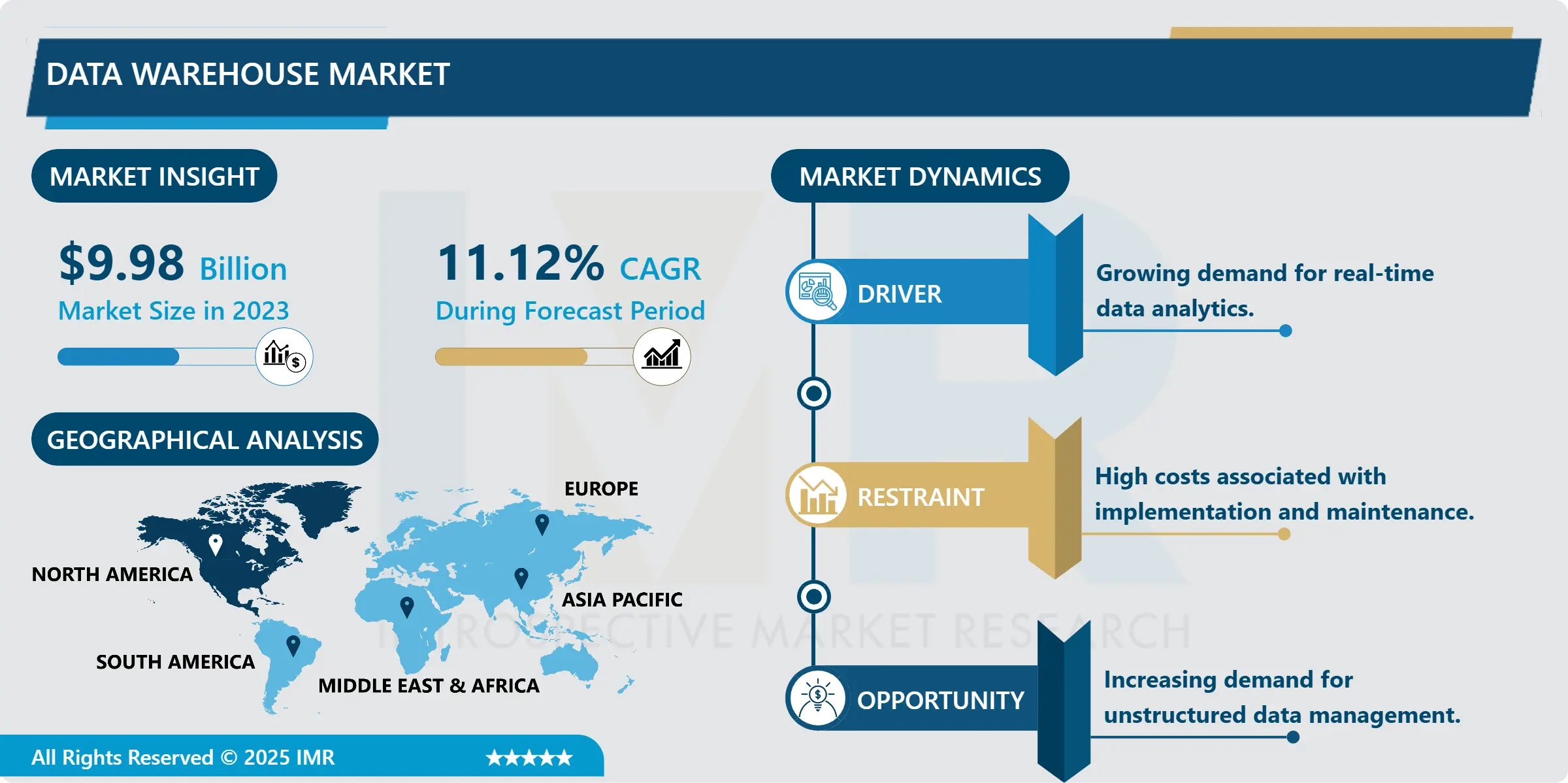
Data Warehouse Market Trend Analysis:
Growth of Cloud-Based Data Warehouses
-
There is a significant trend in the market of data warehouses related to the use of cloud solutions. More and more businesses are signing up for cloud data warehouses because of the value they get from features like flexibility, diminished costs with regard to hardware requirements, and quick setup. Companies such as Amazon, Google, and Snow, have introduced RedShift from Amazon, Google BigQuery, and Snowflake that have gained a lot of market adoptions because of their capability to support and enhance complex queries, modern analytics tool integration, and real-time data processing. This trend is even more apparent where they are present among the SMEs and startups that by necessity are always on the lookout for cost-efficient ways of dealing with their burgeoning data requirements.
Rising Demand for Unstructured Data Management
-
Unstructured data is a huge and still untapped gold mine for organizations. Mobile IoT devices, multimedia contents, a large number of social medial platforms are the causes of the generation of more unstructured data. Major players in the industry can solve the issue of data warehousing and data analysis for unstructured data with major application and high growth potential in the market. Companies that manage to leverage unstructured data for customer attitude determination, future behaviour forecasting, and tailored advertisement techniques will be in a position to gain a number of competitive advantages.
Data Warehouse Market Segment Analysis:
Data Warehouse Market Segmented on the basis of offering type, data type, and region.
By Offering ETL Solutions segment is expected to dominate the market during the forecast period
-
The ETL (Extract, Transform, Load) solution segment is likely to remain the largest segment in the data warehouse market during the period of the forecast. ETL operations are core precesses of data warehousing and involve the transformation of data from various sources for storage in one database. These solutions maintain data consistency and accuracy, and prepare data for the analysis, which makes these solutions very important for businesses to get value from their data assets. As data ecosystems become more intricate, and as usage of near-real-time analytics begins to increase, ETL remains a critical component of contemporary data warehouses.
By Data Type, the Unstructured data segment expected to held the largest share
-
The Unstructured Data segment is expected to dominate the data warehouse market because of the massively increasing data from social media, IoT devices, and video. Unstructured data is also more difficult to categorize and process compared to structured data, thus presenting a huge market need for superior data warehousing solutions. Cutting-edge platforms using AI and ML to unstructured data can help businesses analyze and gain valuable insights for decision-making.
Data Warehouse Market Regional Insights:
North America is Expected to Dominate the Market Over the Forecast period
-
The region represented a considerable chunk of the entire global market; the USA was seen to be adopting new sophisticated data warehouse systems. Some of the factors that have prevented the region from being at the forefront include; The region has prioritized digital initiatives; e-commerce is well developed in the region and cloud first mentality is well adopted in the region. As well, North America is home to complex data-oriented businesses, such as BFSI, healthcare, and retail that require immediate analysis of data and smooth integration of data types. The region also enjoys a strong base of investments directed toward the continual development and improvement of AI and machine learning technologies to support data warehouse solutions.
- Also, supportive legal conditions for the adoption of new solutions contribute to market development across North America. The neighbor and ally, Canada has a burgeoning tech industry and an encouraging government fostering digital transformation that matches well with the U.S. in influencing the regional market. The two emerging trends that are also driving the demand in the region include the shifting from traditional to hybrid cloud models, as well as the growth of unstructured data analytics. The need for businesses to adopt data-driven strategies has continued to grow and as such, North America is expected to retain its dominance of the value chain for the global data warehouse market over the forecast period.
Active Key Players in the Data Warehouse Market:
- Amazon Web Services (United States)
- Cloudera (United States)
- Databricks (United States)
- Google LLC (United States)
- Hewlett Packard Enterprise (United States)
- IBM Corporation (United States)
- Informatica (United States)
- Microsoft Corporation (United States)
- Oracle Corporation (United States)
- QlikTech International AB (United States)
- SAP SE (Germany)
- Snowflake (United States)
- Teradata (United States)
- Vertica (United States)
- Yellowfin BI (Australia)
- Other Active Players
|
Global Data Warehouse Market |
|||
|
Base Year: |
2023 |
Forecast Period: |
2024-2032 |
|
Historical Data: |
2017 to 2023 |
Market Size in 2023: |
USD 9.98 Billion |
|
Forecast Period 2024-32 CAGR: |
11.12 % |
Market Size in 2032: |
USD 25.78 Billion |
|
Segments Covered: |
By Offering Type |
|
|
|
By Data Type |
|
||
|
By Region |
|
||
|
Key Market Drivers: |
|
||
|
Key Market Restraints: |
|
||
|
Key Opportunities: |
|
||
|
Companies Covered in the report: |
|
||
Chapter 1: Introduction
1.1 Scope and Coverage
Chapter 2:Executive Summary
Chapter 3: Market Landscape
3.1 Market Dynamics
3.1.1 Drivers
3.1.2 Restraints
3.1.3 Opportunities
3.1.4 Challenges
3.2 Market Trend Analysis
3.3 PESTLE Analysis
3.4 Porter's Five Forces Analysis
3.5 Industry Value Chain Analysis
3.6 Ecosystem
3.7 Regulatory Landscape
3.8 Price Trend Analysis
3.9 Patent Analysis
3.10 Technology Evolution
3.11 Investment Pockets
3.12 Import-Export Analysis
Chapter 4: Data Warehouse Market by Offering Type
4.1 Data Warehouse Market Snapshot and Growth Engine
4.2 Data Warehouse Market Overview
4.3 ETL Solutions
4.3.1 Introduction and Market Overview
4.3.2 Historic and Forecasted Market Size in Value USD and Volume Units (2017-2032F)
4.3.3 Key Market Trends, Growth Factors and Opportunities
4.3.4 ETL Solutions: Geographic Segmentation Analysis
4.4 Statistical Analysis
4.4.1 Introduction and Market Overview
4.4.2 Historic and Forecasted Market Size in Value USD and Volume Units (2017-2032F)
4.4.3 Key Market Trends, Growth Factors and Opportunities
4.4.4 Statistical Analysis: Geographic Segmentation Analysis
4.5 Data Mining
4.5.1 Introduction and Market Overview
4.5.2 Historic and Forecasted Market Size in Value USD and Volume Units (2017-2032F)
4.5.3 Key Market Trends, Growth Factors and Opportunities
4.5.4 Data Mining: Geographic Segmentation Analysis
4.6 and Others
4.6.1 Introduction and Market Overview
4.6.2 Historic and Forecasted Market Size in Value USD and Volume Units (2017-2032F)
4.6.3 Key Market Trends, Growth Factors and Opportunities
4.6.4 and Others: Geographic Segmentation Analysis
Chapter 5: Data Warehouse Market by Data Type
5.1 Data Warehouse Market Snapshot and Growth Engine
5.2 Data Warehouse Market Overview
5.3 Unstructured Data
5.3.1 Introduction and Market Overview
5.3.2 Historic and Forecasted Market Size in Value USD and Volume Units (2017-2032F)
5.3.3 Key Market Trends, Growth Factors and Opportunities
5.3.4 Unstructured Data: Geographic Segmentation Analysis
5.4 and Semi-Structured & Structured Data
5.4.1 Introduction and Market Overview
5.4.2 Historic and Forecasted Market Size in Value USD and Volume Units (2017-2032F)
5.4.3 Key Market Trends, Growth Factors and Opportunities
5.4.4 and Semi-Structured & Structured Data: Geographic Segmentation Analysis
Chapter 6: Company Profiles and Competitive Analysis
6.1 Competitive Landscape
6.1.1 Competitive Benchmarking
6.1.2 Data Warehouse Market Share by Manufacturer (2023)
6.1.3 Industry BCG Matrix
6.1.4 Heat Map Analysis
6.1.5 Mergers and Acquisitions
6.2 AMAZON WEB SERVICES (UNITED STATES)
6.2.1 Company Overview
6.2.2 Key Executives
6.2.3 Company Snapshot
6.2.4 Role of the Company in the Market
6.2.5 Sustainability and Social Responsibility
6.2.6 Operating Business Segments
6.2.7 Product Portfolio
6.2.8 Business Performance
6.2.9 Key Strategic Moves and Recent Developments
6.2.10 SWOT Analysis
6.3 CLOUDERA (UNITED STATES)
6.4 DATABRICKS (UNITED STATES)
6.5 GOOGLE LLC (UNITED STATES)
6.6 HEWLETT PACKARD ENTERPRISE (UNITED STATES)
6.7 IBM CORPORATION (UNITED STATES)
6.8 INFORMATICA (UNITED STATES)
6.9 MICROSOFT CORPORATION (UNITED STATES)
6.10 ORACLE CORPORATION (UNITED STATES)
6.11 QLIKTECH INTERNATIONAL AB (UNITED STATES)
6.12 SAP SE (GERMANY)
6.13 SNOWFLAKE (UNITED STATES)
6.14 TERADATA (UNITED STATES)
6.15 VERTICA (UNITED STATES)
6.16 YELLOWFIN BI (AUSTRALIA)
6.17 OTHER ACTIVE PLAYERS
Chapter 7: Global Data Warehouse Market By Region
7.1 Overview
7.2. North America Data Warehouse Market
7.2.1 Key Market Trends, Growth Factors and Opportunities
7.2.2 Top Key Companies
7.2.3 Historic and Forecasted Market Size by Segments
7.2.4 Historic and Forecasted Market Size By Offering Type
7.2.4.1 ETL Solutions
7.2.4.2 Statistical Analysis
7.2.4.3 Data Mining
7.2.4.4 and Others
7.2.5 Historic and Forecasted Market Size By Data Type
7.2.5.1 Unstructured Data
7.2.5.2 and Semi-Structured & Structured Data
7.2.6 Historic and Forecast Market Size by Country
7.2.6.1 US
7.2.6.2 Canada
7.2.6.3 Mexico
7.3. Eastern Europe Data Warehouse Market
7.3.1 Key Market Trends, Growth Factors and Opportunities
7.3.2 Top Key Companies
7.3.3 Historic and Forecasted Market Size by Segments
7.3.4 Historic and Forecasted Market Size By Offering Type
7.3.4.1 ETL Solutions
7.3.4.2 Statistical Analysis
7.3.4.3 Data Mining
7.3.4.4 and Others
7.3.5 Historic and Forecasted Market Size By Data Type
7.3.5.1 Unstructured Data
7.3.5.2 and Semi-Structured & Structured Data
7.3.6 Historic and Forecast Market Size by Country
7.3.6.1 Russia
7.3.6.2 Bulgaria
7.3.6.3 The Czech Republic
7.3.6.4 Hungary
7.3.6.5 Poland
7.3.6.6 Romania
7.3.6.7 Rest of Eastern Europe
7.4. Western Europe Data Warehouse Market
7.4.1 Key Market Trends, Growth Factors and Opportunities
7.4.2 Top Key Companies
7.4.3 Historic and Forecasted Market Size by Segments
7.4.4 Historic and Forecasted Market Size By Offering Type
7.4.4.1 ETL Solutions
7.4.4.2 Statistical Analysis
7.4.4.3 Data Mining
7.4.4.4 and Others
7.4.5 Historic and Forecasted Market Size By Data Type
7.4.5.1 Unstructured Data
7.4.5.2 and Semi-Structured & Structured Data
7.4.6 Historic and Forecast Market Size by Country
7.4.6.1 Germany
7.4.6.2 UK
7.4.6.3 France
7.4.6.4 The Netherlands
7.4.6.5 Italy
7.4.6.6 Spain
7.4.6.7 Rest of Western Europe
7.5. Asia Pacific Data Warehouse Market
7.5.1 Key Market Trends, Growth Factors and Opportunities
7.5.2 Top Key Companies
7.5.3 Historic and Forecasted Market Size by Segments
7.5.4 Historic and Forecasted Market Size By Offering Type
7.5.4.1 ETL Solutions
7.5.4.2 Statistical Analysis
7.5.4.3 Data Mining
7.5.4.4 and Others
7.5.5 Historic and Forecasted Market Size By Data Type
7.5.5.1 Unstructured Data
7.5.5.2 and Semi-Structured & Structured Data
7.5.6 Historic and Forecast Market Size by Country
7.5.6.1 China
7.5.6.2 India
7.5.6.3 Japan
7.5.6.4 South Korea
7.5.6.5 Malaysia
7.5.6.6 Thailand
7.5.6.7 Vietnam
7.5.6.8 The Philippines
7.5.6.9 Australia
7.5.6.10 New Zealand
7.5.6.11 Rest of APAC
7.6. Middle East & Africa Data Warehouse Market
7.6.1 Key Market Trends, Growth Factors and Opportunities
7.6.2 Top Key Companies
7.6.3 Historic and Forecasted Market Size by Segments
7.6.4 Historic and Forecasted Market Size By Offering Type
7.6.4.1 ETL Solutions
7.6.4.2 Statistical Analysis
7.6.4.3 Data Mining
7.6.4.4 and Others
7.6.5 Historic and Forecasted Market Size By Data Type
7.6.5.1 Unstructured Data
7.6.5.2 and Semi-Structured & Structured Data
7.6.6 Historic and Forecast Market Size by Country
7.6.6.1 Turkiye
7.6.6.2 Bahrain
7.6.6.3 Kuwait
7.6.6.4 Saudi Arabia
7.6.6.5 Qatar
7.6.6.6 UAE
7.6.6.7 Israel
7.6.6.8 South Africa
7.7. South America Data Warehouse Market
7.7.1 Key Market Trends, Growth Factors and Opportunities
7.7.2 Top Key Companies
7.7.3 Historic and Forecasted Market Size by Segments
7.7.4 Historic and Forecasted Market Size By Offering Type
7.7.4.1 ETL Solutions
7.7.4.2 Statistical Analysis
7.7.4.3 Data Mining
7.7.4.4 and Others
7.7.5 Historic and Forecasted Market Size By Data Type
7.7.5.1 Unstructured Data
7.7.5.2 and Semi-Structured & Structured Data
7.7.6 Historic and Forecast Market Size by Country
7.7.6.1 Brazil
7.7.6.2 Argentina
7.7.6.3 Rest of SA
Chapter 8 Analyst Viewpoint and Conclusion
8.1 Recommendations and Concluding Analysis
8.2 Potential Market Strategies
Chapter 9 Research Methodology
9.1 Research Process
9.2 Primary Research
9.3 Secondary Research
|
Global Data Warehouse Market |
|||
|
Base Year: |
2023 |
Forecast Period: |
2024-2032 |
|
Historical Data: |
2017 to 2023 |
Market Size in 2023: |
USD 9.98 Billion |
|
Forecast Period 2024-32 CAGR: |
11.12 % |
Market Size in 2032: |
USD 25.78 Billion |
|
Segments Covered: |
By Offering Type |
|
|
|
By Data Type |
|
||
|
By Region |
|
||
|
Key Market Drivers: |
|
||
|
Key Market Restraints: |
|
||
|
Key Opportunities: |
|
||
|
Companies Covered in the report: |
|
||


