




Cytokine Market Synopsis:
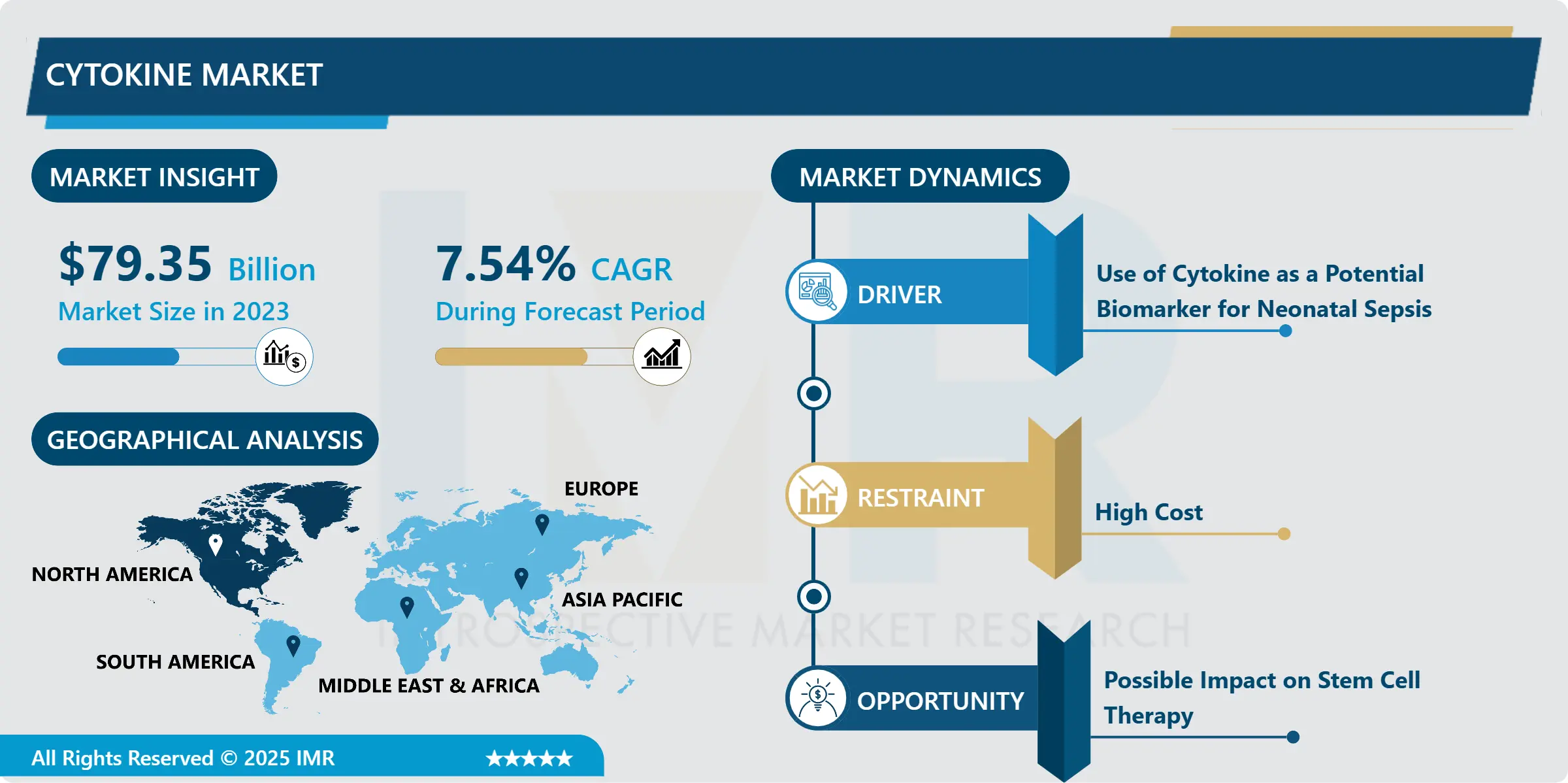
Cytokine Market Size Was Valued at USD 79.35 Billion in 2023, and is Projected to Reach USD 152.64 Billion by 2032, Growing at a CAGR of 7.54% From 2024-2032.
The cytokine market can be defined as a global market comprising of cytokine manufacturing, sales, and application related to cytokine, a kind of protein substance that active in cell signaling, immunity and inflammation. These biological molecules are applied in immunotherapy, in cancer treatment, and in treating inflammation. The market constitutes cytokine drugs, reagents and assays for research and clinical applications. Owing to enhanced developments in biotechnology and increasing need for precise treatment approaches, the cytokine market is in a state of continuous expansion and development.
The cytokine market is rapidly growing due not only to the rising need for targeted treatments and breakthroughs in biotechnology but also as a result of the growing incidence of chronic diseases. Cytokines are proteins with potent signaling and immune response regulating functions, which are currently widely employed in targeted treatments of various neoplastic, immunologic, and infectious diseases. The market finds new therapies for cytokines like monoclonal antibodies and fusion protein effective for the patient as they are more accurate when compared to other forms of treatment. The growth of biologics and an emphasis on individualized medicine is advancing the market even more, where cytokines are to play a significant role in targeted therapies with greater effectiveness and significantly fewer side effects.
Also, there has been a progressive demand regarding cytokines in diseases understanding, along with research and development improvements, which is promoting cytokine-based drugs. Now the government also playing its role though investing in the healthcare sector and launching healthcare related policies are also helping for the market growth. However, constraints like, high production cost, bureaucracy, and the general difficulty involved in cytokine production are still hurdles to overcome. However, there are some hurdles that will slow down the expansions of the market, but still, the market has a promising future for expansion because its development can be observed in connection with the development of new therapeutic functions, as well as due to a constant search for new opportunities per bio and information technologies by bio-technological companies.
Cytokine Market Trend Analysis:
Personalized Medicine and Targeted Therapies
-
Interleukins, interferons, tumor necrosis factors, colony-stimulating factors, and many other cytokines – small proteins that act as signaling molecules, enhancing inflammatory reactions and immune responses – are growing popular for numerous therapeutic interventions. An increased rate of Autoimmune diseases, cancer and infectious diseases is creating potential market for cytokine-based products. These therapies hack the immune system to be able to manage these disorders through increasing or decreasing immune response as appropriate. Furthermore, cytokines can also be used to treat the symptoms and therefore are an important tool in the treatment of these diseases in patients.
- In addition, research and development being directed toward the discovery of targeted therapies and personalized medicine is again driving the increased need for cytokines. These proteins provide more targeted treatment of diseases since they permit tailoring therapy in accordance with patient requirements. They observe that with the growing dependence on evidence based, individual patients’ needs which are more effectively addressed through cytokine-based therapies. With further databases revealing the utility of cytokines in disease control, there would definitely be significant growth in the market for these proteins.
Technological Advancements and Market Growth
-
The increasing incidence of chronic conditions like cancer, autoimmune and infectious conditions is a major factor that has urged the need to use cytokines in controlling the different immune response. This growing demand is backed by the growing biotechnology industry that is incorporating massive resources to explore new cytokine therapeutics and biomarker-based molecular targetings tailor-made for patients only. Moreover, there are new developments in the methods used for assessing cytokines and increasing the knowledge about the signs and functions of cytokines in pathogenesis that contributes to the growth of the market thanks to new effective approaches to treatment.
- Furthermore, continuous studies on cytokines repositioning from traditional pharmacological uses as drugs to be used in regenerative medicine and vaccines give the market a new direction for growth. These applications capitalize on the fundamental function of cytokines to initiate immune reactions and regeneration, thus in the development of other therapeutic strategies in treating diverse diseases. The growth is further complemented by rising R&D expenditure by pharma & biopharmaceutical firms that are keen on expanding cytokine embedded therapeutic frontiers, thus lending appropriate market conducive conditions for continued innovation and market growth.
Cytokine Market Segment Analysis:
Cytokine Market is Segmented on the basis of By Cytokine Type, Application, End User, and Region.
By Cytokine Type, Tumor Necrosis Factor-TNF segment is expected to dominate the market during the forecast period
-
Tumor Necrosis Factor also widely known as TNF is derived from the immune mediators that forms the background of inflammation. It takes part in managing various immune cells and the ways they act on infections and cancer. Besides that, through activating apoptotic death of the infected or damaged cells and enforcing discharge of the other cytokines, TNF is involved in regulation of inflammation and immune responses. Two main drugs currently used to manage the condition are infliximab and adalimumab that is a least costly option regardless of clinical prediction. These therapies are more beneficial in autoimmune disorders such as rheumatoid arthritis, crohn’s disease, and psoriasis because high level of TNF is involved in inflammation and tissue injury. These therapies thus decrease TNF, and a reduction in inflammation is indirectly achieved with corresponding amelioration of the symptoms of these diseases.
- Aside from having a better understanding on how TNF functions, TNF-targeted therapies have become a big leap in the treatment of inflammatory conditions because of the targeted mechanisms used. These treatments prevent TNF to bind it receptors where it would otherwise stimulate inflammatory activities that cause tissue destruction. This inhibition is not only effective in minimizing inflammation, but can also enhance the life patterns of sufferers of chronic inflammatory diseases. With the success achieved in RA treatment patients of other autoimmune and inflammation related diseases are now being treated with TNF inhibitors and this article therefore confirms the great importance of TNF inhibitors in managing diseases.
By End User, Hospitals segment expected to held the largest share
-
Hospitals as Primary Centers for Cytokine Therapies: In light with this, hospitals are primary responsible for managing cytokine therapies because most of them have the necessary structures and workforce, and the necessary facilities. These medical centers are in a position to address all the issues that cytokine involves mainly concerning the giving of cytokines in the forms of infusion or injection into the bodies of patients. Hospitals are best suited to treat clients with complications, or those with critical ailments which call for critical attention. Hospitals give the doctors a controlled working environment that can help them assess side effects, and the patient reaction to cytokines to provide safe services to the patients and effectiveness of the cytokines. Furthermore, hospitals own professional personnel of required right field that will be able to manage other complications that may appear during cytokine therapy besides different supportive interventions.
- Hospital environment is most suitable for cytokine therapies since it regulates safety more often and more efficiently in form of patients and personnel. Cytokine treatments should undergo minor adjustments to control side effects, which often can be manifold and difficult to trace. The provision of human resources entails medical staff such as nurses and doctors who offer these therapies consequently clients benefit from professional service providers. Furthermore, the hospital setting allows for a combination of cytokine manufacture together with other kinds of treatment and care in order to enhance the quality and prognosis of the treatments given to the patient.
Cytokine Market Regional Insights:
North America is Expected to Dominate the Market Over the Forecast period
-
The cytokine market is most developed in North America because it possesses the necessary foundation and conditions to support the creation and distribution of novel therapies. Most notably, the United States is dominating the market as the source of the high research funding and numerous biopharmaceutical companies involved in cytokine production and research. The same applies to the regulatory regime which is stringent while at the same time encouraging for new cytokine-based products to achieve approval and market launch. Thirdly, the relationship between academic institutions and stake holders is highly interactive and beginners want to come up with new therapies and bring them to market much faster. This constantly changing environment attributes to the cytokine market being mainly driven by North America.
The North American cytokine market also benefits from the influence of strong research foundations and a broad range of cytokine-based products in a diverse pipeline. Which is why there is a multitude of American-based companies fully focused on R & D of cytokine-based therapies for various diseases such as autoimmune diseases, cancer and infection diseases among others. Such a strong presence of key biotech firms joined with pharmaceutical companies and research establishments guarantees a constant stream of new proposals that will entrench North America’s leadership in the cytokine market. Coupled with the relatively mature market and a well-developed supply chain, these premises render an unmistakable fact: North America is indisputably the leader of cytokine industry in the world.
Active Key Players in the Cytokine Market
- AbbVie Inc. (USA)
- Amgen Inc. (USA)
- AstraZeneca (UK/Sweden)
- Biocon Limited (India)
- Clinigen Limited (UK)
- Coherus BioSciences, Inc. (USA)
- Fresenius Kabi AG (Germany)
- GlaxoSmithKline PLC (UK)
- Johnson & Johnson (USA)
- Merck & Co., Inc. (USA)
- Novartis AG (Switzerland)
- Partner Therapeutics (USA)
- Pfizer Inc. (USA)
- Sanofi S.A. (France)
- UCB S.A. (Belgium)
- Other Active Players
|
Global Cytokine Market |
|||
|
Base Year: |
2023 |
Forecast Period: |
2024-2032 |
|
Historical Data: |
2017 to 2023 |
Market Size in 2023: |
USD 79.35 Billion |
|
Forecast Period 2024-32 CAGR: |
7.54% |
Market Size in 2032: |
USD 152.64 Billion |
|
|
By Cytokine Type |
|
|
|
By Application |
|
||
|
By End User |
|
||
|
By Region |
|
||
|
Key Market Drivers: |
|
||
|
Key Market Restraints: |
|
||
|
Key Opportunities: |
|
||
|
Companies Covered in the report: |
|
||
Chapter 1: Introduction
1.1 Scope and Coverage
Chapter 2:Executive Summary
Chapter 3: Market Landscape
3.1 Market Dynamics
3.1.1 Drivers
3.1.2 Restraints
3.1.3 Opportunities
3.1.4 Challenges
3.2 Market Trend Analysis
3.3 PESTLE Analysis
3.4 Porter's Five Forces Analysis
3.5 Industry Value Chain Analysis
3.6 Ecosystem
3.7 Regulatory Landscape
3.8 Price Trend Analysis
3.9 Patent Analysis
3.10 Technology Evolution
3.11 Investment Pockets
3.12 Import-Export Analysis
Chapter 4: Cytokine Market by Cytokine Type
4.1 Cytokine Market Snapshot and Growth Engine
4.2 Cytokine Market Overview
4.3 Tumor Necrosis Factor-TNF
4.3.1 Introduction and Market Overview
4.3.2 Historic and Forecasted Market Size in Value USD and Volume Units (2017-2032F)
4.3.3 Key Market Trends, Growth Factors and Opportunities
4.3.4 Tumor Necrosis Factor-TNF: Geographic Segmentation Analysis
4.4 Interleukins-II
4.4.1 Introduction and Market Overview
4.4.2 Historic and Forecasted Market Size in Value USD and Volume Units (2017-2032F)
4.4.3 Key Market Trends, Growth Factors and Opportunities
4.4.4 Interleukins-II: Geographic Segmentation Analysis
4.5 Interferons-IFN
4.5.1 Introduction and Market Overview
4.5.2 Historic and Forecasted Market Size in Value USD and Volume Units (2017-2032F)
4.5.3 Key Market Trends, Growth Factors and Opportunities
4.5.4 Interferons-IFN: Geographic Segmentation Analysis
4.6 Epidermal Growth Factor-EGF
4.6.1 Introduction and Market Overview
4.6.2 Historic and Forecasted Market Size in Value USD and Volume Units (2017-2032F)
4.6.3 Key Market Trends, Growth Factors and Opportunities
4.6.4 Epidermal Growth Factor-EGF: Geographic Segmentation Analysis
4.7 Other Cytokine Types
4.7.1 Introduction and Market Overview
4.7.2 Historic and Forecasted Market Size in Value USD and Volume Units (2017-2032F)
4.7.3 Key Market Trends, Growth Factors and Opportunities
4.7.4 Other Cytokine Types: Geographic Segmentation Analysis
Chapter 5: Cytokine Market by Application
5.1 Cytokine Market Snapshot and Growth Engine
5.2 Cytokine Market Overview
5.3 Cancer
5.3.1 Introduction and Market Overview
5.3.2 Historic and Forecasted Market Size in Value USD and Volume Units (2017-2032F)
5.3.3 Key Market Trends, Growth Factors and Opportunities
5.3.4 Cancer: Geographic Segmentation Analysis
5.4 Asthma and Airway Inflammation
5.4.1 Introduction and Market Overview
5.4.2 Historic and Forecasted Market Size in Value USD and Volume Units (2017-2032F)
5.4.3 Key Market Trends, Growth Factors and Opportunities
5.4.4 Asthma and Airway Inflammation: Geographic Segmentation Analysis
5.5 Arthritis and Other Therapeutic Applications
5.5.1 Introduction and Market Overview
5.5.2 Historic and Forecasted Market Size in Value USD and Volume Units (2017-2032F)
5.5.3 Key Market Trends, Growth Factors and Opportunities
5.5.4 Arthritis and Other Therapeutic Applications: Geographic Segmentation Analysis
Chapter 6: Cytokine Market by End User
6.1 Cytokine Market Snapshot and Growth Engine
6.2 Cytokine Market Overview
6.3 Hospitals
6.3.1 Introduction and Market Overview
6.3.2 Historic and Forecasted Market Size in Value USD and Volume Units (2017-2032F)
6.3.3 Key Market Trends, Growth Factors and Opportunities
6.3.4 Hospitals: Geographic Segmentation Analysis
6.4 Speciality Clinics and Others
6.4.1 Introduction and Market Overview
6.4.2 Historic and Forecasted Market Size in Value USD and Volume Units (2017-2032F)
6.4.3 Key Market Trends, Growth Factors and Opportunities
6.4.4 Speciality Clinics and Others: Geographic Segmentation Analysis
Chapter 7: Company Profiles and Competitive Analysis
7.1 Competitive Landscape
7.1.1 Competitive Benchmarking
7.1.2 Cytokine Market Share by Manufacturer (2023)
7.1.3 Industry BCG Matrix
7.1.4 Heat Map Analysis
7.1.5 Mergers and Acquisitions
7.2 GLAXOSMITHKLINE PLC
7.2.1 Company Overview
7.2.2 Key Executives
7.2.3 Company Snapshot
7.2.4 Role of the Company in the Market
7.2.5 Sustainability and Social Responsibility
7.2.6 Operating Business Segments
7.2.7 Product Portfolio
7.2.8 Business Performance
7.2.9 Key Strategic Moves and Recent Developments
7.2.10 SWOT Analysis
7.3 NOVARTIS AG
7.4 AMGEN INC.
7.5 PFIZER INC.
7.6 SANOFI S.A.
7.7 ASTRA ZENECA
7.8 UCB S.A.
7.9 ABBVIE INC.
7.10 JOHNSON & JOHNSON
7.11 BIOCON LIMITED
7.12 CLINIGEN LIMITED
7.13 MERCK & CO. INC.
7.14 PARTNER THERAPEUTICS
7.15 COHERUS BIOSCIENCES INC.
7.16 FRESENIUS KABI AG
7.17 OTHER ACTIVE PLAYERS
Chapter 8: Global Cytokine Market By Region
8.1 Overview
8.2. North America Cytokine Market
8.2.1 Key Market Trends, Growth Factors and Opportunities
8.2.2 Top Key Companies
8.2.3 Historic and Forecasted Market Size by Segments
8.2.4 Historic and Forecasted Market Size By Cytokine Type
8.2.4.1 Tumor Necrosis Factor-TNF
8.2.4.2 Interleukins-II
8.2.4.3 Interferons-IFN
8.2.4.4 Epidermal Growth Factor-EGF
8.2.4.5 Other Cytokine Types
8.2.5 Historic and Forecasted Market Size By Application
8.2.5.1 Cancer
8.2.5.2 Asthma and Airway Inflammation
8.2.5.3 Arthritis and Other Therapeutic Applications
8.2.6 Historic and Forecasted Market Size By End User
8.2.6.1 Hospitals
8.2.6.2 Speciality Clinics and Others
8.2.7 Historic and Forecast Market Size by Country
8.2.7.1 US
8.2.7.2 Canada
8.2.7.3 Mexico
8.3. Eastern Europe Cytokine Market
8.3.1 Key Market Trends, Growth Factors and Opportunities
8.3.2 Top Key Companies
8.3.3 Historic and Forecasted Market Size by Segments
8.3.4 Historic and Forecasted Market Size By Cytokine Type
8.3.4.1 Tumor Necrosis Factor-TNF
8.3.4.2 Interleukins-II
8.3.4.3 Interferons-IFN
8.3.4.4 Epidermal Growth Factor-EGF
8.3.4.5 Other Cytokine Types
8.3.5 Historic and Forecasted Market Size By Application
8.3.5.1 Cancer
8.3.5.2 Asthma and Airway Inflammation
8.3.5.3 Arthritis and Other Therapeutic Applications
8.3.6 Historic and Forecasted Market Size By End User
8.3.6.1 Hospitals
8.3.6.2 Speciality Clinics and Others
8.3.7 Historic and Forecast Market Size by Country
8.3.7.1 Russia
8.3.7.2 Bulgaria
8.3.7.3 The Czech Republic
8.3.7.4 Hungary
8.3.7.5 Poland
8.3.7.6 Romania
8.3.7.7 Rest of Eastern Europe
8.4. Western Europe Cytokine Market
8.4.1 Key Market Trends, Growth Factors and Opportunities
8.4.2 Top Key Companies
8.4.3 Historic and Forecasted Market Size by Segments
8.4.4 Historic and Forecasted Market Size By Cytokine Type
8.4.4.1 Tumor Necrosis Factor-TNF
8.4.4.2 Interleukins-II
8.4.4.3 Interferons-IFN
8.4.4.4 Epidermal Growth Factor-EGF
8.4.4.5 Other Cytokine Types
8.4.5 Historic and Forecasted Market Size By Application
8.4.5.1 Cancer
8.4.5.2 Asthma and Airway Inflammation
8.4.5.3 Arthritis and Other Therapeutic Applications
8.4.6 Historic and Forecasted Market Size By End User
8.4.6.1 Hospitals
8.4.6.2 Speciality Clinics and Others
8.4.7 Historic and Forecast Market Size by Country
8.4.7.1 Germany
8.4.7.2 UK
8.4.7.3 France
8.4.7.4 The Netherlands
8.4.7.5 Italy
8.4.7.6 Spain
8.4.7.7 Rest of Western Europe
8.5. Asia Pacific Cytokine Market
8.5.1 Key Market Trends, Growth Factors and Opportunities
8.5.2 Top Key Companies
8.5.3 Historic and Forecasted Market Size by Segments
8.5.4 Historic and Forecasted Market Size By Cytokine Type
8.5.4.1 Tumor Necrosis Factor-TNF
8.5.4.2 Interleukins-II
8.5.4.3 Interferons-IFN
8.5.4.4 Epidermal Growth Factor-EGF
8.5.4.5 Other Cytokine Types
8.5.5 Historic and Forecasted Market Size By Application
8.5.5.1 Cancer
8.5.5.2 Asthma and Airway Inflammation
8.5.5.3 Arthritis and Other Therapeutic Applications
8.5.6 Historic and Forecasted Market Size By End User
8.5.6.1 Hospitals
8.5.6.2 Speciality Clinics and Others
8.5.7 Historic and Forecast Market Size by Country
8.5.7.1 China
8.5.7.2 India
8.5.7.3 Japan
8.5.7.4 South Korea
8.5.7.5 Malaysia
8.5.7.6 Thailand
8.5.7.7 Vietnam
8.5.7.8 The Philippines
8.5.7.9 Australia
8.5.7.10 New Zealand
8.5.7.11 Rest of APAC
8.6. Middle East & Africa Cytokine Market
8.6.1 Key Market Trends, Growth Factors and Opportunities
8.6.2 Top Key Companies
8.6.3 Historic and Forecasted Market Size by Segments
8.6.4 Historic and Forecasted Market Size By Cytokine Type
8.6.4.1 Tumor Necrosis Factor-TNF
8.6.4.2 Interleukins-II
8.6.4.3 Interferons-IFN
8.6.4.4 Epidermal Growth Factor-EGF
8.6.4.5 Other Cytokine Types
8.6.5 Historic and Forecasted Market Size By Application
8.6.5.1 Cancer
8.6.5.2 Asthma and Airway Inflammation
8.6.5.3 Arthritis and Other Therapeutic Applications
8.6.6 Historic and Forecasted Market Size By End User
8.6.6.1 Hospitals
8.6.6.2 Speciality Clinics and Others
8.6.7 Historic and Forecast Market Size by Country
8.6.7.1 Turkiye
8.6.7.2 Bahrain
8.6.7.3 Kuwait
8.6.7.4 Saudi Arabia
8.6.7.5 Qatar
8.6.7.6 UAE
8.6.7.7 Israel
8.6.7.8 South Africa
8.7. South America Cytokine Market
8.7.1 Key Market Trends, Growth Factors and Opportunities
8.7.2 Top Key Companies
8.7.3 Historic and Forecasted Market Size by Segments
8.7.4 Historic and Forecasted Market Size By Cytokine Type
8.7.4.1 Tumor Necrosis Factor-TNF
8.7.4.2 Interleukins-II
8.7.4.3 Interferons-IFN
8.7.4.4 Epidermal Growth Factor-EGF
8.7.4.5 Other Cytokine Types
8.7.5 Historic and Forecasted Market Size By Application
8.7.5.1 Cancer
8.7.5.2 Asthma and Airway Inflammation
8.7.5.3 Arthritis and Other Therapeutic Applications
8.7.6 Historic and Forecasted Market Size By End User
8.7.6.1 Hospitals
8.7.6.2 Speciality Clinics and Others
8.7.7 Historic and Forecast Market Size by Country
8.7.7.1 Brazil
8.7.7.2 Argentina
8.7.7.3 Rest of SA
Chapter 9 Analyst Viewpoint and Conclusion
9.1 Recommendations and Concluding Analysis
9.2 Potential Market Strategies
Chapter 10 Research Methodology
10.1 Research Process
10.2 Primary Research
10.3 Secondary Research
|
Global Cytokine Market |
|||
|
Base Year: |
2023 |
Forecast Period: |
2024-2032 |
|
Historical Data: |
2017 to 2023 |
Market Size in 2023: |
USD 79.35 Billion |
|
Forecast Period 2024-32 CAGR: |
7.54% |
Market Size in 2032: |
USD 152.64 Billion |
|
|
By Cytokine Type |
|
|
|
By Application |
|
||
|
By End User |
|
||
|
By Region |
|
||
|
Key Market Drivers: |
|
||
|
Key Market Restraints: |
|
||
|
Key Opportunities: |
|
||
|
Companies Covered in the report: |
|
||


