




Citrus Flavors Market Synopsis:
Citrus Flavors Market Size Was Valued at USD 1.97 Billion in 2023, and is Projected to Reach USD 3.08 Billion by 2032, Growing at a CAGR of 5.1 % From 2024-2032.
The citrus Flavors market relates to the production and application of citric natural and synthetic generated Flavors extracted from oranges, lemons, limes, grapefruit, and related fruits. These Flavors are used in the synthesis of food, beverage, confectionery, dairy products, and other final products to enhance the taste, smell, and mouth feel. Being responsibly charged with the task of managing consumer demand mostly in the aspects of new and natural flavours, the market has much more work to do providing new healthier goods.
Citrus flavours market being under the general flavours segment is rapidly expanding thanks to ever-changing consumer trends towards natural and nutrient-rich produce. Citrus have acute and stimulating taste that is famous; however, their demand varies within the sectors of beverages, confectionery, and salty snacks. Since more people are leaning towards the consumption of bioactive and functional food and beverages, citrus flavors got an even bigger boost, especially in the consumption for soft drinks, energy drinks and flavored water. Additionally, citrus is associated with Vitamin C boost capability and immune booster properties widely sought among the population of increasingly aware consumer clients.
It is Glacial that citrus flavorings are slowly entering into an essential function of structuring new products and ideas because of enhanced world food and stimulating beverages demand and well as Biotechnology that helps in providing better taste. Thirdly, an increase in the percentage of the urban population particularly in Asia-Pacific and Latin American areas along with higher per capita income for higher flavored ready-to-drink beverages and the trend of middle-class people are some of the major factors for growth.
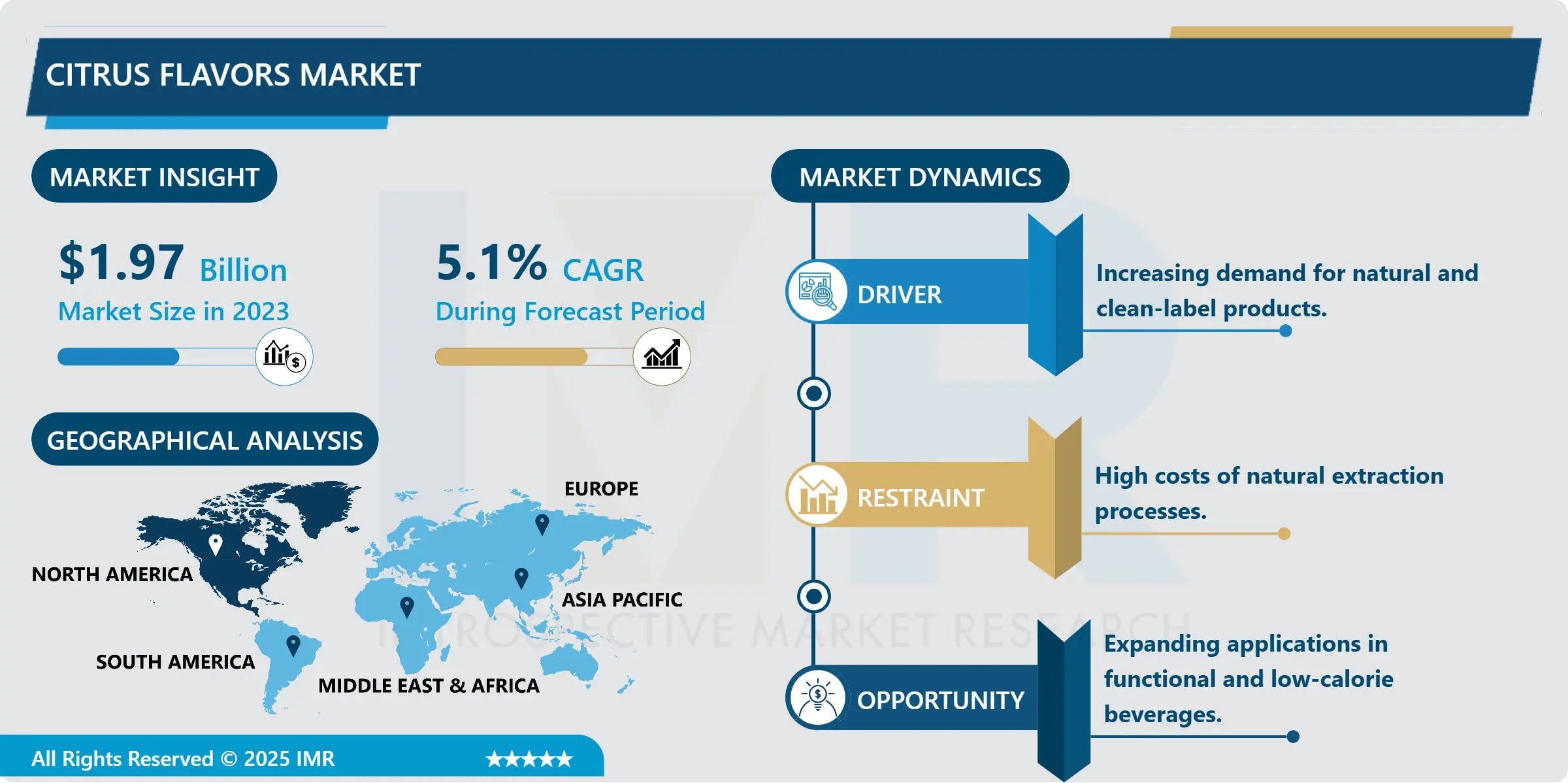
Citrus Flavors Market Trend Analysis:
Growing Demand for Natural and Organic Citrus Flavors
- The demand for natural and organic citrus flavors has been growing rapidly, driven by consumer preferences for clean labels and products without artificial additives. This trend reflects an increasing focus on sustainability and health, with many consumers opting for food and beverages made from natural ingredients. The need for naturally extracted citric acid, sourced exclusively from organic citrus fruits, has risen as people seek alternatives that do not contain artificial preservatives.
- To meet this shift in consumer behavior, top producers have embraced advanced technology to enhance the extraction of natural citrus flavors. By utilizing innovative techniques, they are able to fulfill the complex market demands of clients who prioritize authenticity and health-conscious options in their products.
Rising Demand in Functional Beverages
- The growing demand for functional beverages has become a key driver in the citrus flavors market, particularly for enhanced and flavored waters that incorporate functional ingredients. As consumers seek beverages that offer hydration, energy, and added nutrients, citrus flavors have emerged as a popular choice. These refreshing, tangy profiles are ideal for products like sports drinks, herbal teas, and probiotic beverages, where both taste and health benefits are essential. The appeal of citrus flavors lies in their ability to provide a balance of flavor and functional ingredients, making them a favored addition to health-conscious product lines.
- The increasing global focus on healthier lifestyles presents a significant opportunity for the citrus flavor segment. As more consumers prioritize wellness, the demand for beverages that combine taste with potential health benefits is expected to grow. This shift in consumer preferences is driving innovation and expanding the market for citrus-flavored functional drinks. As a result, the potential for continued growth in this category remains strong, with the promise of new product developments to meet the needs of health-conscious individuals.
Citrus Flavors Market Segment Analysis:
Citrus Flavors Market is Segmented on the basis of Ingredient, Application, and Region.
By Ingredient, Natural segment is expected to dominate the market during the forecast period
- By extension, the market is expected to be divided into four segments namely Traditional segment, Clean-label segment and CVD segment, Natural segment outcompeting all the other segments in terms of growth within the forecast period due to increasing consumer preference for products made without the use of chemicals. Natural citrus flavour ants suit the new food reality of ‘phoney free foods’, food free from chemical additives and produced with consideration for the environment.
- The proven health benefit associated with natural citrus and steady advances in extraction techniques render the use of hi-aloof citrus in food and beverages globally viable. New tendencies towards natural products have not only elevated leadership of the natural segment in the eyes of the consumers but also progressed even further.
By Application, the Beverage segment expected to hold the largest share
- From the above figures, Beverage also accounts for the largest market share in the citrus flavors market by application and the growth in this area will be higher in the future. Citrus because they make soft drinks, flavored water products, energy drinks, functional drinks and naturally flavored carbonated beverages refreshing and sour.
- The ever-increasing trend of adoption of healthy practices has been seen to be reflected in the drinks and due to the increased demand, lemon and other natural fruit flavors in the drinks have been widely accepted by the consumers. This growth is further bolstered by new RTD products and low-calorie flavoured beverage product segments, of which citrus is a popular citrus flavour.
Citrus Flavors Market Regional Insights:
North America is Expected to Dominate the Market Over the Forecast period
- The dominant position is due to the continuous demand of citrus flavored products in foods and beverages in the key markets of the region and well-positioned key stakeholders. The position of the US Rabit is highly conducive because there is a high consumption of flavored beverages, snacks as well as confectionery products.
- Other than this, the consumer move towards natural and natural flavoring is another significant factor that contributes to the regional market growth; along with that, the advancements made in the extraction of the flavors and the positive health benefits of the natural flavors may also act as a future driver for the market. The use of citrus flavors gets a shot in the arm from the rising adoption of vegan or plant-based food diets in North America, which is why the two positions it ahead of the worldwide market. This is evident in both Canada and Mexico because enhanced urbanization and per capita consumer spending boost market potential.
Active Key Players in the Citrus Flavors Market:
- ADM (United States)
- Dohler Group (Germany)
- Firmenich SA (Switzerland)
- Frutarom Industries Ltd. (Israel)
- Givaudan (Switzerland)
- International Flavors & Fragrances Inc. (United States)
- Kerry Group (Ireland)
- McCormick & Company, Inc. (United States)
- Naturex SA (France)
- Robertet Group (France)
- Sensient Technologies Corporation (United States)
- Symrise AG (Germany)
- Takasago International Corporation (Japan)
- T. Hasegawa Co., Ltd. (Japan)
- Treatt PLC (United Kingdom), and Other Active Players
|
Global Citrus Flavors Market |
|||
|
Base Year: |
2023 |
Forecast Period: |
2024-2032 |
|
Historical Data: |
2017 to 2023 |
Market Size in 2023: |
USD 1.97 Billion |
|
Forecast Period 2024-32 CAGR: |
5.1 % |
Market Size in 2032: |
USD 3.08 Billion |
|
Segments Covered: |
By Ingredients |
|
|
|
By Application |
|
||
|
By Region |
|
||
|
Key Market Drivers: |
|
||
|
Key Market Restraints: |
|
||
|
Key Opportunities: |
|
||
|
Companies Covered in the report: |
|
||
Chapter 1: Introduction
1.1 Scope and Coverage
Chapter 2:Executive Summary
Chapter 3: Market Landscape
3.1 Market Dynamics
3.1.1 Drivers
3.1.2 Restraints
3.1.3 Opportunities
3.1.4 Challenges
3.2 Market Trend Analysis
3.3 PESTLE Analysis
3.4 Porter's Five Forces Analysis
3.5 Industry Value Chain Analysis
3.6 Ecosystem
3.7 Regulatory Landscape
3.8 Price Trend Analysis
3.9 Patent Analysis
3.10 Technology Evolution
3.11 Investment Pockets
3.12 Import-Export Analysis
Chapter 4: Citrus Flavors Market by Ingredients
4.1 Citrus Flavors Market Snapshot and Growth Engine
4.2 Citrus Flavors Market Overview
4.3 Natural
4.3.1 Introduction and Market Overview
4.3.2 Historic and Forecasted Market Size in Value USD and Volume Units (2017-2032F)
4.3.3 Key Market Trends, Growth Factors and Opportunities
4.3.4 Natural: Geographic Segmentation Analysis
4.4 Artificial
4.4.1 Introduction and Market Overview
4.4.2 Historic and Forecasted Market Size in Value USD and Volume Units (2017-2032F)
4.4.3 Key Market Trends, Growth Factors and Opportunities
4.4.4 Artificial: Geographic Segmentation Analysis
Chapter 5: Citrus Flavors Market by Application
5.1 Citrus Flavors Market Snapshot and Growth Engine
5.2 Citrus Flavors Market Overview
5.3 Beverage
5.3.1 Introduction and Market Overview
5.3.2 Historic and Forecasted Market Size in Value USD and Volume Units (2017-2032F)
5.3.3 Key Market Trends, Growth Factors and Opportunities
5.3.4 Beverage: Geographic Segmentation Analysis
5.4 Savoury
5.4.1 Introduction and Market Overview
5.4.2 Historic and Forecasted Market Size in Value USD and Volume Units (2017-2032F)
5.4.3 Key Market Trends, Growth Factors and Opportunities
5.4.4 Savoury: Geographic Segmentation Analysis
5.5 Confectionary
5.5.1 Introduction and Market Overview
5.5.2 Historic and Forecasted Market Size in Value USD and Volume Units (2017-2032F)
5.5.3 Key Market Trends, Growth Factors and Opportunities
5.5.4 Confectionary: Geographic Segmentation Analysis
5.6 Dairy
5.6.1 Introduction and Market Overview
5.6.2 Historic and Forecasted Market Size in Value USD and Volume Units (2017-2032F)
5.6.3 Key Market Trends, Growth Factors and Opportunities
5.6.4 Dairy: Geographic Segmentation Analysis
Chapter 6: Company Profiles and Competitive Analysis
6.1 Competitive Landscape
6.1.1 Competitive Benchmarking
6.1.2 Citrus Flavors Market Share by Manufacturer (2023)
6.1.3 Industry BCG Matrix
6.1.4 Heat Map Analysis
6.1.5 Mergers and Acquisitions
6.2 ADM (UNITED STATES)
6.2.1 Company Overview
6.2.2 Key Executives
6.2.3 Company Snapshot
6.2.4 Role of the Company in the Market
6.2.5 Sustainability and Social Responsibility
6.2.6 Operating Business Segments
6.2.7 Product Portfolio
6.2.8 Business Performance
6.2.9 Key Strategic Moves and Recent Developments
6.2.10 SWOT Analysis
6.3 DOHLER GROUP (GERMANY)
6.4 FIRMENICH SA (SWITZERLAND)
6.5 FRUTAROM INDUSTRIES LTD. (ISRAEL)
6.6 GIVAUDAN (SWITZERLAND)
6.7 INTERNATIONAL FLAVORS & FRAGRANCES INC. (UNITED STATES)
6.8 KERRY GROUP (IRELAND)
6.9 MCCORMICK & COMPANY INC. (UNITED STATES)
6.10 NATUREX SA (FRANCE)
6.11 ROBERTET GROUP (FRANCE)
6.12 SENSIENT TECHNOLOGIES CORPORATION (UNITED STATES)
6.13 SYMRISE AG (GERMANY)
6.14 TAKASAGO INTERNATIONAL CORPORATION (JAPAN)
6.15 T. HASEGAWA CO. LTD. (JAPAN)
6.16 TREATT PLC (UNITED KINGDOM)
6.17 OTHER ACTIVE PLAYERS
Chapter 7: Global Citrus Flavors Market By Region
7.1 Overview
7.2. North America Citrus Flavors Market
7.2.1 Key Market Trends, Growth Factors and Opportunities
7.2.2 Top Key Companies
7.2.3 Historic and Forecasted Market Size by Segments
7.2.4 Historic and Forecasted Market Size By Ingredients
7.2.4.1 Natural
7.2.4.2 Artificial
7.2.5 Historic and Forecasted Market Size By Application
7.2.5.1 Beverage
7.2.5.2 Savoury
7.2.5.3 Confectionary
7.2.5.4 Dairy
7.2.6 Historic and Forecast Market Size by Country
7.2.6.1 US
7.2.6.2 Canada
7.2.6.3 Mexico
7.3. Eastern Europe Citrus Flavors Market
7.3.1 Key Market Trends, Growth Factors and Opportunities
7.3.2 Top Key Companies
7.3.3 Historic and Forecasted Market Size by Segments
7.3.4 Historic and Forecasted Market Size By Ingredients
7.3.4.1 Natural
7.3.4.2 Artificial
7.3.5 Historic and Forecasted Market Size By Application
7.3.5.1 Beverage
7.3.5.2 Savoury
7.3.5.3 Confectionary
7.3.5.4 Dairy
7.3.6 Historic and Forecast Market Size by Country
7.3.6.1 Russia
7.3.6.2 Bulgaria
7.3.6.3 The Czech Republic
7.3.6.4 Hungary
7.3.6.5 Poland
7.3.6.6 Romania
7.3.6.7 Rest of Eastern Europe
7.4. Western Europe Citrus Flavors Market
7.4.1 Key Market Trends, Growth Factors and Opportunities
7.4.2 Top Key Companies
7.4.3 Historic and Forecasted Market Size by Segments
7.4.4 Historic and Forecasted Market Size By Ingredients
7.4.4.1 Natural
7.4.4.2 Artificial
7.4.5 Historic and Forecasted Market Size By Application
7.4.5.1 Beverage
7.4.5.2 Savoury
7.4.5.3 Confectionary
7.4.5.4 Dairy
7.4.6 Historic and Forecast Market Size by Country
7.4.6.1 Germany
7.4.6.2 UK
7.4.6.3 France
7.4.6.4 The Netherlands
7.4.6.5 Italy
7.4.6.6 Spain
7.4.6.7 Rest of Western Europe
7.5. Asia Pacific Citrus Flavors Market
7.5.1 Key Market Trends, Growth Factors and Opportunities
7.5.2 Top Key Companies
7.5.3 Historic and Forecasted Market Size by Segments
7.5.4 Historic and Forecasted Market Size By Ingredients
7.5.4.1 Natural
7.5.4.2 Artificial
7.5.5 Historic and Forecasted Market Size By Application
7.5.5.1 Beverage
7.5.5.2 Savoury
7.5.5.3 Confectionary
7.5.5.4 Dairy
7.5.6 Historic and Forecast Market Size by Country
7.5.6.1 China
7.5.6.2 India
7.5.6.3 Japan
7.5.6.4 South Korea
7.5.6.5 Malaysia
7.5.6.6 Thailand
7.5.6.7 Vietnam
7.5.6.8 The Philippines
7.5.6.9 Australia
7.5.6.10 New Zealand
7.5.6.11 Rest of APAC
7.6. Middle East & Africa Citrus Flavors Market
7.6.1 Key Market Trends, Growth Factors and Opportunities
7.6.2 Top Key Companies
7.6.3 Historic and Forecasted Market Size by Segments
7.6.4 Historic and Forecasted Market Size By Ingredients
7.6.4.1 Natural
7.6.4.2 Artificial
7.6.5 Historic and Forecasted Market Size By Application
7.6.5.1 Beverage
7.6.5.2 Savoury
7.6.5.3 Confectionary
7.6.5.4 Dairy
7.6.6 Historic and Forecast Market Size by Country
7.6.6.1 Turkiye
7.6.6.2 Bahrain
7.6.6.3 Kuwait
7.6.6.4 Saudi Arabia
7.6.6.5 Qatar
7.6.6.6 UAE
7.6.6.7 Israel
7.6.6.8 South Africa
7.7. South America Citrus Flavors Market
7.7.1 Key Market Trends, Growth Factors and Opportunities
7.7.2 Top Key Companies
7.7.3 Historic and Forecasted Market Size by Segments
7.7.4 Historic and Forecasted Market Size By Ingredients
7.7.4.1 Natural
7.7.4.2 Artificial
7.7.5 Historic and Forecasted Market Size By Application
7.7.5.1 Beverage
7.7.5.2 Savoury
7.7.5.3 Confectionary
7.7.5.4 Dairy
7.7.6 Historic and Forecast Market Size by Country
7.7.6.1 Brazil
7.7.6.2 Argentina
7.7.6.3 Rest of SA
Chapter 8 Analyst Viewpoint and Conclusion
8.1 Recommendations and Concluding Analysis
8.2 Potential Market Strategies
Chapter 9 Research Methodology
9.1 Research Process
9.2 Primary Research
9.3 Secondary Research
|
Global Citrus Flavors Market |
|||
|
Base Year: |
2023 |
Forecast Period: |
2024-2032 |
|
Historical Data: |
2017 to 2023 |
Market Size in 2023: |
USD 1.97 Billion |
|
Forecast Period 2024-32 CAGR: |
5.1 % |
Market Size in 2032: |
USD 3.08 Billion |
|
Segments Covered: |
By Ingredients |
|
|
|
By Application |
|
||
|
By Region |
|
||
|
Key Market Drivers: |
|
||
|
Key Market Restraints: |
|
||
|
Key Opportunities: |
|
||
|
Companies Covered in the report: |
|
||


