




Calcium Channel Blocker Drugs Market Synopsis:
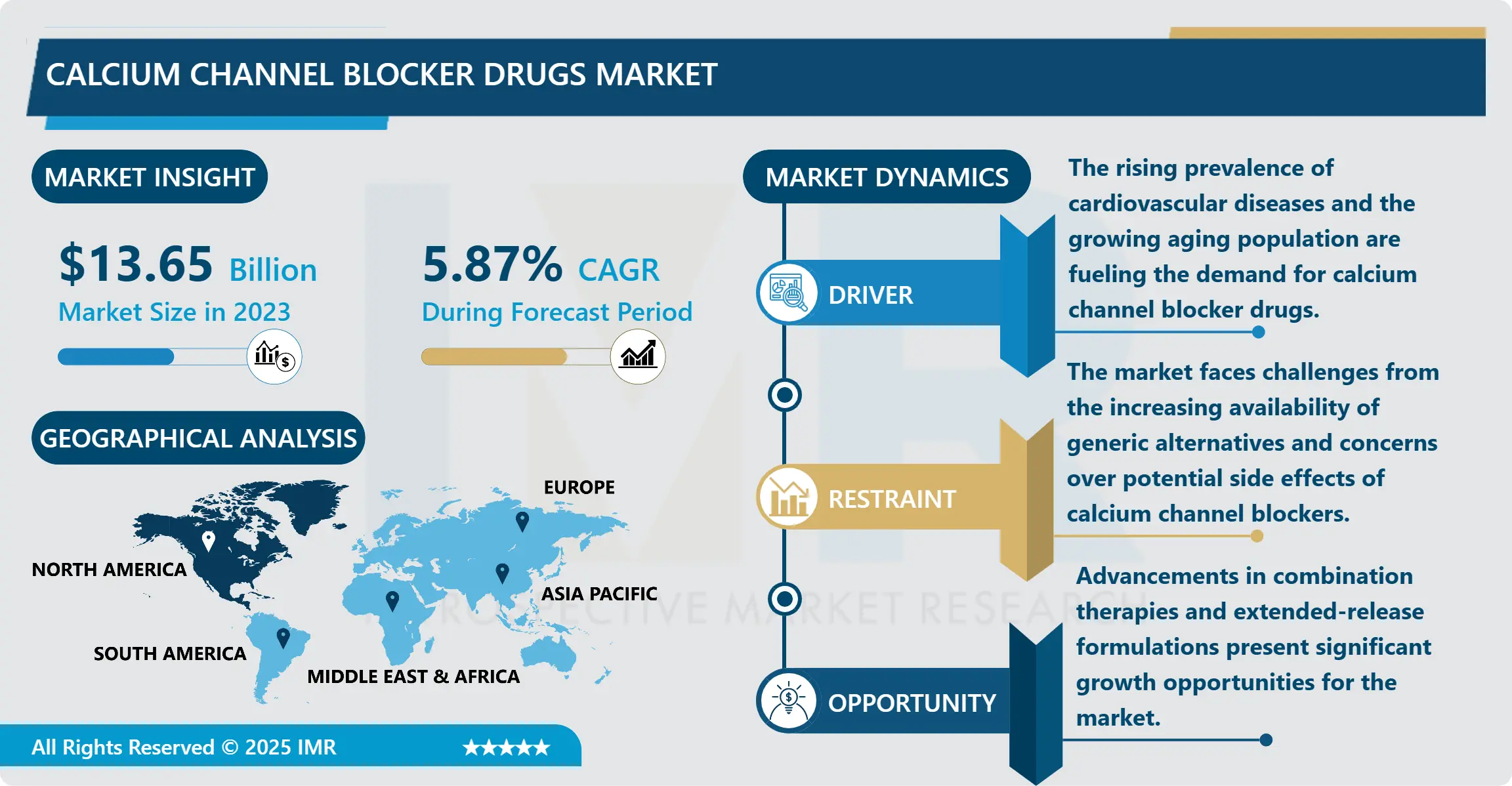
Calcium Channel Blocker Drugs Market Size Was Valued at USD 13.65 Billion in 2023, and is Projected to Reach USD 20.02 Billion by 2032, Growing at a CAGR of 5.87% From 2024-2032.
The Calcium Channel Blocker (CCB) Drugs Market refers to the global industry focused on the production, distribution, and sale of medications that inhibit calcium ion flow into heart and blood vessel cells. These drugs are primarily used to treat hypertension, angina, and certain arrhythmias, supporting cardiovascular health management.
The CCB drugs fast growing due to increasing cases of cardiovascular diseases such as hypertension and angina pectoris. There is rather different action type of calcium channel blockers; such as amlodipine, verapamil, diltiazem that lowers the calcium ions penetration in the smooth muscles of the heart and blood vessels because of the slow rate of beating, low blood pressure, and increased blood flow. Calcium channel blocker drugs must follow the given tendencies, firstly, due to the steady growth in the number of people experiencing heart diseases in the whole world; secondly, as the population ages. NA and EU has a relatively higher usage of these drugs due to the good health care system and these regions consists of more population that is having chronic diseases. Further, the pursuit of new formula and combination therapy is also stimulating the market for the simple reason that health care professional, get better treatment options.
Several restrains has also been identified which may slow down the growth rate of the market in near future including Regulatory issues and side effect linked with some of the Calcium channel blockers, increase in demand of ACE inhibitors and beta blockers therapies etc. Nevertheless, some of these factors remain valid in that they continue to be significant drivers of the slow growth of the calcium channel blocker drugs marketOn the other hand, the rising awareness of cardiovascular disease and the indefinite enhancement of the production of new drugs hold out future growth potential for the calcium channel blocker drugs market.
Calcium Channel Blocker Drugs Market Trend Analysis:
Growing Preference for Combination Therapies
-
The growing preference for combination therapies is a significant driver in the Calcium Channel Blocker Drugs Market. Healthcare providers increasingly favor treatment regimens that combine calcium channel blockers with other drug classes, such as ACE inhibitors or diuretics, to improve clinical outcomes. These combination therapies offer enhanced efficacy, better patient compliance, and simplified treatment protocols, especially for chronic conditions like hypertension and angina. This trend is encouraging pharmaceutical companies to invest in the development and marketing of fixed-dose combination products.
- Moreover, the rising prevalence of cardiovascular diseases globally is amplifying demand for more comprehensive treatment solutions. Combination therapies not only address multiple pathways of disease progression but also reduce the pill burden on patients, leading to higher adherence rates. As a result, the expanding use of multi-drug approaches is expected to boost the growth of the Calcium Channel Blocker Drugs Market over the coming years.
Rising Focus on Extended-Release Formulations
-
The growing focus on extended-release formulations presents a significant opportunity in the Calcium Channel Blocker (CCB) drugs market. Extended-release formulations offer several advantages, including improved patient compliance due to reduced dosing frequency, stable blood drug levels, and minimized side effects. As patients with chronic conditions like hypertension, angina, and arrhythmias require long-term treatment, these formulations enhance the overall effectiveness and convenience of CCBs, making them more appealing in the healthcare sector.
- With increasing demand for chronic disease management, the shift towards extended-release formulations is expected to drive growth in the CCB market. Pharmaceutical companies are investing in research and development to enhance drug efficacy and reduce side effects, contributing to the rising adoption of extended-release versions. This trend opens opportunities for market expansion and innovation, positioning extended-release CCBs as a key solution for patients requiring long-term care.
Calcium Channel Blocker Drugs Market Segment Analysis:
Calcium Channel Blocker Drugs Market Segmented on the basis of Drug Class, Disease Indication, Distribution Channel, and Region
By Drug Class, Benzothizepine segment is expected to dominate the market during the forecast period
-
The calcium channel blocker (CCB) drugs market is segmented by drug class into three main categories: The main categories of calcium channel blockers are; benzothiazepine, dihydropyridine and phenylalkylamine. The benzothiazepine group of drugs like the diltiazem is normally prescribed for the management of hypertension and angina pectororis because of its dual action on the heart and the blood vessel.
- Dihydropyridine derivatives, for example, amlodipine and nifedipine get anchored mainly to the blood vessels and causes the dilation of blood vessels and a decrease in blood pressure and is commonly used in hypertension and coronaries aery diseases. Phenylalkylamine drugs in particular verapamil are used in the treatment of arrhythmias and hypertension but these exert a negative inotropic effect and negatively depress the cardiac function involving rate and contractility. The three classes include patients with different conditions, and the efficacy also depends on the type of cardiovascular disease.
By Distribution Channel, Hospital Pharmacy segment expected to held the largest share
-
Distribution channels continue to play an important role in ensuring that calcium channel blocker drugs get to the patients in the market human particularly the elderly. The hospitals are a powerful channel since their pharmacies distribute drugs to patients who have acute and chronic cardiovascular conditions undergoing in- or outpatient care and needing a wide range of CCBs.
- The other important factor that retail pharmacies provide is availing these to patients who may need to come for refill their prescriptions or maybe buying other non-prescription ones. Furthermore, the online pharmacies can be also considered as an addition of a distribution channel because receiving the medications at home is possible, and the prices can be lower accordingly. Increased usage of e-commerce to conduct sales especially in the Pharmacy segment caused by COVID -19 pandemic will boost the online Pharmacy segment hence making the CCBs more accessible to more patient population.
Calcium Channel Blocker Drugs Market Regional Insights:
North America is Expected to Dominate the Market Over the Forecast period
-
Speaking about regional markets, the researchers expect that North America will lead the calcium channel blocker drugs market in the future, as cardiovascular diseases, including hypertension and angina, are most prevalent there. Health care being well developed, backed by potential research and development in the field with strong base of pharmaceutical companies, catalyse the growth of this market.
- Growth is expected in combination therapies and extended-release formulations, where the calcium channel blockers will be used. The regional is likely to maintain its leadership in this market due to a large aging population and many cardiovascular patients seeking an effective treatment for chronic condition.
Active Key Players in the Calcium Channel Blocker Drugs Market
- Bausch Health (Canada)
- Mylan N.V. (U.S.)
- Teva Pharmaceutical Industries Ltd (Israel)
- Sun Pharmaceutical Industries Ltd (India)
- Novartis AG (U.S.)
- Zydus Group (India)
- Pfizer Inc (U.S.)
- Lupin (India)
- GSK Plc (U.K.
- Sofgen (U.S.)
- Glenmark Pharmaceuticals Inc (India)
- Amneal Pharmaceuticals (U.S.)
- Covis Pharma GmbH (Switzerland)
- Other Active Players
|
Calcium Channel Blocker Drugs Market |
|||
|
Base Year: |
2023 |
Forecast Period: |
2024-2032 |
|
Historical Data: |
2017 to 2023 |
Market Size in 2023: |
USD 13.65 Billion |
|
Forecast Period 2024-32 CAGR: |
5.87% |
Market Size in 2032: |
USD 20.02 Billion |
|
Segments Covered: |
By Drug Class |
|
|
|
By Disease Indication |
|
||
|
By Distribution Channel |
|
||
|
By Region |
|
||
|
Key Market Drivers: |
|
||
|
Key Market Restraints: |
|
||
|
Key Opportunities: |
|
||
|
Companies Covered in the report: |
|
||
Chapter 1: Introduction
1.1 Scope and Coverage
Chapter 2:Executive Summary
Chapter 3: Market Landscape
3.1 Market Dynamics
3.1.1 Drivers
3.1.2 Restraints
3.1.3 Opportunities
3.1.4 Challenges
3.2 Market Trend Analysis
3.3 PESTLE Analysis
3.4 Porter's Five Forces Analysis
3.5 Industry Value Chain Analysis
3.6 Ecosystem
3.7 Regulatory Landscape
3.8 Price Trend Analysis
3.9 Patent Analysis
3.10 Technology Evolution
3.11 Investment Pockets
3.12 Import-Export Analysis
Chapter 4: Calcium Channel Blocker Drugs Market by Drug Class
4.1 Calcium Channel Blocker Drugs Market Snapshot and Growth Engine
4.2 Calcium Channel Blocker Drugs Market Overview
4.3 Benzothizepine
4.3.1 Introduction and Market Overview
4.3.2 Historic and Forecasted Market Size in Value USD and Volume Units (2017-2032F)
4.3.3 Key Market Trends, Growth Factors and Opportunities
4.3.4 Benzothizepine: Geographic Segmentation Analysis
4.4 Dihydropyridine and Phenylalkylamine
4.4.1 Introduction and Market Overview
4.4.2 Historic and Forecasted Market Size in Value USD and Volume Units (2017-2032F)
4.4.3 Key Market Trends, Growth Factors and Opportunities
4.4.4 Dihydropyridine and Phenylalkylamine: Geographic Segmentation Analysis
Chapter 5: Calcium Channel Blocker Drugs Market by Disease Indication
5.1 Calcium Channel Blocker Drugs Market Snapshot and Growth Engine
5.2 Calcium Channel Blocker Drugs Market Overview
5.3 Hypertension
5.3.1 Introduction and Market Overview
5.3.2 Historic and Forecasted Market Size in Value USD and Volume Units (2017-2032F)
5.3.3 Key Market Trends, Growth Factors and Opportunities
5.3.4 Hypertension: Geographic Segmentation Analysis
5.4 Chest Pain
5.4.1 Introduction and Market Overview
5.4.2 Historic and Forecasted Market Size in Value USD and Volume Units (2017-2032F)
5.4.3 Key Market Trends, Growth Factors and Opportunities
5.4.4 Chest Pain: Geographic Segmentation Analysis
5.5 Arrhythmias
5.5.1 Introduction and Market Overview
5.5.2 Historic and Forecasted Market Size in Value USD and Volume Units (2017-2032F)
5.5.3 Key Market Trends, Growth Factors and Opportunities
5.5.4 Arrhythmias: Geographic Segmentation Analysis
5.6 and Others (Blood vessel conditions
5.6.1 Introduction and Market Overview
5.6.2 Historic and Forecasted Market Size in Value USD and Volume Units (2017-2032F)
5.6.3 Key Market Trends, Growth Factors and Opportunities
5.6.4 and Others (Blood vessel conditions: Geographic Segmentation Analysis
5.7 coronary artery disease etc.
5.7.1 Introduction and Market Overview
5.7.2 Historic and Forecasted Market Size in Value USD and Volume Units (2017-2032F)
5.7.3 Key Market Trends, Growth Factors and Opportunities
5.7.4 coronary artery disease etc.: Geographic Segmentation Analysis
Chapter 6: Calcium Channel Blocker Drugs Market by Distribution Channel
6.1 Calcium Channel Blocker Drugs Market Snapshot and Growth Engine
6.2 Calcium Channel Blocker Drugs Market Overview
6.3 Hospital Pharmacy
6.3.1 Introduction and Market Overview
6.3.2 Historic and Forecasted Market Size in Value USD and Volume Units (2017-2032F)
6.3.3 Key Market Trends, Growth Factors and Opportunities
6.3.4 Hospital Pharmacy: Geographic Segmentation Analysis
6.4 Retail Pharmacy
6.4.1 Introduction and Market Overview
6.4.2 Historic and Forecasted Market Size in Value USD and Volume Units (2017-2032F)
6.4.3 Key Market Trends, Growth Factors and Opportunities
6.4.4 Retail Pharmacy: Geographic Segmentation Analysis
6.5 and Online Pharmacy
6.5.1 Introduction and Market Overview
6.5.2 Historic and Forecasted Market Size in Value USD and Volume Units (2017-2032F)
6.5.3 Key Market Trends, Growth Factors and Opportunities
6.5.4 and Online Pharmacy: Geographic Segmentation Analysis
Chapter 7: Company Profiles and Competitive Analysis
7.1 Competitive Landscape
7.1.1 Competitive Benchmarking
7.1.2 Calcium Channel Blocker Drugs Market Share by Manufacturer (2023)
7.1.3 Industry BCG Matrix
7.1.4 Heat Map Analysis
7.1.5 Mergers and Acquisitions
7.2 BAUSCH HEALTH (CANADA)
7.2.1 Company Overview
7.2.2 Key Executives
7.2.3 Company Snapshot
7.2.4 Role of the Company in the Market
7.2.5 Sustainability and Social Responsibility
7.2.6 Operating Business Segments
7.2.7 Product Portfolio
7.2.8 Business Performance
7.2.9 Key Strategic Moves and Recent Developments
7.2.10 SWOT Analysis
7.3 MYLAN N.V. (U.S.)
7.4 TEVA PHARMACEUTICAL INDUSTRIES LTD (ISRAEL)
7.5 SUN PHARMACEUTICAL INDUSTRIES LTD (INDIA)
7.6 NOVARTIS AG (U.S.)
7.7 ZYDUS GROUP (INDIA)
7.8 PFIZER INC (U.S.)
7.9 LUPIN (INDIA)
7.10 GSK PLC (U.K.)
7.11 SOFGEN (U.S.)
7.12 GLENMARK PHARMACEUTICALS INC (INDIA)
7.13 AMNEAL PHARMACEUTICALS (U.S.)
7.14 COVIS PHARMA GMBH (SWITZERLAND)
7.15 OTHER ACTIVE PLAYERS
Chapter 8: Global Calcium Channel Blocker Drugs Market By Region
8.1 Overview
8.2. North America Calcium Channel Blocker Drugs Market
8.2.1 Key Market Trends, Growth Factors and Opportunities
8.2.2 Top Key Companies
8.2.3 Historic and Forecasted Market Size by Segments
8.2.4 Historic and Forecasted Market Size By Drug Class
8.2.4.1 Benzothizepine
8.2.4.2 Dihydropyridine and Phenylalkylamine
8.2.5 Historic and Forecasted Market Size By Disease Indication
8.2.5.1 Hypertension
8.2.5.2 Chest Pain
8.2.5.3 Arrhythmias
8.2.5.4 and Others (Blood vessel conditions
8.2.5.5 coronary artery disease etc.
8.2.6 Historic and Forecasted Market Size By Distribution Channel
8.2.6.1 Hospital Pharmacy
8.2.6.2 Retail Pharmacy
8.2.6.3 and Online Pharmacy
8.2.7 Historic and Forecast Market Size by Country
8.2.7.1 US
8.2.7.2 Canada
8.2.7.3 Mexico
8.3. Eastern Europe Calcium Channel Blocker Drugs Market
8.3.1 Key Market Trends, Growth Factors and Opportunities
8.3.2 Top Key Companies
8.3.3 Historic and Forecasted Market Size by Segments
8.3.4 Historic and Forecasted Market Size By Drug Class
8.3.4.1 Benzothizepine
8.3.4.2 Dihydropyridine and Phenylalkylamine
8.3.5 Historic and Forecasted Market Size By Disease Indication
8.3.5.1 Hypertension
8.3.5.2 Chest Pain
8.3.5.3 Arrhythmias
8.3.5.4 and Others (Blood vessel conditions
8.3.5.5 coronary artery disease etc.
8.3.6 Historic and Forecasted Market Size By Distribution Channel
8.3.6.1 Hospital Pharmacy
8.3.6.2 Retail Pharmacy
8.3.6.3 and Online Pharmacy
8.3.7 Historic and Forecast Market Size by Country
8.3.7.1 Russia
8.3.7.2 Bulgaria
8.3.7.3 The Czech Republic
8.3.7.4 Hungary
8.3.7.5 Poland
8.3.7.6 Romania
8.3.7.7 Rest of Eastern Europe
8.4. Western Europe Calcium Channel Blocker Drugs Market
8.4.1 Key Market Trends, Growth Factors and Opportunities
8.4.2 Top Key Companies
8.4.3 Historic and Forecasted Market Size by Segments
8.4.4 Historic and Forecasted Market Size By Drug Class
8.4.4.1 Benzothizepine
8.4.4.2 Dihydropyridine and Phenylalkylamine
8.4.5 Historic and Forecasted Market Size By Disease Indication
8.4.5.1 Hypertension
8.4.5.2 Chest Pain
8.4.5.3 Arrhythmias
8.4.5.4 and Others (Blood vessel conditions
8.4.5.5 coronary artery disease etc.
8.4.6 Historic and Forecasted Market Size By Distribution Channel
8.4.6.1 Hospital Pharmacy
8.4.6.2 Retail Pharmacy
8.4.6.3 and Online Pharmacy
8.4.7 Historic and Forecast Market Size by Country
8.4.7.1 Germany
8.4.7.2 UK
8.4.7.3 France
8.4.7.4 The Netherlands
8.4.7.5 Italy
8.4.7.6 Spain
8.4.7.7 Rest of Western Europe
8.5. Asia Pacific Calcium Channel Blocker Drugs Market
8.5.1 Key Market Trends, Growth Factors and Opportunities
8.5.2 Top Key Companies
8.5.3 Historic and Forecasted Market Size by Segments
8.5.4 Historic and Forecasted Market Size By Drug Class
8.5.4.1 Benzothizepine
8.5.4.2 Dihydropyridine and Phenylalkylamine
8.5.5 Historic and Forecasted Market Size By Disease Indication
8.5.5.1 Hypertension
8.5.5.2 Chest Pain
8.5.5.3 Arrhythmias
8.5.5.4 and Others (Blood vessel conditions
8.5.5.5 coronary artery disease etc.
8.5.6 Historic and Forecasted Market Size By Distribution Channel
8.5.6.1 Hospital Pharmacy
8.5.6.2 Retail Pharmacy
8.5.6.3 and Online Pharmacy
8.5.7 Historic and Forecast Market Size by Country
8.5.7.1 China
8.5.7.2 India
8.5.7.3 Japan
8.5.7.4 South Korea
8.5.7.5 Malaysia
8.5.7.6 Thailand
8.5.7.7 Vietnam
8.5.7.8 The Philippines
8.5.7.9 Australia
8.5.7.10 New Zealand
8.5.7.11 Rest of APAC
8.6. Middle East & Africa Calcium Channel Blocker Drugs Market
8.6.1 Key Market Trends, Growth Factors and Opportunities
8.6.2 Top Key Companies
8.6.3 Historic and Forecasted Market Size by Segments
8.6.4 Historic and Forecasted Market Size By Drug Class
8.6.4.1 Benzothizepine
8.6.4.2 Dihydropyridine and Phenylalkylamine
8.6.5 Historic and Forecasted Market Size By Disease Indication
8.6.5.1 Hypertension
8.6.5.2 Chest Pain
8.6.5.3 Arrhythmias
8.6.5.4 and Others (Blood vessel conditions
8.6.5.5 coronary artery disease etc.
8.6.6 Historic and Forecasted Market Size By Distribution Channel
8.6.6.1 Hospital Pharmacy
8.6.6.2 Retail Pharmacy
8.6.6.3 and Online Pharmacy
8.6.7 Historic and Forecast Market Size by Country
8.6.7.1 Turkiye
8.6.7.2 Bahrain
8.6.7.3 Kuwait
8.6.7.4 Saudi Arabia
8.6.7.5 Qatar
8.6.7.6 UAE
8.6.7.7 Israel
8.6.7.8 South Africa
8.7. South America Calcium Channel Blocker Drugs Market
8.7.1 Key Market Trends, Growth Factors and Opportunities
8.7.2 Top Key Companies
8.7.3 Historic and Forecasted Market Size by Segments
8.7.4 Historic and Forecasted Market Size By Drug Class
8.7.4.1 Benzothizepine
8.7.4.2 Dihydropyridine and Phenylalkylamine
8.7.5 Historic and Forecasted Market Size By Disease Indication
8.7.5.1 Hypertension
8.7.5.2 Chest Pain
8.7.5.3 Arrhythmias
8.7.5.4 and Others (Blood vessel conditions
8.7.5.5 coronary artery disease etc.
8.7.6 Historic and Forecasted Market Size By Distribution Channel
8.7.6.1 Hospital Pharmacy
8.7.6.2 Retail Pharmacy
8.7.6.3 and Online Pharmacy
8.7.7 Historic and Forecast Market Size by Country
8.7.7.1 Brazil
8.7.7.2 Argentina
8.7.7.3 Rest of SA
Chapter 9 Analyst Viewpoint and Conclusion
9.1 Recommendations and Concluding Analysis
9.2 Potential Market Strategies
Chapter 10 Research Methodology
10.1 Research Process
10.2 Primary Research
10.3 Secondary Research
|
Calcium Channel Blocker Drugs Market |
|||
|
Base Year: |
2023 |
Forecast Period: |
2024-2032 |
|
Historical Data: |
2017 to 2023 |
Market Size in 2023: |
USD 13.65 Billion |
|
Forecast Period 2024-32 CAGR: |
5.87% |
Market Size in 2032: |
USD 20.02 Billion |
|
Segments Covered: |
By Drug Class |
|
|
|
By Disease Indication |
|
||
|
By Distribution Channel |
|
||
|
By Region |
|
||
|
Key Market Drivers: |
|
||
|
Key Market Restraints: |
|
||
|
Key Opportunities: |
|
||
|
Companies Covered in the report: |
|
||


