




Bulimia Nervosa Treatment Market Synopsis:
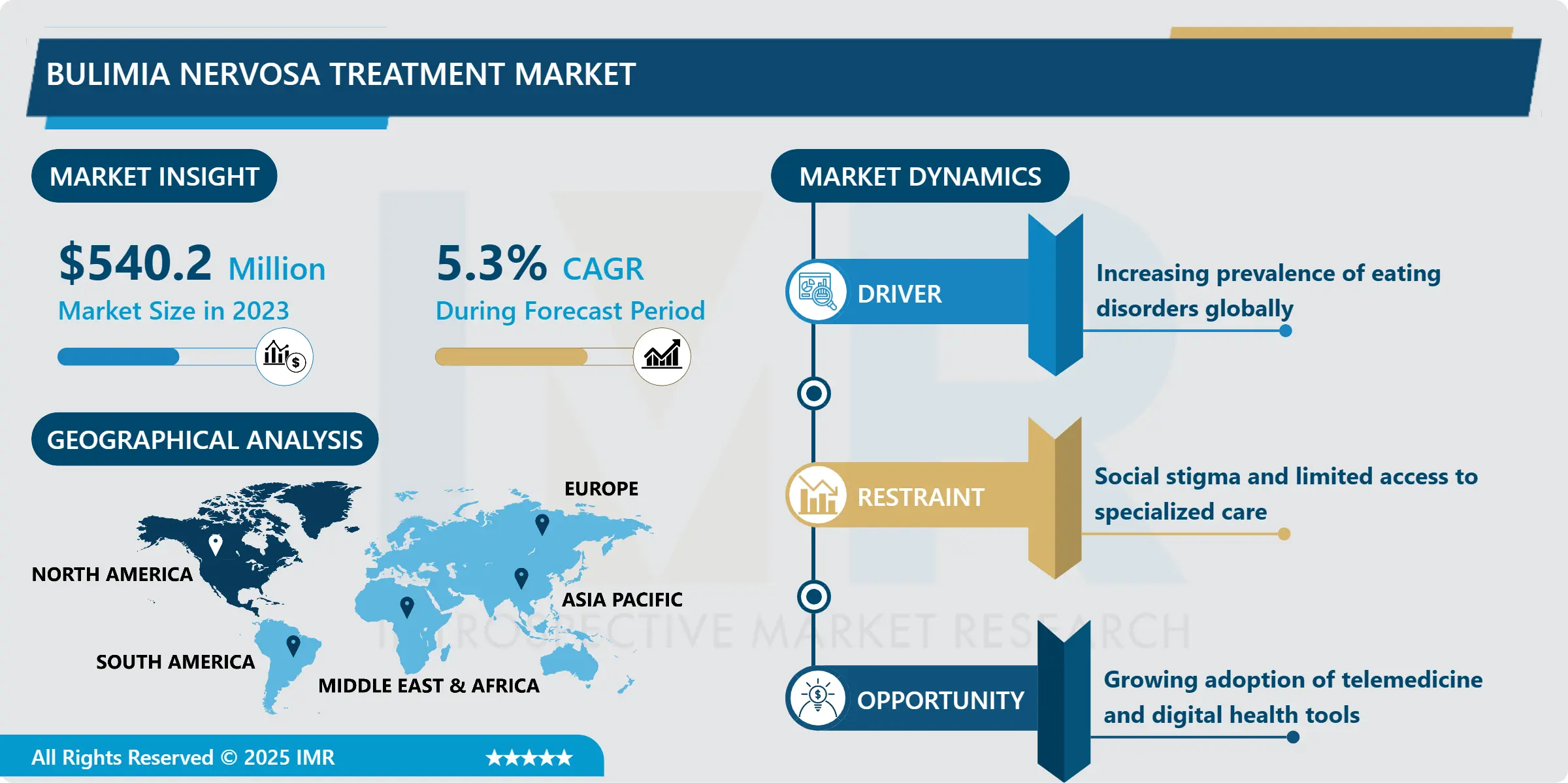
Bulimia Nervosa Treatment Market Size Was Valued at USD 540.2 Million in 2023, and is Projected to Reach USD 859.8 Million by 2032, Growing at a CAGR of 5.3% From 2024-2032.
The Bulimia Nervosa Treatment Market thus refers to any medical and therapeutic approach for the treatment of bulimia nervosa which is an eating disorder characterized by one or more episodes of binge eating punctuated by self-induced vomiting or by the use of laxatives, fasting or excessive exercising.
The Global Bulimia Nervosa Treatment Market was growing at a slower pace, due to low mental health awareness; however, with the advancement of new treatments and increase in mental health awareness globally the market is expected to grow rapidly. Increased awareness of governments and healthcare facilities to eating disorder has also resulted in increased funding to research on the disease and more treatment centres. Dieting with primary focus on disorders such as bulimia nervosa that affect women and sometimes men, takes medical treatment with medications, psychotherapy, and changes in lifestyle. The increasing use of EBP oriented therapies including CBT in correcting the disorder together with the pharmacological interventions is also positively influencing the market expansion.
New targeted drugs for mood and appetite, for example, have provided a necessary dimension to the treatment regimens. Telemedicine service offering has extended the market to patients who due to the location can regulate therapy. However, there are still problems: provide the clients with additional attention and care, prejudices against mental illness, and a lack of qualified assistance in the developing countries. Moreso, the market is likely to grow as stigma associated with diseases, treatment and prevention decreases due to awareness campaigns and other health promotion activities.
Bulimia Nervosa Treatment Market Trend Analysis:
Personalized Medicine Revolutionizing Bulimia Nervosa Treatment
-
Analyses have also highlighted that precision method or popularly known as Personalized medicine is set to be a revolutionary theme in the Bulimia Nervosa Treatment Market. Given that a patient’s response to treatment depends on their gender, age, ancestry, and other conditions they have, such as diabetes, healthcare personnel can improve results from therapy.
- Greater specification of medication through pharmacogenomic breakthroughs as well as sophisticated behavioural observations are possible. It has not only raised the recovery rates, but also tended to minimize the problem of relapse – a significant issue in eating disorder treatment. Patient engagement and the use of treatment/ symptom self-reports have been further augmented and enhanced by the enhancement of various digital health applications.
Expansion in Emerging Economies
-
The expansion of emerging economies presents a significant opportunity for the bulimia nervosa treatment market. As these regions experience rising awareness about mental health and increasing healthcare access, the demand for specialized treatments, including therapy, medications, and nutritional counseling, is on the rise. Growing healthcare infrastructure, along with a shift towards more comprehensive mental health care, enables patients to access appropriate treatment options for eating disorders like bulimia nervosa.
- The increasing prevalence of bulimia nervosa, particularly among adolescents and young adults in emerging economies, is prompting healthcare providers to invest in more targeted solutions. This growing market is further supported by the increasing influence of global mental health campaigns, healthcare reforms, and the rising focus on mental well-being in these regions. As a result, stakeholders in the treatment space have a unique opportunity to cater to an underserved and expanding patient base.
Bulimia Nervosa Treatment Market Segment Analysis:
Bulimia Nervosa Treatment Market is Segmented on the basis of Treatment Type, Route of Administration, Distribution Channel, and Region
By Treatment Type, Drug Treatment segment is expected to dominate the market during the forecast period
-
Drug Treatment segment will have the largest share in the Bulimia Nervosa Treatment Market during the forecast period as this has been identified as a crucial part of managing the disorder related symptoms as like mood disorders, anxiety and depression. Such drugs as SSRIs, including fluoxetine are quite popular as they help to decrease the number of binge-purge episodes. It can be attributed to increased usage of pills as they are easy to use and have quicker effect over behavior therapy.
- With different drugs that have lesser side effects are making the segment more attractive. Also, the use of generics has enhanced access to drug treatment especially to the low middle-income countries. It is evident that more and more people seem to know about evidence based pharmacological treatments and this means that more people are going to embrace this segment thereby making it even more dominant in the market.
By Route of Administration, Oral segment expected to held the largest share
-
The Oral Route of Administration segment is expected to have the maximum market share in the overall drug delivery market; this segment is easy to administer, affordable and can be easily accessed. Tablets and capsules, for example antidepressant and appetite suppressors, are easy to administer and are well tolerated by the patients. That is because most of the first-line drugs for managing BN have been formulated in oral formats which also helps this segment.
- The progress made in the field defines the long-acting and controlled-release preparations that improve the efficacy of therapy and reduce side effects. Heath care workers prefer oral agents because of ease in managing the patients as well as the treatment plans that can be both inpatient and outpatient. This segment also benefits from advancements in telemedicine as having remote consultations enable the patient to be prescribed and receive oral medications.
Bulimia Nervosa Treatment Market Regional Insights:
North America is Expected to Dominate the Market Over the Forecast period
-
The Bulimia Nervosa Treatment market is anticipated to witness significant growth in North America over the forecast period. Factors driving this dominance include the region’s advanced healthcare infrastructure, high awareness levels regarding eating disorders, and strong support from both government and private initiatives. Furthermore, the presence of leading pharmaceutical companies and specialized treatment centers contributes to the market’s expansion, offering patients a broad range of therapeutic options.
- In addition, increasing investments in mental health research and the rising prevalence of eating disorders among the population are expected to further fuel market growth. The region’s focus on early diagnosis, innovative treatment modalities, and comprehensive insurance coverage also positions North America as a key leader in the global Bulimia Nervosa Treatment market landscape.
Active Key Players in the Bulimia Nervosa Treatment Market:
-
Acadia Healthcare (USA)
- Alkermes (Ireland)
- AstraZeneca (UK)
- Bristol-Myers Squibb (USA)
- Camurus AB (Sweden)
- Cipla Inc. (India)
- Eli Lilly and Company (USA)
- GlaxoSmithKline (UK)
- H. Lundbeck A/S (Denmark)
- Johnson & Johnson (USA)
- Merck & Co. (USA)
- Novartis (Switzerland)
- Pfizer Inc. (USA)
- Roche Holding AG (Switzerland)
- Takeda Pharmaceutical (Japan)
- Other Active Players
|
Global Bulimia Nervosa Treatment Market |
|||
|
Base Year: |
2023 |
Forecast Period: |
2024-2032 |
|
Historical Data: |
2017 to 2023 |
Market Size in 2023: |
USD 540.2 Million |
|
Forecast Period 2024-32 CAGR: |
5.3% |
Market Size in 2032: |
USD 859.8 Million |
|
Segments Covered: |
By Treatment Type |
|
|
|
By Route of Administration |
|
||
|
By Distribution Channel |
|
||
|
By Region |
|
||
|
Key Market Drivers: |
|
||
|
Key Market Restraints: |
|
||
|
Key Opportunities: |
|
||
|
Companies Covered in the report: |
|
||
Chapter 1: Introduction
1.1 Scope and Coverage
Chapter 2:Executive Summary
Chapter 3: Market Landscape
3.1 Market Dynamics
3.1.1 Drivers
3.1.2 Restraints
3.1.3 Opportunities
3.1.4 Challenges
3.2 Market Trend Analysis
3.3 PESTLE Analysis
3.4 Porter's Five Forces Analysis
3.5 Industry Value Chain Analysis
3.6 Ecosystem
3.7 Regulatory Landscape
3.8 Price Trend Analysis
3.9 Patent Analysis
3.10 Technology Evolution
3.11 Investment Pockets
3.12 Import-Export Analysis
Chapter 4: Bulimia Nervosa Treatment Market by Treatment Type
4.1 Bulimia Nervosa Treatment Market Snapshot and Growth Engine
4.2 Bulimia Nervosa Treatment Market Overview
4.3 Drug Treatment
4.3.1 Introduction and Market Overview
4.3.2 Historic and Forecasted Market Size in Value USD and Volume Units (2017-2032F)
4.3.3 Key Market Trends, Growth Factors and Opportunities
4.3.4 Drug Treatment: Geographic Segmentation Analysis
4.4 Non-drug Treatment
4.4.1 Introduction and Market Overview
4.4.2 Historic and Forecasted Market Size in Value USD and Volume Units (2017-2032F)
4.4.3 Key Market Trends, Growth Factors and Opportunities
4.4.4 Non-drug Treatment: Geographic Segmentation Analysis
Chapter 5: Bulimia Nervosa Treatment Market by Route of Administration
5.1 Bulimia Nervosa Treatment Market Snapshot and Growth Engine
5.2 Bulimia Nervosa Treatment Market Overview
5.3 Oral
5.3.1 Introduction and Market Overview
5.3.2 Historic and Forecasted Market Size in Value USD and Volume Units (2017-2032F)
5.3.3 Key Market Trends, Growth Factors and Opportunities
5.3.4 Oral: Geographic Segmentation Analysis
5.4 Intravenous
5.4.1 Introduction and Market Overview
5.4.2 Historic and Forecasted Market Size in Value USD and Volume Units (2017-2032F)
5.4.3 Key Market Trends, Growth Factors and Opportunities
5.4.4 Intravenous: Geographic Segmentation Analysis
5.5 Others
5.5.1 Introduction and Market Overview
5.5.2 Historic and Forecasted Market Size in Value USD and Volume Units (2017-2032F)
5.5.3 Key Market Trends, Growth Factors and Opportunities
5.5.4 Others: Geographic Segmentation Analysis
Chapter 6: Bulimia Nervosa Treatment Market by Distribution Channel
6.1 Bulimia Nervosa Treatment Market Snapshot and Growth Engine
6.2 Bulimia Nervosa Treatment Market Overview
6.3 Hospital Pharmacies
6.3.1 Introduction and Market Overview
6.3.2 Historic and Forecasted Market Size in Value USD and Volume Units (2017-2032F)
6.3.3 Key Market Trends, Growth Factors and Opportunities
6.3.4 Hospital Pharmacies: Geographic Segmentation Analysis
6.4 Retail Pharmacies
6.4.1 Introduction and Market Overview
6.4.2 Historic and Forecasted Market Size in Value USD and Volume Units (2017-2032F)
6.4.3 Key Market Trends, Growth Factors and Opportunities
6.4.4 Retail Pharmacies: Geographic Segmentation Analysis
6.5 Online Pharmacies
6.5.1 Introduction and Market Overview
6.5.2 Historic and Forecasted Market Size in Value USD and Volume Units (2017-2032F)
6.5.3 Key Market Trends, Growth Factors and Opportunities
6.5.4 Online Pharmacies: Geographic Segmentation Analysis
Chapter 7: Company Profiles and Competitive Analysis
7.1 Competitive Landscape
7.1.1 Competitive Benchmarking
7.1.2 Bulimia Nervosa Treatment Market Share by Manufacturer (2023)
7.1.3 Industry BCG Matrix
7.1.4 Heat Map Analysis
7.1.5 Mergers and Acquisitions
7.2 ACADIA HEALTHCARE (USA)
7.2.1 Company Overview
7.2.2 Key Executives
7.2.3 Company Snapshot
7.2.4 Role of the Company in the Market
7.2.5 Sustainability and Social Responsibility
7.2.6 Operating Business Segments
7.2.7 Product Portfolio
7.2.8 Business Performance
7.2.9 Key Strategic Moves and Recent Developments
7.2.10 SWOT Analysis
7.3 ALKERMES (IRELAND)
7.4 ASTRAZENECA (UK)
7.5 BRISTOL-MYERS SQUIBB (USA)
7.6 CAMURUS AB (SWEDEN)
7.7 CIPLA INC. (INDIA)
7.8 ELI LILLY AND COMPANY (USA)
7.9 GLAXOSMITHKLINE (UK)
7.10 H. LUNDBECK A/S (DENMARK)
7.11 JOHNSON & JOHNSON (USA)
7.12 MERCK & CO. (USA)
7.13 NOVARTIS (SWITZERLAND)
7.14 PFIZER INC. (USA)
7.15 ROCHE HOLDING AG (SWITZERLAND)
7.16 TAKEDA PHARMACEUTICAL (JAPAN)
7.17 OTHER ACTIVE PLAYERS
Chapter 8: Global Bulimia Nervosa Treatment Market By Region
8.1 Overview
8.2. North America Bulimia Nervosa Treatment Market
8.2.1 Key Market Trends, Growth Factors and Opportunities
8.2.2 Top Key Companies
8.2.3 Historic and Forecasted Market Size by Segments
8.2.4 Historic and Forecasted Market Size By Treatment Type
8.2.4.1 Drug Treatment
8.2.4.2 Non-drug Treatment
8.2.5 Historic and Forecasted Market Size By Route of Administration
8.2.5.1 Oral
8.2.5.2 Intravenous
8.2.5.3 Others
8.2.6 Historic and Forecasted Market Size By Distribution Channel
8.2.6.1 Hospital Pharmacies
8.2.6.2 Retail Pharmacies
8.2.6.3 Online Pharmacies
8.2.7 Historic and Forecast Market Size by Country
8.2.7.1 US
8.2.7.2 Canada
8.2.7.3 Mexico
8.3. Eastern Europe Bulimia Nervosa Treatment Market
8.3.1 Key Market Trends, Growth Factors and Opportunities
8.3.2 Top Key Companies
8.3.3 Historic and Forecasted Market Size by Segments
8.3.4 Historic and Forecasted Market Size By Treatment Type
8.3.4.1 Drug Treatment
8.3.4.2 Non-drug Treatment
8.3.5 Historic and Forecasted Market Size By Route of Administration
8.3.5.1 Oral
8.3.5.2 Intravenous
8.3.5.3 Others
8.3.6 Historic and Forecasted Market Size By Distribution Channel
8.3.6.1 Hospital Pharmacies
8.3.6.2 Retail Pharmacies
8.3.6.3 Online Pharmacies
8.3.7 Historic and Forecast Market Size by Country
8.3.7.1 Russia
8.3.7.2 Bulgaria
8.3.7.3 The Czech Republic
8.3.7.4 Hungary
8.3.7.5 Poland
8.3.7.6 Romania
8.3.7.7 Rest of Eastern Europe
8.4. Western Europe Bulimia Nervosa Treatment Market
8.4.1 Key Market Trends, Growth Factors and Opportunities
8.4.2 Top Key Companies
8.4.3 Historic and Forecasted Market Size by Segments
8.4.4 Historic and Forecasted Market Size By Treatment Type
8.4.4.1 Drug Treatment
8.4.4.2 Non-drug Treatment
8.4.5 Historic and Forecasted Market Size By Route of Administration
8.4.5.1 Oral
8.4.5.2 Intravenous
8.4.5.3 Others
8.4.6 Historic and Forecasted Market Size By Distribution Channel
8.4.6.1 Hospital Pharmacies
8.4.6.2 Retail Pharmacies
8.4.6.3 Online Pharmacies
8.4.7 Historic and Forecast Market Size by Country
8.4.7.1 Germany
8.4.7.2 UK
8.4.7.3 France
8.4.7.4 The Netherlands
8.4.7.5 Italy
8.4.7.6 Spain
8.4.7.7 Rest of Western Europe
8.5. Asia Pacific Bulimia Nervosa Treatment Market
8.5.1 Key Market Trends, Growth Factors and Opportunities
8.5.2 Top Key Companies
8.5.3 Historic and Forecasted Market Size by Segments
8.5.4 Historic and Forecasted Market Size By Treatment Type
8.5.4.1 Drug Treatment
8.5.4.2 Non-drug Treatment
8.5.5 Historic and Forecasted Market Size By Route of Administration
8.5.5.1 Oral
8.5.5.2 Intravenous
8.5.5.3 Others
8.5.6 Historic and Forecasted Market Size By Distribution Channel
8.5.6.1 Hospital Pharmacies
8.5.6.2 Retail Pharmacies
8.5.6.3 Online Pharmacies
8.5.7 Historic and Forecast Market Size by Country
8.5.7.1 China
8.5.7.2 India
8.5.7.3 Japan
8.5.7.4 South Korea
8.5.7.5 Malaysia
8.5.7.6 Thailand
8.5.7.7 Vietnam
8.5.7.8 The Philippines
8.5.7.9 Australia
8.5.7.10 New Zealand
8.5.7.11 Rest of APAC
8.6. Middle East & Africa Bulimia Nervosa Treatment Market
8.6.1 Key Market Trends, Growth Factors and Opportunities
8.6.2 Top Key Companies
8.6.3 Historic and Forecasted Market Size by Segments
8.6.4 Historic and Forecasted Market Size By Treatment Type
8.6.4.1 Drug Treatment
8.6.4.2 Non-drug Treatment
8.6.5 Historic and Forecasted Market Size By Route of Administration
8.6.5.1 Oral
8.6.5.2 Intravenous
8.6.5.3 Others
8.6.6 Historic and Forecasted Market Size By Distribution Channel
8.6.6.1 Hospital Pharmacies
8.6.6.2 Retail Pharmacies
8.6.6.3 Online Pharmacies
8.6.7 Historic and Forecast Market Size by Country
8.6.7.1 Turkiye
8.6.7.2 Bahrain
8.6.7.3 Kuwait
8.6.7.4 Saudi Arabia
8.6.7.5 Qatar
8.6.7.6 UAE
8.6.7.7 Israel
8.6.7.8 South Africa
8.7. South America Bulimia Nervosa Treatment Market
8.7.1 Key Market Trends, Growth Factors and Opportunities
8.7.2 Top Key Companies
8.7.3 Historic and Forecasted Market Size by Segments
8.7.4 Historic and Forecasted Market Size By Treatment Type
8.7.4.1 Drug Treatment
8.7.4.2 Non-drug Treatment
8.7.5 Historic and Forecasted Market Size By Route of Administration
8.7.5.1 Oral
8.7.5.2 Intravenous
8.7.5.3 Others
8.7.6 Historic and Forecasted Market Size By Distribution Channel
8.7.6.1 Hospital Pharmacies
8.7.6.2 Retail Pharmacies
8.7.6.3 Online Pharmacies
8.7.7 Historic and Forecast Market Size by Country
8.7.7.1 Brazil
8.7.7.2 Argentina
8.7.7.3 Rest of SA
Chapter 9 Analyst Viewpoint and Conclusion
9.1 Recommendations and Concluding Analysis
9.2 Potential Market Strategies
Chapter 10 Research Methodology
10.1 Research Process
10.2 Primary Research
10.3 Secondary Research
|
Global Bulimia Nervosa Treatment Market |
|||
|
Base Year: |
2023 |
Forecast Period: |
2024-2032 |
|
Historical Data: |
2017 to 2023 |
Market Size in 2023: |
USD 540.2 Million |
|
Forecast Period 2024-32 CAGR: |
5.3% |
Market Size in 2032: |
USD 859.8 Million |
|
Segments Covered: |
By Treatment Type |
|
|
|
By Route of Administration |
|
||
|
By Distribution Channel |
|
||
|
By Region |
|
||
|
Key Market Drivers: |
|
||
|
Key Market Restraints: |
|
||
|
Key Opportunities: |
|
||
|
Companies Covered in the report: |
|
||


