Beta Catenin Market Synopsis:
Beta Catenin Market Size Was Valued at USD 2,495.01 Million in 2023 and is Projected to Reach USD 5,646.76 Million by 2032, Growing at a CAGR of 9.5% From 2024-2032.
The Beta Catenin Market emphasizes the investigation, chartering, and utilization of beta-catenin, which recognizes as a versatile protein with central roles in cell signalling and adhesion. Beta-catenin’s involvement in a particularly important pathway, want signalling, which involves the regulation of various aspects of cells including embryogenic development, tissue maintenance and cell carcinoma, makes it an attractive protein target in therapeutic and pharmacological pursuits. The stock market is motivated by its potential in disease diagnosis especially genetic disorders, cancers and metabolic diseases.
Beta Catenin Market to grow at impressive growth rate due to accelerating biotechnology and pharmaceutical industry. Since beta-catenin is involved in many physiological and pathological processes, its importance in the development of therapeutic agents remains ever increasing. This too is driving research into the regulatory mechanisms of beta-catenin; primarily due to an increasing global desire for targeted therapy and a more individual approach to illnesses such as cancer. Recent progress in the field of genomics, proteomics and computational biology has lichened the understanding of molecular basis of beta-catenin signalling mechanism in particular at different state of disease and thus offers new strategies in drug discovery.
Chronic illnesses like cancer and genetic diseases are on the rise all over the world and which needs more focused research on beta-catenin. This target has already been used by the pharmaceutical industry to identify drugs that could “turn on” or “turn off” this GPCR and thus improve the results of treatment. Thus, there is an opportunity to note that such a prospects of using the technology has the following constraints: the existence of various regulatory requirements in different countries and the relatively low effectiveness in some areas which indicate further study is needed.
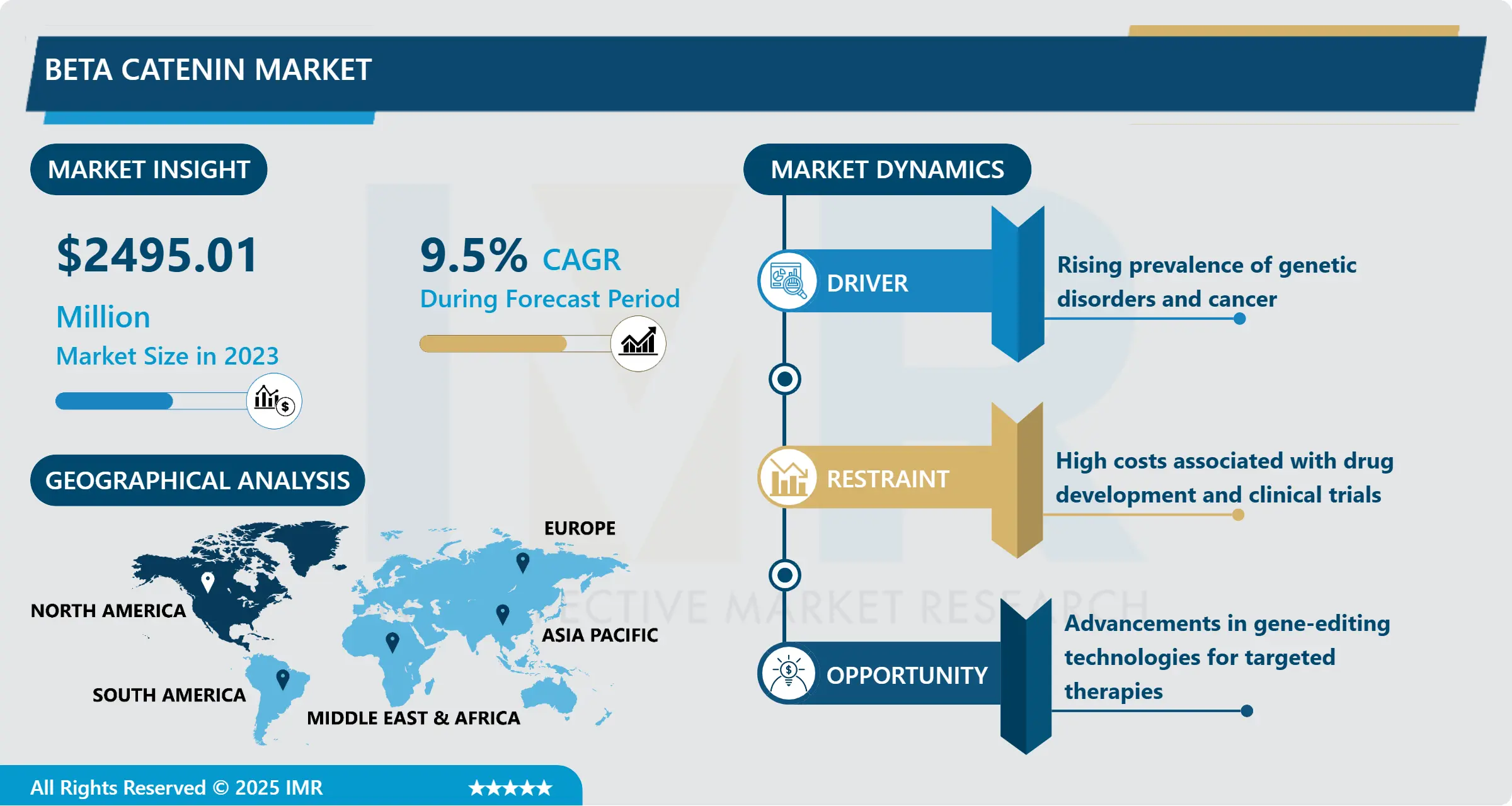
Beta Catenin Market Trend Analysis:
Advancements in Targeted Therapy Development
- A significant inclination under the Beta Catenin Market is targeted therapies that seek to control the activity of beta-catenin. Scientists and the industry are now targeting small molecules, monoclonal antibodies and other biologics designed to be selective against beta-catenin in the want signalling pathway. These are especially important in oncology as beta-catenin dysregulation contributes to tumour advancement. Also, improvements in technologies such as CRISPR-Cas9 and RNA therapies for gene editing and silencing open broader prospects for gene manipulation in therapeutics and make the idea of beta-catenin-targeted treatment even more attractive.
Expanding Applications in Rare and Genetic Disorders
- One of the great opportunities inherent in the Beta Catenin Market is the diagnosis and management of various types of rare and genetic disorders. The aberrations of beta-catenin expression and gene include mutation and dysregulation, which are related to familial adenomatous polyposis, liver disorders, and skeletal abnormalities. Rising consciousness and financing of orphan drugs have prompted pharma benefit companies to take a gander opioids at beta-catenin as a restorative point. More partnership between research organizations and biopharmaceutical companies and governments are driving this market with the quest for advanced solutions for the healthiness of patients.
Beta Catenin Market Segment Analysis:
Beta Catenin Market is Segmented on the basis of Type, Application, and Region
By Type, Nefopam segment is expected to dominate the market during the forecast period
- According to the given market, it is expected that the Nefopam Segment would be the largest one for the Beta Catenin Market during the forecast period. Nefopam, an analgesic that has initially been used to treat moderate to severe pain, has recently attracted interest due to some potential benefits beyond the pain-relieving property. They make melatonin as an excellent pharmacological candidate as well as a potential drug in the treatment of chronic and degenerative diseases. The claims of the segment are well backed by future clinical research and its practiced safety. There are big expectations regarding this drug and its further usage in the treatment of neurodegenerative disorders, inflammatory diseases, and other diseases. This versatile characteristic places it as a polymorphic compound in the spectrum of beta-catenin studies.
By Application, the Genetic disorder segment expected to hold the largest share
- The Genetic Disorder Segment is thus likely to dominate the catenin Market as a result of the rising occurrence of genetically inherited diseases associated with beta-catenin. Pathological conditions that are linked with beta-catenin signaling loss and gain of function include familial cancers, congenital skeletal malformations, and liver diseases. As technology in genetic screening and molecular therapy expands, early assessment of these diseases and individualized therapies for them are now more possible. Because beta-catenin is involved in gene expression and cell regulation, pharmaceutical companies have set their aim on creating drugs for diseases related to this protein. This segment's growth is further boosted by trends such as government support for orphan drugs and increasing awareness about rare diseases.
Beta Catenin Market Regional Insights:
North America is Expected to Dominate the Market Over the Forecast period
- The leadership within the region is based primarily on its cutting-edge healthcare structure, the presence of a solid research base, and the well-funded Biotechnology industry. The United States is an example of such a country with a heightened emphasis on oncology and genetic disorder Investigation. Currently, there is continuing research on beta-catenin across several of the largest pharmaceutical companies in North America and major academic medical centers, and therefore a steady stream of new therapies is being developed.
- Canada is also essential in the market since it provides policies focusing on biotechnology and growth in the healthcare field. Another explanation for the region’s influence is the high level of chronic diseases and hereditary disorders, together with the trend toward developing more precise therapeutic strategies. Furthermore, while academic institutions and biotech companies are entering into partnership arrangements to advance novel therapies that can target beta-catenin pathways, they are improving next-generation Want therapies.
Active Key Players in the Beta Catenin Market:
- AbbVie (USA)
- Amgen (USA)
- AstraZeneca (UK)
- Bayer AG (Germany)
- Biogen (USA)
- Bristol-Myers Squibb (USA)
- Eli Lilly and Company (USA)
- Genentech (USA)
- GlaxoSmithKline (UK)
- Johnson & Johnson (USA)
- Merck & Co., Inc. (USA)
- Novartis AG (Switzerland)
- Pfizer Inc. (USA)
- Roche Holding AG (Switzerland)
- Sanofi (France)
- Other Active Players
|
Beta Catenin Market |
|||
|
Base Year: |
2023 |
Forecast Period: |
2024-2032 |
|
Historical Data: |
2017 to 2023 |
Market Size in 2023: |
USD 2,495.01 Million |
|
Forecast Period 2024-32 CAGR: |
9.5% |
Market Size in 2032: |
USD 5,646.76 Million |
|
Segments Covered: |
By Type |
|
|
|
By Application |
|
||
|
By Region |
|
||
|
Key Market Drivers: |
|
||
|
Key Market Restraints: |
|
||
|
Key Opportunities: |
|
||
|
Companies Covered in the report: |
|
||
Chapter 1: Introduction
1.1 Scope and Coverage
Chapter 2:Executive Summary
Chapter 3: Market Landscape
3.1 Market Dynamics
3.1.1 Drivers
3.1.2 Restraints
3.1.3 Opportunities
3.1.4 Challenges
3.2 Market Trend Analysis
3.3 PESTLE Analysis
3.4 Porter's Five Forces Analysis
3.5 Industry Value Chain Analysis
3.6 Ecosystem
3.7 Regulatory Landscape
3.8 Price Trend Analysis
3.9 Patent Analysis
3.10 Technology Evolution
3.11 Investment Pockets
3.12 Import-Export Analysis
Chapter 4: Beta Catenin Market by Type
4.1 Beta Catenin Market Snapshot and Growth Engine
4.2 Beta Catenin Market Overview
4.3 BBI-801 Exisulind M-101 Nefopam Hydrochloride Others
4.3.1 Introduction and Market Overview
4.3.2 Historic and Forecasted Market Size in Value USD and Volume Units (2017-2032F)
4.3.3 Key Market Trends, Growth Factors and Opportunities
4.3.4 BBI-801 Exisulind M-101 Nefopam Hydrochloride Others: Geographic Segmentation Analysis
Chapter 5: Beta Catenin Market by Application
5.1 Beta Catenin Market Snapshot and Growth Engine
5.2 Beta Catenin Market Overview
5.3 Oncology Genetic Disorder Others
5.3.1 Introduction and Market Overview
5.3.2 Historic and Forecasted Market Size in Value USD and Volume Units (2017-2032F)
5.3.3 Key Market Trends, Growth Factors and Opportunities
5.3.4 Oncology Genetic Disorder Others: Geographic Segmentation Analysis
Chapter 6: Company Profiles and Competitive Analysis
6.1 Competitive Landscape
6.1.1 Competitive Benchmarking
6.1.2 Beta Catenin Market Share by Manufacturer (2023)
6.1.3 Industry BCG Matrix
6.1.4 Heat Map Analysis
6.1.5 Mergers and Acquisitions
6.2 ABBVIE (USA)
6.2.1 Company Overview
6.2.2 Key Executives
6.2.3 Company Snapshot
6.2.4 Role of the Company in the Market
6.2.5 Sustainability and Social Responsibility
6.2.6 Operating Business Segments
6.2.7 Product Portfolio
6.2.8 Business Performance
6.2.9 Key Strategic Moves and Recent Developments
6.2.10 SWOT Analysis
6.3 AMGEN (USA)
6.4 ASTRAZENECA (UK)
6.5 BAYER AG (GERMANY)
6.6 BIOGEN (USA)
6.7 BRISTOL-MYERS SQUIBB (USA)
6.8 ELI LILLY AND COMPANY (USA)
6.9 GENENTECH (USA)
6.10 GLAXOSMITHKLINE (UK)
6.11 JOHNSON & JOHNSON (USA)
6.12 MERCK & CO. INC. (USA)
6.13 NOVARTIS AG (SWITZERLAND)
6.14 PFIZER INC. (USA)
6.15 ROCHE HOLDING AG (SWITZERLAND)
6.16 SANOFI (FRANCE)
6.17 OTHER ACTIVE PLAYERS
Chapter 7: Global Beta Catenin Market By Region
7.1 Overview
7.2. North America Beta Catenin Market
7.2.1 Key Market Trends, Growth Factors and Opportunities
7.2.2 Top Key Companies
7.2.3 Historic and Forecasted Market Size by Segments
7.2.4 Historic and Forecasted Market Size By Type
7.2.4.1 BBI-801 Exisulind M-101 Nefopam Hydrochloride Others
7.2.5 Historic and Forecasted Market Size By Application
7.2.5.1 Oncology Genetic Disorder Others
7.2.6 Historic and Forecast Market Size by Country
7.2.6.1 US
7.2.6.2 Canada
7.2.6.3 Mexico
7.3. Eastern Europe Beta Catenin Market
7.3.1 Key Market Trends, Growth Factors and Opportunities
7.3.2 Top Key Companies
7.3.3 Historic and Forecasted Market Size by Segments
7.3.4 Historic and Forecasted Market Size By Type
7.3.4.1 BBI-801 Exisulind M-101 Nefopam Hydrochloride Others
7.3.5 Historic and Forecasted Market Size By Application
7.3.5.1 Oncology Genetic Disorder Others
7.3.6 Historic and Forecast Market Size by Country
7.3.6.1 Russia
7.3.6.2 Bulgaria
7.3.6.3 The Czech Republic
7.3.6.4 Hungary
7.3.6.5 Poland
7.3.6.6 Romania
7.3.6.7 Rest of Eastern Europe
7.4. Western Europe Beta Catenin Market
7.4.1 Key Market Trends, Growth Factors and Opportunities
7.4.2 Top Key Companies
7.4.3 Historic and Forecasted Market Size by Segments
7.4.4 Historic and Forecasted Market Size By Type
7.4.4.1 BBI-801 Exisulind M-101 Nefopam Hydrochloride Others
7.4.5 Historic and Forecasted Market Size By Application
7.4.5.1 Oncology Genetic Disorder Others
7.4.6 Historic and Forecast Market Size by Country
7.4.6.1 Germany
7.4.6.2 UK
7.4.6.3 France
7.4.6.4 The Netherlands
7.4.6.5 Italy
7.4.6.6 Spain
7.4.6.7 Rest of Western Europe
7.5. Asia Pacific Beta Catenin Market
7.5.1 Key Market Trends, Growth Factors and Opportunities
7.5.2 Top Key Companies
7.5.3 Historic and Forecasted Market Size by Segments
7.5.4 Historic and Forecasted Market Size By Type
7.5.4.1 BBI-801 Exisulind M-101 Nefopam Hydrochloride Others
7.5.5 Historic and Forecasted Market Size By Application
7.5.5.1 Oncology Genetic Disorder Others
7.5.6 Historic and Forecast Market Size by Country
7.5.6.1 China
7.5.6.2 India
7.5.6.3 Japan
7.5.6.4 South Korea
7.5.6.5 Malaysia
7.5.6.6 Thailand
7.5.6.7 Vietnam
7.5.6.8 The Philippines
7.5.6.9 Australia
7.5.6.10 New Zealand
7.5.6.11 Rest of APAC
7.6. Middle East & Africa Beta Catenin Market
7.6.1 Key Market Trends, Growth Factors and Opportunities
7.6.2 Top Key Companies
7.6.3 Historic and Forecasted Market Size by Segments
7.6.4 Historic and Forecasted Market Size By Type
7.6.4.1 BBI-801 Exisulind M-101 Nefopam Hydrochloride Others
7.6.5 Historic and Forecasted Market Size By Application
7.6.5.1 Oncology Genetic Disorder Others
7.6.6 Historic and Forecast Market Size by Country
7.6.6.1 Turkiye
7.6.6.2 Bahrain
7.6.6.3 Kuwait
7.6.6.4 Saudi Arabia
7.6.6.5 Qatar
7.6.6.6 UAE
7.6.6.7 Israel
7.6.6.8 South Africa
7.7. South America Beta Catenin Market
7.7.1 Key Market Trends, Growth Factors and Opportunities
7.7.2 Top Key Companies
7.7.3 Historic and Forecasted Market Size by Segments
7.7.4 Historic and Forecasted Market Size By Type
7.7.4.1 BBI-801 Exisulind M-101 Nefopam Hydrochloride Others
7.7.5 Historic and Forecasted Market Size By Application
7.7.5.1 Oncology Genetic Disorder Others
7.7.6 Historic and Forecast Market Size by Country
7.7.6.1 Brazil
7.7.6.2 Argentina
7.7.6.3 Rest of SA
Chapter 8 Analyst Viewpoint and Conclusion
8.1 Recommendations and Concluding Analysis
8.2 Potential Market Strategies
Chapter 9 Research Methodology
9.1 Research Process
9.2 Primary Research
9.3 Secondary Research
|
Beta Catenin Market |
|||
|
Base Year: |
2023 |
Forecast Period: |
2024-2032 |
|
Historical Data: |
2017 to 2023 |
Market Size in 2023: |
USD 2,495.01 Million |
|
Forecast Period 2024-32 CAGR: |
9.5% |
Market Size in 2032: |
USD 5,646.76 Million |
|
Segments Covered: |
By Type |
|
|
|
By Application |
|
||
|
By Region |
|
||
|
Key Market Drivers: |
|
||
|
Key Market Restraints: |
|
||
|
Key Opportunities: |
|
||
|
Companies Covered in the report: |
|
||