Automotive Position Sensors Market Synopsis:
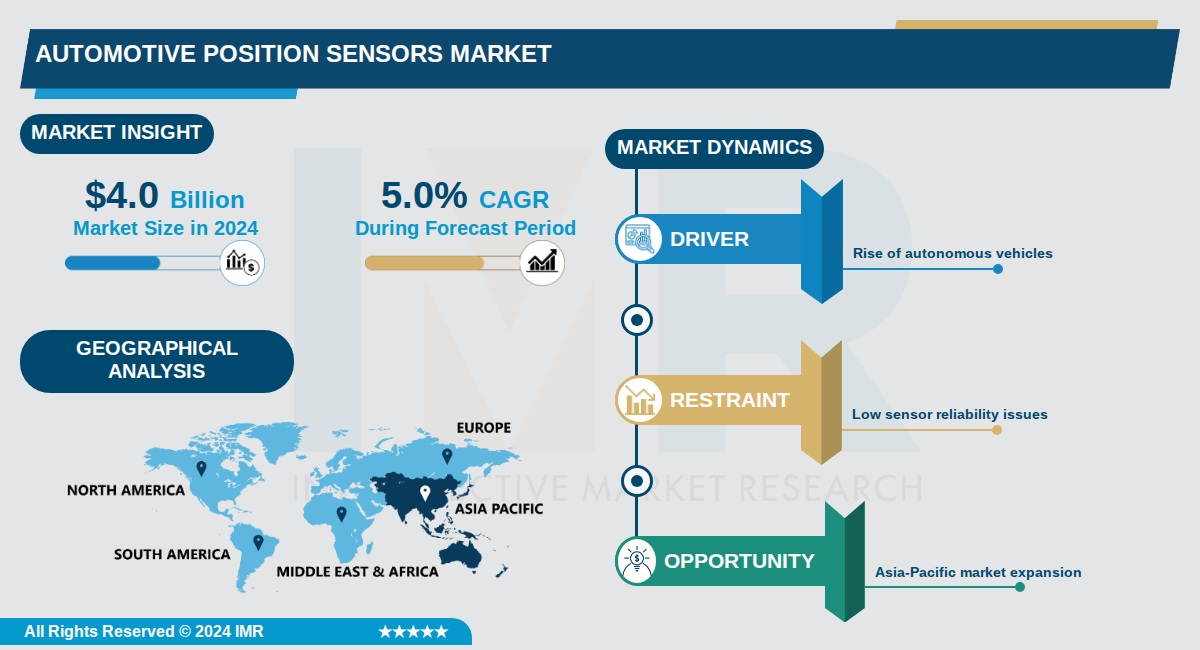
Automotive Position Sensors Market Size Was Valued at USD 4.0 Billion in 2024, and is Projected to Reach USD 6.0 Billion by 2035, Growing at a CAGR of 5.0% From 2024-2035.
The Automotive Position Sensors Market is valued at $4.0 billion in 2024 and is projected to reach $6.0 billion by 2035, growing at a compound annual growth rate (CAGR) of 5.0%. This growth reflects the increasing integration of sensors in modern vehicles for enhanced precision in position detection across various applications.
Position sensors, including linear, rotary, angular, and multi-axis types, play a critical role in automotive systems such as engine management, chassis control, throttle positioning, and suspension. Major players like Bosch, Continental, Denso, and Infineon Technologies dominate the market, driving innovation through advanced technologies.
Regionally, North America leads due to high adoption in safety features, while Asia-Pacific emerges as the fastest-growing region fueled by automotive manufacturing hubs in China, Japan, and India. The OEM segment holds the largest share, supported by rising vehicle production and demand for passenger cars and electric vehicles.
Automotive Position Sensors Market Trend Analysis:
Electrification of Vehicles and EV Integration
- Electric vehicles require sophisticated sensor systems for battery management, motor control, power electronics, and regenerative braking. Linear and rotary position sensors are critical for monitoring battery cell positions, ensuring optimal thermal management, and controlling motor speed and torque in EV powertrains.
- Advanced non-contact rotary position sensors are being developed specifically for electric vehicle powertrains, as demonstrated by Infineon Technologies' 2023 introduction of these sensors. This trend directly supports the automotive industry's shift toward electrification and autonomous driving technologies.
- The adoption of EVs and e-mobility solutions is driving significant growth in the automotive position sensors market, with manufacturers emphasizing the need for precision sensing in luxury vehicles and next-generation electric platforms.
Hall Effect Sensor Adoption for Enhanced Vehicle Safety
- Hall Effect position sensors are gaining widespread adoption in automotive applications for critical safety functions including crankshaft position detection for spark plug timing, seat and seatbelt positioning, and anti-lock braking system (ABS) speed sensing.
- Rising road accidents and increasing consumer concern regarding driver and passenger safety are propelling demand for these sensors across the globe. Position sensors installed in passenger cars improve overall performance while contributing directly to safety enhancement and emission reduction.
- The passenger car segment holds the major market share, with higher application of position sensors driven by growing consumer demand for vehicles with enhanced safety levels and stricter emission norms being introduced across multiple countries.
Development of Advanced Driver-Assistance Systems (ADAS) and Autonomous Driving Technologies
- The proliferation of ADAS and autonomous driving technologies represents a substantial growth engine for the position sensors market. Companies like Allegro Microsystems announced new multi-axis magnetic sensor ICs in 2024 Q1 specifically designed to enhance ADAS capabilities in modern vehicles.
- The automotive industry's changing focus toward technological trends including electrification and autonomous driving is estimated to propel position sensor market demand across major regions. North America is particularly leveraging these innovations, with major automotive players driving adoption of advanced position sensor systems.
- Linear position sensors, which dominate the automotive segment, are increasingly utilized in applications such as throttle position sensing and precision motion control required for autonomous vehicle operation and advanced driver assistance features.
Automotive Position Sensors Market Segment Analysis:
Automotive Position Sensors Market is Segmented on the basis of By Type, By Application, By Vehicle Type
By Type, Linear Position Sensors segment is expected to dominate the market during the forecast period
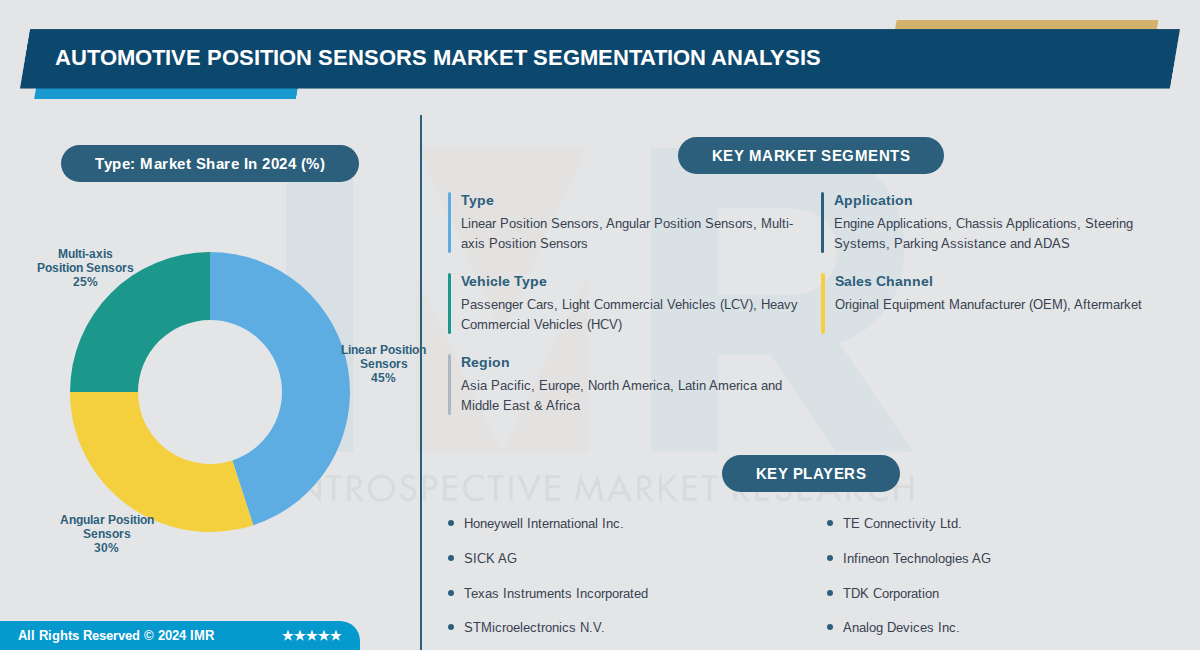
- Linear position sensors dominate with 45% share due to widespread application in throttle position monitoring, brake systems, and suspension control where linear motion measurement is critical for vehicle performance and safety.
- The prevalence of linear sensors is driven by their established reliability in traditional automotive systems and their essential role in ADAS (Advanced Driver Assistance Systems) implementations across passenger vehicles globally.
By Application, Engine Applications segment is expected to dominate the market during the forecast period
- Engine applications lead with 35% market share as position sensors are essential for throttle control, fuel injection optimization, and emission management in both conventional and electric vehicles.
- Chassis applications represent 32% of the market and are rapidly growing due to increased adoption of advanced suspension systems, brake-by-wire technologies, and the shift toward electric and autonomous vehicle architectures.
By Vehicle Type, Passenger Cars segment is expected to dominate the market during the forecast period
- Passenger cars dominate with 60% market share driven by higher production volumes, greater integration of ADAS and safety systems, and increasing consumer demand for advanced comfort and autonomous features in personal vehicles.
- Passenger vehicles require more sophisticated position sensor arrays for multiple applications including steering assistance, parking aids, and stability control, whereas commercial vehicles prioritize cost-effectiveness and durability.
By Sales Channel, Original Equipment Manufacturer (OEM) segment is expected to dominate the market during the forecast period
- OEM channel dominates with 78% market share as automotive manufacturers integrate position sensors during vehicle production to meet stringent safety regulations and performance specifications for new vehicle platforms.
- The OEM segment benefits from long-term contracts with major automakers, predictable demand from vehicle production cycles, and the complexity of integrating sensors into proprietary vehicle control systems during manufacturing.
By Region, Asia Pacific segment is expected to dominate the market during the forecast period
- Asia Pacific leads with 42% market share due to rapid expansion of electric vehicle manufacturing in China, India, and Japan, coupled with increasing automotive production volumes and rising adoption of ADAS technologies in the region.
- Europe maintains strong 39% share driven by stringent EU safety regulations, high penetration of advanced driver assistance systems, and leadership by major automotive sensor manufacturers including Bosch, Continental, and Denso in the region.
Automotive Position Sensors Market Regional Insights:
Asia-Pacific is Expected to Dominate the Market Over the Forecast Period
- Asia-Pacific dominates the automotive position sensors market due to its substantial market share and high production volumes in key countries like China, Japan, India, and South Korea. These nations lead in automotive manufacturing and vehicle production, driving demand for position sensors in various applications. The region's rapid industrialization and expanding automotive sector solidify its leading position.
- The region benefits from robust manufacturing infrastructure, government initiatives promoting electric vehicles and advanced technologies, and favorable regulations supporting automotive innovation. Countries like China and India are investing heavily in digital agriculture and vehicle electrification, boosting sensor adoption. Low production costs and a skilled workforce further enhance market growth.
- Major players are actively expanding in Asia-Pacific through investments and new facilities, with recent developments focusing on precision sensors for autonomous driving. Companies are leveraging the region's supply chain realignments, particularly in Taiwan and Southeast Asia, to meet rising demand. This has positioned Asia-Pacific as both the largest and fastest-growing market.
Active Key Players in the Automotive Position Sensors Market:
- Honeywell International Inc. (USA)
- TE Connectivity Ltd. (Ireland)
- SICK AG (Germany)
- Infineon Technologies AG (Germany)
- Texas Instruments Incorporated (USA)
- TDK Corporation (Japan)
- STMicroelectronics N.V. (Switzerland)
- Analog Devices Inc. (USA)
- Robert Bosch GmbH (Germany)
- Sensata Technologies, Inc. (USA)
- Balluff GmbH (Germany)
- Siemens AG (Germany)
- Omron Corporation (Japan)
- Microchip Technology Incorporated (USA)
- Renishaw plc (UK)
- Amphenol Corporation (USA)
- NXP Semiconductors (Netherlands)
- Allegro MicroSystems, Inc. (USA)
- Other Active Players
|
Automotive Position Sensors Market |
|||
|
Base Year: |
2024 |
Forecast Period: |
2024-2035 |
|
Historical Data: |
2017 to 2024 |
Market Size in 2024: |
USD 4.0 Billion |
|
Forecast Period 2024-2035 CAGR: |
5.0 % |
Market Size in 2035: |
USD 6.0 Billion |
|
Segments Covered: |
By Type |
|
|
|
By Application |
|
||
|
By Vehicle Type |
|
||
|
By Sales Channel |
|
||
|
By Region |
|
||
|
By Region |
|
||
|
Key Market Drivers: |
|
||
|
Key Market Restraints: |
|
||
|
Key Opportunities: |
|
||
|
Companies Covered in the report: |
|
||
Chapter 1: Introduction
1.1 Scope and Coverage
Chapter 2: Executive Summary
Chapter 3: Market Landscape
3.1 Market Dynamics and Opportunity Analysis
3.1.1 Growth Drivers
3.1.2 Limiting Factors
3.1.3 Growth Opportunities
3.1.4 Challenges and Risks
3.2 Market Trend Analysis
3.3 Industry Ecosystem
3.4 Industry Value Chain Mapping
3.5 Strategic PESTLE Overview
3.6 Porter's Five Forces Framework
3.7 Regulatory Framework
3.8 Pricing Trend Analysis
3.9 Intellectual Property Review
3.10 Technology Evolution
3.11 Import-Export Analysis
3.12 Consumer Behavior Analysis
3.13 Investment Pocket Analysis
3.14 Go-To Market Strategy
Chapter 4: Automotive Position Sensors Market by Type (2017-2035)
4.1 Automotive Position Sensors Market Snapshot and Growth Engine
4.2 Market Overview
4.3 Linear Position Sensors
4.3.1 Introduction and Market Overview
4.3.2 Historic and Forecasted Market Size in Value USD and Volume Units
4.3.3 Key Market Trends, Growth Factors, and Opportunities
4.3.4 Geographic Segmentation Analysis
4.4 Angular Position Sensors
4.5 Multi-axis Position Sensors
Chapter 5: Automotive Position Sensors Market by Application (2017-2035)
5.1 Automotive Position Sensors Market Snapshot and Growth Engine
5.2 Market Overview
5.3 Engine Applications
5.3.1 Introduction and Market Overview
5.3.2 Historic and Forecasted Market Size in Value USD and Volume Units
5.3.3 Key Market Trends, Growth Factors, and Opportunities
5.3.4 Geographic Segmentation Analysis
5.4 Chassis Applications
5.5 Steering Systems
5.6 Parking Assistance and ADAS
Chapter 6: Automotive Position Sensors Market by Vehicle Type (2017-2035)
6.1 Automotive Position Sensors Market Snapshot and Growth Engine
6.2 Market Overview
6.3 Passenger Cars
6.3.1 Introduction and Market Overview
6.3.2 Historic and Forecasted Market Size in Value USD and Volume Units
6.3.3 Key Market Trends, Growth Factors, and Opportunities
6.3.4 Geographic Segmentation Analysis
6.4 Light Commercial Vehicles (LCV)
6.5 Heavy Commercial Vehicles (HCV)
Chapter 7: Automotive Position Sensors Market by Sales Channel (2017-2035)
7.1 Automotive Position Sensors Market Snapshot and Growth Engine
7.2 Market Overview
7.3 Original Equipment Manufacturer (OEM)
7.3.1 Introduction and Market Overview
7.3.2 Historic and Forecasted Market Size in Value USD and Volume Units
7.3.3 Key Market Trends, Growth Factors, and Opportunities
7.3.4 Geographic Segmentation Analysis
7.4 Aftermarket
Chapter 8: Automotive Position Sensors Market by Region (2017-2035)
8.1 Automotive Position Sensors Market Snapshot and Growth Engine
8.2 Market Overview
8.3 Asia Pacific
8.3.1 Introduction and Market Overview
8.3.2 Historic and Forecasted Market Size in Value USD and Volume Units
8.3.3 Key Market Trends, Growth Factors, and Opportunities
8.3.4 Geographic Segmentation Analysis
8.4 Europe
8.5 North America
8.6 Latin America and Middle East & Africa
Chapter 9: Company Profiles and Competitive Analysis
9.1 Competitive Landscape
9.1.1 Competitive Benchmarking
9.1.2 Automotive Position Sensors Market Share by Manufacturer/Service Provider (2024)
9.1.3 Industry BCG Matrix
9.1.4 Partnerships, Mergers & Acquisitions
9.2 HONEYWELL INTERNATIONAL INC.
9.2.1 Company Overview
9.2.2 Key Executives
9.2.3 Company Snapshot
9.2.4 Role of the Company in the Market
9.2.5 Sustainability and Social Responsibility
9.2.6 Operating Business Segments
9.2.7 Product Portfolio
9.2.8 Business Performance
9.2.9 Recent News & Developments
9.2.10 SWOT Analysis
9.3 TE CONNECTIVITY LTD.
9.4 SICK AG
9.5 INFINEON TECHNOLOGIES AG
9.6 TEXAS INSTRUMENTS INCORPORATED
9.7 TDK CORPORATION
9.8 STMICROELECTRONICS N.V.
9.9 ANALOG DEVICES INC.
9.10 ROBERT BOSCH GMBH
9.11 SENSATA TECHNOLOGIES
9.12 INC.
9.13 BALLUFF GMBH
9.14 SIEMENS AG
9.15 OMRON CORPORATION
9.16 MICROCHIP TECHNOLOGY INCORPORATED
9.17 RENISHAW PLC
9.18 AMPHENOL CORPORATION
9.19 NXP SEMICONDUCTORS
9.20 ALLEGRO MICROSYSTEMS
9.21 INC.
Chapter 10: Global Automotive Position Sensors Market By Region
10.1 Overview
10.2. North America Automotive Position Sensors Market
10.2.1 Key Market Trends, Growth Factors and Opportunities
10.2.2 Top Key Companies
10.2.3 Historic and Forecasted Market Size by Segments
10.2.4 Historic and Forecast Market Size by Country
10.3. Eastern Europe Automotive Position Sensors Market
10.3.1 Key Market Trends, Growth Factors and Opportunities
10.3.2 Top Key Companies
10.3.3 Historic and Forecasted Market Size by Segments
10.3.4 Historic and Forecast Market Size by Country
10.4. Western Europe Automotive Position Sensors Market
10.4.1 Key Market Trends, Growth Factors and Opportunities
10.4.2 Top Key Companies
10.4.3 Historic and Forecasted Market Size by Segments
10.4.4 Historic and Forecast Market Size by Country
10.5. Asia Pacific Automotive Position Sensors Market
10.5.1 Key Market Trends, Growth Factors and Opportunities
10.5.2 Top Key Companies
10.5.3 Historic and Forecasted Market Size by Segments
10.5.4 Historic and Forecast Market Size by Country
10.6. Middle East & Africa Automotive Position Sensors Market
10.6.1 Key Market Trends, Growth Factors and Opportunities
10.6.2 Top Key Companies
10.6.3 Historic and Forecasted Market Size by Segments
10.6.4 Historic and Forecast Market Size by Country
10.7. South America Automotive Position Sensors Market
10.7.1 Key Market Trends, Growth Factors and Opportunities
10.7.2 Top Key Companies
10.7.3 Historic and Forecasted Market Size by Segments
10.7.4 Historic and Forecast Market Size by Country
Chapter 11: Analyst Viewpoint and Conclusion
Chapter 12: Research Methodology
12.1 Research Process
12.2 Primary Research
12.3 Secondary Research
Chapter 13: Case Study
Chapter 14: Appendix
14.1 Sources
14.2 List of Tables and Figures
14.3 Short Forms and Citations
14.4 Assumption and Conversion
14.5 Disclaimer
|
Automotive Position Sensors Market |
|||
|
Base Year: |
2024 |
Forecast Period: |
2024-2035 |
|
Historical Data: |
2017 to 2024 |
Market Size in 2024: |
USD 4.0 Billion |
|
Forecast Period 2024-2035 CAGR: |
5.0 % |
Market Size in 2035: |
USD 6.0 Billion |
|
Segments Covered: |
By Type |
|
|
|
By Application |
|
||
|
By Vehicle Type |
|
||
|
By Sales Channel |
|
||
|
By Region |
|
||
|
By Region |
|
||
|
Key Market Drivers: |
|
||
|
Key Market Restraints: |
|
||
|
Key Opportunities: |
|
||
|
Companies Covered in the report: |
|
||