




Automotive Collision Repair Market Synopsis:
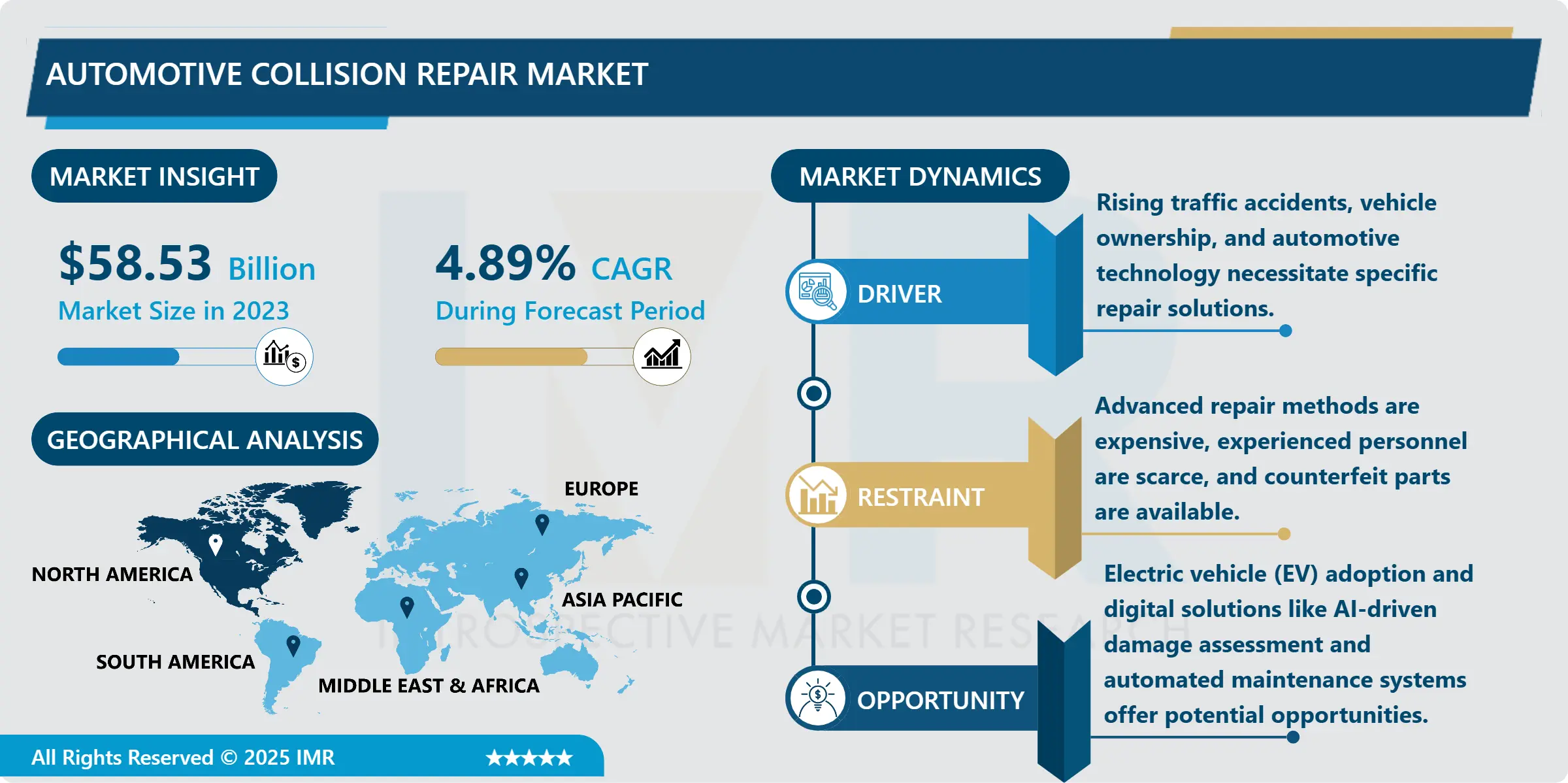
Automotive Collision Repair Market Size Was Valued at USD 58.53 Billion in 2023, and is Projected to Reach USD 82.71 Billion by 2032, Growing at a CAGR of 4.89% From 2024-2032.
The Automotive Collision Repair Market comprises all the goods and services required to restore vehicles that has been impacted through an accident, collision or any other kind of impact. This market encompasses those undertaking repair work, replacement of a faulty component(s), painting, denting removal, and structures repair among others while using both OEM and aftermarket parts to facilitate the repair. There are many players in this ecosystem such as independents shops, car dealers, insurance companies and suppliers of car parts. A growing number of vehicles in the world and more and more frequent road accidents drive the need for collision repairs.
ADAS, lightweight vehicle materials, car connectivity and innovations in powertrains are altering the dynamics of this market by demanding corresponding approaches to maintenance and repair. Thus, the growing usage of EVs complicates collision repair procedures, and as a result, there is a requirement for higher training and service introducing. Consumers really value quality services and they also do not want their devices to be out of service for very long hence advanced repair solutions like AI for assessment of the damage and auto painting solutions.
The position of insurance in the collision repair market is importance since a majority of collision repairs are paid through insurance claims. Higher customer awareness on insured repair and improvement and extension of insurance services are the factors impacting growth. Nevertheless, factors such as fake components, skilled workforce unavailability and high cost of various forms of repairing technologies are likely to act as restriction to the markets’ growth. However, the automotive collision repair market remains with the possibility of steady growth due to factors such as increased urbanization and consumer disposable incomes coupled with technological advancement in repair industry.
Automotive Collision Repair Market Trend Analysis:
Integration of Advanced Driver-Assistance Systems (ADAS) in Repairs
- As the number of installed Advanced Driver Assistance Systems (ADAS) features increases, including lane departure warnings, adaptive cruise control, and automatic emergency braking, the automotive collision repair market is undergoing significant transformation. Vehicles equipped with these sophisticated technologies require meticulous fine-tuning and recalibration after sustaining any damage, creating a growing demand for specialized diagnostic equipment and advanced repair tools.
- Small and medium-sized businesses (SMBs) in the repair sector are increasingly investing in high-end diagnostic tools, calibration systems, and continuous education programs to meet these evolving technological needs. This shift is not only enhancing the skill sets of technicians but also revolutionizing traditional repair processes within collision repair services. The reliance on advanced technology is elevating the industry's standards, making technology integration a critical factor for success. Ultimately, ADAS technologies are reshaping the future of collision repair, promoting innovation and precision.
Rising Influence of Digital Solutions and Automation
- The collision repair market is undergoing a dramatic transformation due to rapid technological advancements. Concepts such as computerized damage estimation, driven by artificial intelligence, and the emergence of autonomously controlled repair systems are reshaping traditional repair practices. New indirect technologies are playing a crucial role, including mobile applications that allow users to quickly assess estimated repair costs, automatic digital claims processing systems, and innovative automated painting solutions. These advancements improve efficiency and enhance accuracy in the repair process.
- The introduction of cloud-based solutions has led to significant improvements in communication and collaboration between repair centers, insurance companies, and parts suppliers. This interconnected ecosystem facilitates faster decision-making, greater transparency, and a substantial increase in the overall speed of the repair cycle. As a result, the entire collision repair industry is becoming more streamlined, customer-friendly, and technologically advanced.
Automotive Collision Repair Market Segment Analysis:
Automotive Collision Repair Market is Segmented on the basis of Product Type, Repair Type, Service Channel, Sales Channel, Shop Type, Vehicle Type, and Region.
By Product Type, the Spare Parts segment is expected to dominate the market during the forecast period
- The Automotive Collision Repair Market by product type consists of spare parts, replacement parts, paintings & coatings and consumables wherein all these products are an essential element of the repair value chain. The largest groups of components sold include spare and replacement parts including bumpers, fenders and windscreen as these are some of the most critical auto parts which need to be replaced in case of an accident or mechanical failure.
- The body works employs paintings and coatings that play a crucial role in the aesthetic aspect of restoration, which gives the car its new look after a repair; the new growths in the painting industry pertain to the environmentally friendly products and the fast-drying assortments. Expenses such as adhesive, abrasive, and cleaning materials are used during repair to show the importance of using high quality materials for repairing services with long life cycle duration and precision.
By Vehicle Type, Passenger Cars egment expected to held the largest share
- The Automotive Collision Repair Market also offer services to a wide variety of vehicles such as cars, Multi-purpose Vehicles and Light Commercial Vehicles, Heavy Commercial vehicles, and two-wheeler, each segment holding a different position in the market. This includes passenger car, which accounts for the majority of the insured type of automobile because majority of the people own them, use them often and are more likely to have an accident in the urban center than owners of other type of automobile.
- The demand of commercial vehicle such as truck, buses etc are high in the market since they cover lots of kilometer and they are frequently used for heavy duty jobs. low achievers to the market especially in the densely populated and developing regions and are easily involved in accidents in traffic congested areas. Every segment requires specific repair services ranging from premium car spare parts for affects sales and passenger cars to affordable parts for commercial and two-wheeled vehicles and thus establishing interdependence.
Automotive Collision Repair Market Regional Insights:
North America is Expected to Dominate the Market Over the Forecast period
- North America is estimated to hold the highest market share in the automotive collision repair industry, driven by several key factors. The region has a large number of vehicles on the road, and a majority of the population owns at least one vehicle, creating a strong base for repair services. Additionally, the market benefits from a highly developed and concentrated network of repair shops and service centers that offer specialized and efficient services.
- Another significant factor contributing to market growth is the presence of a well-established insurance sector, which provides broad and comprehensive coverage for collision repairs, thereby encouraging customers to seek professional repair solutions. Moreover, the rising popularity of electric vehicles and self-driving cars, particularly in the United States and Canada, is fueling the demand for specialized services like ADAS (Advanced Driver-Assistance Systems) repair. Technological advancements and increased consumer focus on high-quality repairs further solidify North America's leading position in this market.
Active Key Players in the Automotive Collision Repair Market:
- DENSO CORPORATION (Japan)
- Robert Bosch GmbH (Germany)
- Continental AG (Germany)
- 3M (USA)
- AISIN CORPORATION (Japan)
- VALEO S.A. (France)
- Hyundai Motor Company (South Korea)
- DuPont (USA)
- Nippon Paint Holdings Co., Ltd (Japan)
- Tenneco Inc. (USA)
- Honeywell International Inc. (USA)
- Henkel AG & Co. KGaA (Germany)
- Magna International Inc (Canada)
- OPmobility SE (Germany)
- FORVIA Faurecia (France)
- Martinrea International Inc (Canada)
- MANN+HUMMEL (Germany)
- Mitsuba Corp. (Japan)
- ABRA Auto Body Repair of America (USA)
- Caliber Holdings LLC (USA)
- Gerber Collision & Glass (USA)
- ATP Automotive (USA)
- AMERICA'S AUTO BODY (USA)
- Jeff Schmitt (USA)
- Mitsubishi (Japan)
- Automotive Technology (USA), and Other Active Players
|
Automotive Collision Repair Market |
|||
|
Base Year: |
2023 |
Forecast Period: |
2024-2032 |
|
Historical Data: |
2017 to 2023 |
Market Size in 2023: |
USD 58.53 Billion |
|
Forecast Period 2024-32 CAGR: |
4.89% |
Market Size in 2032: |
USD 82.71 Billion |
|
Segments Covered: |
By Product Type |
|
|
|
By Repair Type |
|
||
|
By Service Channel |
|
||
|
By Sales Channel |
|
||
|
By Shops Type |
|
||
|
By Vehicle Type |
|
||
|
By Region |
|
||
|
Key Market Drivers: |
|
||
|
Key Market Restraints: |
|
||
|
Key Opportunities: |
|
||
|
Companies Covered in the report: |
|
||
Chapter 1: Introduction
1.1 Scope and Coverage
Chapter 2:Executive Summary
Chapter 3: Market Landscape
3.1 Market Dynamics
3.1.1 Drivers
3.1.2 Restraints
3.1.3 Opportunities
3.1.4 Challenges
3.2 Market Trend Analysis
3.3 PESTLE Analysis
3.4 Porter's Five Forces Analysis
3.5 Industry Value Chain Analysis
3.6 Ecosystem
3.7 Regulatory Landscape
3.8 Price Trend Analysis
3.9 Patent Analysis
3.10 Technology Evolution
3.11 Investment Pockets
3.12 Import-Export Analysis
Chapter 4: Automotive Collision Repair Market by Product Type
4.1 Automotive Collision Repair Market Snapshot and Growth Engine
4.2 Automotive Collision Repair Market Overview
4.3 Spare Parts
4.3.1 Introduction and Market Overview
4.3.2 Historic and Forecasted Market Size in Value USD and Volume Units (2017-2032F)
4.3.3 Key Market Trends, Growth Factors and Opportunities
4.3.4 Spare Parts: Geographic Segmentation Analysis
4.4 Replacement Parts
4.4.1 Introduction and Market Overview
4.4.2 Historic and Forecasted Market Size in Value USD and Volume Units (2017-2032F)
4.4.3 Key Market Trends, Growth Factors and Opportunities
4.4.4 Replacement Parts: Geographic Segmentation Analysis
4.5 Paintings & Coatings
4.5.1 Introduction and Market Overview
4.5.2 Historic and Forecasted Market Size in Value USD and Volume Units (2017-2032F)
4.5.3 Key Market Trends, Growth Factors and Opportunities
4.5.4 Paintings & Coatings: Geographic Segmentation Analysis
4.6 and Consumables
4.6.1 Introduction and Market Overview
4.6.2 Historic and Forecasted Market Size in Value USD and Volume Units (2017-2032F)
4.6.3 Key Market Trends, Growth Factors and Opportunities
4.6.4 and Consumables: Geographic Segmentation Analysis
Chapter 5: Automotive Collision Repair Market by Repair Type
5.1 Automotive Collision Repair Market Snapshot and Growth Engine
5.2 Automotive Collision Repair Market Overview
5.3 Dent Removal
5.3.1 Introduction and Market Overview
5.3.2 Historic and Forecasted Market Size in Value USD and Volume Units (2017-2032F)
5.3.3 Key Market Trends, Growth Factors and Opportunities
5.3.4 Dent Removal: Geographic Segmentation Analysis
5.4 Auto Glass Replacement
5.4.1 Introduction and Market Overview
5.4.2 Historic and Forecasted Market Size in Value USD and Volume Units (2017-2032F)
5.4.3 Key Market Trends, Growth Factors and Opportunities
5.4.4 Auto Glass Replacement: Geographic Segmentation Analysis
5.5 Straightening Out Bent Metal
5.5.1 Introduction and Market Overview
5.5.2 Historic and Forecasted Market Size in Value USD and Volume Units (2017-2032F)
5.5.3 Key Market Trends, Growth Factors and Opportunities
5.5.4 Straightening Out Bent Metal: Geographic Segmentation Analysis
5.6 Replacing Doors or Panels
5.6.1 Introduction and Market Overview
5.6.2 Historic and Forecasted Market Size in Value USD and Volume Units (2017-2032F)
5.6.3 Key Market Trends, Growth Factors and Opportunities
5.6.4 Replacing Doors or Panels: Geographic Segmentation Analysis
5.7 Paint Matching
5.7.1 Introduction and Market Overview
5.7.2 Historic and Forecasted Market Size in Value USD and Volume Units (2017-2032F)
5.7.3 Key Market Trends, Growth Factors and Opportunities
5.7.4 Paint Matching: Geographic Segmentation Analysis
5.8 Scratch Removal
5.8.1 Introduction and Market Overview
5.8.2 Historic and Forecasted Market Size in Value USD and Volume Units (2017-2032F)
5.8.3 Key Market Trends, Growth Factors and Opportunities
5.8.4 Scratch Removal: Geographic Segmentation Analysis
5.9 Auto Detailing
5.9.1 Introduction and Market Overview
5.9.2 Historic and Forecasted Market Size in Value USD and Volume Units (2017-2032F)
5.9.3 Key Market Trends, Growth Factors and Opportunities
5.9.4 Auto Detailing: Geographic Segmentation Analysis
5.10 and Others
5.10.1 Introduction and Market Overview
5.10.2 Historic and Forecasted Market Size in Value USD and Volume Units (2017-2032F)
5.10.3 Key Market Trends, Growth Factors and Opportunities
5.10.4 and Others: Geographic Segmentation Analysis
Chapter 6: Automotive Collision Repair Market by Service Channel
6.1 Automotive Collision Repair Market Snapshot and Growth Engine
6.2 Automotive Collision Repair Market Overview
6.3 OE
6.3.1 Introduction and Market Overview
6.3.2 Historic and Forecasted Market Size in Value USD and Volume Units (2017-2032F)
6.3.3 Key Market Trends, Growth Factors and Opportunities
6.3.4 OE: Geographic Segmentation Analysis
6.4 DIFM (Do it for Me)
6.4.1 Introduction and Market Overview
6.4.2 Historic and Forecasted Market Size in Value USD and Volume Units (2017-2032F)
6.4.3 Key Market Trends, Growth Factors and Opportunities
6.4.4 DIFM (Do it for Me): Geographic Segmentation Analysis
6.5 and DIY (Do it Yourself)
6.5.1 Introduction and Market Overview
6.5.2 Historic and Forecasted Market Size in Value USD and Volume Units (2017-2032F)
6.5.3 Key Market Trends, Growth Factors and Opportunities
6.5.4 and DIY (Do it Yourself): Geographic Segmentation Analysis
Chapter 7: Automotive Collision Repair Market by Sales Channel
7.1 Automotive Collision Repair Market Snapshot and Growth Engine
7.2 Automotive Collision Repair Market Overview
7.3 New OEM
7.3.1 Introduction and Market Overview
7.3.2 Historic and Forecasted Market Size in Value USD and Volume Units (2017-2032F)
7.3.3 Key Market Trends, Growth Factors and Opportunities
7.3.4 New OEM: Geographic Segmentation Analysis
7.4 After
7.4.1 Introduction and Market Overview
7.4.2 Historic and Forecasted Market Size in Value USD and Volume Units (2017-2032F)
7.4.3 Key Market Trends, Growth Factors and Opportunities
7.4.4 After: Geographic Segmentation Analysis
7.5 Recycled
7.5.1 Introduction and Market Overview
7.5.2 Historic and Forecasted Market Size in Value USD and Volume Units (2017-2032F)
7.5.3 Key Market Trends, Growth Factors and Opportunities
7.5.4 Recycled: Geographic Segmentation Analysis
7.6 Remanufactured
7.6.1 Introduction and Market Overview
7.6.2 Historic and Forecasted Market Size in Value USD and Volume Units (2017-2032F)
7.6.3 Key Market Trends, Growth Factors and Opportunities
7.6.4 Remanufactured: Geographic Segmentation Analysis
7.7 and Salvage
7.7.1 Introduction and Market Overview
7.7.2 Historic and Forecasted Market Size in Value USD and Volume Units (2017-2032F)
7.7.3 Key Market Trends, Growth Factors and Opportunities
7.7.4 and Salvage: Geographic Segmentation Analysis
Chapter 8: Automotive Collision Repair Market by Shops Type
8.1 Automotive Collision Repair Market Snapshot and Growth Engine
8.2 Automotive Collision Repair Market Overview
8.3 Auto Body Shops
8.3.1 Introduction and Market Overview
8.3.2 Historic and Forecasted Market Size in Value USD and Volume Units (2017-2032F)
8.3.3 Key Market Trends, Growth Factors and Opportunities
8.3.4 Auto Body Shops: Geographic Segmentation Analysis
8.4 Dealer Owned Shops
8.4.1 Introduction and Market Overview
8.4.2 Historic and Forecasted Market Size in Value USD and Volume Units (2017-2032F)
8.4.3 Key Market Trends, Growth Factors and Opportunities
8.4.4 Dealer Owned Shops: Geographic Segmentation Analysis
8.5 Independent Repair Shops
8.5.1 Introduction and Market Overview
8.5.2 Historic and Forecasted Market Size in Value USD and Volume Units (2017-2032F)
8.5.3 Key Market Trends, Growth Factors and Opportunities
8.5.4 Independent Repair Shops: Geographic Segmentation Analysis
Chapter 9: Automotive Collision Repair Market by Vehicle Type
9.1 Automotive Collision Repair Market Snapshot and Growth Engine
9.2 Automotive Collision Repair Market Overview
9.3 Passenger Cars
9.3.1 Introduction and Market Overview
9.3.2 Historic and Forecasted Market Size in Value USD and Volume Units (2017-2032F)
9.3.3 Key Market Trends, Growth Factors and Opportunities
9.3.4 Passenger Cars: Geographic Segmentation Analysis
9.4 Commercial Vehicle
9.4.1 Introduction and Market Overview
9.4.2 Historic and Forecasted Market Size in Value USD and Volume Units (2017-2032F)
9.4.3 Key Market Trends, Growth Factors and Opportunities
9.4.4 Commercial Vehicle: Geographic Segmentation Analysis
9.5 and Two Wheelers
9.5.1 Introduction and Market Overview
9.5.2 Historic and Forecasted Market Size in Value USD and Volume Units (2017-2032F)
9.5.3 Key Market Trends, Growth Factors and Opportunities
9.5.4 and Two Wheelers: Geographic Segmentation Analysis
Chapter 10: Company Profiles and Competitive Analysis
10.1 Competitive Landscape
10.1.1 Competitive Benchmarking
10.1.2 Automotive Collision Repair Market Share by Manufacturer (2023)
10.1.3 Industry BCG Matrix
10.1.4 Heat Map Analysis
10.1.5 Mergers and Acquisitions
10.2 DENSO CORPORATION (JAPAN)
10.2.1 Company Overview
10.2.2 Key Executives
10.2.3 Company Snapshot
10.2.4 Role of the Company in the Market
10.2.5 Sustainability and Social Responsibility
10.2.6 Operating Business Segments
10.2.7 Product Portfolio
10.2.8 Business Performance
10.2.9 Key Strategic Moves and Recent Developments
10.2.10 SWOT Analysis
10.3 ROBERT BOSCH GMBH (GERMANY)
10.4 CONTINENTAL AG (GERMANY)
10.5 3M (USA)
10.6 AISIN CORPORATION (JAPAN)
10.7 VALEO S.A. (FRANCE)
10.8 HYUNDAI MOTOR COMPANY (SOUTH KOREA)
10.9 DUPONT (USA)
10.10 NIPPON PAINT HOLDINGS CO. LTD (JAPAN)
10.11 TENNECO INC. (USA)
10.12 HONEYWELL INTERNATIONAL INC. (USA)
10.13 HENKEL AG & CO. KGAA (GERMANY)
10.14 MAGNA INTERNATIONAL INC (CANADA)
10.15 OPMOBILITY SE (GERMANY)
10.16 FORVIA FAURECIA (FRANCE)
10.17 MARTINREA INTERNATIONAL INC (CANADA)
10.18 MANN+HUMMEL (GERMANY)
10.19 MITSUBA CORP. (JAPAN)
10.20 ABRA AUTO BODY REPAIR OF AMERICA (USA)
10.21 CALIBER HOLDINGS LLC (USA)
10.22 GERBER COLLISION & GLASS (USA)
10.23 ATP AUTOMOTIVE (USA)
10.24 AMERICA'S AUTO BODY (USA)
10.25 JEFF SCHMITT (USA)
10.26 MITSUBISHI (JAPAN)
10.27 AUTOMOTIVE TECHNOLOGY (USA)
10.28 AMONG OTHER ACTIVE PLAYERS
Chapter 11: Global Automotive Collision Repair Market By Region
11.1 Overview
11.2. North America Automotive Collision Repair Market
11.2.1 Key Market Trends, Growth Factors and Opportunities
11.2.2 Top Key Companies
11.2.3 Historic and Forecasted Market Size by Segments
11.2.4 Historic and Forecasted Market Size By Product Type
11.2.4.1 Spare Parts
11.2.4.2 Replacement Parts
11.2.4.3 Paintings & Coatings
11.2.4.4 and Consumables
11.2.5 Historic and Forecasted Market Size By Repair Type
11.2.5.1 Dent Removal
11.2.5.2 Auto Glass Replacement
11.2.5.3 Straightening Out Bent Metal
11.2.5.4 Replacing Doors or Panels
11.2.5.5 Paint Matching
11.2.5.6 Scratch Removal
11.2.5.7 Auto Detailing
11.2.5.8 and Others
11.2.6 Historic and Forecasted Market Size By Service Channel
11.2.6.1 OE
11.2.6.2 DIFM (Do it for Me)
11.2.6.3 and DIY (Do it Yourself)
11.2.7 Historic and Forecasted Market Size By Sales Channel
11.2.7.1 New OEM
11.2.7.2 After
11.2.7.3 Recycled
11.2.7.4 Remanufactured
11.2.7.5 and Salvage
11.2.8 Historic and Forecasted Market Size By Shops Type
11.2.8.1 Auto Body Shops
11.2.8.2 Dealer Owned Shops
11.2.8.3 Independent Repair Shops
11.2.9 Historic and Forecasted Market Size By Vehicle Type
11.2.9.1 Passenger Cars
11.2.9.2 Commercial Vehicle
11.2.9.3 and Two Wheelers
11.2.10 Historic and Forecast Market Size by Country
11.2.10.1 US
11.2.10.2 Canada
11.2.10.3 Mexico
11.3. Eastern Europe Automotive Collision Repair Market
11.3.1 Key Market Trends, Growth Factors and Opportunities
11.3.2 Top Key Companies
11.3.3 Historic and Forecasted Market Size by Segments
11.3.4 Historic and Forecasted Market Size By Product Type
11.3.4.1 Spare Parts
11.3.4.2 Replacement Parts
11.3.4.3 Paintings & Coatings
11.3.4.4 and Consumables
11.3.5 Historic and Forecasted Market Size By Repair Type
11.3.5.1 Dent Removal
11.3.5.2 Auto Glass Replacement
11.3.5.3 Straightening Out Bent Metal
11.3.5.4 Replacing Doors or Panels
11.3.5.5 Paint Matching
11.3.5.6 Scratch Removal
11.3.5.7 Auto Detailing
11.3.5.8 and Others
11.3.6 Historic and Forecasted Market Size By Service Channel
11.3.6.1 OE
11.3.6.2 DIFM (Do it for Me)
11.3.6.3 and DIY (Do it Yourself)
11.3.7 Historic and Forecasted Market Size By Sales Channel
11.3.7.1 New OEM
11.3.7.2 After
11.3.7.3 Recycled
11.3.7.4 Remanufactured
11.3.7.5 and Salvage
11.3.8 Historic and Forecasted Market Size By Shops Type
11.3.8.1 Auto Body Shops
11.3.8.2 Dealer Owned Shops
11.3.8.3 Independent Repair Shops
11.3.9 Historic and Forecasted Market Size By Vehicle Type
11.3.9.1 Passenger Cars
11.3.9.2 Commercial Vehicle
11.3.9.3 and Two Wheelers
11.3.10 Historic and Forecast Market Size by Country
11.3.10.1 Russia
11.3.10.2 Bulgaria
11.3.10.3 The Czech Republic
11.3.10.4 Hungary
11.3.10.5 Poland
11.3.10.6 Romania
11.3.10.7 Rest of Eastern Europe
11.4. Western Europe Automotive Collision Repair Market
11.4.1 Key Market Trends, Growth Factors and Opportunities
11.4.2 Top Key Companies
11.4.3 Historic and Forecasted Market Size by Segments
11.4.4 Historic and Forecasted Market Size By Product Type
11.4.4.1 Spare Parts
11.4.4.2 Replacement Parts
11.4.4.3 Paintings & Coatings
11.4.4.4 and Consumables
11.4.5 Historic and Forecasted Market Size By Repair Type
11.4.5.1 Dent Removal
11.4.5.2 Auto Glass Replacement
11.4.5.3 Straightening Out Bent Metal
11.4.5.4 Replacing Doors or Panels
11.4.5.5 Paint Matching
11.4.5.6 Scratch Removal
11.4.5.7 Auto Detailing
11.4.5.8 and Others
11.4.6 Historic and Forecasted Market Size By Service Channel
11.4.6.1 OE
11.4.6.2 DIFM (Do it for Me)
11.4.6.3 and DIY (Do it Yourself)
11.4.7 Historic and Forecasted Market Size By Sales Channel
11.4.7.1 New OEM
11.4.7.2 After
11.4.7.3 Recycled
11.4.7.4 Remanufactured
11.4.7.5 and Salvage
11.4.8 Historic and Forecasted Market Size By Shops Type
11.4.8.1 Auto Body Shops
11.4.8.2 Dealer Owned Shops
11.4.8.3 Independent Repair Shops
11.4.9 Historic and Forecasted Market Size By Vehicle Type
11.4.9.1 Passenger Cars
11.4.9.2 Commercial Vehicle
11.4.9.3 and Two Wheelers
11.4.10 Historic and Forecast Market Size by Country
11.4.10.1 Germany
11.4.10.2 UK
11.4.10.3 France
11.4.10.4 The Netherlands
11.4.10.5 Italy
11.4.10.6 Spain
11.4.10.7 Rest of Western Europe
11.5. Asia Pacific Automotive Collision Repair Market
11.5.1 Key Market Trends, Growth Factors and Opportunities
11.5.2 Top Key Companies
11.5.3 Historic and Forecasted Market Size by Segments
11.5.4 Historic and Forecasted Market Size By Product Type
11.5.4.1 Spare Parts
11.5.4.2 Replacement Parts
11.5.4.3 Paintings & Coatings
11.5.4.4 and Consumables
11.5.5 Historic and Forecasted Market Size By Repair Type
11.5.5.1 Dent Removal
11.5.5.2 Auto Glass Replacement
11.5.5.3 Straightening Out Bent Metal
11.5.5.4 Replacing Doors or Panels
11.5.5.5 Paint Matching
11.5.5.6 Scratch Removal
11.5.5.7 Auto Detailing
11.5.5.8 and Others
11.5.6 Historic and Forecasted Market Size By Service Channel
11.5.6.1 OE
11.5.6.2 DIFM (Do it for Me)
11.5.6.3 and DIY (Do it Yourself)
11.5.7 Historic and Forecasted Market Size By Sales Channel
11.5.7.1 New OEM
11.5.7.2 After
11.5.7.3 Recycled
11.5.7.4 Remanufactured
11.5.7.5 and Salvage
11.5.8 Historic and Forecasted Market Size By Shops Type
11.5.8.1 Auto Body Shops
11.5.8.2 Dealer Owned Shops
11.5.8.3 Independent Repair Shops
11.5.9 Historic and Forecasted Market Size By Vehicle Type
11.5.9.1 Passenger Cars
11.5.9.2 Commercial Vehicle
11.5.9.3 and Two Wheelers
11.5.10 Historic and Forecast Market Size by Country
11.5.10.1 China
11.5.10.2 India
11.5.10.3 Japan
11.5.10.4 South Korea
11.5.10.5 Malaysia
11.5.10.6 Thailand
11.5.10.7 Vietnam
11.5.10.8 The Philippines
11.5.10.9 Australia
11.5.10.10 New Zealand
11.5.10.11 Rest of APAC
11.6. Middle East & Africa Automotive Collision Repair Market
11.6.1 Key Market Trends, Growth Factors and Opportunities
11.6.2 Top Key Companies
11.6.3 Historic and Forecasted Market Size by Segments
11.6.4 Historic and Forecasted Market Size By Product Type
11.6.4.1 Spare Parts
11.6.4.2 Replacement Parts
11.6.4.3 Paintings & Coatings
11.6.4.4 and Consumables
11.6.5 Historic and Forecasted Market Size By Repair Type
11.6.5.1 Dent Removal
11.6.5.2 Auto Glass Replacement
11.6.5.3 Straightening Out Bent Metal
11.6.5.4 Replacing Doors or Panels
11.6.5.5 Paint Matching
11.6.5.6 Scratch Removal
11.6.5.7 Auto Detailing
11.6.5.8 and Others
11.6.6 Historic and Forecasted Market Size By Service Channel
11.6.6.1 OE
11.6.6.2 DIFM (Do it for Me)
11.6.6.3 and DIY (Do it Yourself)
11.6.7 Historic and Forecasted Market Size By Sales Channel
11.6.7.1 New OEM
11.6.7.2 After
11.6.7.3 Recycled
11.6.7.4 Remanufactured
11.6.7.5 and Salvage
11.6.8 Historic and Forecasted Market Size By Shops Type
11.6.8.1 Auto Body Shops
11.6.8.2 Dealer Owned Shops
11.6.8.3 Independent Repair Shops
11.6.9 Historic and Forecasted Market Size By Vehicle Type
11.6.9.1 Passenger Cars
11.6.9.2 Commercial Vehicle
11.6.9.3 and Two Wheelers
11.6.10 Historic and Forecast Market Size by Country
11.6.10.1 Turkiye
11.6.10.2 Bahrain
11.6.10.3 Kuwait
11.6.10.4 Saudi Arabia
11.6.10.5 Qatar
11.6.10.6 UAE
11.6.10.7 Israel
11.6.10.8 South Africa
11.7. South America Automotive Collision Repair Market
11.7.1 Key Market Trends, Growth Factors and Opportunities
11.7.2 Top Key Companies
11.7.3 Historic and Forecasted Market Size by Segments
11.7.4 Historic and Forecasted Market Size By Product Type
11.7.4.1 Spare Parts
11.7.4.2 Replacement Parts
11.7.4.3 Paintings & Coatings
11.7.4.4 and Consumables
11.7.5 Historic and Forecasted Market Size By Repair Type
11.7.5.1 Dent Removal
11.7.5.2 Auto Glass Replacement
11.7.5.3 Straightening Out Bent Metal
11.7.5.4 Replacing Doors or Panels
11.7.5.5 Paint Matching
11.7.5.6 Scratch Removal
11.7.5.7 Auto Detailing
11.7.5.8 and Others
11.7.6 Historic and Forecasted Market Size By Service Channel
11.7.6.1 OE
11.7.6.2 DIFM (Do it for Me)
11.7.6.3 and DIY (Do it Yourself)
11.7.7 Historic and Forecasted Market Size By Sales Channel
11.7.7.1 New OEM
11.7.7.2 After
11.7.7.3 Recycled
11.7.7.4 Remanufactured
11.7.7.5 and Salvage
11.7.8 Historic and Forecasted Market Size By Shops Type
11.7.8.1 Auto Body Shops
11.7.8.2 Dealer Owned Shops
11.7.8.3 Independent Repair Shops
11.7.9 Historic and Forecasted Market Size By Vehicle Type
11.7.9.1 Passenger Cars
11.7.9.2 Commercial Vehicle
11.7.9.3 and Two Wheelers
11.7.10 Historic and Forecast Market Size by Country
11.7.10.1 Brazil
11.7.10.2 Argentina
11.7.10.3 Rest of SA
Chapter 12 Analyst Viewpoint and Conclusion
12.1 Recommendations and Concluding Analysis
12.2 Potential Market Strategies
Chapter 13 Research Methodology
13.1 Research Process
13.2 Primary Research
13.3 Secondary Research
|
Automotive Collision Repair Market |
|||
|
Base Year: |
2023 |
Forecast Period: |
2024-2032 |
|
Historical Data: |
2017 to 2023 |
Market Size in 2023: |
USD 58.53 Billion |
|
Forecast Period 2024-32 CAGR: |
4.89% |
Market Size in 2032: |
USD 82.71 Billion |
|
Segments Covered: |
By Product Type |
|
|
|
By Repair Type |
|
||
|
By Service Channel |
|
||
|
By Sales Channel |
|
||
|
By Shops Type |
|
||
|
By Vehicle Type |
|
||
|
By Region |
|
||
|
Key Market Drivers: |
|
||
|
Key Market Restraints: |
|
||
|
Key Opportunities: |
|
||
|
Companies Covered in the report: |
|
||


