




Atomic Force Microscope Market Synopsis:
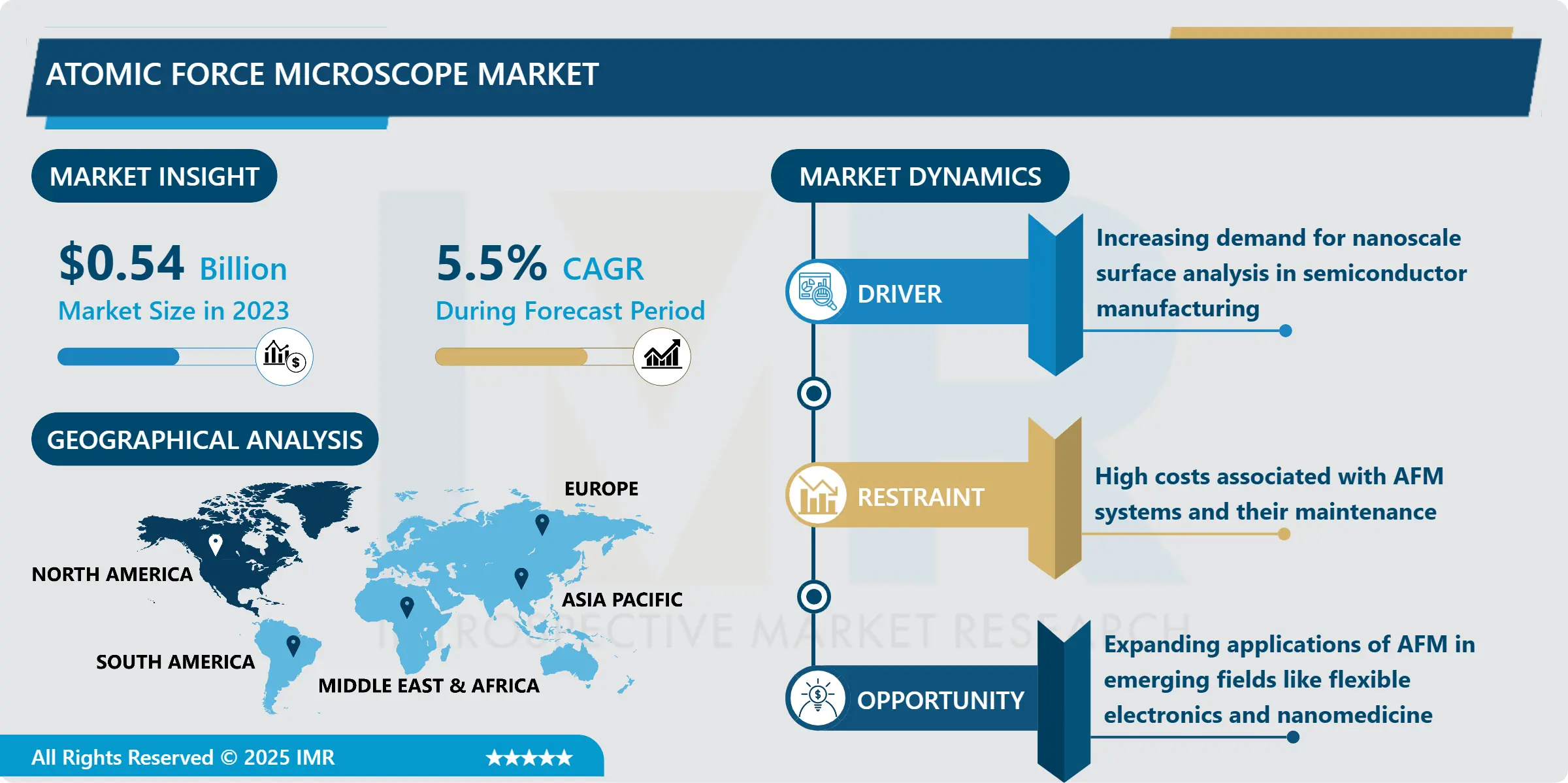
Atomic Force Microscope Market Size Was Valued at USD 0.54 Billion in 2023, and is Projected to Reach USD 0.83 Billion by 2032, Growing at a CAGR of 5.5% From 2024-2032.
The Atomic Force Microscope (AFM) industry is the market of creation and use of an AFM, which is a visual instrument designed to measure the forces between a probe tip and a surface at the nanometer level. These devices are essential for studying and identifying surfaces and materials in different sectors, ranging from health and life sciences, advanced material and nanotechnology industries. The AFM functions through the method of scanning a fine tip over a surface, giving 3D topographical data at near about one nanometer. Thus, being able to analyze mechanical, electrical, and magnetical characteristics, it is an essential tool in the most complicated research and development stages in the world.
Atomic Force Microscope market is developing at a satisfactory pace worldwide as there is a growing need for enhanced imaging instruments and analysis equipment in the different field. The increasing use of nanotechnology and increasing emphasis on research in material sciences are fueling the utilisation of AFMs. Its advancements in accuracy of surface analysis have made these microscopes gain ground in the semiconductor, life sciences and pharmaceutical industries. Further, emerging higher scanning speed, better topographical resolution and new generation AFM instruments are contributing to the increased applicability in a wide range of applications which in turn is driving growth in the market.
The risks experienced by the government and private establishments are evident due to increased funding on Research and Development. In life sciences, AFMs are critical in investigation of biomolecular interactions, and cell mechanics. Semiconductor firms have attributed an important use of electron microscopes in the industry where they are used in quality control and Failure Analysis Department. The ability to make applications across these numerous disciplines underscores evolution of this market and places AFM as an essential platform for contemporary scientific investigation and commercial products.
Atomic Force Microscope Market Trend Analysis:
Technological Advancements Accelerate Growth
-
The AFM market is currently witnessing new product innovation with manufacturers coming up with new ruggedized AFM models that are automated and high speed to meet the growing demand for faster and more accurate imaging. They explained that interaction between AI and machine learning is currently appearing as one of the key development trends that will allow AFM systems to diagnose defects, predict equipment faults and carry out sophisticated data analysis automatically.
- Further expansion of the range is discussed to be provided by the prospect of utilizing the so-called hybrid AFMs that incorporate capabilities of the AFM in combination with other imaging techniques such as optical microscopy. All these enhancements contribute not only to the ease of using the AFMs, but also to the diversification of a more extensive group of users, from academic researchers to industrial quality assurance departments.
Growing Opportunities in Nanotechnology Applications
-
The increasing integration of nanotechnology across various industries significantly enhances the growth potential of the Atomic Force Microscopy (AFM) market. As sectors such as electronics, biotechnology, and materials science delve further into nanoscale innovations, the demand for highly precise and reliable measurement tools like AFM continues to rise.
- AFM's importance is underscored by its critical role in advancing applications such as nano drug delivery systems, flexible electronics, and high-performance nanocomposites. These technologies demand intricate nanoscale analysis and imaging, which AFM delivers with exceptional accuracy. Furthermore, the expanding focus on sustainable and clean energy solutions presents another promising avenue for AFM technology, particularly in examining and optimizing photovoltaic materials., As these fields increasingly adopt AFM to meet rigorous precision standards, the market is poised for robust growth, driven by its indispensability in nanoscale research and product development across emerging high-tech domains.
Atomic Force Microscope Market Segment Analysis:
Atomic Force Microscope Market is Segmented on the basis of Type, Application, and Region.
By Type, Industrial Grade AFM segment is expected to dominate the market during the forecast period
-
The Industrial-grade Atomic Force Microscope segment is expected to hold a large share in the market in the course of the forecast period because of its superior use in manufacturing and checking the quality of industrial products. Excel microscopes are made for intensive usage in unfavorable conditions and being very precise and efficient. Semiconductor and automobile companies use industrial AFM particularly for surface evaluation and to investigate the causes of equipment failure.
- Using advanced technology, there is the discovery of affordable industrial high throughput AFMs for a broad group of SMEs. The ability to characterize metals and polymers makes them important tools of industries that demand characterization technologies.
By Application, Life Sciences and Biology segment expected to held the largest share
-
The latest trend of the AFM market is likely to be led by the Life Sciences and Biology segment since these microscopes have significant importance in biomolecular and cellular investigations. Scientists apply AFMs to examine DNA and proteins, as well as other biomolecules that are almost invisible to other microscopes, so that groundbreaking discoveries in genomics, proteomics, and drug development are possible. This characteristic makes them suitable for monitoring live cells and biological processes in physiological environments.
- Increased use of AFMs in personalized medicine and biotechnology has helped to raise the demand for such microscopes in this section. The qualitative and quantitative analysis offered by AFMs in aspects of the biological samples entrenches the importance of AFMs in the field of life sciences.
Atomic Force Microscope Market Regional Insights:
North America is Expected to Dominate the Market Over the Forecast period
-
North America stands as the largest consumer of Atomic Force Microscopes (AFMs), primarily due to its highly developed research infrastructure, strong governmental support for scientific advancement, and the presence of leading AFM manufacturers. The United States, in particular, has emerged as a global leader in AFM innovation, driven by its thriving semiconductor and biotechnology sectors. These industries demand cutting-edge microscopy solutions for precision analysis and quality control, further fueling the adoption of AFM technology.
- Numerous universities and advanced research institutions across North America heavily invest in AFMs to support high-level scientific research, ranging from materials science to life sciences. The region’s commitment to technological progress and innovation continues to boost demand for AFMs. With a combination of supportive policies, industrial demand, and a robust academic presence, North America maintains its position as the most dominant and influential market for AFM technologies worldwide.
Active Key Players in the Atomic Force Microscope Market:
-
Asylum Research (USA)
- Bruker Corporation (USA)
- Hitachi High-Tech Corporation (Japan)
- JPK Instruments AG (Germany)
- Keysight Technologies (USA)
- Nanosurf AG (Switzerland)
- NT-MDT Spectrum Instruments (Russia)
- Park Systems Corporation (South Korea)
- RHK Technology (USA)
- Shimadzu Corporation (Japan)
- Thermo Fisher Scientific Inc. (USA)
- WITec GmbH (Germany)
- Zeta Instruments (USA)
- Oxford Instruments (UK)
- NanoMagnetics Instruments (UK), and Other Active Players
|
Global Atomic Force Microscope Market |
|||
|
Base Year: |
2023 |
Forecast Period: |
2024-2032 |
|
Historical Data: |
2017 to 2023 |
Market Size in 2023: |
USD 0.54 Billion |
|
Forecast Period 2024-32 CAGR: |
5.5% |
Market Size in 2032: |
USD 0.83 Billion |
|
Segments Covered: |
By Type |
|
|
|
By Application |
|
||
|
By Region |
|
||
|
Key Market Drivers: |
|
||
|
Key Market Restraints: |
|
||
|
Key Opportunities: |
|
||
|
Companies Covered in the report: |
|
||
Chapter 1: Introduction
1.1 Scope and Coverage
Chapter 2:Executive Summary
Chapter 3: Market Landscape
3.1 Market Dynamics
3.1.1 Drivers
3.1.2 Restraints
3.1.3 Opportunities
3.1.4 Challenges
3.2 Market Trend Analysis
3.3 PESTLE Analysis
3.4 Porter's Five Forces Analysis
3.5 Industry Value Chain Analysis
3.6 Ecosystem
3.7 Regulatory Landscape
3.8 Price Trend Analysis
3.9 Patent Analysis
3.10 Technology Evolution
3.11 Investment Pockets
3.12 Import-Export Analysis
Chapter 4: Atomic Force Microscope Market by Type
4.1 Atomic Force Microscope Market Snapshot and Growth Engine
4.2 Atomic Force Microscope Market Overview
4.3 Industrial Grade AFM
4.3.1 Introduction and Market Overview
4.3.2 Historic and Forecasted Market Size in Value USD and Volume Units (2017-2032F)
4.3.3 Key Market Trends, Growth Factors and Opportunities
4.3.4 Industrial Grade AFM: Geographic Segmentation Analysis
4.4 Research Grade AFM
4.4.1 Introduction and Market Overview
4.4.2 Historic and Forecasted Market Size in Value USD and Volume Units (2017-2032F)
4.4.3 Key Market Trends, Growth Factors and Opportunities
4.4.4 Research Grade AFM: Geographic Segmentation Analysis
Chapter 5: Atomic Force Microscope Market by Application
5.1 Atomic Force Microscope Market Snapshot and Growth Engine
5.2 Atomic Force Microscope Market Overview
5.3 Life Sciences and Biology
5.3.1 Introduction and Market Overview
5.3.2 Historic and Forecasted Market Size in Value USD and Volume Units (2017-2032F)
5.3.3 Key Market Trends, Growth Factors and Opportunities
5.3.4 Life Sciences and Biology: Geographic Segmentation Analysis
5.4 Semiconductors and Electronics
5.4.1 Introduction and Market Overview
5.4.2 Historic and Forecasted Market Size in Value USD and Volume Units (2017-2032F)
5.4.3 Key Market Trends, Growth Factors and Opportunities
5.4.4 Semiconductors and Electronics: Geographic Segmentation Analysis
5.5 Nanomaterials science
5.5.1 Introduction and Market Overview
5.5.2 Historic and Forecasted Market Size in Value USD and Volume Units (2017-2032F)
5.5.3 Key Market Trends, Growth Factors and Opportunities
5.5.4 Nanomaterials science: Geographic Segmentation Analysis
5.6 Others
5.6.1 Introduction and Market Overview
5.6.2 Historic and Forecasted Market Size in Value USD and Volume Units (2017-2032F)
5.6.3 Key Market Trends, Growth Factors and Opportunities
5.6.4 Others: Geographic Segmentation Analysis
Chapter 6: Company Profiles and Competitive Analysis
6.1 Competitive Landscape
6.1.1 Competitive Benchmarking
6.1.2 Atomic Force Microscope Market Share by Manufacturer (2023)
6.1.3 Industry BCG Matrix
6.1.4 Heat Map Analysis
6.1.5 Mergers and Acquisitions
6.2 ASYLUM RESEARCH (USA)
6.2.1 Company Overview
6.2.2 Key Executives
6.2.3 Company Snapshot
6.2.4 Role of the Company in the Market
6.2.5 Sustainability and Social Responsibility
6.2.6 Operating Business Segments
6.2.7 Product Portfolio
6.2.8 Business Performance
6.2.9 Key Strategic Moves and Recent Developments
6.2.10 SWOT Analysis
6.3 BRUKER CORPORATION (USA)
6.4 HITACHI HIGH-TECH CORPORATION (JAPAN)
6.5 JPK INSTRUMENTS AG (GERMANY)
6.6 KEYSIGHT TECHNOLOGIES (USA)
6.7 NANOSURF AG (SWITZERLAND)
6.8 NT-MDT SPECTRUM INSTRUMENTS (RUSSIA)
6.9 PARK SYSTEMS CORPORATION (SOUTH KOREA)
6.10 RHK TECHNOLOGY (USA)
6.11 SHIMADZU CORPORATION (JAPAN)
6.12 THERMO FISHER SCIENTIFIC INC. (USA)
6.13 WITEC GMBH (GERMANY)
6.14 ZETA INSTRUMENTS (USA)
6.15 OXFORD INSTRUMENTS (UK)
6.16 NANOMAGNETICS INSTRUMENTS (UK)
6.17 OTHER ACTIVE PLAYERS
Chapter 7: Global Atomic Force Microscope Market By Region
7.1 Overview
7.2. North America Atomic Force Microscope Market
7.2.1 Key Market Trends, Growth Factors and Opportunities
7.2.2 Top Key Companies
7.2.3 Historic and Forecasted Market Size by Segments
7.2.4 Historic and Forecasted Market Size By Type
7.2.4.1 Industrial Grade AFM
7.2.4.2 Research Grade AFM
7.2.5 Historic and Forecasted Market Size By Application
7.2.5.1 Life Sciences and Biology
7.2.5.2 Semiconductors and Electronics
7.2.5.3 Nanomaterials science
7.2.5.4 Others
7.2.6 Historic and Forecast Market Size by Country
7.2.6.1 US
7.2.6.2 Canada
7.2.6.3 Mexico
7.3. Eastern Europe Atomic Force Microscope Market
7.3.1 Key Market Trends, Growth Factors and Opportunities
7.3.2 Top Key Companies
7.3.3 Historic and Forecasted Market Size by Segments
7.3.4 Historic and Forecasted Market Size By Type
7.3.4.1 Industrial Grade AFM
7.3.4.2 Research Grade AFM
7.3.5 Historic and Forecasted Market Size By Application
7.3.5.1 Life Sciences and Biology
7.3.5.2 Semiconductors and Electronics
7.3.5.3 Nanomaterials science
7.3.5.4 Others
7.3.6 Historic and Forecast Market Size by Country
7.3.6.1 Russia
7.3.6.2 Bulgaria
7.3.6.3 The Czech Republic
7.3.6.4 Hungary
7.3.6.5 Poland
7.3.6.6 Romania
7.3.6.7 Rest of Eastern Europe
7.4. Western Europe Atomic Force Microscope Market
7.4.1 Key Market Trends, Growth Factors and Opportunities
7.4.2 Top Key Companies
7.4.3 Historic and Forecasted Market Size by Segments
7.4.4 Historic and Forecasted Market Size By Type
7.4.4.1 Industrial Grade AFM
7.4.4.2 Research Grade AFM
7.4.5 Historic and Forecasted Market Size By Application
7.4.5.1 Life Sciences and Biology
7.4.5.2 Semiconductors and Electronics
7.4.5.3 Nanomaterials science
7.4.5.4 Others
7.4.6 Historic and Forecast Market Size by Country
7.4.6.1 Germany
7.4.6.2 UK
7.4.6.3 France
7.4.6.4 The Netherlands
7.4.6.5 Italy
7.4.6.6 Spain
7.4.6.7 Rest of Western Europe
7.5. Asia Pacific Atomic Force Microscope Market
7.5.1 Key Market Trends, Growth Factors and Opportunities
7.5.2 Top Key Companies
7.5.3 Historic and Forecasted Market Size by Segments
7.5.4 Historic and Forecasted Market Size By Type
7.5.4.1 Industrial Grade AFM
7.5.4.2 Research Grade AFM
7.5.5 Historic and Forecasted Market Size By Application
7.5.5.1 Life Sciences and Biology
7.5.5.2 Semiconductors and Electronics
7.5.5.3 Nanomaterials science
7.5.5.4 Others
7.5.6 Historic and Forecast Market Size by Country
7.5.6.1 China
7.5.6.2 India
7.5.6.3 Japan
7.5.6.4 South Korea
7.5.6.5 Malaysia
7.5.6.6 Thailand
7.5.6.7 Vietnam
7.5.6.8 The Philippines
7.5.6.9 Australia
7.5.6.10 New Zealand
7.5.6.11 Rest of APAC
7.6. Middle East & Africa Atomic Force Microscope Market
7.6.1 Key Market Trends, Growth Factors and Opportunities
7.6.2 Top Key Companies
7.6.3 Historic and Forecasted Market Size by Segments
7.6.4 Historic and Forecasted Market Size By Type
7.6.4.1 Industrial Grade AFM
7.6.4.2 Research Grade AFM
7.6.5 Historic and Forecasted Market Size By Application
7.6.5.1 Life Sciences and Biology
7.6.5.2 Semiconductors and Electronics
7.6.5.3 Nanomaterials science
7.6.5.4 Others
7.6.6 Historic and Forecast Market Size by Country
7.6.6.1 Turkiye
7.6.6.2 Bahrain
7.6.6.3 Kuwait
7.6.6.4 Saudi Arabia
7.6.6.5 Qatar
7.6.6.6 UAE
7.6.6.7 Israel
7.6.6.8 South Africa
7.7. South America Atomic Force Microscope Market
7.7.1 Key Market Trends, Growth Factors and Opportunities
7.7.2 Top Key Companies
7.7.3 Historic and Forecasted Market Size by Segments
7.7.4 Historic and Forecasted Market Size By Type
7.7.4.1 Industrial Grade AFM
7.7.4.2 Research Grade AFM
7.7.5 Historic and Forecasted Market Size By Application
7.7.5.1 Life Sciences and Biology
7.7.5.2 Semiconductors and Electronics
7.7.5.3 Nanomaterials science
7.7.5.4 Others
7.7.6 Historic and Forecast Market Size by Country
7.7.6.1 Brazil
7.7.6.2 Argentina
7.7.6.3 Rest of SA
Chapter 8 Analyst Viewpoint and Conclusion
8.1 Recommendations and Concluding Analysis
8.2 Potential Market Strategies
Chapter 9 Research Methodology
9.1 Research Process
9.2 Primary Research
9.3 Secondary Research
|
Global Atomic Force Microscope Market |
|||
|
Base Year: |
2023 |
Forecast Period: |
2024-2032 |
|
Historical Data: |
2017 to 2023 |
Market Size in 2023: |
USD 0.54 Billion |
|
Forecast Period 2024-32 CAGR: |
5.5% |
Market Size in 2032: |
USD 0.83 Billion |
|
Segments Covered: |
By Type |
|
|
|
By Application |
|
||
|
By Region |
|
||
|
Key Market Drivers: |
|
||
|
Key Market Restraints: |
|
||
|
Key Opportunities: |
|
||
|
Companies Covered in the report: |
|
||


