




Atomic Clock Market Synopsis:
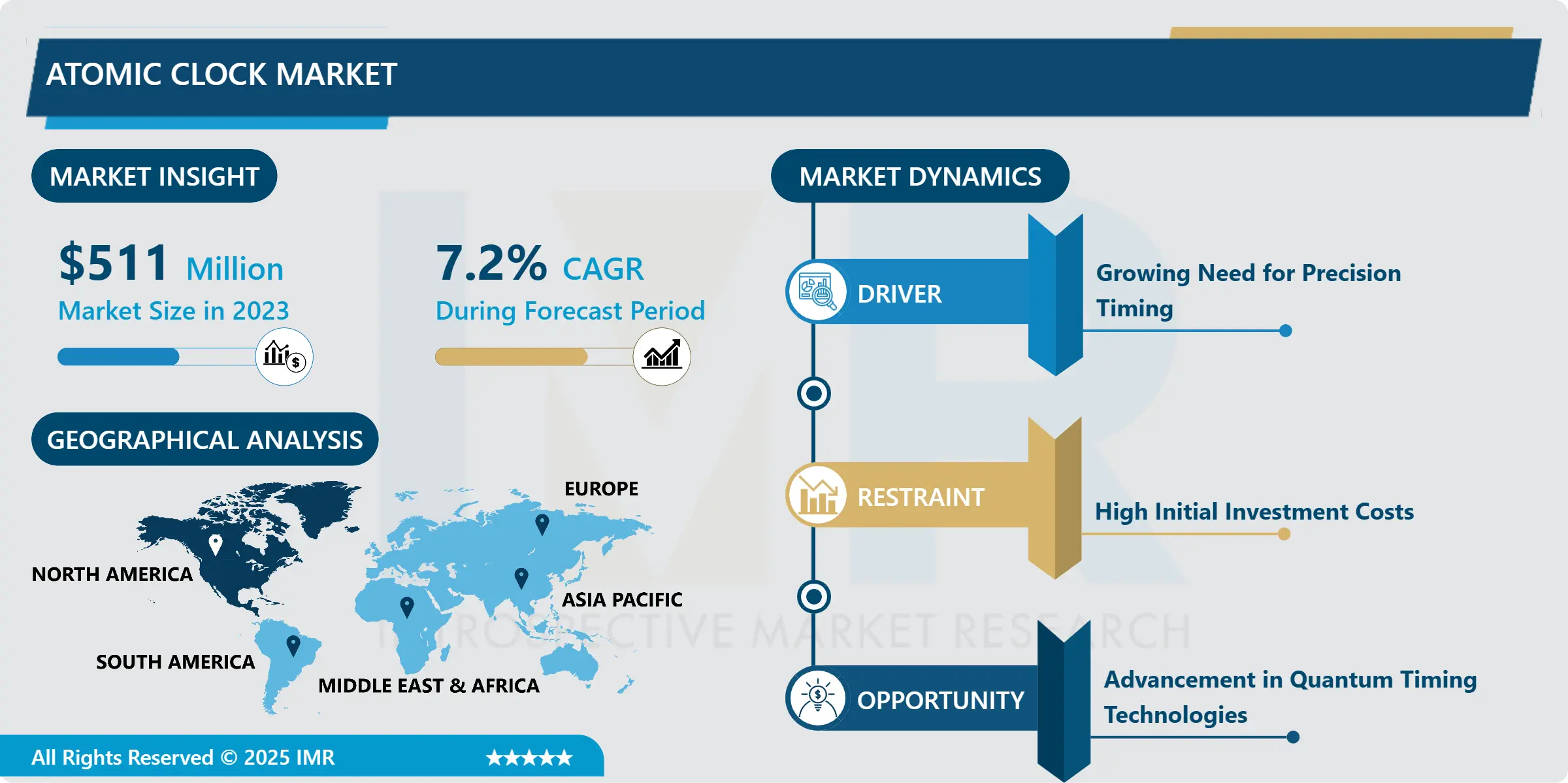
Atomic Clock Market Size Was Valued at USD 511 Million in 2023, and is Projected to Reach USD 955.38 Million by 2032, Growing at a CAGR of 7.2% From 2024-2032.
The main market is made up of highly accurate time pieces, which currently use the frequency of atomic transitions for operation. Hence atomic clocks are deemed necessary in a variety of uses for instance Global Navigation Satellite Systems (GNSS), telecommunications, scientific investigations and in military applications. These clocks determine time by means of differentiated atomic vibration, most often of cesium or rubidium – and this is what makes it possible to harmonize the synchronization of complex systems and technologies. The atomic clock is now enjoying high demand all over the world especially when precision time is required in aerospace companies, space exploration programs, and even defense systems.
The atomic clock market has been on the rise within recent years given the increased demand for accurate timing applications. Atomic clocks are essential also to modern service industries such as telecommunications and space operations; which make the exact time reference a functional prerequisite these days. These clocks are also essential especially in scientific research since the timing is important in experiments and in processing of data. The subsequent growth of more and more autonomous systems and connected technologies has provided additional stimulus to atomic clocks in new fields.
These systems, including 5G networks, space missions, and protected military operations, now incorporate atomic clocks into the market environment, changing its appearance. There is great interest expressing a demand for emerging advanced atomic clock technologies that can be used in government and private facilities. However, recent trends in the field also show development in the R & D sections, along with improvements in the technology, which has led to application to miniaturized portable atomic clocks, thus expanding the area of usage.
Atomic Clock Market Trend Analysis:
Rising Adoption in Space Exploration
-
There is a noticeable and growing trend in the atomic clock market, particularly driven by its increasing application in space research and exploration. Pulse atomic clocks play a crucial role in facilitating precise navigation and real-time communication across vast interplanetary distances. These clocks, such as NASA’s Deep Space Atomic Clock (DSAC), are revolutionizing how extended space missions are conducted by offering an unprecedented level of timing accuracy and synchronization.
- Innovation enables spacecraft to travel deeper into space with reduced reliance on Earth-based tracking systems. Moreover, the adoption of these technologies is not limited to national space agencies like NASA, but is also expanding to include private space companies, all seeking to enhance mission capabilities and efficiency. As a result, this application is becoming a key driver in the development and expansion of the global atomic clock market, opening up new frontiers in space technology.
Expansion in Quantum Technologies
-
The atomic clock market is poised for remarkable transformation, driven by rapid advancements in quantum field technologies. These innovations are continually enhancing the precision and performance of atomic clocks, pushing the boundaries of timekeeping accuracy. Quantum sensing and timing technologies are not only refining atomic clocks but also fueling breakthroughs in a variety of cutting-edge applications. These include secure communication systems, autonomous vehicles, aerospace navigation, and the infrastructure of smart cities.
- As quantum technology becomes more integrated into atomic clock systems, their reliability and capabilities expand, offering tremendous potential across multiple industries. Governments and private sectors are significantly increasing investments in quantum research, recognizing its transformative power. This momentum is expected to unlock expansive opportunities for atomic clocks in both established and emerging sectors. With quantum-driven development, atomic clocks are set to become a foundational technology in the future digital and technological landscape.
Atomic Clock Market Segment Analysis:
Atomic Clock Market is Segmented on the basis of Type, Application, and Region.
By Type, Cesium segment is expected to dominate the market during the forecast period
-
Out of the various cesium-based atomic clocks, industry players are expected to prefer using high stability and accurate atomic clocks during the forcast period. Cesium clocks are used on the international level as the standard in time and frequency and provide the best option for exacting uses. These clocks are popular in telcommunication networks, GNSS systems and scientific researches, keeping the works of widely developed technologies that demand a precise synchronization of time.
- Cesium atomic clocks represent a highly demanded due to their reputable performance and versatility of use. This segment will continue to grow because of constant improvement in designs of cesium clock such as the portable and compact type. The rise of cesium clocks as major devices utilized in the newer technology like 5G, Self-driving cars and many others has greatly boosted this market.
By Application, Space & Military/Aerospace segment expected to held the largest share
-
Of the many areas of application, it could be postulated that the space and military/aerospace applications will constitute the most significant atomic clock markets, being required for successful mission-critical timing. In aerospace industry atomic clocks remain to provide highly accurate navigation and communication needs for flying machines including aeroplanes and space shuts. They are crucial elements in GNSS systems and are used to give real-time timing reference for satellite-dependent operations.
- As in military uses atomic clocks are used for secure communication, radar systems and missile control. This assertion is backed by massive expenditure demonstrable in defense projects and space research endeavors in the segment. A specific example of the significance of this segment is the use of synchronous atomic clocks in the mostly new segments, including unmanned systems and satellite constellations.
Atomic Clock Market Regional Insights:
North America is Expected to Dominate the Market Over the Forecast period
-
North America has emerged as the leading region in the global atomic clock market, holding the largest share due to a combination of strategic, technological, and institutional advantages. The region benefits from a robust technological infrastructure and significant investments in key sectors such as defense, aerospace, and telecommunications. Major government agencies like NASA and the U.S. Department of Defense have long pioneered the use and development of atomic clock technology, particularly for applications in space exploration, GPS systems, and secure military communications. These organizations have driven innovation and set high standards for accuracy and reliability.
- The region’s advanced telecommunications networks and secure digital infrastructure further support the widespread adoption of atomic clocks. With a concentration of leading market players and continuous innovation, North America remains at the forefront of technological advancement in this domain, reinforcing its dominant position in the global atomic clock market.
Active Key Players in the Atomic Clock Market
-
AccuBeat (Israel)
- AdvanSplit (France)
- BRG Precision Products (USA)
- Excelitas Technologies (USA)
- Frequency Electronics Inc. (USA)
- Galleon Systems (UK)
- Hoptroff London (UK)
- IQD Frequency Products (UK)
- Microchip Technology Inc. (USA)
- Oscilloquartz SA (Switzerland)
- Orolia (USA)
- Oscilloquartz (Switzerland)
- Stanford Research Systems (USA)
- Tekron (New Zealand)
- VREMYA-CH (Russia), and Other Active Players
|
Global Atomic Clock Market |
|||
|
Base Year: |
2023 |
Forecast Period: |
2024-2032 |
|
Historical Data: |
2017 to 2023 |
Market Size in 2023: |
USD 511 Million |
|
Forecast Period 2024-32 CAGR: |
7.2% |
Market Size in 2032: |
USD 955.38 Million |
|
Segments Covered: |
By Type |
|
|
|
By Application |
|
||
|
By Region |
|
||
|
Key Market Drivers: |
|
||
|
Key Market Restraints: |
|
||
|
Key Opportunities: |
|
||
|
Companies Covered in the report: |
|
||
Chapter 1: Introduction
1.1 Scope and Coverage
Chapter 2:Executive Summary
Chapter 3: Market Landscape
3.1 Market Dynamics
3.1.1 Drivers
3.1.2 Restraints
3.1.3 Opportunities
3.1.4 Challenges
3.2 Market Trend Analysis
3.3 PESTLE Analysis
3.4 Porter's Five Forces Analysis
3.5 Industry Value Chain Analysis
3.6 Ecosystem
3.7 Regulatory Landscape
3.8 Price Trend Analysis
3.9 Patent Analysis
3.10 Technology Evolution
3.11 Investment Pockets
3.12 Import-Export Analysis
Chapter 4: Atomic Clock Market by Type
4.1 Atomic Clock Market Snapshot and Growth Engine
4.2 Atomic Clock Market Overview
4.3 Cesium
4.3.1 Introduction and Market Overview
4.3.2 Historic and Forecasted Market Size in Value USD and Volume Units (2017-2032F)
4.3.3 Key Market Trends, Growth Factors and Opportunities
4.3.4 Cesium: Geographic Segmentation Analysis
4.4 Rubidium
4.4.1 Introduction and Market Overview
4.4.2 Historic and Forecasted Market Size in Value USD and Volume Units (2017-2032F)
4.4.3 Key Market Trends, Growth Factors and Opportunities
4.4.4 Rubidium: Geographic Segmentation Analysis
4.5 Hydrogen
4.5.1 Introduction and Market Overview
4.5.2 Historic and Forecasted Market Size in Value USD and Volume Units (2017-2032F)
4.5.3 Key Market Trends, Growth Factors and Opportunities
4.5.4 Hydrogen: Geographic Segmentation Analysis
Chapter 5: Atomic Clock Market by Application
5.1 Atomic Clock Market Snapshot and Growth Engine
5.2 Atomic Clock Market Overview
5.3 Space & Military/Aerospace
5.3.1 Introduction and Market Overview
5.3.2 Historic and Forecasted Market Size in Value USD and Volume Units (2017-2032F)
5.3.3 Key Market Trends, Growth Factors and Opportunities
5.3.4 Space & Military/Aerospace: Geographic Segmentation Analysis
5.4 Scientific & Metrology Research
5.4.1 Introduction and Market Overview
5.4.2 Historic and Forecasted Market Size in Value USD and Volume Units (2017-2032F)
5.4.3 Key Market Trends, Growth Factors and Opportunities
5.4.4 Scientific & Metrology Research: Geographic Segmentation Analysis
5.5 Telecom & Broadcasting
5.5.1 Introduction and Market Overview
5.5.2 Historic and Forecasted Market Size in Value USD and Volume Units (2017-2032F)
5.5.3 Key Market Trends, Growth Factors and Opportunities
5.5.4 Telecom & Broadcasting: Geographic Segmentation Analysis
5.6 Others
5.6.1 Introduction and Market Overview
5.6.2 Historic and Forecasted Market Size in Value USD and Volume Units (2017-2032F)
5.6.3 Key Market Trends, Growth Factors and Opportunities
5.6.4 Others: Geographic Segmentation Analysis
Chapter 6: Company Profiles and Competitive Analysis
6.1 Competitive Landscape
6.1.1 Competitive Benchmarking
6.1.2 Atomic Clock Market Share by Manufacturer (2023)
6.1.3 Industry BCG Matrix
6.1.4 Heat Map Analysis
6.1.5 Mergers and Acquisitions
6.2 ACCUBEAT (ISRAEL)
6.2.1 Company Overview
6.2.2 Key Executives
6.2.3 Company Snapshot
6.2.4 Role of the Company in the Market
6.2.5 Sustainability and Social Responsibility
6.2.6 Operating Business Segments
6.2.7 Product Portfolio
6.2.8 Business Performance
6.2.9 Key Strategic Moves and Recent Developments
6.2.10 SWOT Analysis
6.3 ADVANSPLIT (FRANCE)
6.4 BRG PRECISION PRODUCTS (USA)
6.5 EXCELITAS TECHNOLOGIES (USA)
6.6 FREQUENCY ELECTRONICS INC. (USA)
6.7 GALLEON SYSTEMS (UK)
6.8 HOPTROFF LONDON (UK)
6.9 IQD FREQUENCY PRODUCTS (UK)
6.10 MICROCHIP TECHNOLOGY INC. (USA)
6.11 OSCILLOQUARTZ SA (SWITZERLAND)
6.12 OROLIA (USA)
6.13 OSCILLOQUARTZ (SWITZERLAND)
6.14 STANFORD RESEARCH SYSTEMS (USA)
6.15 TEKRON (NEW ZEALAND)
6.16 VREMYA-CH (RUSSIA)
6.17 OTHER ACTIVE PLAYERS
Chapter 7: Global Atomic Clock Market By Region
7.1 Overview
7.2. North America Atomic Clock Market
7.2.1 Key Market Trends, Growth Factors and Opportunities
7.2.2 Top Key Companies
7.2.3 Historic and Forecasted Market Size by Segments
7.2.4 Historic and Forecasted Market Size By Type
7.2.4.1 Cesium
7.2.4.2 Rubidium
7.2.4.3 Hydrogen
7.2.5 Historic and Forecasted Market Size By Application
7.2.5.1 Space & Military/Aerospace
7.2.5.2 Scientific & Metrology Research
7.2.5.3 Telecom & Broadcasting
7.2.5.4 Others
7.2.6 Historic and Forecast Market Size by Country
7.2.6.1 US
7.2.6.2 Canada
7.2.6.3 Mexico
7.3. Eastern Europe Atomic Clock Market
7.3.1 Key Market Trends, Growth Factors and Opportunities
7.3.2 Top Key Companies
7.3.3 Historic and Forecasted Market Size by Segments
7.3.4 Historic and Forecasted Market Size By Type
7.3.4.1 Cesium
7.3.4.2 Rubidium
7.3.4.3 Hydrogen
7.3.5 Historic and Forecasted Market Size By Application
7.3.5.1 Space & Military/Aerospace
7.3.5.2 Scientific & Metrology Research
7.3.5.3 Telecom & Broadcasting
7.3.5.4 Others
7.3.6 Historic and Forecast Market Size by Country
7.3.6.1 Russia
7.3.6.2 Bulgaria
7.3.6.3 The Czech Republic
7.3.6.4 Hungary
7.3.6.5 Poland
7.3.6.6 Romania
7.3.6.7 Rest of Eastern Europe
7.4. Western Europe Atomic Clock Market
7.4.1 Key Market Trends, Growth Factors and Opportunities
7.4.2 Top Key Companies
7.4.3 Historic and Forecasted Market Size by Segments
7.4.4 Historic and Forecasted Market Size By Type
7.4.4.1 Cesium
7.4.4.2 Rubidium
7.4.4.3 Hydrogen
7.4.5 Historic and Forecasted Market Size By Application
7.4.5.1 Space & Military/Aerospace
7.4.5.2 Scientific & Metrology Research
7.4.5.3 Telecom & Broadcasting
7.4.5.4 Others
7.4.6 Historic and Forecast Market Size by Country
7.4.6.1 Germany
7.4.6.2 UK
7.4.6.3 France
7.4.6.4 The Netherlands
7.4.6.5 Italy
7.4.6.6 Spain
7.4.6.7 Rest of Western Europe
7.5. Asia Pacific Atomic Clock Market
7.5.1 Key Market Trends, Growth Factors and Opportunities
7.5.2 Top Key Companies
7.5.3 Historic and Forecasted Market Size by Segments
7.5.4 Historic and Forecasted Market Size By Type
7.5.4.1 Cesium
7.5.4.2 Rubidium
7.5.4.3 Hydrogen
7.5.5 Historic and Forecasted Market Size By Application
7.5.5.1 Space & Military/Aerospace
7.5.5.2 Scientific & Metrology Research
7.5.5.3 Telecom & Broadcasting
7.5.5.4 Others
7.5.6 Historic and Forecast Market Size by Country
7.5.6.1 China
7.5.6.2 India
7.5.6.3 Japan
7.5.6.4 South Korea
7.5.6.5 Malaysia
7.5.6.6 Thailand
7.5.6.7 Vietnam
7.5.6.8 The Philippines
7.5.6.9 Australia
7.5.6.10 New Zealand
7.5.6.11 Rest of APAC
7.6. Middle East & Africa Atomic Clock Market
7.6.1 Key Market Trends, Growth Factors and Opportunities
7.6.2 Top Key Companies
7.6.3 Historic and Forecasted Market Size by Segments
7.6.4 Historic and Forecasted Market Size By Type
7.6.4.1 Cesium
7.6.4.2 Rubidium
7.6.4.3 Hydrogen
7.6.5 Historic and Forecasted Market Size By Application
7.6.5.1 Space & Military/Aerospace
7.6.5.2 Scientific & Metrology Research
7.6.5.3 Telecom & Broadcasting
7.6.5.4 Others
7.6.6 Historic and Forecast Market Size by Country
7.6.6.1 Turkiye
7.6.6.2 Bahrain
7.6.6.3 Kuwait
7.6.6.4 Saudi Arabia
7.6.6.5 Qatar
7.6.6.6 UAE
7.6.6.7 Israel
7.6.6.8 South Africa
7.7. South America Atomic Clock Market
7.7.1 Key Market Trends, Growth Factors and Opportunities
7.7.2 Top Key Companies
7.7.3 Historic and Forecasted Market Size by Segments
7.7.4 Historic and Forecasted Market Size By Type
7.7.4.1 Cesium
7.7.4.2 Rubidium
7.7.4.3 Hydrogen
7.7.5 Historic and Forecasted Market Size By Application
7.7.5.1 Space & Military/Aerospace
7.7.5.2 Scientific & Metrology Research
7.7.5.3 Telecom & Broadcasting
7.7.5.4 Others
7.7.6 Historic and Forecast Market Size by Country
7.7.6.1 Brazil
7.7.6.2 Argentina
7.7.6.3 Rest of SA
Chapter 8 Analyst Viewpoint and Conclusion
8.1 Recommendations and Concluding Analysis
8.2 Potential Market Strategies
Chapter 9 Research Methodology
9.1 Research Process
9.2 Primary Research
9.3 Secondary Research
|
Global Atomic Clock Market |
|||
|
Base Year: |
2023 |
Forecast Period: |
2024-2032 |
|
Historical Data: |
2017 to 2023 |
Market Size in 2023: |
USD 511 Million |
|
Forecast Period 2024-32 CAGR: |
7.2% |
Market Size in 2032: |
USD 955.38 Million |
|
Segments Covered: |
By Type |
|
|
|
By Application |
|
||
|
By Region |
|
||
|
Key Market Drivers: |
|
||
|
Key Market Restraints: |
|
||
|
Key Opportunities: |
|
||
|
Companies Covered in the report: |
|
||


