




Key Market Highlights
Anti Inflammatory Therapeutics Market Size Was Valued at USD 125.40 Billion in 2024, and is Projected to Reach USD 269.43 Billion by 2035, Growing at a CAGR of 7.2% from 2025-2035.
- Market Size in 2024: USD 125.40 Billion
- Projected Market Size by 2035: USD 269.43 Billion
- CAGR (2025–2035): 7.2%
- Leading Market in 2024: North America
- Fastest-Growing Market: Asia-Pacific
- By Drug Class: The Anti-Inflammatory Drugs segment is anticipated to lead the market by accounting for 26.66% of the market share throughout the forecast period.
- By Route of Administration: The Oral segment is expected to capture 36.4% of the market share, thereby maintaining its dominance over the forecast period.
- By Region: North America region is projected to hold 32.22% of the market share during the forecast period.
- Active Players: AbbVie Inc. (United States), Alvogen (United States), Amgen Inc. (United States), AstraZeneca PLC (United Kingdom), and Other Active Players.
Anti Inflammatory Therapeutics Market Synopsis:
The Anti-Inflammatory Therapeutics Market focuses on treatments that reduce pain, swelling, and inflammation caused by conditions such as arthritis, migraines, respiratory disorders, and autoimmune diseases. These therapies, including traditional drugs and advanced biologics, provide faster and more targeted relief with fewer adverse effects. Market growth is driven by rising prevalence of chronic and autoimmune diseases, increased adoption of biologics, and government initiatives promoting nonsteroidal anti-inflammatory drugs in emerging regions. The COVID-19 pandemic further accelerated demand, as excessive inflammation and cytokine storms in patients spurred R&D and clinical trials for effective anti-inflammatory interventions. Challenges include patent expirations of blockbuster drugs and potential side effects, but innovations and increasing healthcare awareness continue to support market expansion.
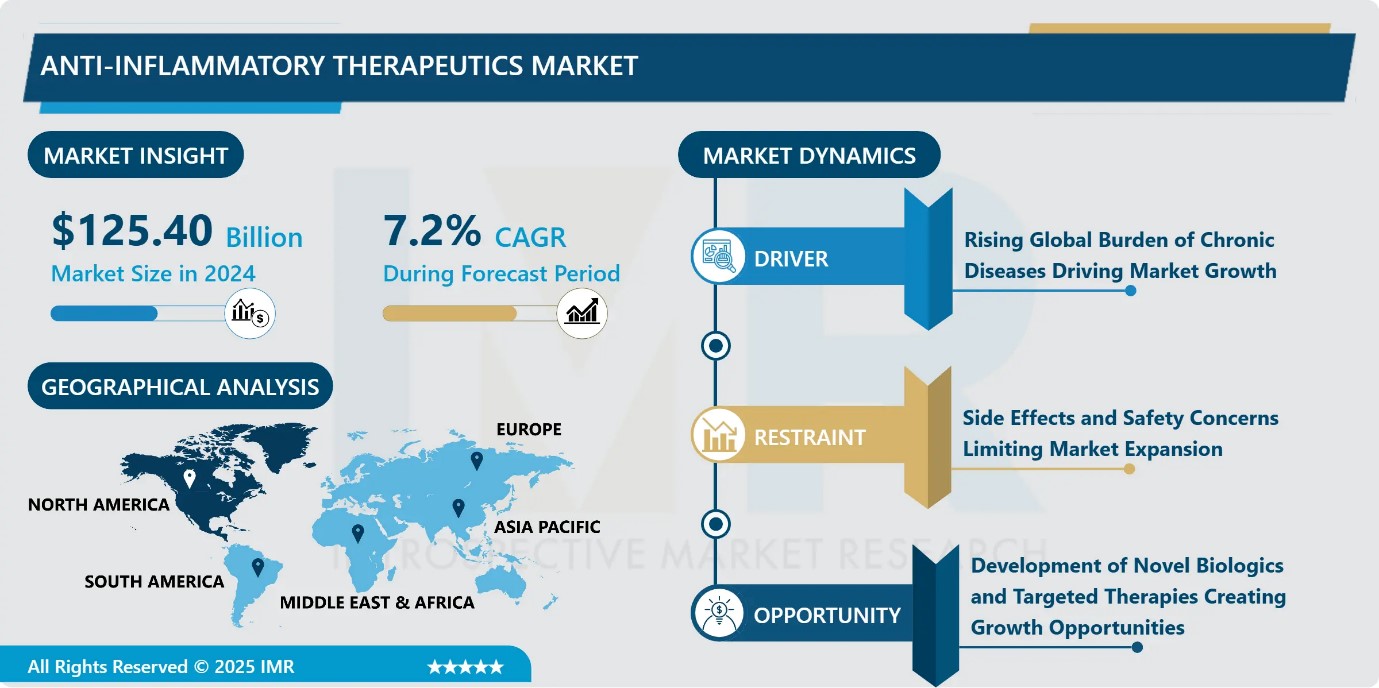
Anti Inflammatory Therapeutics Market Dynamics and Trend Analysis:
Anti Inflammatory Therapeutics Market Growth Driver
Rising Global Burden of Chronic Diseases Driving Market Growth
- The growing prevalence of chronic inflammatory diseases worldwide is a key driver of the anti-inflammatory drugs market. Conditions such as rheumatoid and osteoarthritis, inflammatory bowel disease, asthma, and other autoimmune disorders are increasing due to aging populations, sedentary lifestyles, and poor dietary habits. In 2023, the European Pain Federation reported that nearly 740 million people suffered from severe pain, with about 20% developing chronic conditions. Additionally, the World Health Organization estimated that 262 million people globally are affected by asthma. This rising disease burden is significantly increasing demand for effective prescription and over-the-counter anti-inflammatory therapies, supporting sustained market growth.
Anti Inflammatory Therapeutics Market Limiting Factor
Side Effects and Safety Concerns Limiting Market Expansion
- Safety concerns associated with conventional anti-inflammatory therapies remain a key restraint on market growth. Widely used drug classes such as non-steroidal anti-inflammatory drugs (NSAIDs) and corticosteroids are linked to adverse effects, particularly with long-term use. NSAIDs may cause gastrointestinal complications, including ulcers and bleeding, and are also associated with elevated cardiovascular risks. Corticosteroids can result in side effects such as weight gain, hypertension, and mood disturbances. These risks often lead to conservative prescribing practices and reduced patient compliance, especially in chronic or mild conditions. Ongoing regulatory and clinical scrutiny, including concerns raised during the COVID-19 pandemic, further underscores the need for safer therapeutic alternatives, constraining growth of traditional anti-inflammatory treatments.
Anti Inflammatory Therapeutics Market Expansion Opportunity
Development of Novel Biologics and Targeted Therapies Creating Growth Opportunities
- Advancements in the understanding of inflammatory disease pathways are creating strong growth opportunities in the anti-inflammatory market through the development of novel biologics and targeted therapies. Biologic drugs, produced from living systems, enable precise targeting of specific inflammatory mediators, leading to enhanced treatment outcomes and reduced adverse effects compared to conventional therapies. The anti-tumor necrosis factor (TNF) drug class has captured a significant market share due to its proven efficacy in managing rheumatoid arthritis and inflammatory bowel disease. In addition, the emergence of Janus kinase (JAK) inhibitors and other targeted small molecules is expanding therapeutic options, improving patient outcomes, and driving future market expansion
Anti Inflammatory Therapeutics Market Challenge and Risk
Regulatory Complexity and High Treatment Costs as Key Market Challenges
- The global anti-inflammatory therapeutics market faces notable challenges from stringent regulatory requirements and high treatment costs. Numerous drugs and injectable therapies remain pending approval, as regulatory authorities such as the U.S. Food and Drug Administration impose rigorous and time-intensive standards across clinical development, manufacturing, and commercialization processes. These hurdles often delay market entry and increase development risk.
- Additionally, the high cost of advanced anti-inflammatory treatments, particularly biologics and novel therapies, limits patient access and adoption, especially in cost-sensitive regions. Together, prolonged approval timelines and significant financial burden on healthcare systems and patients pose challenges to market expansion, emphasizing the need for cost-effective innovation and streamlined regulatory strategies.
Anti Inflammatory Therapeutics Market Trend
Biologics Pipeline Acceleration Through AI-Enabled Drug Discovery
- Artificial intelligence is emerging as a key trend reshaping the anti-inflammatory biologics market by accelerating drug discovery and development timelines. Generative AI models enable rapid target identification, optimization of binding affinity, and early risk reduction of lead candidates, significantly shortening development cycles. Companies such as Insilico Medicine have demonstrated this potential by advancing biologic candidates from computational design to early clinical stages within compressed timeframes.
- Major pharmaceutical companies are increasingly integrating AI platforms with proprietary libraries to strengthen immunology pipelines and introduce differentiated mechanisms of action. In parallel, genomics-based companion diagnostics are improving patient stratification, enhancing clinical trial success and reimbursement prospects. This data-driven innovation cycle is expected to sustain biologics advancement through 2030, particularly in digitally advanced regions.
Anti Inflammatory Therapeutics Market Segment Analysis:
Anti Inflammatory Therapeutics Market is segmented based on Drug Class, Route of Administration, Indication, Patient Type and Region.
By Drug Type, Anti-inflammatory segment is expected to dominate the market with around 26.66% share during the forecast period.
- Anti-inflammatory biologics continue to lead the market, driven by ongoing innovation in targeted immunomodulatory therapies and expanding approvals across a wide range of inflammatory and autoimmune diseases. Their dominance is supported by advancements in artificial intelligence–enabled drug discovery, which improves target identification, optimizes molecular design, and accelerates development timelines. Biologics provide superior clinical outcomes, durable disease control, and more favorable safety profiles compared to conventional therapies, making them the preferred option for long-term treatment. While non-steroidal anti-inflammatory drugs remain important for short-term symptom relief, and corticosteroids face reduced usage due to safety concerns, biologics are increasingly adopted for chronic disease management, reinforcing their leadership position in the market.
By Route of Administration, Oral route is expected to dominate with close to 36.4% market share during the forecast period.
- The oral route remains the dominant mode of administration in the anti-inflammatory market, primarily due to its convenience, ease of use, and strong patient preference. Once-daily and extended-release oral formulations have significantly improved treatment adherence, supporting widespread adoption in chronic disease management. Oral therapies are easier to prescribe, store, and administer compared to injectable alternatives, making them suitable for long-term outpatient care.
- While parenteral routes are essential for biologics and acute hospital-based treatments, and topical formulations are advancing through enhanced skin-penetration technologies, oral delivery continues to lead due to its practicality and cost-effectiveness. Inhalation routes address niche respiratory indications, but oral administration remains the preferred choice for broad therapeutic use, reinforcing its market dominance.
Anti Inflammatory Therapeutics Market Regional Insights:
North America region is estimated to lead the market with around 32.22% share during the forecast period.
- North America leads the anti-inflammatory therapeutics market, driven by advanced healthcare infrastructure, robust R&D investments, and a growing prevalence of chronic inflammatory diseases such as arthritis and osteoarthritis. The United States is the primary contributor, supported by FDA-backed regulatory frameworks, government-funded research, and widespread adoption of innovative biologics and biosimilars.
- Canada enhances the market through favorable drug approval processes and access policies. Major pharmaceutical companies like Pfizer, Johnson & Johnson, and AbbVie drive continuous innovation, while high awareness of non-opioid treatments and the use of both prescription and OTC therapies further strengthen the region’s dominance in the global market.
Anti-Inflammatory Therapeutics Market Active Players:
- AbbVie Inc. (United States)
- Alvogen (United States)
- Amgen Inc. (United States)
- AstraZeneca PLC (United Kingdom)
- Bayer AG (Germany)
- Biogen (United States)
- Bristol-Myers Squibb Company (United States
- Eli Lilly and Company (United States)
- Ferring Pharmaceuticals (Switzerland)
- GlaxoSmithKline plc (United Kingdom)
- Johnson & Johnson (United States)
- Merck & Co., Inc. (United States
- Novartis AG (Switzerland)
- Pfizer Inc. (United States)
- La Roche AG / F. Hoffmann-La Roche Ltd (Switzerland)
- Other Active Players
Key Industry Developments in the Anti-Inflammatory Therapeutics Market:
- In April 2025, AbbVie received FDA approval for RINVOQ (upadacitinib) to treat giant cell arteritis. Clinical trials showed nearly half of patients achieved sustained remission. This marked a significant improvement over placebo outcomes.
- In March 2025, Novartis obtained FDA accelerated approval for Vanrafia (atrasentan) in primary IgA nephropathy. The therapy demonstrated a notable reduction in proteinuria in clinical studies. This approval advances treatment options for patients with kidney disease.
Technical Overview of the Anti-Inflammatory Therapeutics Market
- The anti-inflammatory therapeutics market encompasses a broad range of pharmacological agents designed to modulate inflammatory pathways involved in acute and chronic diseases. These therapies act by inhibiting key mediators such as cyclooxygenase enzymes, cytokines, chemokines, and intracellular signaling pathways responsible for immune activation. The market includes small-molecule drugs, biologics, and advanced targeted therapies, each differing in mechanism of action, specificity, and safety profile. Recent technological advances have enabled improved drug delivery systems, including extended-release oral formulations, injectable biologics, and enhanced topical and inhalation platforms.
- In addition, innovations in molecular biology, genomics, and bioinformatics are supporting the identification of novel therapeutic targets and patient-specific treatment approaches. Artificial intelligence and computational modeling are increasingly integrated into drug discovery and development, accelerating lead optimization and reducing failure rates. Regulatory compliance, manufacturing scalability, and pharmacovigilance remain critical technical considerations shaping product development and commercialization within this market.
|
Anti-Inflammatory Therapeutics Market |
|||
|
Base Year: |
2024 |
Forecast Period: |
2025-2035 |
|
Historical Data: |
2018 to 2023 |
Market Size in 2024: |
USD 125.40 Bn. |
|
Forecast Period 2025-35 CAGR: |
7.2% |
Market Size in 2035: |
USD 269.43 Bn. |
|
Segments Covered: |
By Drug Class |
|
|
|
By Route of Administration
|
|
||
|
By Indication |
|
||
|
Patient Type |
|
||
|
By Region |
|
||
|
Growth Driver: |
|
||
|
Limiting Factor |
|
||
|
Expansion Opportunity |
|
||
|
Challenge and Risk |
|
||
|
Companies Covered in the Report: |
|
||
Chapter 1: Introduction
1.1 Scope and Coverage
Chapter 2:Executive Summary
Chapter 3: Market Landscape
3.1 Market Dynamics and Opportunity Analysis
3.1.1 Growth Drivers
3.1.2 Limiting Factors
3.1.3 Growth Opportunities
3.1.4 Challenges and Risks
3.2 Market Trend Analysis
3.3 Industry Ecosystem
3.4 Industry Value Chain Mapping
3.5 Strategic PESTLE Overview
3.6 Porter's Five Forces Framework
3.7 Regulatory Framework
3.8 Pricing Trend Analysis
3.9 Intellectual Property Review
3.10 Technology Evolution
3.11 Import-Export Analysis
3.12 Consumer Behavior Analysis
3.13 Investment Pocket Analysis
3.14 Go-To Market Strategy
Chapter 4: Anti Inflammatory Therapeutics Market by Drug Class (2018-2035)
4.1 Anti Inflammatory Therapeutics Market Snapshot and Growth Engine
4.2 Market Overview
4.3 Non-Steroidal Anti-Inflammatory Drugs
4.3.1 Introduction and Market Overview
4.3.2 Historic and Forecasted Market Size in Value USD and Volume Units
4.3.3 Key Market Trends, Growth Factors, and Opportunities
4.3.4 Geographic Segmentation Analysis
4.4 Corticosteroids
4.5 Disease-Modifying Anti-Rheumatic Drugs
4.6 and Biologics
Chapter 5: Anti Inflammatory Therapeutics Market by Route of Administration (2018-2035)
5.1 Anti Inflammatory Therapeutics Market Snapshot and Growth Engine
5.2 Market Overview
5.3 Oral
5.3.1 Introduction and Market Overview
5.3.2 Historic and Forecasted Market Size in Value USD and Volume Units
5.3.3 Key Market Trends, Growth Factors, and Opportunities
5.3.4 Geographic Segmentation Analysis
5.4 Topical
5.5 and Injectable
Chapter 6: Anti Inflammatory Therapeutics Market by Indication (2018-2035)
6.1 Anti Inflammatory Therapeutics Market Snapshot and Growth Engine
6.2 Market Overview
6.3 Arthritis
6.3.1 Introduction and Market Overview
6.3.2 Historic and Forecasted Market Size in Value USD and Volume Units
6.3.3 Key Market Trends, Growth Factors, and Opportunities
6.3.4 Geographic Segmentation Analysis
6.4 Pain Management
6.5 Inflammatory Bowel Disease
6.6 and Allergic Rhinitis
Chapter 7: Anti Inflammatory Therapeutics Market by Patient Type (2018-2035)
7.1 Anti Inflammatory Therapeutics Market Snapshot and Growth Engine
7.2 Market Overview
7.3 Adults
7.3.1 Introduction and Market Overview
7.3.2 Historic and Forecasted Market Size in Value USD and Volume Units
7.3.3 Key Market Trends, Growth Factors, and Opportunities
7.3.4 Geographic Segmentation Analysis
7.4 Pediatrics
7.5 and Geriatrics
Chapter 8: Company Profiles and Competitive Analysis
8.1 Competitive Landscape
8.1.1 Competitive Benchmarking
8.1.2 Anti Inflammatory Therapeutics Market Share by Manufacturer/Service Provider(2024)
8.1.3 Industry BCG Matrix
8.1.4 PArtnerships, Mergers & Acquisitions
8.2 ABBVIE INC. (UNITED STATES)
8.2.1 Company Overview
8.2.2 Key Executives
8.2.3 Company Snapshot
8.2.4 Role of the Company in the Market
8.2.5 Sustainability and Social Responsibility
8.2.6 Operating Business Segments
8.2.7 Product Portfolio
8.2.8 Business Performance
8.2.9 Recent News & Developments
8.2.10 SWOT Analysis
8.3 ALVOGEN (UNITED STATES)
8.4 AMGEN INC. (UNITED STATES)
8.5 ASTRAZENECA PLC (UNITED KINGDOM)
8.6 BAYER AG (GERMANY)
8.7 BIOGEN (UNITED STATES)
8.8 BRISTOL-MYERS SQUIBB COMPANY (UNITED STATES)
8.9 ELI LILLY AND COMPANY (UNITED STATES)
8.10 FERRING PHARMACEUTICALS (SWITZERLAND)
8.11 GLAXOSMITHKLINE PLC (UNITED KINGDOM)
8.12 JOHNSON & JOHNSON (UNITED STATES)
8.13 MERCK & CO.
8.14 INC. (UNITED STATES)
8.15 NOVARTIS AG (SWITZERLAND)
8.16 PFIZER INC. (UNITED STATES)
8.17 LA ROCHE AG / F. HOFFMANN-LA ROCHE LTD (SWITZERLAND)
8.18 AND OTHER ACTIVE PLAYERS.
Chapter 9: Global Anti Inflammatory Therapeutics Market By Region
9.1 Overview
9.2. North America Anti Inflammatory Therapeutics Market
9.2.1 Key Market Trends, Growth Factors and Opportunities
9.2.2 Top Key Companies
9.2.3 Historic and Forecasted Market Size by Segments
9.2.4 Historic and Forecast Market Size by Country
9.2.4.1 US
9.2.4.2 Canada
9.2.4.3 Mexico
9.3. Eastern Europe Anti Inflammatory Therapeutics Market
9.3.1 Key Market Trends, Growth Factors and Opportunities
9.3.2 Top Key Companies
9.3.3 Historic and Forecasted Market Size by Segments
9.3.4 Historic and Forecast Market Size by Country
9.3.4.1 Russia
9.3.4.2 Bulgaria
9.3.4.3 The Czech Republic
9.3.4.4 Hungary
9.3.4.5 Poland
9.3.4.6 Romania
9.3.4.7 Rest of Eastern Europe
9.4. Western Europe Anti Inflammatory Therapeutics Market
9.4.1 Key Market Trends, Growth Factors and Opportunities
9.4.2 Top Key Companies
9.4.3 Historic and Forecasted Market Size by Segments
9.4.4 Historic and Forecast Market Size by Country
9.4.4.1 Germany
9.4.4.2 UK
9.4.4.3 France
9.4.4.4 The Netherlands
9.4.4.5 Italy
9.4.4.6 Spain
9.4.4.7 Rest of Western Europe
9.5. Asia Pacific Anti Inflammatory Therapeutics Market
9.5.1 Key Market Trends, Growth Factors and Opportunities
9.5.2 Top Key Companies
9.5.3 Historic and Forecasted Market Size by Segments
9.5.4 Historic and Forecast Market Size by Country
9.5.4.1 China
9.5.4.2 India
9.5.4.3 Japan
9.5.4.4 South Korea
9.5.4.5 Malaysia
9.5.4.6 Thailand
9.5.4.7 Vietnam
9.5.4.8 The Philippines
9.5.4.9 Australia
9.5.4.10 New Zealand
9.5.4.11 Rest of APAC
9.6. Middle East & Africa Anti Inflammatory Therapeutics Market
9.6.1 Key Market Trends, Growth Factors and Opportunities
9.6.2 Top Key Companies
9.6.3 Historic and Forecasted Market Size by Segments
9.6.4 Historic and Forecast Market Size by Country
9.6.4.1 Turkiye
9.6.4.2 Bahrain
9.6.4.3 Kuwait
9.6.4.4 Saudi Arabia
9.6.4.5 Qatar
9.6.4.6 UAE
9.6.4.7 Israel
9.6.4.8 South Africa
9.7. South America Anti Inflammatory Therapeutics Market
9.7.1 Key Market Trends, Growth Factors and Opportunities
9.7.2 Top Key Companies
9.7.3 Historic and Forecasted Market Size by Segments
9.7.4 Historic and Forecast Market Size by Country
9.7.4.1 Brazil
9.7.4.2 Argentina
9.7.4.3 Rest of SA
Chapter 10 Analyst Viewpoint and Conclusion
Chapter 11 Our Thematic Research Methodology
11.1 Research Process
11.2 Primary Research
11.3 Secondary Research
Chapter 12 Case Study
Chapter 13 Appendix
13.1 Sources
13.2 List of Tables and figures
13.3 Short Forms and Citations
13.4 Assumption and Conversion
13.5 Disclaimer
|
Anti-Inflammatory Therapeutics Market |
|||
|
Base Year: |
2024 |
Forecast Period: |
2025-2035 |
|
Historical Data: |
2018 to 2023 |
Market Size in 2024: |
USD 125.40 Bn. |
|
Forecast Period 2025-35 CAGR: |
7.2% |
Market Size in 2035: |
USD 269.43 Bn. |
|
Segments Covered: |
By Drug Class |
|
|
|
By Route of Administration
|
|
||
|
By Indication |
|
||
|
Patient Type |
|
||
|
By Region |
|
||
|
Growth Driver: |
|
||
|
Limiting Factor |
|
||
|
Expansion Opportunity |
|
||
|
Challenge and Risk |
|
||
|
Companies Covered in the Report: |
|
||


