




Anti-Aging Treatment Market Synopsis
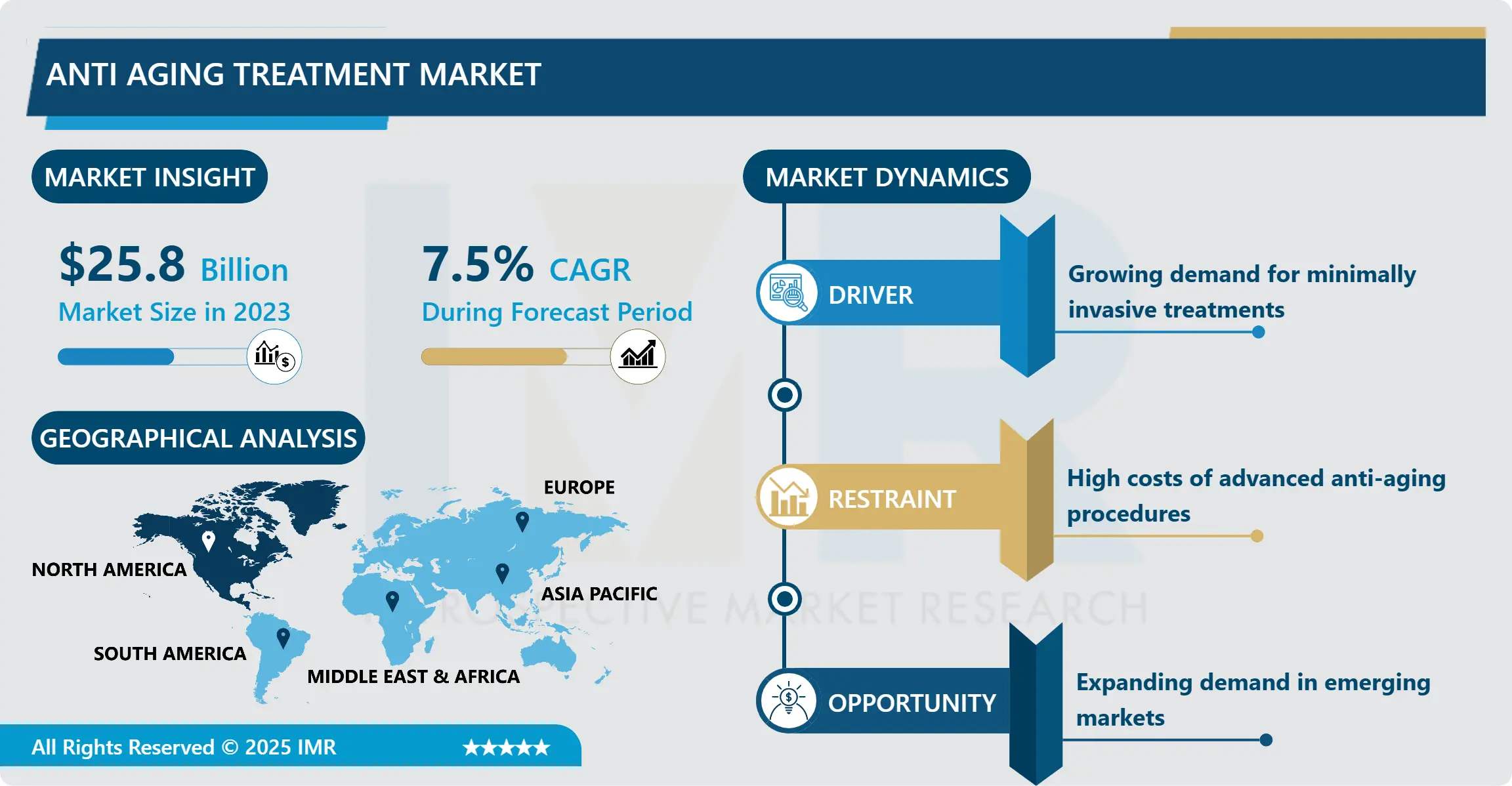
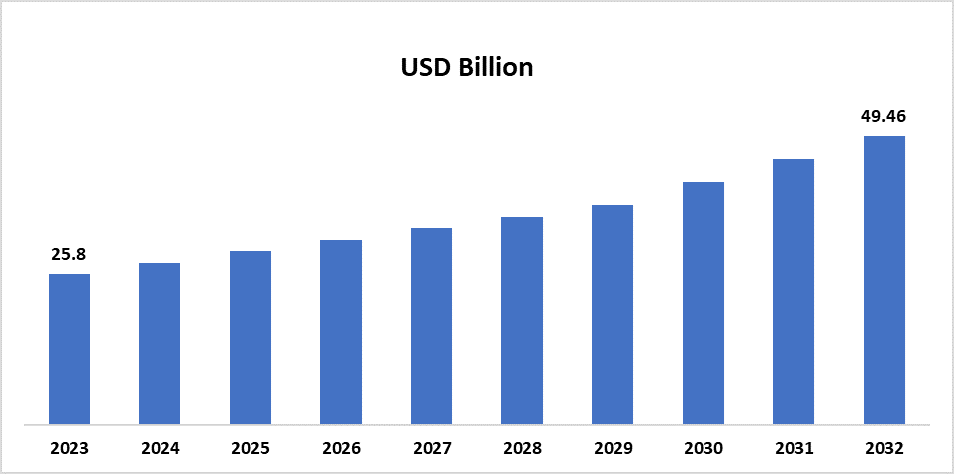
Anti-Aging Treatment Market Size Was Valued at USD 25.8 Billion in 2023 and is Projected to Reach USD 49.46 Billion by 2032, Growing at a CAGR of 7.5 % From 2024-2032.
Anti-Aging Treatment Market can be defined as products, services or therapy facilities that are aimed to help reverse or stop the natural skin aging process including wrinkling, lines, dark spots, and skin sagging. These include topical creams and micro-dermabrasions and laser therapy, different treatments through injection, and surgery, and targeting a wider population, who have some expectations to get youthful transformations.
The Anti-Aging Treatment Market has increased remarkably globally in the coming years due to increasing awareness of appearance and skincare along with increasing demand for treatment that can provide results naturally and without developing subsequent adverse impacts. Among the drivers that have contributed in equal measure to improve the market growth include the following: Demographical; through the size of the elderly and the middle-aged population Technological through skin-related technologies social influence through the impacts of social media. The industry is being supported additionally by new consumer trends which have seen them shifting towards non–invasive and minimally invasive procedures since they yield results of surgery without the hazards.
Among the modern possibilities in Laser Skin Care, dermal fillers, and other anti-aging treatments, such as botulinum toxins, there are several technological advances. Moreover, the advanced use of technology like artificial intelligence and machine learning in aesthetics has in some way made patients more personalized or oriented which makes the result more satisfactory. Besides extending the services in anti-aging treatment for both females and males, this will continue to rise as more males come to the market to seek these services. Rising interest in the reconsideration of people’s way of life and concern for skin, health, and beauty contributes to the frequent use of anti-wrinkle procedures as one of the facial treatment.
Anti-Aging Treatment Market Trend Analysis
Rise of Non-Invasive and Minimally Invasive Procedures
-
They pointed out that the trends identified include that the global anti-aging treatment market is more innovative, the increase in non-invasive/ minimally invasive procedures. In this case, some of the beautifying products such as Botox, dermal fillers, and chemical peel are preferred by the consumer as better than surgery since they go through the healing process faster, are cheaper and pose minimal risks as compared to surgeries. Other reasons that have made these procedures popular are sophisticated delivery systems such as micro pen and nanocarrier-based systems. Modern technologies including ultrasound instruments, and radiofrequency instruments are popular in clinics, and med spas, because current technologies offer painless, and individual technological remedy is highly advantageous, together with natural-appearing outcomes that directly address the concerns of society.
Growing Demand in Emerging Markets
-
Especially in all emerging markets there are very high potentials for anti-aging treatments. The region of Asia Pacific is among those that is going through highest rates of economic growth and certainly this has led to higher income that can be spend for clients’ improvements through aesthetic practices. For this reason, the Asian regions see youthful looks and with the encouragement from celebrities and other social networks, people have accepted skin anti-aging treatments. Also, there is emergence of aesthetic clinics In addition, it has been found that advanced technologies can now be bought at a relatively cheaper cost in these parts. GREATEST BENEFIT residing in collaborations, training, and localized products and companies investing in these economies to exploit these developing markets.
Anti-Aging Treatment Market Segment Analysis:
Anti-Aging Treatment Market is Segmented on the basis of product type, technology, and end user.
By Product Type, UV absorber segment is expected to dominate the market during the forecast period
-
UV Absorber segment is likely to dominate the overall market due to its ability to address preternatural aging due to… UV absorbers are for instance used in such products as; creams for sun protection and skincare for defense against UV radiation that hurts, degradation of collagen, formation of wrinkles, and pigmentation. With increased awareness of photodamage and the need to wear sunscreen daily, manufacturers have included UV absorbers as one of the weapons against skin aging. Furthermore, the aspect of formulation in respect to the broad-spectrum protection and water resistance has enhanced the already enhanced functionality and usefulness of these products and therefore these BP water-resistant products cannot be compared with any other products that are available in the market.
By Technology, the Botulinum segment expected to held the largest share
-
In this respect, the Botulinum segment is forecasted to exhibit a high percentage of the market share because of the upward trend of cosmeceutical application for the reduction of wrinkles and fine lines. Botox and Dysport belonging to the family of botulinum toxin-containing agents have been of great use in paralyzing muscles of face for a temporary period to wipe out dynamic wrinkles which gives the face a natural look and youthful appearance. The need to have better first-time-ever non-invasive aesthetic interventions has put botulinum toxin in demand by various generations. Bolder evolution including new preparations that boast longer-lasting preparations and micro pigmentation technologies has further expanded its usage because it has been smartly classified into the anti-aging cure category.
Anti-Aging Treatment Market Regional Insights:
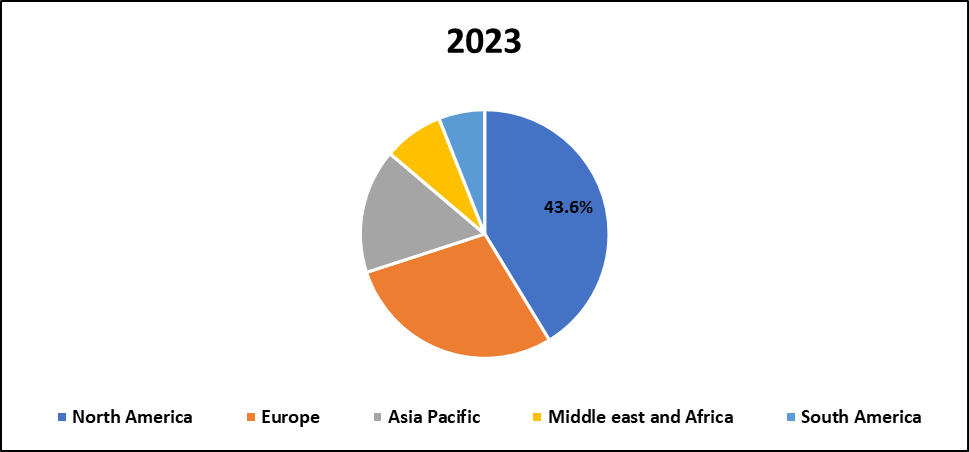
North America is Expected to Dominate the Market Over the Forecast period
-
Out of all the regions, North America has the highest projected growth rate in the Anti-Aging Treatment Market because of the supply of advanced healthcare industry and FREQUENT consumption pend on the Anti-Aging Treatment Market. Here, the United States emerged as noteworthy; other dominant actors, main vendors, and dermatology, clinics gross some of the newest technologies such as laser resurfacing, skin tightening by radio frequencies, and novel kinds of injections. Another strength is a large elderly population which in the majority need treatments that will enable them to remain youthful. High-quality treatment and North American market leadership retention were provided by such factors as the effective regulatory environment and professional development, which ensured treatment quality levels.
- The dominance of the region can be also explained by good consumer awareness, effect of media and celebrities. The favorable tendencies of early diagnosis and measures taken for the treatment have extended the target consumer base of products preventing the aging process among the young. Moreover, males are ready to accept various treatments which contributes to the growth of the market in North America as well as advancements in technology such as telemedicine which enables consultations and products that help in enlarging the market. Collaboration between research centers and firms in this field has enhanced the development of efficient anti-aging solutions that make the area dominant globally.
Active Key Players in the Anti-Aging Treatment Market
- Allergan (USA)
- Alma Lasers (Israel)
- Beiersdorf AG (Germany)
- Candela Medical (USA)
- Cynosure (USA)
- Cutera, Inc. (USA)
- Estée Lauder Companies Inc. (USA)
- Fotona (Slovenia)
- Galderma (Switzerland)
- Hologic, Inc. (USA)
- Lumenis (Israel)
- Lutronic Corporation (South Korea)
- Merz Pharma (Germany)
- Procter & Gamble (USA)
- Revance Therapeutics (USA), Other Active Players
|
Anti-Aging Treatment Market |
|||
|
Base Year: |
2023 |
Forecast Period: |
2024-2032 |
|
Historical Data: |
2017 to 2023 |
Market Size in 2023: |
USD 25.8 Billion |
|
Forecast Period 2024-32 CAGR: |
7.5 % |
Market Size in 2032: |
USD 49.46 Billion |
|
Segments Covered: |
By Product Type |
|
|
|
By Technology |
|
||
|
By End-user |
|
||
|
By Region |
|
||
|
Key Market Drivers: |
|
||
|
Key Market Restraints: |
|
||
|
Key Opportunities: |
|
||
|
Companies Covered in the report: |
|
||
Chapter 1: Introduction
1.1 Scope and Coverage
Chapter 2:Executive Summary
Chapter 3: Market Landscape
3.1 Market Dynamics
3.1.1 Drivers
3.1.2 Restraints
3.1.3 Opportunities
3.1.4 Challenges
3.2 Market Trend Analysis
3.3 PESTLE Analysis
3.4 Porter's Five Forces Analysis
3.5 Industry Value Chain Analysis
3.6 Ecosystem
3.7 Regulatory Landscape
3.8 Price Trend Analysis
3.9 Patent Analysis
3.10 Technology Evolution
3.11 Investment Pockets
3.12 Import-Export Analysis
Chapter 4: Anti Aging Treatment Market by Product Type
4.1 Anti Aging Treatment Market Snapshot and Growth Engine
4.2 Anti Aging Treatment Market Overview
4.3 UV Absorbers Anti-Wrinkle Products Anti-Stretch Mark Products Natural Products Others
4.3.1 Introduction and Market Overview
4.3.2 Historic and Forecasted Market Size in Value USD and Volume Units (2017-2032F)
4.3.3 Key Market Trends, Growth Factors and Opportunities
4.3.4 UV Absorbers Anti-Wrinkle Products Anti-Stretch Mark Products Natural Products Others: Geographic Segmentation Analysis
Chapter 5: Anti Aging Treatment Market by Technology
5.1 Anti Aging Treatment Market Snapshot and Growth Engine
5.2 Anti Aging Treatment Market Overview
5.3 Botulinum Toxin Therapy Dermabrasion Microdermabrasion Chemical Peels Fractional Laser Skin Resurfacing Dermal Fillers
5.3.1 Introduction and Market Overview
5.3.2 Historic and Forecasted Market Size in Value USD and Volume Units (2017-2032F)
5.3.3 Key Market Trends, Growth Factors and Opportunities
5.3.4 Botulinum Toxin Therapy Dermabrasion Microdermabrasion Chemical Peels Fractional Laser Skin Resurfacing Dermal Fillers: Geographic Segmentation Analysis
5.4 No ablative Skin Rejuvenation
5.4.1 Introduction and Market Overview
5.4.2 Historic and Forecasted Market Size in Value USD and Volume Units (2017-2032F)
5.4.3 Key Market Trends, Growth Factors and Opportunities
5.4.4 No ablative Skin Rejuvenation: Geographic Segmentation Analysis
Chapter 6: Anti Aging Treatment Market by End User
6.1 Anti Aging Treatment Market Snapshot and Growth Engine
6.2 Anti Aging Treatment Market Overview
6.3 Hospitals Skin Care Clinics Homecare Settings Other
6.3.1 Introduction and Market Overview
6.3.2 Historic and Forecasted Market Size in Value USD and Volume Units (2017-2032F)
6.3.3 Key Market Trends, Growth Factors and Opportunities
6.3.4 Hospitals Skin Care Clinics Homecare Settings Other: Geographic Segmentation Analysis
Chapter 7: Company Profiles and Competitive Analysis
7.1 Competitive Landscape
7.1.1 Competitive Benchmarking
7.1.2 Anti Aging Treatment Market Share by Manufacturer (2023)
7.1.3 Industry BCG Matrix
7.1.4 Heat Map Analysis
7.1.5 Mergers and Acquisitions
7.2 ERGAN (USA)
7.2.1 Company Overview
7.2.2 Key Executives
7.2.3 Company Snapshot
7.2.4 Role of the Company in the Market
7.2.5 Sustainability and Social Responsibility
7.2.6 Operating Business Segments
7.2.7 Product Portfolio
7.2.8 Business Performance
7.2.9 Key Strategic Moves and Recent Developments
7.2.10 SWOT Analysis
7.3 ALMA LASERS (ISRAEL)
7.4 BEIERSDORF AG (GERMANY)
7.5 CANDELA MEDICAL (USA)
7.6 CYNOSURE (USA)
7.7 CUTERA INC. (USA)
7.8 ESTÉE LAUDER COMPANIES INC. (USA)
7.9 FOTONA (SLOVENIA)
7.10 GALDERMA (SWITZERLAND)
7.11 HOLOGIC INC. (USA)
7.12 LUMENIS (ISRAEL)
7.13 LUTRONIC CORPORATION (SOUTH KOREA)
7.14 MERZ PHARMA (GERMANY)
7.15 PROCTER & GAMBLE (USA)
7.16 REVANCE THERAPEUTICS (USA)
7.17 OTHER ACTIVE PLAYERS
Chapter 8: Global Anti Aging Treatment Market By Region
8.1 Overview
8.2. North America Anti Aging Treatment Market
8.2.1 Key Market Trends, Growth Factors and Opportunities
8.2.2 Top Key Companies
8.2.3 Historic and Forecasted Market Size by Segments
8.2.4 Historic and Forecasted Market Size By Product Type
8.2.4.1 UV Absorbers Anti-Wrinkle Products Anti-Stretch Mark Products Natural Products Others
8.2.5 Historic and Forecasted Market Size By Technology
8.2.5.1 Botulinum Toxin Therapy Dermabrasion Microdermabrasion Chemical Peels Fractional Laser Skin Resurfacing Dermal Fillers
8.2.5.2 No ablative Skin Rejuvenation
8.2.6 Historic and Forecasted Market Size By End User
8.2.6.1 Hospitals Skin Care Clinics Homecare Settings Other
8.2.7 Historic and Forecast Market Size by Country
8.2.7.1 US
8.2.7.2 Canada
8.2.7.3 Mexico
8.3. Eastern Europe Anti Aging Treatment Market
8.3.1 Key Market Trends, Growth Factors and Opportunities
8.3.2 Top Key Companies
8.3.3 Historic and Forecasted Market Size by Segments
8.3.4 Historic and Forecasted Market Size By Product Type
8.3.4.1 UV Absorbers Anti-Wrinkle Products Anti-Stretch Mark Products Natural Products Others
8.3.5 Historic and Forecasted Market Size By Technology
8.3.5.1 Botulinum Toxin Therapy Dermabrasion Microdermabrasion Chemical Peels Fractional Laser Skin Resurfacing Dermal Fillers
8.3.5.2 No ablative Skin Rejuvenation
8.3.6 Historic and Forecasted Market Size By End User
8.3.6.1 Hospitals Skin Care Clinics Homecare Settings Other
8.3.7 Historic and Forecast Market Size by Country
8.3.7.1 Russia
8.3.7.2 Bulgaria
8.3.7.3 The Czech Republic
8.3.7.4 Hungary
8.3.7.5 Poland
8.3.7.6 Romania
8.3.7.7 Rest of Eastern Europe
8.4. Western Europe Anti Aging Treatment Market
8.4.1 Key Market Trends, Growth Factors and Opportunities
8.4.2 Top Key Companies
8.4.3 Historic and Forecasted Market Size by Segments
8.4.4 Historic and Forecasted Market Size By Product Type
8.4.4.1 UV Absorbers Anti-Wrinkle Products Anti-Stretch Mark Products Natural Products Others
8.4.5 Historic and Forecasted Market Size By Technology
8.4.5.1 Botulinum Toxin Therapy Dermabrasion Microdermabrasion Chemical Peels Fractional Laser Skin Resurfacing Dermal Fillers
8.4.5.2 No ablative Skin Rejuvenation
8.4.6 Historic and Forecasted Market Size By End User
8.4.6.1 Hospitals Skin Care Clinics Homecare Settings Other
8.4.7 Historic and Forecast Market Size by Country
8.4.7.1 Germany
8.4.7.2 UK
8.4.7.3 France
8.4.7.4 The Netherlands
8.4.7.5 Italy
8.4.7.6 Spain
8.4.7.7 Rest of Western Europe
8.5. Asia Pacific Anti Aging Treatment Market
8.5.1 Key Market Trends, Growth Factors and Opportunities
8.5.2 Top Key Companies
8.5.3 Historic and Forecasted Market Size by Segments
8.5.4 Historic and Forecasted Market Size By Product Type
8.5.4.1 UV Absorbers Anti-Wrinkle Products Anti-Stretch Mark Products Natural Products Others
8.5.5 Historic and Forecasted Market Size By Technology
8.5.5.1 Botulinum Toxin Therapy Dermabrasion Microdermabrasion Chemical Peels Fractional Laser Skin Resurfacing Dermal Fillers
8.5.5.2 No ablative Skin Rejuvenation
8.5.6 Historic and Forecasted Market Size By End User
8.5.6.1 Hospitals Skin Care Clinics Homecare Settings Other
8.5.7 Historic and Forecast Market Size by Country
8.5.7.1 China
8.5.7.2 India
8.5.7.3 Japan
8.5.7.4 South Korea
8.5.7.5 Malaysia
8.5.7.6 Thailand
8.5.7.7 Vietnam
8.5.7.8 The Philippines
8.5.7.9 Australia
8.5.7.10 New Zealand
8.5.7.11 Rest of APAC
8.6. Middle East & Africa Anti Aging Treatment Market
8.6.1 Key Market Trends, Growth Factors and Opportunities
8.6.2 Top Key Companies
8.6.3 Historic and Forecasted Market Size by Segments
8.6.4 Historic and Forecasted Market Size By Product Type
8.6.4.1 UV Absorbers Anti-Wrinkle Products Anti-Stretch Mark Products Natural Products Others
8.6.5 Historic and Forecasted Market Size By Technology
8.6.5.1 Botulinum Toxin Therapy Dermabrasion Microdermabrasion Chemical Peels Fractional Laser Skin Resurfacing Dermal Fillers
8.6.5.2 No ablative Skin Rejuvenation
8.6.6 Historic and Forecasted Market Size By End User
8.6.6.1 Hospitals Skin Care Clinics Homecare Settings Other
8.6.7 Historic and Forecast Market Size by Country
8.6.7.1 Turkiye
8.6.7.2 Bahrain
8.6.7.3 Kuwait
8.6.7.4 Saudi Arabia
8.6.7.5 Qatar
8.6.7.6 UAE
8.6.7.7 Israel
8.6.7.8 South Africa
8.7. South America Anti Aging Treatment Market
8.7.1 Key Market Trends, Growth Factors and Opportunities
8.7.2 Top Key Companies
8.7.3 Historic and Forecasted Market Size by Segments
8.7.4 Historic and Forecasted Market Size By Product Type
8.7.4.1 UV Absorbers Anti-Wrinkle Products Anti-Stretch Mark Products Natural Products Others
8.7.5 Historic and Forecasted Market Size By Technology
8.7.5.1 Botulinum Toxin Therapy Dermabrasion Microdermabrasion Chemical Peels Fractional Laser Skin Resurfacing Dermal Fillers
8.7.5.2 No ablative Skin Rejuvenation
8.7.6 Historic and Forecasted Market Size By End User
8.7.6.1 Hospitals Skin Care Clinics Homecare Settings Other
8.7.7 Historic and Forecast Market Size by Country
8.7.7.1 Brazil
8.7.7.2 Argentina
8.7.7.3 Rest of SA
Chapter 9 Analyst Viewpoint and Conclusion
9.1 Recommendations and Concluding Analysis
9.2 Potential Market Strategies
Chapter 10 Research Methodology
10.1 Research Process
10.2 Primary Research
10.3 Secondary Research
|
Anti-Aging Treatment Market |
|||
|
Base Year: |
2023 |
Forecast Period: |
2024-2032 |
|
Historical Data: |
2017 to 2023 |
Market Size in 2023: |
USD 25.8 Billion |
|
Forecast Period 2024-32 CAGR: |
7.5 % |
Market Size in 2032: |
USD 49.46 Billion |
|
Segments Covered: |
By Product Type |
|
|
|
By Technology |
|
||
|
By End-user |
|
||
|
By Region |
|
||
|
Key Market Drivers: |
|
||
|
Key Market Restraints: |
|
||
|
Key Opportunities: |
|
||
|
Companies Covered in the report: |
|
||


