




Angina Market Synopsis:
Angina Market Size Was Valued at USD 11.38 Billion in 2023 and is Projected to Reach USD 16.48 Billion by 2032, Growing at a CAGR of 4.2 % From 2024-2032.
The Angina Market includes the growth, production, and commercialization of therapeutic goods designed to treat angina; a clinical condition that is expressed as chest discomfort due to insufficient blood supply to the heart. It is a market of therapeutic drugs and surgical procedures, and diagnosis tools for various forms of angina including stable angina and unstable angina.
The target market, commonly known as the Angina Market, is still expanding because cardiovascular diseases are on the rise globally, and they are the leading cause of death globally. Inactivity, unhealthy eating, smoking, and climbing the obesity line are some of the reasons behind increased incidences of angina. This is made worse by the fact that people in the advanced age category are more susceptible to contracting coronary artery disease – the leading cause of angina. They are eager patients for novel and feasible pharmacological treatments for angina pectoris and for minimally invasive procedures and new diagnostic methodologies as well.
The mainstay of the treatment of angina includes the use of beta-blockers, calcium channel blockers, nitrates, and antiplatelet agents. Advances in drug delivery systems that touch on issues to do with formulations of drugs including extended-release formulations has enhanced patient adherence and productivity. Further, they also know that healthcare providers are now using enhanced diagnostic technologies to ensure expected accurate diagnosis and right treatment planning which includes cardiac imaging and stress testing. stretching each year due to constant research and development and a shifting emphasis on personalized medicine, the Angina Market is set to grow rapidly in the future
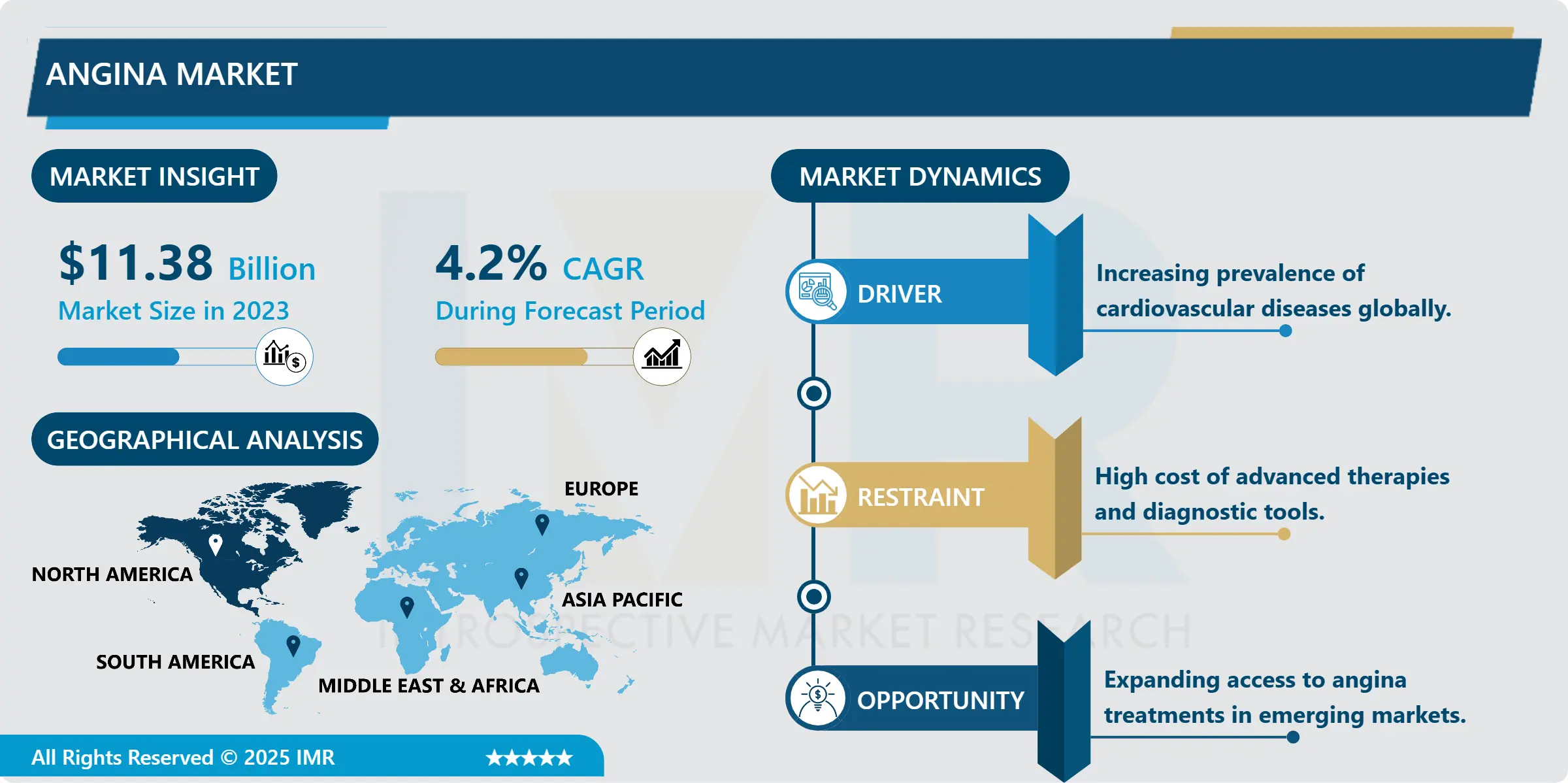
Angina Market Trend Analysis:
Advancements in Drug Delivery Systems
- The Angina market is witnessing significant growth due to advancements in drug delivery technologies. Innovations such as transdermal patches, oral dissolvable films, and nanotechnology-based formulations are gaining preference for their improved bioavailability and reduced side effects. These systems offer controlled and sustained drug release, enhancing treatment effectiveness and patient compliance compared to traditional dosage forms.
- The rise of precision medicine is paving the way for personalized treatment approaches tailored to individual patient needs. This shift towards targeted and patient-centric therapies further boosts demand for advanced drug delivery methods. These technological advancements are shaping the future of angina pectoris management, making treatment more efficient, personalized, and user-friendly for patients.
Growing Focus on Emerging Markets
- New opportunities can be found in Asia-Pacific, Latin America, and the Middle East, a promising region for the Angina Market development. An increase in cardiomyopathy incidence observed in these areas, combined with growing expenditure on medical care and better availability of medical facilities has contributed to the need for controlling angina pectoris.
- The governments in these regions are focusing on cardiovascular health by increasing awareness and investing in new possibilities in the healthcare field. In addition, the increasing acquisition of these markets by global pharmaceuticals is paving the way for the launch of new therapeutic products at comparatively cheaper prices, thus providing growth opportunities to the market.
Angina Market Segment Analysis:
Angina Market is Segmented on the basis of Drug Class, Indication, and Region.
By Drug Class, Beta-blockers segment is expected to dominate the market during the forecast period
- The Beta Blockers segment is expected to remain the largest segment in the Angina Market during the forecast period because it is one of the most commonly prescribed drugs for the management of anginal symptoms. Beta-blockers are best in controlling the attacks, decreasing heart rate, and decreasing myocardial oxygen demand thus increasing the survival/QOL in patients with both stable and unstable angina. These drugs include propranolol, atenolol, and metoprolol since they are standard and widely prescribed drugs with favourable safety and efficacy profiles. This is another reason why the segment is dominant because the formulation is generic, and that means that beta blockers are easily affordable by anyone.
- Newer compounds of beta blockers are depicting better patient compliance and treatment results owing to newer formulations like extended-release preparations. The need for beta blockers as a class of drugs for angina is expected to remain strong since cardiovascular disease remains a growing issue across the world.
By Indication, the Stable Angina segment is expected to held the largest share
- The Stable Angina segment is expected to have the biggest share of the Angina Market because the illness is prevalent among patients with coronary artery illness. Stable angina is identified by exertional chest pain or pain at a specific time that can be managed by the shutter and is among the many persistent diseases. Various medicine such as beta-blockers, calcium channel blockers and nitrates are widely prescribed in management of stable angina for palliation as well as in the delay of the progress of the disease.
- The reason for higher growth of this segment is attributed to the growing understanding about the symptoms indicating potential stable angina and the evolving technology in diagnostics. The accrual and dissemination of a variety of treatments from life style changes to pharmacologic management of LUTS enhances patient management. Stable angina is expected to continue to dominate the current market as the healthcare providers and policymakers focus on preventive cardiology.
Angina Market Regional Insights:
North America is Expected to Dominate the Market Over the Forecast period
- North Americ’s dominance is contributing largely to the high incidences of cardiovascular conditions in the region resulting from poor lifestyles, poor diet, and increased life spans. USA occupies the leading position in the market due to the combined effect of the highly developed system of healthcare, the broad use of up-to-date diagnostic methods, and interest in the cardiovascular research.
- The continually improving reimbursement policies and high patient awareness level regarding the appropriate diagnosis and treatment of angina also provide thrust to the North American market. These circumstances make region leading in the market because of the presence of such companies as major players which have been posting steady progress in developing various therapies. Due to the increase in healthcare costs and development in the treatment procedures, North America is expected to sustain the leading position in the Global Angina Market.
Active Key Players in the Angina Market
- Abbott Laboratories (USA)
- Amgen Inc. (USA)
- AstraZeneca (UK)
- Bayer AG (Germany)
- Bristol-Myers Squibb (USA)
- Boehringer Ingelheim (Germany)
- Daiichi Sankyo Co., Ltd. (Japan)
- Eli Lilly and Company (USA)
- GlaxoSmithKline plc (UK)
- Johnson & Johnson (USA)
- Merck & Co., Inc. (USA)
- Novartis AG (Switzerland)
- Pfizer Inc. (USA)
- Sanofi (France)
- Takeda Pharmaceutical Company Limited (Japan), and Other Active Players
|
Angina Market |
|||
|
Base Year: |
2023 |
Forecast Period: |
2024-2032 |
|
Historical Data: |
2017 to 2023 |
Market Size in 2023: |
USD 11.38 Billion |
|
Forecast Period 2024-32 CAGR: |
4.2 % |
Market Size in 2032: |
USD 16.48 Billion |
|
Segments Covered: |
By Drug Class |
|
|
|
By Indication |
|
||
|
By Region |
|
||
|
Key Market Drivers: |
|
||
|
Key Market Restraints: |
|
||
|
Key Opportunities: |
|
||
|
Companies Covered in the report: |
|
||
Chapter 1: Introduction
1.1 Scope and Coverage
Chapter 2:Executive Summary
Chapter 3: Market Landscape
3.1 Market Dynamics
3.1.1 Drivers
3.1.2 Restraints
3.1.3 Opportunities
3.1.4 Challenges
3.2 Market Trend Analysis
3.3 PESTLE Analysis
3.4 Porter's Five Forces Analysis
3.5 Industry Value Chain Analysis
3.6 Ecosystem
3.7 Regulatory Landscape
3.8 Price Trend Analysis
3.9 Patent Analysis
3.10 Technology Evolution
3.11 Investment Pockets
3.12 Import-Export Analysis
Chapter 4: Angina Market by Drug class
4.1 Angina Market Snapshot and Growth Engine
4.2 Angina Market Overview
4.3 Beta-blockers
4.3.1 Introduction and Market Overview
4.3.2 Historic and Forecasted Market Size in Value USD and Volume Units (2017-2032F)
4.3.3 Key Market Trends, Growth Factors and Opportunities
4.3.4 Beta-blockers: Geographic Segmentation Analysis
4.4 Calcium channel blockers
4.4.1 Introduction and Market Overview
4.4.2 Historic and Forecasted Market Size in Value USD and Volume Units (2017-2032F)
4.4.3 Key Market Trends, Growth Factors and Opportunities
4.4.4 Calcium channel blockers: Geographic Segmentation Analysis
4.5 Nitrates
4.5.1 Introduction and Market Overview
4.5.2 Historic and Forecasted Market Size in Value USD and Volume Units (2017-2032F)
4.5.3 Key Market Trends, Growth Factors and Opportunities
4.5.4 Nitrates: Geographic Segmentation Analysis
4.6 Angiotensin-converting enzyme inhibitors
4.6.1 Introduction and Market Overview
4.6.2 Historic and Forecasted Market Size in Value USD and Volume Units (2017-2032F)
4.6.3 Key Market Trends, Growth Factors and Opportunities
4.6.4 Angiotensin-converting enzyme inhibitors: Geographic Segmentation Analysis
4.7 Other
4.7.1 Introduction and Market Overview
4.7.2 Historic and Forecasted Market Size in Value USD and Volume Units (2017-2032F)
4.7.3 Key Market Trends, Growth Factors and Opportunities
4.7.4 Other: Geographic Segmentation Analysis
Chapter 5: Angina Market by Indication
5.1 Angina Market Snapshot and Growth Engine
5.2 Angina Market Overview
5.3 Stable
5.3.1 Introduction and Market Overview
5.3.2 Historic and Forecasted Market Size in Value USD and Volume Units (2017-2032F)
5.3.3 Key Market Trends, Growth Factors and Opportunities
5.3.4 Stable: Geographic Segmentation Analysis
5.4 Unstable
5.4.1 Introduction and Market Overview
5.4.2 Historic and Forecasted Market Size in Value USD and Volume Units (2017-2032F)
5.4.3 Key Market Trends, Growth Factors and Opportunities
5.4.4 Unstable: Geographic Segmentation Analysis
Chapter 6: Company Profiles and Competitive Analysis
6.1 Competitive Landscape
6.1.1 Competitive Benchmarking
6.1.2 Angina Market Share by Manufacturer (2023)
6.1.3 Industry BCG Matrix
6.1.4 Heat Map Analysis
6.1.5 Mergers and Acquisitions
6.2 ABBOTT LABORATORIES (USA)
6.2.1 Company Overview
6.2.2 Key Executives
6.2.3 Company Snapshot
6.2.4 Role of the Company in the Market
6.2.5 Sustainability and Social Responsibility
6.2.6 Operating Business Segments
6.2.7 Product Portfolio
6.2.8 Business Performance
6.2.9 Key Strategic Moves and Recent Developments
6.2.10 SWOT Analysis
6.3 AMGEN INC. (USA)
6.4 ASTRAZENECA (UK)
6.5 BAYER AG (GERMANY)
6.6 BRISTOL-MYERS SQUIBB (USA)
6.7 BOEHRINGER INGELHEIM (GERMANY)
6.8 DAIICHI SANKYO CO. LTD. (JAPAN)
6.9 ELI LILLY AND COMPANY (USA)
6.10 GLAXOSMITHKLINE PLC (UK)
6.11 JOHNSON & JOHNSON (USA)
6.12 MERCK & CO. INC. (USA)
6.13 NOVARTIS AG (SWITZERLAND)
6.14 PFIZER INC. (USA)
6.15 SANOFI (FRANCE)
6.16 TAKEDA PHARMACEUTICAL COMPANY LIMITED (JAPAN)
6.17 OTHER ACTIVE PLAYERS
Chapter 7: Global Angina Market By Region
7.1 Overview
7.2. North America Angina Market
7.2.1 Key Market Trends, Growth Factors and Opportunities
7.2.2 Top Key Companies
7.2.3 Historic and Forecasted Market Size by Segments
7.2.4 Historic and Forecasted Market Size By Drug class
7.2.4.1 Beta-blockers
7.2.4.2 Calcium channel blockers
7.2.4.3 Nitrates
7.2.4.4 Angiotensin-converting enzyme inhibitors
7.2.4.5 Other
7.2.5 Historic and Forecasted Market Size By Indication
7.2.5.1 Stable
7.2.5.2 Unstable
7.2.6 Historic and Forecast Market Size by Country
7.2.6.1 US
7.2.6.2 Canada
7.2.6.3 Mexico
7.3. Eastern Europe Angina Market
7.3.1 Key Market Trends, Growth Factors and Opportunities
7.3.2 Top Key Companies
7.3.3 Historic and Forecasted Market Size by Segments
7.3.4 Historic and Forecasted Market Size By Drug class
7.3.4.1 Beta-blockers
7.3.4.2 Calcium channel blockers
7.3.4.3 Nitrates
7.3.4.4 Angiotensin-converting enzyme inhibitors
7.3.4.5 Other
7.3.5 Historic and Forecasted Market Size By Indication
7.3.5.1 Stable
7.3.5.2 Unstable
7.3.6 Historic and Forecast Market Size by Country
7.3.6.1 Russia
7.3.6.2 Bulgaria
7.3.6.3 The Czech Republic
7.3.6.4 Hungary
7.3.6.5 Poland
7.3.6.6 Romania
7.3.6.7 Rest of Eastern Europe
7.4. Western Europe Angina Market
7.4.1 Key Market Trends, Growth Factors and Opportunities
7.4.2 Top Key Companies
7.4.3 Historic and Forecasted Market Size by Segments
7.4.4 Historic and Forecasted Market Size By Drug class
7.4.4.1 Beta-blockers
7.4.4.2 Calcium channel blockers
7.4.4.3 Nitrates
7.4.4.4 Angiotensin-converting enzyme inhibitors
7.4.4.5 Other
7.4.5 Historic and Forecasted Market Size By Indication
7.4.5.1 Stable
7.4.5.2 Unstable
7.4.6 Historic and Forecast Market Size by Country
7.4.6.1 Germany
7.4.6.2 UK
7.4.6.3 France
7.4.6.4 The Netherlands
7.4.6.5 Italy
7.4.6.6 Spain
7.4.6.7 Rest of Western Europe
7.5. Asia Pacific Angina Market
7.5.1 Key Market Trends, Growth Factors and Opportunities
7.5.2 Top Key Companies
7.5.3 Historic and Forecasted Market Size by Segments
7.5.4 Historic and Forecasted Market Size By Drug class
7.5.4.1 Beta-blockers
7.5.4.2 Calcium channel blockers
7.5.4.3 Nitrates
7.5.4.4 Angiotensin-converting enzyme inhibitors
7.5.4.5 Other
7.5.5 Historic and Forecasted Market Size By Indication
7.5.5.1 Stable
7.5.5.2 Unstable
7.5.6 Historic and Forecast Market Size by Country
7.5.6.1 China
7.5.6.2 India
7.5.6.3 Japan
7.5.6.4 South Korea
7.5.6.5 Malaysia
7.5.6.6 Thailand
7.5.6.7 Vietnam
7.5.6.8 The Philippines
7.5.6.9 Australia
7.5.6.10 New Zealand
7.5.6.11 Rest of APAC
7.6. Middle East & Africa Angina Market
7.6.1 Key Market Trends, Growth Factors and Opportunities
7.6.2 Top Key Companies
7.6.3 Historic and Forecasted Market Size by Segments
7.6.4 Historic and Forecasted Market Size By Drug class
7.6.4.1 Beta-blockers
7.6.4.2 Calcium channel blockers
7.6.4.3 Nitrates
7.6.4.4 Angiotensin-converting enzyme inhibitors
7.6.4.5 Other
7.6.5 Historic and Forecasted Market Size By Indication
7.6.5.1 Stable
7.6.5.2 Unstable
7.6.6 Historic and Forecast Market Size by Country
7.6.6.1 Turkiye
7.6.6.2 Bahrain
7.6.6.3 Kuwait
7.6.6.4 Saudi Arabia
7.6.6.5 Qatar
7.6.6.6 UAE
7.6.6.7 Israel
7.6.6.8 South Africa
7.7. South America Angina Market
7.7.1 Key Market Trends, Growth Factors and Opportunities
7.7.2 Top Key Companies
7.7.3 Historic and Forecasted Market Size by Segments
7.7.4 Historic and Forecasted Market Size By Drug class
7.7.4.1 Beta-blockers
7.7.4.2 Calcium channel blockers
7.7.4.3 Nitrates
7.7.4.4 Angiotensin-converting enzyme inhibitors
7.7.4.5 Other
7.7.5 Historic and Forecasted Market Size By Indication
7.7.5.1 Stable
7.7.5.2 Unstable
7.7.6 Historic and Forecast Market Size by Country
7.7.6.1 Brazil
7.7.6.2 Argentina
7.7.6.3 Rest of SA
Chapter 8 Analyst Viewpoint and Conclusion
8.1 Recommendations and Concluding Analysis
8.2 Potential Market Strategies
Chapter 9 Research Methodology
9.1 Research Process
9.2 Primary Research
9.3 Secondary Research
|
Angina Market |
|||
|
Base Year: |
2023 |
Forecast Period: |
2024-2032 |
|
Historical Data: |
2017 to 2023 |
Market Size in 2023: |
USD 11.38 Billion |
|
Forecast Period 2024-32 CAGR: |
4.2 % |
Market Size in 2032: |
USD 16.48 Billion |
|
Segments Covered: |
By Drug Class |
|
|
|
By Indication |
|
||
|
By Region |
|
||
|
Key Market Drivers: |
|
||
|
Key Market Restraints: |
|
||
|
Key Opportunities: |
|
||
|
Companies Covered in the report: |
|
||


