Air Defense Systems Market Synopsis:
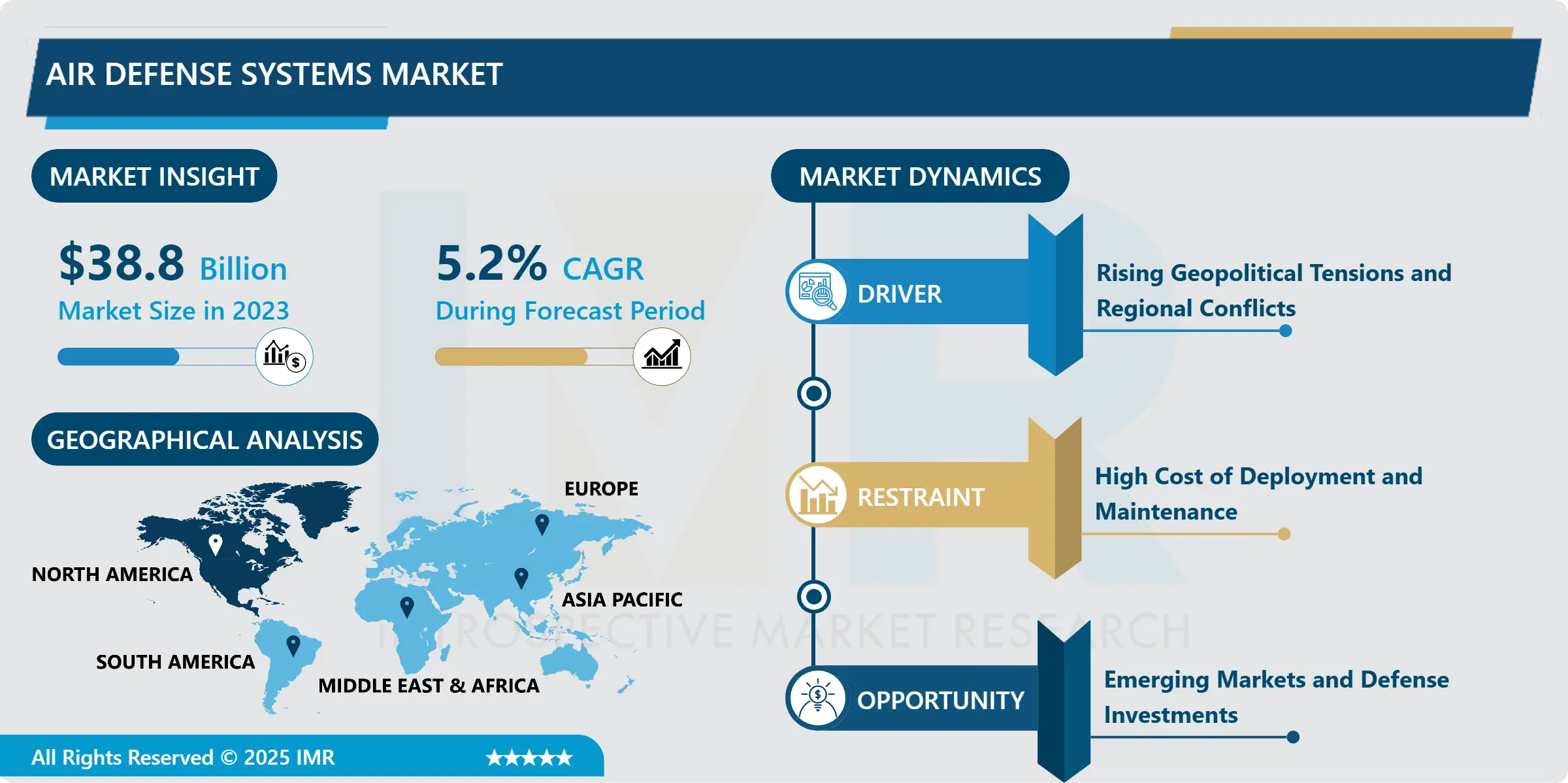
Air Defense Systems Market Size Was Valued at USD 38.80 Billion in 2023, and is Projected to Reach USD 61.23 Billion by 2032, Growing at a CAGR of 5.20% From 2024-2032.
Air Defense Systems Market involves solutions, products, Plattforms and services that detect, track, engage, and counter airborne targets including aircrafts, missiles, UAVs, other aerial objects, etc. These equipments include radar equipments and systems, missile equipments and systems, command and control equipments and units and electronic counter-measure equipments and systems for protection of national airspace and strategic assets. Pumped by escalating order tensions, development of war fighting hardware and equipment, and the use of UAVs, the market for delivery of surveillance broken down to military, government, and homeland security clients globally focuses on near instantaneous response, high accuracy targeting and adaptability for defense objectives.
This market is gradually expanding due to the global tensions, technological improvements involving air defense systems, and the idea of protecting airspace from new types of risks. The market encompasses a wide variety of systems for detecting, tracking, intercepting, and defeating airborne threats including missile, aircrafts, UAVs and other aerial platforms. All these systems are strategic in national defense and security and are important for safeguarding valuable entities, facilities and infrastructure. The demand for the latest and improved radar systems, enhanced interceptors and integrated defense systems have resulted to increased Research and Development to support maturity of technologies like multi-layered defense and directed energy weapons.
Thus, North America and Europe remain the major regions driving the air defense systems market because of the sound military budgets of the USA and Great Britain and as well the tendencies to update the defense infrastructure. Asia-Pacific is anticipated to grow at the highest CAGR during the given time period led by the rising defense budgets of nations like China, India and Japan among others. This is an important note because opponents in these regions are increasingly using UAVs and missile threats to destroy targets on the ground. In addition, the market is experiencing a gradual trend towards complexity on integrated, network-based systems more towards synchronising the real-time flow of operations. The development of novel air defense systems is also resulting in growth in previously uncovered earnings streams in new economies such as the Middle East and Latin America. In view of these threats and as they change, the requirement for advanced and innovative air defense systems are likely to rise.
Air Defense Systems Market Trend Analysis:
Shaping the Modern Air Defense Systems Market
-
Today, air defense systems are developing actively to address an increasing number of airborne dangers, including UAVs, missiles, and combat aircraft. One of the major trends within the market, is the implementation of artificial intelligence and machine learning which greatly increase the effectiveness of the targeting, interception and overall functionality of these systems. AI algorithms are enhancing the speed of decision making as threat analysis is made automatically hence less time is taken. This integration makes it easier and faster in the detection of threats, targeting, and INTERCEPTION strategies. With the advanced air defense systems being command and control, they are able to hold and engage a number of threats at one go making the overall defense more rigid against different aerial aggressors.
- As part of modern air defense systems, hypersonic missiles, with speeds exceeding Mach 5, have also stepped up the speed at which they are developed and deployed. They can hardly_name counter such high-velocity projectiles, which is why nations invest generous amounts into advanced missile defense stations meant for dealing with hypersonic weaponry. These systems use advanced high frequency radar, next generation of sensors and faster tracking mechanism to identify and neutralise hypersonic missiles in flight. Consequently, defense forces are relying more so on versatile and fast responding air defense systems to safeguard major assets on Land and Marine domains in the face of emerging threats.
Advancements in the Air Defense Systems Market
-
National and defensive authorities of states globally are gradually paying attention to the development of air defense mechanisms against diverse possible threats. Some of example are unmanned aerial vehicles (UAVs), ballistic missiles, and hypersonic weapons which pose a new complexity to the conventional defence systems. Instead, countries are aiming at improving what they hold by ensuring that they would be able to counter such threats. Having high and low radar agendas, among other requirements, emerging technologies for intercepting targets has become an important issue for contractors. Furthermore, the development of AI within air defense systems is continuing, and its implementation in relation with detection, targeting, and decision making is commodity the effectiveness of reaction to possible threats.
- Among such regions, Asia-Pacific, Arabian Gulf, and Europe, investments in modernizing air defense capabilities are still rising due to the emerging complexities of the security threats and insecurity around the world. These zones are investing in building arrays of high tiers of defense that would be able to hold up aerial threats well. The example proving ant’s statement is the fact that during the recent years many Asia-Pacific countries increases defense expenditures, mainly in order to improve their air defense systems due to tensions with neighbors. In the same manner, Middle East is putting investment in modern air defense systems as a result of the continuous security threats that exists in the region both internally and externally. In Europe too NATO member states are improving capability of their air forces and improving compatibility of our air forces to ensure against growing threats in the airspace.
Air Defense Systems Market Segment Analysis:
Air Defense Systems Market is Segmented on the basis of By Component, Type, Platform, Range, and Region.
By Component, Weapon System segment is expected to dominate the market during the forecast period
-
Weapon systems in defense technology refer to the systems that involve various advanced technologies aimed and used to counter different threats. These systems are missiles used for long-range attack, and overhead defense, anti-aircraft guns for combating aircrafts such as fighter planes and drone, anti-drone or counter unmanned aerial systems C- UAS used in detection, interception and elimination of drones and other UAVs. Over time, these weapon systems become integrated with a number of advanced technologies such as; Artificial Intelligence (AI) and machine learning that facilitate identification and response to hostile elements in real time.
- The weapon systems are components of other larger operational integrated defense systems such as fire control systems, command and control systems. Such components help in directing and providing accurate targeting, improved situation awareness as well as coordination of the other defensive forces. New generations of military threats remain introduced to apply pressure onto the weapon systems segment and develop new innovative means including the systems of directed energy, new radar equipment, and hypersonic missiles in order to retain the technological dominance as well as counter ai more sophisticated threats.
By Range, Long Range segment expected to held the largest share
-
Long range systems are intended to offer security over huge territories, therefore they are vital in the protection of valued structures, military facilities and extensive territories. These systems are able to track and shoot with great precision anti-air and anti-missile targets ranging over hundred kilometres. The greatest value derived from long-range defense systems is the fact that they offer preliminary warning or attack before the threats can get close enough to their targets. It is crucial in contemporary battles where enemies may strike from great distances, and the capacity to eliminate risks over distance improves the general protective approach.
- Such systems use state of the art radar and tracking devices to identify and track the threats at great distance coupled with highly developed fire control and missle guidance systems during intercepts. When integrated into electromanagement, military forces are capable to defend key facilities, ensure air and missile security for naval groups, and counter threats of unauthorized aircraft. Further, the long-range systems are highly relevant for the measures of deterrence where the coverage range and efficiency of targeting mark the readiness of a defense to deter the attackers and flee away without intercepting them at close ranges.
Air Defense Systems Market Regional Insights:
North America is Expected to Dominate the Market Over the Forecast period
-
North America is also major market for air defense systems due to the presence of big defense budgets not only in US but also Canada where modernization of defense system is in progress. The United States military is paying more attention to leveraging new age technologies to meet challenges of current and future nature. As indicated by new threats like hypersonic missile or UAVs, also called drones, modern defense equipment are required and have become necessary for adequate defense against these challenges. In regards to the current strategy, the U.S has made major improvements towards its air shield systems and provided a layered protection to its military installations which has helped the overall development of this business in the North American market.
- It is, however, necessary to identify the modernization of air defenses of various countries in the region as a principal factor contributing to increased demand for such systems as THAAD (Terminal High Altitude Area Defense) or the Aegis Combat System. These systems solely provide more sophisticated missile defense solutions, target at the middle and terminal segments of the course. It continues to strengthen North America’s leading position in developing and deploying such systems to counter traditional missile threats and the new sources of danger, including hypersonic ones. The growth of this market is supported by the necessity to sustain superior technologies to meet such a higher demand for efficient air defense systems in the region.
Active Key Players in the Air Defense Systems Market
- Aslesan A.S.
- BAE Systems plc
- Boeing
- Elibit Systems Ltd.
- General Dynamics
- Hanwha Corporation
- Israel Aerospace Industries Ltd.
- Kongberg Gruppen ASA
- L3Harris Technologies Inc.
- Leonardo S.p.A
- Lockheed Martin Corporation
- Northrop Grumman
- Rheinmetall AG
- RTX Corporation
- Saab AB
- Thales Group
- Other Active Players.
Key Industry Developments in the Air Defense Systems Market:
-
In June 2024, BAE Systems plc announced the launch of Tridon Mk2, a next-generation 40mm anti-aircraft system, with unique ability to offer protection against ever-evolving aerial threats. This new solution is suitable for combat operations requiring high-precision and reliable anti-aircraft systems to protect military forces and civil infrastructure.
- In May 2024, Lockheed Martin Corporation partnered with Poland’s local industrial partners to expand technical capabilities and deliver manufacturing expertise of components related to Patriot Advanced Capability - 3 (PAC-3) Missile Segment Enhancement, supporting air and missile defense of the country.
- In February 2024, General Dynamics received a contract from the Australian Armed Forces for the delivery of more than 225 PANDUR 6x6 EVO wheeled armored vehicles. The contract also covers eight new variants of vehicles powered by a 120 mm mortar combat system, along with the ones based on electronic warfare and mobile air defense.
|
Global Air Defense Systems Market |
|||
|
Base Year: |
2023 |
Forecast Period: |
2024-2032 |
|
Historical Data: |
2017 to 2023 |
Market Size in 2023: |
USD 38.80 Billion |
|
Forecast Period 2024-32 CAGR: |
5.20% |
Market Size in 2032: |
USD 61.23 Billion |
|
|
By Component |
|
|
|
Segments Covered: |
By Type |
|
|
|
By Platform |
|
||
|
By Range |
|
||
|
By Region |
|
||
|
Key Market Drivers: |
|
||
|
Key Market Restraints: |
|
||
|
Key Opportunities: |
|
||
|
Companies Covered in the report: |
|
||
Chapter 1: Introduction
1.1 Scope and Coverage
Chapter 2:Executive Summary
Chapter 3: Market Landscape
3.1 Market Dynamics
3.1.1 Drivers
3.1.2 Restraints
3.1.3 Opportunities
3.1.4 Challenges
3.2 Market Trend Analysis
3.3 PESTLE Analysis
3.4 Porter's Five Forces Analysis
3.5 Industry Value Chain Analysis
3.6 Ecosystem
3.7 Regulatory Landscape
3.8 Price Trend Analysis
3.9 Patent Analysis
3.10 Technology Evolution
3.11 Investment Pockets
3.12 Import-Export Analysis
Chapter 4: Air Defense Systems Market by Component
4.1 Air Defense Systems Market Snapshot and Growth Engine
4.2 Air Defense Systems Market Overview
4.3 Weapon System
4.3.1 Introduction and Market Overview
4.3.2 Historic and Forecasted Market Size in Value USD and Volume Units (2017-2032F)
4.3.3 Key Market Trends, Growth Factors and Opportunities
4.3.4 Weapon System: Geographic Segmentation Analysis
4.4 Fire Control System
4.4.1 Introduction and Market Overview
4.4.2 Historic and Forecasted Market Size in Value USD and Volume Units (2017-2032F)
4.4.3 Key Market Trends, Growth Factors and Opportunities
4.4.4 Fire Control System: Geographic Segmentation Analysis
4.5 Command and Control System and Others
4.5.1 Introduction and Market Overview
4.5.2 Historic and Forecasted Market Size in Value USD and Volume Units (2017-2032F)
4.5.3 Key Market Trends, Growth Factors and Opportunities
4.5.4 Command and Control System and Others: Geographic Segmentation Analysis
Chapter 5: Air Defense Systems Market by Type
5.1 Air Defense Systems Market Snapshot and Growth Engine
5.2 Air Defense Systems Market Overview
5.3 Missile Defense System
5.3.1 Introduction and Market Overview
5.3.2 Historic and Forecasted Market Size in Value USD and Volume Units (2017-2032F)
5.3.3 Key Market Trends, Growth Factors and Opportunities
5.3.4 Missile Defense System: Geographic Segmentation Analysis
5.4 Anti-Aircraft System
5.4.1 Introduction and Market Overview
5.4.2 Historic and Forecasted Market Size in Value USD and Volume Units (2017-2032F)
5.4.3 Key Market Trends, Growth Factors and Opportunities
5.4.4 Anti-Aircraft System: Geographic Segmentation Analysis
5.5 Counter Unmanned Aerial Systems (C-UAS) and Counter Rocket
5.5.1 Introduction and Market Overview
5.5.2 Historic and Forecasted Market Size in Value USD and Volume Units (2017-2032F)
5.5.3 Key Market Trends, Growth Factors and Opportunities
5.5.4 Counter Unmanned Aerial Systems (C-UAS) and Counter Rocket: Geographic Segmentation Analysis
5.6 Artillery and Mortar Systems (C-RAM)
5.6.1 Introduction and Market Overview
5.6.2 Historic and Forecasted Market Size in Value USD and Volume Units (2017-2032F)
5.6.3 Key Market Trends, Growth Factors and Opportunities
5.6.4 Artillery and Mortar Systems (C-RAM): Geographic Segmentation Analysis
Chapter 6: Air Defense Systems Market by Platform
6.1 Air Defense Systems Market Snapshot and Growth Engine
6.2 Air Defense Systems Market Overview
6.3 Land
6.3.1 Introduction and Market Overview
6.3.2 Historic and Forecasted Market Size in Value USD and Volume Units (2017-2032F)
6.3.3 Key Market Trends, Growth Factors and Opportunities
6.3.4 Land: Geographic Segmentation Analysis
6.4 Naval and Airborne
6.4.1 Introduction and Market Overview
6.4.2 Historic and Forecasted Market Size in Value USD and Volume Units (2017-2032F)
6.4.3 Key Market Trends, Growth Factors and Opportunities
6.4.4 Naval and Airborne: Geographic Segmentation Analysis
Chapter 7: Air Defense Systems Market by Range
7.1 Air Defense Systems Market Snapshot and Growth Engine
7.2 Air Defense Systems Market Overview
7.3 Long Range
7.3.1 Introduction and Market Overview
7.3.2 Historic and Forecasted Market Size in Value USD and Volume Units (2017-2032F)
7.3.3 Key Market Trends, Growth Factors and Opportunities
7.3.4 Long Range: Geographic Segmentation Analysis
7.4 Medium Range and Short Range
7.4.1 Introduction and Market Overview
7.4.2 Historic and Forecasted Market Size in Value USD and Volume Units (2017-2032F)
7.4.3 Key Market Trends, Growth Factors and Opportunities
7.4.4 Medium Range and Short Range: Geographic Segmentation Analysis
Chapter 8: Company Profiles and Competitive Analysis
8.1 Competitive Landscape
8.1.1 Competitive Benchmarking
8.1.2 Air Defense Systems Market Share by Manufacturer (2023)
8.1.3 Industry BCG Matrix
8.1.4 Heat Map Analysis
8.1.5 Mergers and Acquisitions
8.2 SAAB AB
8.2.1 Company Overview
8.2.2 Key Executives
8.2.3 Company Snapshot
8.2.4 Role of the Company in the Market
8.2.5 Sustainability and Social Responsibility
8.2.6 Operating Business Segments
8.2.7 Product Portfolio
8.2.8 Business Performance
8.2.9 Key Strategic Moves and Recent Developments
8.2.10 SWOT Analysis
8.3 ISRAEL AEROSPACE INDUSTRIES LTD.
8.4 LEONARDO S.P.A
8.5 LOCKHEED MARTIN CORPORATION
8.6 BAE SYSTEMS PLC
8.7 RHEINMETALL AG
8.8 THALES GROUP
8.9 KONGBERG GRUPPEN
8.10 RTX CORPORATION
8.11 NORTHROP GRUMMAN
8.12 BOEING
8.13 ASLESAN A.S.
8.14 HANWHA GROUP
8.15 ELIBIT SYSTEMS
8.16 GENERAL DYNAMICS
8.17 AND L3HARRIS TECHNOLOGIES INC
8.18 OTHER ACTIVE PLAYERS
Chapter 9: Global Air Defense Systems Market By Region
9.1 Overview
9.2. North America Air Defense Systems Market
9.2.1 Key Market Trends, Growth Factors and Opportunities
9.2.2 Top Key Companies
9.2.3 Historic and Forecasted Market Size by Segments
9.2.4 Historic and Forecasted Market Size By Component
9.2.4.1 Weapon System
9.2.4.2 Fire Control System
9.2.4.3 Command and Control System and Others
9.2.5 Historic and Forecasted Market Size By Type
9.2.5.1 Missile Defense System
9.2.5.2 Anti-Aircraft System
9.2.5.3 Counter Unmanned Aerial Systems (C-UAS) and Counter Rocket
9.2.5.4 Artillery and Mortar Systems (C-RAM)
9.2.6 Historic and Forecasted Market Size By Platform
9.2.6.1 Land
9.2.6.2 Naval and Airborne
9.2.7 Historic and Forecasted Market Size By Range
9.2.7.1 Long Range
9.2.7.2 Medium Range and Short Range
9.2.8 Historic and Forecast Market Size by Country
9.2.8.1 US
9.2.8.2 Canada
9.2.8.3 Mexico
9.3. Eastern Europe Air Defense Systems Market
9.3.1 Key Market Trends, Growth Factors and Opportunities
9.3.2 Top Key Companies
9.3.3 Historic and Forecasted Market Size by Segments
9.3.4 Historic and Forecasted Market Size By Component
9.3.4.1 Weapon System
9.3.4.2 Fire Control System
9.3.4.3 Command and Control System and Others
9.3.5 Historic and Forecasted Market Size By Type
9.3.5.1 Missile Defense System
9.3.5.2 Anti-Aircraft System
9.3.5.3 Counter Unmanned Aerial Systems (C-UAS) and Counter Rocket
9.3.5.4 Artillery and Mortar Systems (C-RAM)
9.3.6 Historic and Forecasted Market Size By Platform
9.3.6.1 Land
9.3.6.2 Naval and Airborne
9.3.7 Historic and Forecasted Market Size By Range
9.3.7.1 Long Range
9.3.7.2 Medium Range and Short Range
9.3.8 Historic and Forecast Market Size by Country
9.3.8.1 Russia
9.3.8.2 Bulgaria
9.3.8.3 The Czech Republic
9.3.8.4 Hungary
9.3.8.5 Poland
9.3.8.6 Romania
9.3.8.7 Rest of Eastern Europe
9.4. Western Europe Air Defense Systems Market
9.4.1 Key Market Trends, Growth Factors and Opportunities
9.4.2 Top Key Companies
9.4.3 Historic and Forecasted Market Size by Segments
9.4.4 Historic and Forecasted Market Size By Component
9.4.4.1 Weapon System
9.4.4.2 Fire Control System
9.4.4.3 Command and Control System and Others
9.4.5 Historic and Forecasted Market Size By Type
9.4.5.1 Missile Defense System
9.4.5.2 Anti-Aircraft System
9.4.5.3 Counter Unmanned Aerial Systems (C-UAS) and Counter Rocket
9.4.5.4 Artillery and Mortar Systems (C-RAM)
9.4.6 Historic and Forecasted Market Size By Platform
9.4.6.1 Land
9.4.6.2 Naval and Airborne
9.4.7 Historic and Forecasted Market Size By Range
9.4.7.1 Long Range
9.4.7.2 Medium Range and Short Range
9.4.8 Historic and Forecast Market Size by Country
9.4.8.1 Germany
9.4.8.2 UK
9.4.8.3 France
9.4.8.4 The Netherlands
9.4.8.5 Italy
9.4.8.6 Spain
9.4.8.7 Rest of Western Europe
9.5. Asia Pacific Air Defense Systems Market
9.5.1 Key Market Trends, Growth Factors and Opportunities
9.5.2 Top Key Companies
9.5.3 Historic and Forecasted Market Size by Segments
9.5.4 Historic and Forecasted Market Size By Component
9.5.4.1 Weapon System
9.5.4.2 Fire Control System
9.5.4.3 Command and Control System and Others
9.5.5 Historic and Forecasted Market Size By Type
9.5.5.1 Missile Defense System
9.5.5.2 Anti-Aircraft System
9.5.5.3 Counter Unmanned Aerial Systems (C-UAS) and Counter Rocket
9.5.5.4 Artillery and Mortar Systems (C-RAM)
9.5.6 Historic and Forecasted Market Size By Platform
9.5.6.1 Land
9.5.6.2 Naval and Airborne
9.5.7 Historic and Forecasted Market Size By Range
9.5.7.1 Long Range
9.5.7.2 Medium Range and Short Range
9.5.8 Historic and Forecast Market Size by Country
9.5.8.1 China
9.5.8.2 India
9.5.8.3 Japan
9.5.8.4 South Korea
9.5.8.5 Malaysia
9.5.8.6 Thailand
9.5.8.7 Vietnam
9.5.8.8 The Philippines
9.5.8.9 Australia
9.5.8.10 New Zealand
9.5.8.11 Rest of APAC
9.6. Middle East & Africa Air Defense Systems Market
9.6.1 Key Market Trends, Growth Factors and Opportunities
9.6.2 Top Key Companies
9.6.3 Historic and Forecasted Market Size by Segments
9.6.4 Historic and Forecasted Market Size By Component
9.6.4.1 Weapon System
9.6.4.2 Fire Control System
9.6.4.3 Command and Control System and Others
9.6.5 Historic and Forecasted Market Size By Type
9.6.5.1 Missile Defense System
9.6.5.2 Anti-Aircraft System
9.6.5.3 Counter Unmanned Aerial Systems (C-UAS) and Counter Rocket
9.6.5.4 Artillery and Mortar Systems (C-RAM)
9.6.6 Historic and Forecasted Market Size By Platform
9.6.6.1 Land
9.6.6.2 Naval and Airborne
9.6.7 Historic and Forecasted Market Size By Range
9.6.7.1 Long Range
9.6.7.2 Medium Range and Short Range
9.6.8 Historic and Forecast Market Size by Country
9.6.8.1 Turkiye
9.6.8.2 Bahrain
9.6.8.3 Kuwait
9.6.8.4 Saudi Arabia
9.6.8.5 Qatar
9.6.8.6 UAE
9.6.8.7 Israel
9.6.8.8 South Africa
9.7. South America Air Defense Systems Market
9.7.1 Key Market Trends, Growth Factors and Opportunities
9.7.2 Top Key Companies
9.7.3 Historic and Forecasted Market Size by Segments
9.7.4 Historic and Forecasted Market Size By Component
9.7.4.1 Weapon System
9.7.4.2 Fire Control System
9.7.4.3 Command and Control System and Others
9.7.5 Historic and Forecasted Market Size By Type
9.7.5.1 Missile Defense System
9.7.5.2 Anti-Aircraft System
9.7.5.3 Counter Unmanned Aerial Systems (C-UAS) and Counter Rocket
9.7.5.4 Artillery and Mortar Systems (C-RAM)
9.7.6 Historic and Forecasted Market Size By Platform
9.7.6.1 Land
9.7.6.2 Naval and Airborne
9.7.7 Historic and Forecasted Market Size By Range
9.7.7.1 Long Range
9.7.7.2 Medium Range and Short Range
9.7.8 Historic and Forecast Market Size by Country
9.7.8.1 Brazil
9.7.8.2 Argentina
9.7.8.3 Rest of SA
Chapter 10 Analyst Viewpoint and Conclusion
10.1 Recommendations and Concluding Analysis
10.2 Potential Market Strategies
Chapter 11 Research Methodology
11.1 Research Process
11.2 Primary Research
11.3 Secondary Research
|
Global Air Defense Systems Market |
|||
|
Base Year: |
2023 |
Forecast Period: |
2024-2032 |
|
Historical Data: |
2017 to 2023 |
Market Size in 2023: |
USD 38.80 Billion |
|
Forecast Period 2024-32 CAGR: |
5.20% |
Market Size in 2032: |
USD 61.23 Billion |
|
|
By Component |
|
|
|
Segments Covered: |
By Type |
|
|
|
By Platform |
|
||
|
By Range |
|
||
|
By Region |
|
||
|
Key Market Drivers: |
|
||
|
Key Market Restraints: |
|
||
|
Key Opportunities: |
|
||
|
Companies Covered in the report: |
|
||