




Key Market Highlights
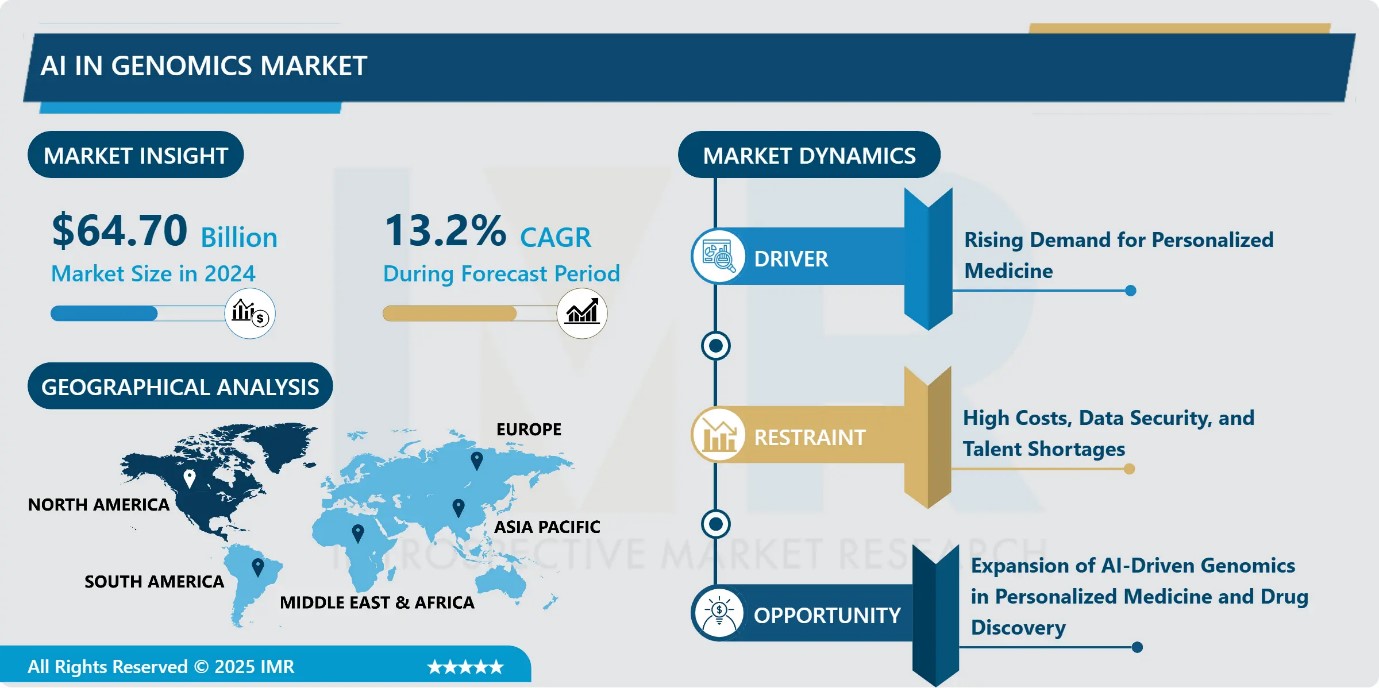
AI in Genomics Market Size Was Valued at USD 64.70 Billion in 2024, and is Projected to Reach USD 253.06 Billion by 2035, growing at a CAGR of 13.2% from 2025-2035.
- Market Size in 2024: USD 64.70 Billion
- Projected Market Size by 2035: USD 253.06 Billion
- CAGR (2025–2035): 13.2%
- Leading Market in 2024: North America
- Fastest-Growing Market: Asia-Pacific
- By Technology: The Machine Learning segment is anticipated to lead the market by accounting for 36.2% of the market share throughout the forecast period.
- By End Users: The Pharmaceutical and Biotechnology Companies segment is expected to capture 39.7% of the market share, thereby maintaining its dominance over the forecast period.
- By Region: The North America region is projected to hold 33.8% of the market share during the forecast period.
- Active Players: Agilent Technologies, Inc. (U.S.), BenevolentAI (U.K.), BGI (China), Data4Cure, Inc. (U.S.), DEEP GENOMICS (Canada), and Other Active Players.
AI in Genomics Market Synopsis:
The AI in Genomics Market focuses on the integration of artificial intelligence technologies such as machine learning, deep learning, and natural language processing into genomics research and clinical applications. It encompasses AI-powered software, platforms, and services designed to analyze massive genomic and multi-omic datasets, extracting actionable biological insights. The market addresses the growing need to process the exponential volume of genomic data generated by next-generation sequencing, enabling precision medicine, accelerated drug discovery, and accurate disease diagnostics. Driven by falling sequencing costs, advances in AI algorithms, and high-performance computing, the market facilitates personalized healthcare, improves decision-making, and enhances research efficiency. Increasing adoption across pharmaceutical, biotechnology, and research institutions positions AI as a transformative tool in decoding the human genome and translating data into clinically relevant outcomes.
AI in Genomics Market Dynamics and Trend Analysis:
AI in Genomics Market Growth Driver
Rising Demand for Personalized Medicine
- The increasing focus on personalized medicine is a key factor driving the growth of the AI in Genomics market. Healthcare is steadily transitioning from uniform treatment approaches toward therapies tailored to individual genetic profiles. Genomic data plays a critical role in enabling this shift, as evidenced by the growing adoption of genomics-based clinical research and therapeutic development. Artificial intelligence supports the efficient analysis of complex genomic datasets, allowing deeper insights into disease mechanisms and patient variability. This capability enables pharmaceutical and biotechnology companies to design more targeted drugs, improve clinical decision-making, and enhance patient outcomes, making AI-driven genomics an essential component of modern precision healthcare.
AI in Genomics Market Limiting Factor
High Costs, Data Security, and Talent Shortages
- The growth of the AI in Genomics market is constrained by several critical challenges. High implementation and operational costs associated with advanced computing infrastructure, specialized software, and ongoing system maintenance limit adoption, particularly among smaller organizations and research institutions. In addition, the highly sensitive nature of genomic data raises significant privacy and cybersecurity concerns, requiring strict compliance with regulatory frameworks and robust data protection measures.
- Ensuring data security while maintaining analytical value remains complex. Furthermore, the shortage of professionals with combined expertise in genomics, bioinformatics, and artificial intelligence slows innovation and integration, collectively restraining the widespread adoption of AI-driven genomic solutions.
AI in Genomics Market Expansion Opportunity
Expansion of AI-Driven Genomics in Personalized Medicine and Drug Discovery
- The convergence of artificial intelligence and genomics presents a strong market opportunity by enabling highly personalized healthcare and accelerating drug discovery processes. Advanced AI algorithms can integrate genomic and clinical data to predict disease risk, optimize therapy selection, and improve treatment outcomes with greater precision. Simultaneously, AI-driven genomic analysis is transforming drug development by supporting target identification, lead optimization, and toxicity prediction, significantly reducing development timelines and costs. The increasing adoption of genomic sequencing technologies across research and clinical settings is generating vast datasets that require advanced analytical solutions. As a result, AI-powered genomics platforms are becoming essential tools for pharmaceutical innovation, precision medicine, and preventive healthcare strategies.
AI in Genomics Market Challenge and Risk
Regulatory, Ethical, and Data Integration Barriers
- The AI in Genomics market faces notable challenges arising from regulatory, ethical, and technical complexities. Regulatory frameworks often struggle to keep pace with rapid advances in AI-driven genomic applications, creating uncertainty around the validation and approval of AI-based diagnostics and clinical decision tools. Ethical concerns related to data ownership, algorithmic bias, informed consent, and equitable access further complicate adoption and public trust.
- Additionally, limited data standardization across sequencing platforms, research institutions, and clinical systems hinders effective data integration. Fragmented datasets and interoperability issues increase preprocessing requirements, restrict scalability, and reduce the generalizability of AI models, collectively slowing innovation and broader market adoption.
AI in Genomics Market Trend
Advancements in Machine Learning Algorithms
- Advancements in machine learning algorithms are emerging as a key trend shaping the AI in Genomics market. Sophisticated approaches, including deep learning models, are significantly improving the accuracy and efficiency of genomic data analysis, enabling better identification of disease-associated genetic variants. The application of neural network architectures in base calling has enhanced both short-read and long-read genome sequencing by improving interpretation of instrument-generated data. Alongside technological progress, there is increasing emphasis on ethical standards, data privacy, and regulatory compliance in genomic research. Strategic collaborations among AI startups, biotechnology companies, and research institutions continue to accelerate innovation, supporting advances in disease diagnosis, drug discovery, and precision genomic medicine.
AI in Genomics Market Segment Analysis:
AI in Genomics Market is segmented based on Application, Technology, Deployment, End User, Solution Type, and Region.
By Technology, Machine learning segment is expected to dominate the market with around 36.2% share during the forecast period.
- The machine learning segment dominates the AI in Genomics market due to its extensive use in genomic data analysis, predictive modeling, and drug discovery applications. Machine learning algorithms enable efficient handling of large-scale genomic datasets, automating labor-intensive tasks such as data annotation, genomic mapping, and identification of potential drug targets.
- By correlating genomic patterns with established biological knowledge, these models support accurate disease prediction and gene expression analysis. While deep learning is emerging as an advanced approach capable of detecting complex sequence-level patterns, machine learning remains the primary technology due to its scalability, interpretability, and seamless integration into existing genomics workflows, driving widespread adoption across research and clinical settings.
By End User, Pharmaceutical and Biotechnology is expected to dominate with close to 39.7% market share during the forecast period.
- Pharmaceutical and biotechnology companies dominate the AI in Genomics market, accounting for the largest share among end users due to their extensive adoption of AI-driven genomic technologies across drug discovery and development workflows. These companies utilize artificial intelligence and machine learning for clinical data management, biomarker identification, companion diagnostics, and predictive toxicity assessment, enabling early identification of drug candidates with higher success potential and reduced clinical failure risk.
- Their strong focus on precision medicine and genomics-based therapies continues to reinforce demand. Meanwhile, hospitals and clinics are witnessing rapid growth as genomic testing becomes integral to oncology and rare disease care, while diagnostic laboratories, research institutes, agricultural research bodies, and forensic laboratories contribute steady, niche demand.
AI in Genomics Market Regional Insights:
North America region is estimated to lead the market with around 33.8% share during the forecast period.
- North America dominated the AI in Genomics market in 2025, accounting for the largest revenue share of 33.8%. The region’s leadership is driven by substantial investments in genomic research, advanced healthcare infrastructure, and widespread adoption of AI-based diagnostics.
- Major U.S. cancer centers and biotechnology firms deploy AI and deep learning models for tumor classification, biomarker quantification, and multimodal genomic analyses, improving precision medicine outcomes. The strong presence of pharmaceutical and biotech companies, combined with cutting-edge digital infrastructure and high R&D funding, fosters innovation in AI-powered genomic tools, making North America the primary hub for market growth and technological advancement in the sector.
AI in Genomics Market Active Players:
- Agilent Technologies, Inc. (U.S.)
- BenevolentAI (U.K.)
- BGI (China)
- Data4Cure, Inc. (U.S.)
- DEEP GENOMICS (Canada)
- Fabric Genomics (U.S.)
- F. Hoffmann-La Roche Ltd. (Switzerland)
- Freenome Holdings, Inc. (U.S.)
- General Electric Company (U.S.)
- IBM (U.S.)
- Illumina, Inc. (U.S.)
- IntegraGen (France)
- Microsoft Corporation (U.S.)
- NVIDIA Corporation (U.S.)
- SOPHiA GENETICS (Switzerland)
- Other Active Players
Key Industry Developments in the AI in Genomics Market:
- In November 2025, NVIDIA, Sheba Medical Center (Israel), and Mount Sinai (NY) launched a three-year AI project targeting the noncoding 98% of the human genome.The initiative leverages large language models and high-performance computing to decode regulatory elements linked to complex diseases.
Technical Overview: AI in Genomics Market
- The AI in Genomics market leverages advanced computational techniques to analyze, interpret, and extract insights from large-scale genomic datasets generated by high-throughput sequencing technologies. Core technologies include machine learning, deep learning, and statistical modeling, which are applied across workflows such as sequence alignment, variant calling, gene expression analysis, and functional annotation. Machine learning algorithms support pattern recognition and predictive modeling by correlating genomic features with phenotypic and clinical outcomes, while deep learning architectures, including convolutional and recurrent neural networks, enable accurate base calling, structural variant detection, and disease risk prediction.
- AI platforms integrate multi-omics data, including genomics, transcriptomics, and proteomics, to enhance biological interpretation. Cloud computing and high-performance computing infrastructures further enable scalable data processing and storage. Together, these technologies improve analytical accuracy, reduce manual intervention, accelerate discovery timelines, and support applications in drug development, precision medicine, diagnostics, and population genomics.
Chapter 1: Introduction
1.1 Scope and Coverage
Chapter 2:Executive Summary
Chapter 3: Market Landscape
3.1 Market Dynamics and Opportunity Analysis
3.1.1 Growth Drivers
3.1.2 Limiting Factors
3.1.3 Growth Opportunities
3.1.4 Challenges and Risks
3.2 Market Trend Analysis
3.3 Industry Ecosystem
3.4 Industry Value Chain Mapping
3.5 Strategic PESTLE Overview
3.6 Porter's Five Forces Framework
3.7 Regulatory Framework
3.8 Pricing Trend Analysis
3.9 Intellectual Property Review
3.10 Technology Evolution
3.11 Import-Export Analysis
3.12 Consumer Behavior Analysis
3.13 Investment Pocket Analysis
3.14 Go-To Market Strategy
Chapter 4: AI in genomics Market by Application (2018-2035)
4.1 AI in genomics Market Snapshot and Growth Engine
4.2 Market Overview
4.3 Drug Discovery
4.3.1 Introduction and Market Overview
4.3.2 Historic and Forecasted Market Size in Value USD and Volume Units
4.3.3 Key Market Trends, Growth Factors, and Opportunities
4.3.4 Geographic Segmentation Analysis
4.4 Genomic Data Analysis
4.5 Personalized Medicine
4.6 Agrigenomics
4.7 and Diagnostics
Chapter 5: AI in genomics Market by Technology (2018-2035)
5.1 AI in genomics Market Snapshot and Growth Engine
5.2 Market Overview
5.3 Machine Learning
5.3.1 Introduction and Market Overview
5.3.2 Historic and Forecasted Market Size in Value USD and Volume Units
5.3.3 Key Market Trends, Growth Factors, and Opportunities
5.3.4 Geographic Segmentation Analysis
5.4 Deep Learning
5.5 Natural Language Processing
5.6 and Computer Vision
Chapter 6: AI in genomics Market by Deployment Type (2018-2035)
6.1 AI in genomics Market Snapshot and Growth Engine
6.2 Market Overview
6.3 Cloud-Based and On-Premises
6.3.1 Introduction and Market Overview
6.3.2 Historic and Forecasted Market Size in Value USD and Volume Units
6.3.3 Key Market Trends, Growth Factors, and Opportunities
6.3.4 Geographic Segmentation Analysis
Chapter 7: AI in genomics Market by Solution Type (2018-2035)
7.1 AI in genomics Market Snapshot and Growth Engine
7.2 Market Overview
7.3 Software and Services
7.3.1 Introduction and Market Overview
7.3.2 Historic and Forecasted Market Size in Value USD and Volume Units
7.3.3 Key Market Trends, Growth Factors, and Opportunities
7.3.4 Geographic Segmentation Analysis
Chapter 8: AI in genomics Market by End User (2018-2035)
8.1 AI in genomics Market Snapshot and Growth Engine
8.2 Market Overview
8.3 Pharmaceutical and Biotechnology Companies
8.3.1 Introduction and Market Overview
8.3.2 Historic and Forecasted Market Size in Value USD and Volume Units
8.3.3 Key Market Trends, Growth Factors, and Opportunities
8.3.4 Geographic Segmentation Analysis
8.4 Research Institutions
8.5 and Healthcare Providers
Chapter 9: Company Profiles and Competitive Analysis
9.1 Competitive Landscape
9.1.1 Competitive Benchmarking
9.1.2 AI in genomics Market Share by Manufacturer/Service Provider(2024)
9.1.3 Industry BCG Matrix
9.1.4 PArtnerships, Mergers & Acquisitions
9.2 AGILENT TECHNOLOGIES
9.2.1 Company Overview
9.2.2 Key Executives
9.2.3 Company Snapshot
9.2.4 Role of the Company in the Market
9.2.5 Sustainability and Social Responsibility
9.2.6 Operating Business Segments
9.2.7 Product Portfolio
9.2.8 Business Performance
9.2.9 Recent News & Developments
9.2.10 SWOT Analysis
9.3 INC. (U.S.)
9.4 BENEVOLENTAI (U.K.)
9.5 BGI (CHINA)
9.6 DATA4CURE
9.7 INC. (U.S.)
9.8 DEEP GENOMICS (CANADA)
9.9 FABRIC GENOMICS (U.S.)
9.10 F. HOFFMANN-LA ROCHE LTD. (SWITZERLAND)
9.11 FREENOME HOLDINGS
9.12 INC. (U.S.)
9.13 GENERAL ELECTRIC COMPANY (U.S.)
9.14 IBM (U.S.)
9.15 ILLUMINA
9.16 INC. (U.S.)
9.17 INTEGRAGEN (FRANCE)
9.18 MICROSOFT CORPORATION (U.S.)
9.19 NVIDIA CORPORATION (U.S.)
9.20 SOPHIA GENETICS (SWITZERLAND)
9.21 AND OTHER ACTIVE PLAYERS.
Chapter 10: Global AI in genomics Market By Region
10.1 Overview
10.2. North America AI in genomics Market
10.2.1 Key Market Trends, Growth Factors and Opportunities
10.2.2 Top Key Companies
10.2.3 Historic and Forecasted Market Size by Segments
10.2.4 Historic and Forecast Market Size by Country
10.2.4.1 US
10.2.4.2 Canada
10.2.4.3 Mexico
10.3. Eastern Europe AI in genomics Market
10.3.1 Key Market Trends, Growth Factors and Opportunities
10.3.2 Top Key Companies
10.3.3 Historic and Forecasted Market Size by Segments
10.3.4 Historic and Forecast Market Size by Country
10.3.4.1 Russia
10.3.4.2 Bulgaria
10.3.4.3 The Czech Republic
10.3.4.4 Hungary
10.3.4.5 Poland
10.3.4.6 Romania
10.3.4.7 Rest of Eastern Europe
10.4. Western Europe AI in genomics Market
10.4.1 Key Market Trends, Growth Factors and Opportunities
10.4.2 Top Key Companies
10.4.3 Historic and Forecasted Market Size by Segments
10.4.4 Historic and Forecast Market Size by Country
10.4.4.1 Germany
10.4.4.2 UK
10.4.4.3 France
10.4.4.4 The Netherlands
10.4.4.5 Italy
10.4.4.6 Spain
10.4.4.7 Rest of Western Europe
10.5. Asia Pacific AI in genomics Market
10.5.1 Key Market Trends, Growth Factors and Opportunities
10.5.2 Top Key Companies
10.5.3 Historic and Forecasted Market Size by Segments
10.5.4 Historic and Forecast Market Size by Country
10.5.4.1 China
10.5.4.2 India
10.5.4.3 Japan
10.5.4.4 South Korea
10.5.4.5 Malaysia
10.5.4.6 Thailand
10.5.4.7 Vietnam
10.5.4.8 The Philippines
10.5.4.9 Australia
10.5.4.10 New Zealand
10.5.4.11 Rest of APAC
10.6. Middle East & Africa AI in genomics Market
10.6.1 Key Market Trends, Growth Factors and Opportunities
10.6.2 Top Key Companies
10.6.3 Historic and Forecasted Market Size by Segments
10.6.4 Historic and Forecast Market Size by Country
10.6.4.1 Turkiye
10.6.4.2 Bahrain
10.6.4.3 Kuwait
10.6.4.4 Saudi Arabia
10.6.4.5 Qatar
10.6.4.6 UAE
10.6.4.7 Israel
10.6.4.8 South Africa
10.7. South America AI in genomics Market
10.7.1 Key Market Trends, Growth Factors and Opportunities
10.7.2 Top Key Companies
10.7.3 Historic and Forecasted Market Size by Segments
10.7.4 Historic and Forecast Market Size by Country
10.7.4.1 Brazil
10.7.4.2 Argentina
10.7.4.3 Rest of SA
Chapter 11 Analyst Viewpoint and Conclusion
Chapter 12 Our Thematic Research Methodology
12.1 Research Process
12.2 Primary Research
12.3 Secondary Research
Chapter 13 Case Study
Chapter 14 Appendix
14.1 Sources
14.2 List of Tables and figures
14.3 Short Forms and Citations
14.4 Assumption and Conversion
14.5 Disclaimer
|
AI in Genomics Market |
|||
|
Base Year: |
2024 |
Forecast Period: |
2025-2035 |
|
Historical Data: |
2018 to 2023 |
Market Size in 2024: |
USD 64.70 Bn. |
|
Forecast Period 2025-35 CAGR: |
13.2% |
Market Size in 2035: |
USD 253.06 Bn. |
|
Segments Covered: |
By Technology |
|
|
|
By Application
|
|
||
|
By Deployment Type |
|
||
|
By Solution Type |
|
||
|
By End Users |
|
||
|
By Region |
|
||
|
Growth Driver: |
|
||
|
Limiting Factor |
|
||
|
Expansion Opportunity |
|
||
|
Challenge and Risk |
|
||
|
Companies Covered in the Report: |
|
||
Chapter 1: Introduction
1.1 Scope and Coverage
Chapter 2:Executive Summary
Chapter 3: Market Landscape
3.1 Market Dynamics and Opportunity Analysis
3.1.1 Growth Drivers
3.1.2 Limiting Factors
3.1.3 Growth Opportunities
3.1.4 Challenges and Risks
3.2 Market Trend Analysis
3.3 Industry Ecosystem
3.4 Industry Value Chain Mapping
3.5 Strategic PESTLE Overview
3.6 Porter's Five Forces Framework
3.7 Regulatory Framework
3.8 Pricing Trend Analysis
3.9 Intellectual Property Review
3.10 Technology Evolution
3.11 Import-Export Analysis
3.12 Consumer Behavior Analysis
3.13 Investment Pocket Analysis
3.14 Go-To Market Strategy
Chapter 4: AI in genomics Market by Application (2018-2035)
4.1 AI in genomics Market Snapshot and Growth Engine
4.2 Market Overview
4.3 Drug Discovery
4.3.1 Introduction and Market Overview
4.3.2 Historic and Forecasted Market Size in Value USD and Volume Units
4.3.3 Key Market Trends, Growth Factors, and Opportunities
4.3.4 Geographic Segmentation Analysis
4.4 Genomic Data Analysis
4.5 Personalized Medicine
4.6 Agrigenomics
4.7 and Diagnostics
Chapter 5: AI in genomics Market by Technology (2018-2035)
5.1 AI in genomics Market Snapshot and Growth Engine
5.2 Market Overview
5.3 Machine Learning
5.3.1 Introduction and Market Overview
5.3.2 Historic and Forecasted Market Size in Value USD and Volume Units
5.3.3 Key Market Trends, Growth Factors, and Opportunities
5.3.4 Geographic Segmentation Analysis
5.4 Deep Learning
5.5 Natural Language Processing
5.6 and Computer Vision
Chapter 6: AI in genomics Market by Deployment Type (2018-2035)
6.1 AI in genomics Market Snapshot and Growth Engine
6.2 Market Overview
6.3 Cloud-Based and On-Premises
6.3.1 Introduction and Market Overview
6.3.2 Historic and Forecasted Market Size in Value USD and Volume Units
6.3.3 Key Market Trends, Growth Factors, and Opportunities
6.3.4 Geographic Segmentation Analysis
Chapter 7: AI in genomics Market by Solution Type (2018-2035)
7.1 AI in genomics Market Snapshot and Growth Engine
7.2 Market Overview
7.3 Software and Services
7.3.1 Introduction and Market Overview
7.3.2 Historic and Forecasted Market Size in Value USD and Volume Units
7.3.3 Key Market Trends, Growth Factors, and Opportunities
7.3.4 Geographic Segmentation Analysis
Chapter 8: AI in genomics Market by End User (2018-2035)
8.1 AI in genomics Market Snapshot and Growth Engine
8.2 Market Overview
8.3 Pharmaceutical and Biotechnology Companies
8.3.1 Introduction and Market Overview
8.3.2 Historic and Forecasted Market Size in Value USD and Volume Units
8.3.3 Key Market Trends, Growth Factors, and Opportunities
8.3.4 Geographic Segmentation Analysis
8.4 Research Institutions
8.5 and Healthcare Providers
Chapter 9: Company Profiles and Competitive Analysis
9.1 Competitive Landscape
9.1.1 Competitive Benchmarking
9.1.2 AI in genomics Market Share by Manufacturer/Service Provider(2024)
9.1.3 Industry BCG Matrix
9.1.4 PArtnerships, Mergers & Acquisitions
9.2 AGILENT TECHNOLOGIES
9.2.1 Company Overview
9.2.2 Key Executives
9.2.3 Company Snapshot
9.2.4 Role of the Company in the Market
9.2.5 Sustainability and Social Responsibility
9.2.6 Operating Business Segments
9.2.7 Product Portfolio
9.2.8 Business Performance
9.2.9 Recent News & Developments
9.2.10 SWOT Analysis
9.3 INC. (U.S.)
9.4 BENEVOLENTAI (U.K.)
9.5 BGI (CHINA)
9.6 DATA4CURE
9.7 INC. (U.S.)
9.8 DEEP GENOMICS (CANADA)
9.9 FABRIC GENOMICS (U.S.)
9.10 F. HOFFMANN-LA ROCHE LTD. (SWITZERLAND)
9.11 FREENOME HOLDINGS
9.12 INC. (U.S.)
9.13 GENERAL ELECTRIC COMPANY (U.S.)
9.14 IBM (U.S.)
9.15 ILLUMINA
9.16 INC. (U.S.)
9.17 INTEGRAGEN (FRANCE)
9.18 MICROSOFT CORPORATION (U.S.)
9.19 NVIDIA CORPORATION (U.S.)
9.20 SOPHIA GENETICS (SWITZERLAND)
9.21 AND OTHER ACTIVE PLAYERS.
Chapter 10: Global AI in genomics Market By Region
10.1 Overview
10.2. North America AI in genomics Market
10.2.1 Key Market Trends, Growth Factors and Opportunities
10.2.2 Top Key Companies
10.2.3 Historic and Forecasted Market Size by Segments
10.2.4 Historic and Forecast Market Size by Country
10.2.4.1 US
10.2.4.2 Canada
10.2.4.3 Mexico
10.3. Eastern Europe AI in genomics Market
10.3.1 Key Market Trends, Growth Factors and Opportunities
10.3.2 Top Key Companies
10.3.3 Historic and Forecasted Market Size by Segments
10.3.4 Historic and Forecast Market Size by Country
10.3.4.1 Russia
10.3.4.2 Bulgaria
10.3.4.3 The Czech Republic
10.3.4.4 Hungary
10.3.4.5 Poland
10.3.4.6 Romania
10.3.4.7 Rest of Eastern Europe
10.4. Western Europe AI in genomics Market
10.4.1 Key Market Trends, Growth Factors and Opportunities
10.4.2 Top Key Companies
10.4.3 Historic and Forecasted Market Size by Segments
10.4.4 Historic and Forecast Market Size by Country
10.4.4.1 Germany
10.4.4.2 UK
10.4.4.3 France
10.4.4.4 The Netherlands
10.4.4.5 Italy
10.4.4.6 Spain
10.4.4.7 Rest of Western Europe
10.5. Asia Pacific AI in genomics Market
10.5.1 Key Market Trends, Growth Factors and Opportunities
10.5.2 Top Key Companies
10.5.3 Historic and Forecasted Market Size by Segments
10.5.4 Historic and Forecast Market Size by Country
10.5.4.1 China
10.5.4.2 India
10.5.4.3 Japan
10.5.4.4 South Korea
10.5.4.5 Malaysia
10.5.4.6 Thailand
10.5.4.7 Vietnam
10.5.4.8 The Philippines
10.5.4.9 Australia
10.5.4.10 New Zealand
10.5.4.11 Rest of APAC
10.6. Middle East & Africa AI in genomics Market
10.6.1 Key Market Trends, Growth Factors and Opportunities
10.6.2 Top Key Companies
10.6.3 Historic and Forecasted Market Size by Segments
10.6.4 Historic and Forecast Market Size by Country
10.6.4.1 Turkiye
10.6.4.2 Bahrain
10.6.4.3 Kuwait
10.6.4.4 Saudi Arabia
10.6.4.5 Qatar
10.6.4.6 UAE
10.6.4.7 Israel
10.6.4.8 South Africa
10.7. South America AI in genomics Market
10.7.1 Key Market Trends, Growth Factors and Opportunities
10.7.2 Top Key Companies
10.7.3 Historic and Forecasted Market Size by Segments
10.7.4 Historic and Forecast Market Size by Country
10.7.4.1 Brazil
10.7.4.2 Argentina
10.7.4.3 Rest of SA
Chapter 11 Analyst Viewpoint and Conclusion
Chapter 12 Our Thematic Research Methodology
12.1 Research Process
12.2 Primary Research
12.3 Secondary Research
Chapter 13 Case Study
Chapter 14 Appendix
14.1 Sources
14.2 List of Tables and figures
14.3 Short Forms and Citations
14.4 Assumption and Conversion
14.5 Disclaimer


