Agitation in Delirium Management Market Synopsis:
Agitation in Delirium Management Market Size Was Valued at USD 235.23 Million in 2023, and is Projected to Reach USD 352.6 Million by 2032, Growing at a CAGR of 4.6% From 2024-2032.
The market agitation in delirium management pertains tom the creation and delivery of treatments geared at managing agitation, which often occurs in patients undergoing delirium especially those admitted in hospital or in intensive care unit. It is therefore a condition whereby client presents with impaired judgement, attention, new altered objective perceptions, abnormal thought content and psychomotor activity, and use of generalized substances. Therefore, preventing and controlling agitation in such patients becomes imperative so as to minimize the development of other adverse effects, enhance the clinical results and decrease the load on the health care services. This market includes both chemical treatments, and drugs like sleep drugs and tranquilizers and non-drug remedies like psychotherapy and changes in the environment. Higher proportion of elderly people, more frequent occurrence of diseases like dementia, expanding customer awareness about the necessity to manage delirium better, as well the progress in addressing this issue through protocol and patient care advancements, are the factors that will define further development of the market.
The market of products for managing agitation in delirium continues to grow as more healthcare organizations have realized that managing agitation in delirium patients is crucial, especially among the ICU patients. Confusion as observed in patients with sepsis, stroke or postoperatively; it is characterized by acute confusion, disorientation, and agitation. Agitation in delirium is dangerous for the patient because it can lead to increased LOS and healthcare costs, as well as higher risk of complications. Therefore, management of agitation has become one of the most important goals rendering specialized treatment algorithms and approaches targeting such side effects.
The use of oral and injectable drugs, particularly antipsychotics and sedatives, has been considered for many years as the mainstay of agitation treatment, but non-drug treatments have recently become popular because they cause fewer side effects and possibly promote patients’ recovery. The market is driven by rising knowledge of the frequency of delirium within the older generation admitted to ICUs and post-surgery patients. Market growth is supported by the factors like an increase in the geriatric population, the high percentage of which is sensitive to delirium, and changes in consciousness that the importance of early diagnostics and treatment has been recognized. Moreover, sustained developments in technology, including delirium detection instruments and monitorings are helping in more precise intervention. On the one hand, it is promising in terms of further market development, however, there are certain critical issues to be looked at; the deficit of research evidence-based guidelines to be implemented, lack of perspectives in the safety of some pharmacological treatments.
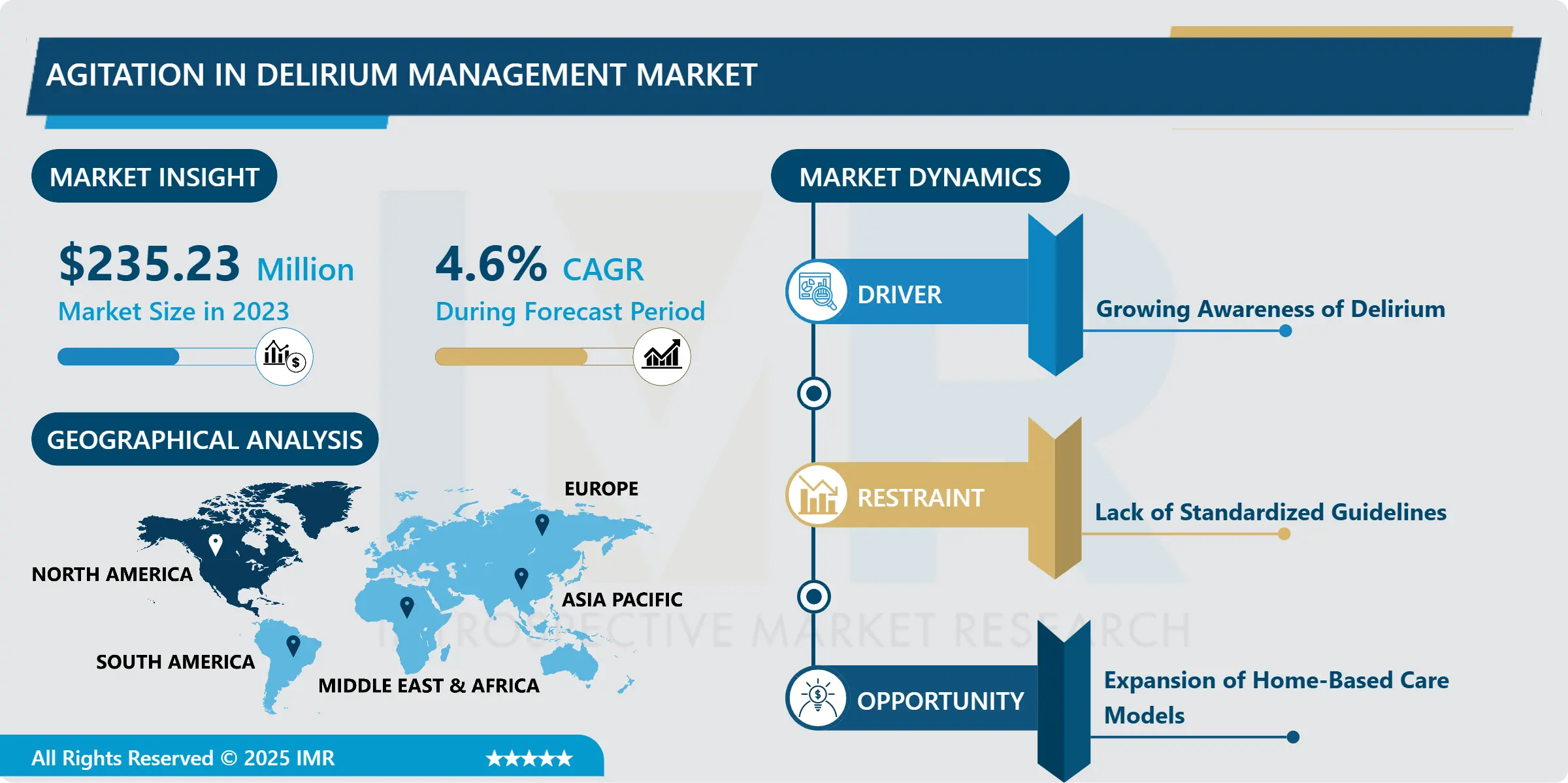
Agitation in Delirium Management Market Trend Analysis:
Early Identification and Advanced Technologies in Delirium Management
-
Health care providers are realizing the seriousness of delirium especially in patients from the geriatrics group – and they direct attention at recognizing the condition as early as possible and initiating treatment procedures. It has short-term consequence that includes prolonged length of stay, increased risk of cognitive change and progression, and mortality; therefore, early recognition and management of distressing delirious symptoms are warranted. Subsequently, owing to the realization of the negative impacts of delirium in patients, the use of such enhanced screening instruments has been embraced. It is not uncommon for delirium to be missed or identified too late; early identification of delirium through these tools prevent this. That is why, today, there is a push to incorporate these tools into proper day-to-day use, and make sure that delirium is caught early enough to not get worse, which will ultimately help with patient recovery and lessening the load on healthcare systems.
- Potential opportunities in early delirium detection concern the application of the biomarkers and integration of AI technologies into diagnostic algorithms. These innovations are likely to greatly improve the assessment of delirium, especially where patients are unable to verbalise, for example in critical care or post-operative patients who may be sedated. In like manner, AI algorithms can look at a large number of patient data and come up with details that a clinician might easily overlook but can pose high-risk factors. Apart from benefiting in diagnosis of delirium at earlier stages and tailoring care complimentary to patient, this approach assists healthcare professionals in providing improved adequacy in management of the condition. The use of such technologies helps to bring change in the management of delirium indicating better care to patient and cost-effective process to manage the complications.
Growth Opportunities in Delirium Agitation Management
-
It is important given the growing elderly population that the need for managing delirium especially in aged patients is now more critical. Confusion and a lot of movement is a common symptom known as delirium and can often develop in elderly patients during their hospital stay or when recovering after undergoing surgery. This demographic shift represents a significant market for pharmaceutical firms and medical device makers to create treatments and technologies to treat delirium, including anti-psychotic medications targeting agitation in patients. As the number of older patients developing delirium skyrockets in geriatric settings, it becomes evident that proper symptomatic and therapeutic interventions for managing agitation and confusion in elderly patients and at the same time improving their recovery trajectory are requisite.
- Pharmacological interventions form a vital component for fulfilling this demand as illustrated next. Newer agents, which do not have the side effects include the newer sedatives and antipsychotic medications that have higher potential to improve patient outcomes than the traditional medications with side effects. Allopurinol might last longer for the managing of delirium but it had a minor side effect compared to the common antipsychotic medications These medications could result in better, safer, shorter use of agitation and decreased adverse reactions. At the same time, the expansion of non-pharmacological methods, including cognitive therapies and environmental changes stimulates the development of new forms of adjunctive treatments that can support pharmaceutical interventions. With the shift in the healthcare providers’ ongoing pursuit towards customization and patient-centered care, the application market for delirium remains significant for future growth due to the lack of adequate, effective, and convenient approaches.
Agitation in Delirium Management Market Segment Analysis:
Agitation in Delirium Management Market is Segmented on the basis of By Drug Type, Route of Administration, End-Users, Distribution Channel, and Region.
By Drug Type, First-generation Antipsychotics segment is expected to dominate the market during the forecast period
-
First generation antipsychotics (FGAs) also referred to as the typical antipsychotics have been a widely used treatment for Schizophrenia and other psychotic disorders for many years. These drugs mainly act by means of dopamine receptor antagonism sending D2 receptors in the brain; this helps in the treatment of psychotic symptoms such as paranoid or hallucinogenic thoughts, and thought disorders. FGAs are ideal for cases where patients have episodic psychotic symptoms and these medications are mostly used for treatment in hospitals because their effectiveness is quickly seen. Although their efficiency has been relatively established, the overall utilization of the drugs has been greatly restricted due to severe side effects such as extrapyramidal symptoms (EPS) including tremors, rigidity, and tardive dyskinesia, a heath complication whereby a person develops repetitive, involuntary movements.
- Side effects of FGAs lead to the use of SGAs in outpatient care while FGAs remain prevalent attributable to need for rapid control of target symptoms. Some of these are haloperidol and chlorpromazine- two of the most popular FGAs- are still used especially in the ICU or when issues such as patient compliance are less of an issue. Although newer antipsychotic drugs are said to cause less motor side effects, FGAs continue to be an effective treatment modality particularly for severe psychotic symptoms. This role in particularly acute treatment and also inpatient management makes them a mainstay of psychiatric pharmacotherapy in spite of side effects though.
By Distribution Channel, Hospital Pharmacy segment expected to held the largest share
-
These include the specialty shops which are hospital pharmacies whereby the use of the necessary drugs and psychiatric substances for patients admitted in hospitals is made available. These latter are supposed to provide diverse psychiatric medications including antipsychotics, antidepressants, mood stabilizers, and anxiolytics for patients treated in inpatient facilities. During acute treatment or crisis intervention, it is very relevant for the organisation and the patient that hospital pharmacies get to provide the medication to the clinical staff who need to give the medication shortly afterwards. This close supervision facilitates accurate observation of when and how to administer the drugs, as well as adjust the drug schedule because of patient’s response to the treatment.
- Besides distributing oral medications, hospital pharmacies also reinforce specific therapies that may necessitate closer supervision than on-patient drugs, which include intramuscular or intravenous injections of psychiatric drugs. Long-acting forms of antipsychotics, like depot injections, are preparations of medicine that have to be injected to patient; this formula allows patients to be under treatment for long periods without daily doses. Moreover, it is the role of these hospital pharmacies to check form any adverse effects and interactions which may be forthcoming in the course of the process and to ensure that the patient continues to benefit from the treatment be administered to him or her. In this regard, management of these aspects of patient care by hospital pharmacies contributes to optimization of a therapeutic result, especially in cases of psychiatric patients with acute or chronic pathology.
Agitation in Delirium Management Market Regional Insights:
North America is Expected to Dominate the Market Over the Forecast period
-
The Market for Agitation in Delirium Management is growing rapidly in countries of North America especially in U.S and Canada due to predominantly aging population increasing the prevalence of delirium and the highly developed health sector. Owing to growing incidence of acute illnesses that necessitate ICU or postoperative care among the elderly, rates of delirium are on the rise. This has led to raised interest in better care delirium strategies with an idea of addressing agitation. Larger numbers of hospitals are now employing medications like antipsychotics and sedatives and employing nonpharmacological treatments like cognitive therapies and environmental changes. Together these approaches have the goal of lessening the effects of delirium, enhancing a patient’s prognosis and cutting costs to drive the market forward.
- Further, there is a substantial increase in government commitment and various healthcare activities in the market to enhance the patient care quality. Internationally and in the United States of America in particular, healthcare reforms including the Hospital Readmissions Reduction Program (HRRP) and several quality related endeavors prompt healthcare organizations to embrace quality care of delirium. The US Centers for Medicare and Medicaid Services CMS has also trialed evidence-based models for care, which calls on hospitals to integrate pharmacological as well as behavioural measures for agitation. North America especially is projected to witness high growth in the sale of more enhanced agitation management product solutions due to a shift in healthcare systems in the management of such important conditions as delirium.
Active Key Players in the Agitation in Delirium Management Market
- Akorn Incorporated,
- BioXcel Therapeutics, Inc.,
- Fresenius Kabi AG,
- Glenmark Pharmaceuticals Limited,
- Mylan N.V.,
- Novartis AG,
- Pfizer, Inc.,
- Sun Pharmaceutical Industries Ltd.,
- Takeda Pharmaceutical Company Limited
- Teva Pharmaceutical Industries Ltd.,
- Zydus Cadila,
- Other Active Players.
|
Global Agitation in Delirium Management Market |
|||
|
Base Year: |
2023 |
Forecast Period: |
2024-2032 |
|
Historical Data: |
2017 to 2023 |
Market Size in 2023: |
USD 235.23 Million |
|
Forecast Period 2024-32 CAGR: |
4.6% |
Market Size in 2032: |
USD 352.6 Million |
|
Segments Covered: |
By Drug Type |
|
|
|
By Route of Administration |
|
||
|
By End-Users |
|
||
|
By Distribution Channel |
|
||
|
By Region |
|
||
|
Key Market Drivers: |
|
||
|
Key Market Restraints: |
|
||
|
Key Opportunities: |
|
||
|
Companies Covered in the report: |
|
||
Chapter 1: Introduction
1.1 Scope and Coverage
Chapter 2:Executive Summary
Chapter 3: Market Landscape
3.1 Market Dynamics
3.1.1 Drivers
3.1.2 Restraints
3.1.3 Opportunities
3.1.4 Challenges
3.2 Market Trend Analysis
3.3 PESTLE Analysis
3.4 Porter's Five Forces Analysis
3.5 Industry Value Chain Analysis
3.6 Ecosystem
3.7 Regulatory Landscape
3.8 Price Trend Analysis
3.9 Patent Analysis
3.10 Technology Evolution
3.11 Investment Pockets
3.12 Import-Export Analysis
Chapter 4: Agitation in Delirium Management Market by Drug
4.1 Agitation in Delirium Management Market Snapshot and Growth Engine
4.2 Agitation in Delirium Management Market Overview
4.3 First-generation Antipsychotics
4.3.1 Introduction and Market Overview
4.3.2 Historic and Forecasted Market Size in Value USD and Volume Units (2017-2032F)
4.3.3 Key Market Trends, Growth Factors and Opportunities
4.3.4 First-generation Antipsychotics: Geographic Segmentation Analysis
4.4 Second-generation Antipsychotics
4.4.1 Introduction and Market Overview
4.4.2 Historic and Forecasted Market Size in Value USD and Volume Units (2017-2032F)
4.4.3 Key Market Trends, Growth Factors and Opportunities
4.4.4 Second-generation Antipsychotics: Geographic Segmentation Analysis
4.5 Benzodiazepines
4.5.1 Introduction and Market Overview
4.5.2 Historic and Forecasted Market Size in Value USD and Volume Units (2017-2032F)
4.5.3 Key Market Trends, Growth Factors and Opportunities
4.5.4 Benzodiazepines: Geographic Segmentation Analysis
4.6 Others
4.6.1 Introduction and Market Overview
4.6.2 Historic and Forecasted Market Size in Value USD and Volume Units (2017-2032F)
4.6.3 Key Market Trends, Growth Factors and Opportunities
4.6.4 Others: Geographic Segmentation Analysis
Chapter 5: Agitation in Delirium Management Market by Route of Administration
5.1 Agitation in Delirium Management Market Snapshot and Growth Engine
5.2 Agitation in Delirium Management Market Overview
5.3 Oral
5.3.1 Introduction and Market Overview
5.3.2 Historic and Forecasted Market Size in Value USD and Volume Units (2017-2032F)
5.3.3 Key Market Trends, Growth Factors and Opportunities
5.3.4 Oral: Geographic Segmentation Analysis
5.4 Intramuscular
5.4.1 Introduction and Market Overview
5.4.2 Historic and Forecasted Market Size in Value USD and Volume Units (2017-2032F)
5.4.3 Key Market Trends, Growth Factors and Opportunities
5.4.4 Intramuscular: Geographic Segmentation Analysis
5.5 Others
5.5.1 Introduction and Market Overview
5.5.2 Historic and Forecasted Market Size in Value USD and Volume Units (2017-2032F)
5.5.3 Key Market Trends, Growth Factors and Opportunities
5.5.4 Others: Geographic Segmentation Analysis
Chapter 6: Agitation in Delirium Management Market by End-Users
6.1 Agitation in Delirium Management Market Snapshot and Growth Engine
6.2 Agitation in Delirium Management Market Overview
6.3 Clinic
6.3.1 Introduction and Market Overview
6.3.2 Historic and Forecasted Market Size in Value USD and Volume Units (2017-2032F)
6.3.3 Key Market Trends, Growth Factors and Opportunities
6.3.4 Clinic: Geographic Segmentation Analysis
6.4 Hospital
6.4.1 Introduction and Market Overview
6.4.2 Historic and Forecasted Market Size in Value USD and Volume Units (2017-2032F)
6.4.3 Key Market Trends, Growth Factors and Opportunities
6.4.4 Hospital: Geographic Segmentation Analysis
6.5 Others
6.5.1 Introduction and Market Overview
6.5.2 Historic and Forecasted Market Size in Value USD and Volume Units (2017-2032F)
6.5.3 Key Market Trends, Growth Factors and Opportunities
6.5.4 Others: Geographic Segmentation Analysis
Chapter 7: Agitation in Delirium Management Market by Distribution Channel
7.1 Agitation in Delirium Management Market Snapshot and Growth Engine
7.2 Agitation in Delirium Management Market Overview
7.3 Hospital Pharmacy
7.3.1 Introduction and Market Overview
7.3.2 Historic and Forecasted Market Size in Value USD and Volume Units (2017-2032F)
7.3.3 Key Market Trends, Growth Factors and Opportunities
7.3.4 Hospital Pharmacy: Geographic Segmentation Analysis
7.4 Retail Pharmacy
7.4.1 Introduction and Market Overview
7.4.2 Historic and Forecasted Market Size in Value USD and Volume Units (2017-2032F)
7.4.3 Key Market Trends, Growth Factors and Opportunities
7.4.4 Retail Pharmacy: Geographic Segmentation Analysis
7.5 Online Pharmacy).
7.5.1 Introduction and Market Overview
7.5.2 Historic and Forecasted Market Size in Value USD and Volume Units (2017-2032F)
7.5.3 Key Market Trends, Growth Factors and Opportunities
7.5.4 Online Pharmacy).: Geographic Segmentation Analysis
Chapter 8: Company Profiles and Competitive Analysis
8.1 Competitive Landscape
8.1.1 Competitive Benchmarking
8.1.2 Agitation in Delirium Management Market Share by Manufacturer (2023)
8.1.3 Industry BCG Matrix
8.1.4 Heat Map Analysis
8.1.5 Mergers and Acquisitions
8.2 TEVA PHARMACEUTICAL INDUSTRIES LTD.
8.2.1 Company Overview
8.2.2 Key Executives
8.2.3 Company Snapshot
8.2.4 Role of the Company in the Market
8.2.5 Sustainability and Social Responsibility
8.2.6 Operating Business Segments
8.2.7 Product Portfolio
8.2.8 Business Performance
8.2.9 Key Strategic Moves and Recent Developments
8.2.10 SWOT Analysis
8.3 SUN PHARMACEUTICAL INDUSTRIES LTD.
8.4 GLENMARK PHARMACEUTICALS LIMITED
8.5 MYLAN N.V.
8.6 FRESENIUS KABI AG
8.7 NOVARTIS AG
8.8 AKORN INCORPORATED
8.9 ZYDUS CADILA
8.10 PFIZER INC.
8.11 BIOXCEL THERAPEUTICS INC.
8.12 AND TAKEDA PHARMACEUTICAL COMPANY LIMITED
8.13 OTHER ACTIVE PLAYERS
Chapter 9: Global Agitation in Delirium Management Market By Region
9.1 Overview
9.2. North America Agitation in Delirium Management Market
9.2.1 Key Market Trends, Growth Factors and Opportunities
9.2.2 Top Key Companies
9.2.3 Historic and Forecasted Market Size by Segments
9.2.4 Historic and Forecasted Market Size By Drug
9.2.4.1 First-generation Antipsychotics
9.2.4.2 Second-generation Antipsychotics
9.2.4.3 Benzodiazepines
9.2.4.4 Others
9.2.5 Historic and Forecasted Market Size By Route of Administration
9.2.5.1 Oral
9.2.5.2 Intramuscular
9.2.5.3 Others
9.2.6 Historic and Forecasted Market Size By End-Users
9.2.6.1 Clinic
9.2.6.2 Hospital
9.2.6.3 Others
9.2.7 Historic and Forecasted Market Size By Distribution Channel
9.2.7.1 Hospital Pharmacy
9.2.7.2 Retail Pharmacy
9.2.7.3 Online Pharmacy).
9.2.8 Historic and Forecast Market Size by Country
9.2.8.1 US
9.2.8.2 Canada
9.2.8.3 Mexico
9.3. Eastern Europe Agitation in Delirium Management Market
9.3.1 Key Market Trends, Growth Factors and Opportunities
9.3.2 Top Key Companies
9.3.3 Historic and Forecasted Market Size by Segments
9.3.4 Historic and Forecasted Market Size By Drug
9.3.4.1 First-generation Antipsychotics
9.3.4.2 Second-generation Antipsychotics
9.3.4.3 Benzodiazepines
9.3.4.4 Others
9.3.5 Historic and Forecasted Market Size By Route of Administration
9.3.5.1 Oral
9.3.5.2 Intramuscular
9.3.5.3 Others
9.3.6 Historic and Forecasted Market Size By End-Users
9.3.6.1 Clinic
9.3.6.2 Hospital
9.3.6.3 Others
9.3.7 Historic and Forecasted Market Size By Distribution Channel
9.3.7.1 Hospital Pharmacy
9.3.7.2 Retail Pharmacy
9.3.7.3 Online Pharmacy).
9.3.8 Historic and Forecast Market Size by Country
9.3.8.1 Russia
9.3.8.2 Bulgaria
9.3.8.3 The Czech Republic
9.3.8.4 Hungary
9.3.8.5 Poland
9.3.8.6 Romania
9.3.8.7 Rest of Eastern Europe
9.4. Western Europe Agitation in Delirium Management Market
9.4.1 Key Market Trends, Growth Factors and Opportunities
9.4.2 Top Key Companies
9.4.3 Historic and Forecasted Market Size by Segments
9.4.4 Historic and Forecasted Market Size By Drug
9.4.4.1 First-generation Antipsychotics
9.4.4.2 Second-generation Antipsychotics
9.4.4.3 Benzodiazepines
9.4.4.4 Others
9.4.5 Historic and Forecasted Market Size By Route of Administration
9.4.5.1 Oral
9.4.5.2 Intramuscular
9.4.5.3 Others
9.4.6 Historic and Forecasted Market Size By End-Users
9.4.6.1 Clinic
9.4.6.2 Hospital
9.4.6.3 Others
9.4.7 Historic and Forecasted Market Size By Distribution Channel
9.4.7.1 Hospital Pharmacy
9.4.7.2 Retail Pharmacy
9.4.7.3 Online Pharmacy).
9.4.8 Historic and Forecast Market Size by Country
9.4.8.1 Germany
9.4.8.2 UK
9.4.8.3 France
9.4.8.4 The Netherlands
9.4.8.5 Italy
9.4.8.6 Spain
9.4.8.7 Rest of Western Europe
9.5. Asia Pacific Agitation in Delirium Management Market
9.5.1 Key Market Trends, Growth Factors and Opportunities
9.5.2 Top Key Companies
9.5.3 Historic and Forecasted Market Size by Segments
9.5.4 Historic and Forecasted Market Size By Drug
9.5.4.1 First-generation Antipsychotics
9.5.4.2 Second-generation Antipsychotics
9.5.4.3 Benzodiazepines
9.5.4.4 Others
9.5.5 Historic and Forecasted Market Size By Route of Administration
9.5.5.1 Oral
9.5.5.2 Intramuscular
9.5.5.3 Others
9.5.6 Historic and Forecasted Market Size By End-Users
9.5.6.1 Clinic
9.5.6.2 Hospital
9.5.6.3 Others
9.5.7 Historic and Forecasted Market Size By Distribution Channel
9.5.7.1 Hospital Pharmacy
9.5.7.2 Retail Pharmacy
9.5.7.3 Online Pharmacy).
9.5.8 Historic and Forecast Market Size by Country
9.5.8.1 China
9.5.8.2 India
9.5.8.3 Japan
9.5.8.4 South Korea
9.5.8.5 Malaysia
9.5.8.6 Thailand
9.5.8.7 Vietnam
9.5.8.8 The Philippines
9.5.8.9 Australia
9.5.8.10 New Zealand
9.5.8.11 Rest of APAC
9.6. Middle East & Africa Agitation in Delirium Management Market
9.6.1 Key Market Trends, Growth Factors and Opportunities
9.6.2 Top Key Companies
9.6.3 Historic and Forecasted Market Size by Segments
9.6.4 Historic and Forecasted Market Size By Drug
9.6.4.1 First-generation Antipsychotics
9.6.4.2 Second-generation Antipsychotics
9.6.4.3 Benzodiazepines
9.6.4.4 Others
9.6.5 Historic and Forecasted Market Size By Route of Administration
9.6.5.1 Oral
9.6.5.2 Intramuscular
9.6.5.3 Others
9.6.6 Historic and Forecasted Market Size By End-Users
9.6.6.1 Clinic
9.6.6.2 Hospital
9.6.6.3 Others
9.6.7 Historic and Forecasted Market Size By Distribution Channel
9.6.7.1 Hospital Pharmacy
9.6.7.2 Retail Pharmacy
9.6.7.3 Online Pharmacy).
9.6.8 Historic and Forecast Market Size by Country
9.6.8.1 Turkiye
9.6.8.2 Bahrain
9.6.8.3 Kuwait
9.6.8.4 Saudi Arabia
9.6.8.5 Qatar
9.6.8.6 UAE
9.6.8.7 Israel
9.6.8.8 South Africa
9.7. South America Agitation in Delirium Management Market
9.7.1 Key Market Trends, Growth Factors and Opportunities
9.7.2 Top Key Companies
9.7.3 Historic and Forecasted Market Size by Segments
9.7.4 Historic and Forecasted Market Size By Drug
9.7.4.1 First-generation Antipsychotics
9.7.4.2 Second-generation Antipsychotics
9.7.4.3 Benzodiazepines
9.7.4.4 Others
9.7.5 Historic and Forecasted Market Size By Route of Administration
9.7.5.1 Oral
9.7.5.2 Intramuscular
9.7.5.3 Others
9.7.6 Historic and Forecasted Market Size By End-Users
9.7.6.1 Clinic
9.7.6.2 Hospital
9.7.6.3 Others
9.7.7 Historic and Forecasted Market Size By Distribution Channel
9.7.7.1 Hospital Pharmacy
9.7.7.2 Retail Pharmacy
9.7.7.3 Online Pharmacy).
9.7.8 Historic and Forecast Market Size by Country
9.7.8.1 Brazil
9.7.8.2 Argentina
9.7.8.3 Rest of SA
Chapter 10 Analyst Viewpoint and Conclusion
10.1 Recommendations and Concluding Analysis
10.2 Potential Market Strategies
Chapter 11 Research Methodology
11.1 Research Process
11.2 Primary Research
11.3 Secondary Research
|
Global Agitation in Delirium Management Market |
|||
|
Base Year: |
2023 |
Forecast Period: |
2024-2032 |
|
Historical Data: |
2017 to 2023 |
Market Size in 2023: |
USD 235.23 Million |
|
Forecast Period 2024-32 CAGR: |
4.6% |
Market Size in 2032: |
USD 352.6 Million |
|
Segments Covered: |
By Drug Type |
|
|
|
By Route of Administration |
|
||
|
By End-Users |
|
||
|
By Distribution Channel |
|
||
|
By Region |
|
||
|
Key Market Drivers: |
|
||
|
Key Market Restraints: |
|
||
|
Key Opportunities: |
|
||
|
Companies Covered in the report: |
|
||