Robotic Dexterous Hand Market Synopsis:
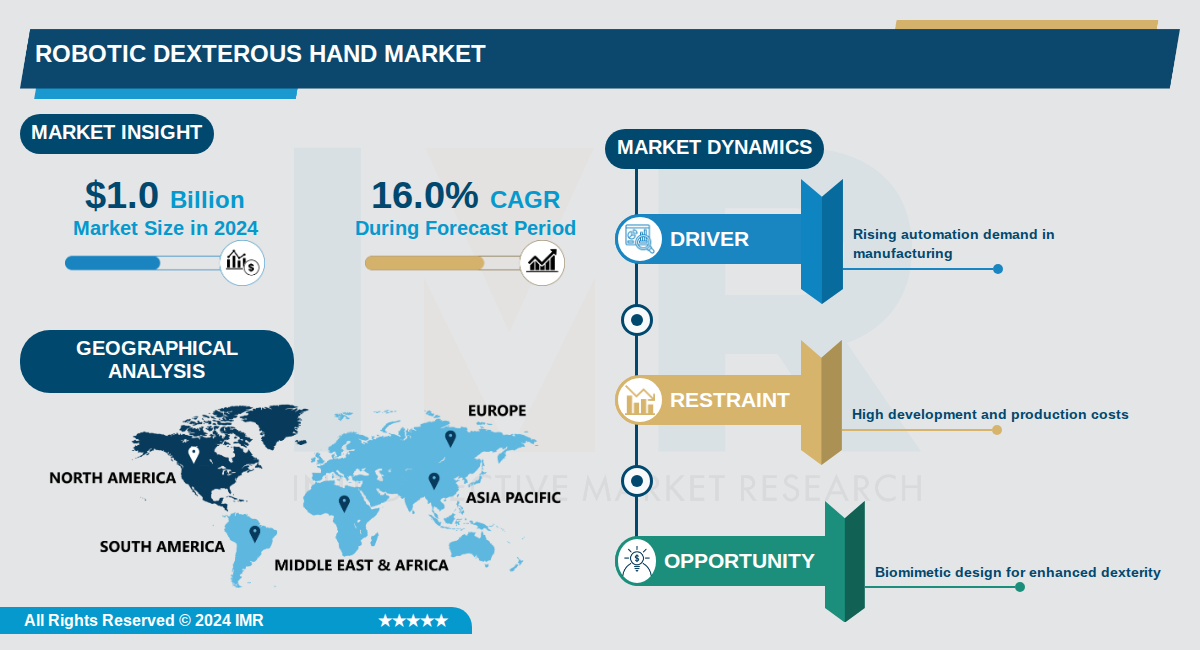
Robotic Dexterous Hand Market Size Was Valued at USD 1.0 Billion in 2024, and is Projected to Reach USD 3.0 Billion by 2035, Growing at a CAGR of 16.0% From 2024-2035.
The Robotic Dexterous Hand Market, encompassing advanced multi-fingered systems mimicking human dexterity, is valued at $1.0 billion in 2024 and is projected to reach $3.0 billion by 2035, reflecting a robust CAGR of 16.0%.[user data]
This market is propelled by innovations in AI, machine learning, sensor technology, and actuation systems, enabling precise manipulation in sectors like manufacturing, healthcare, research, logistics, and emerging fields such as space exploration and prosthetics. Electric hands dominate due to superior control, while pneumatic variants offer cost-effective alternatives.
Key players including Shadow Robot, qbRobotics, Schunk, and emerging firms like Seed Robotics and INSPIRE-ROBOTS lead a concentrated yet evolving landscape. Trends such as miniaturization, soft robotics, enhanced tactile sensing, and AI integration are driving scalability from prototypes to commercial solutions.
Robotic Dexterous Hand Market Trend Analysis:
Biomimetic Designs for Enhanced Dexterity
- Biomimetic designs mimic human hand structures to achieve superior flexibility and grip capabilities, with Shadow Robot's Shadow Dexterous Hand v4 introduced in 2022 featuring anatomically accurate joints and tendons for unprecedented manipulation precision. This approach allows robots to handle delicate objects like eggs or tools with human-like finesse, surpassing traditional rigid grippers. Companies like PaXini Technology are advancing these designs using novel materials that replicate skin and muscle elasticity, enabling applications in healthcare for gentle patient handling.
- In manufacturing, biomimetic hands from Schunk, such as the Co-act Dual Variant 82 launched in 2023, integrate soft actuators that conform to irregular shapes, reducing damage to products by 30% in assembly lines according to industry tests. This trend is accelerating adoption in logistics, where Dorabot deploys such hands for picking varied e-commerce items at speeds up to 20% faster than conventional systems. The result is broader deployment in human-robot collaborative environments, minimizing safety risks.
- Market projections show biomimetic hands driving the segment to capture over 40% of the $2.92 billion humanoid dexterous hand market by 2033, fueled by partnerships like Allegro Hand with Tesla for Optimus robot integration.
Haptic Feedback Integration for Precise Manipulation
- Haptic feedback systems embed tactile sensors in robotic hands to provide real-time touch sensation data, as seen in Shadow Robot's v4 model which delivers force feedback resolution down to 0.1N for surgeons performing remote telesurgery. This enables precise control in delicate tasks, with Festo's pneumatic-driven hands incorporating vibrotactile arrays that simulate human touch sensitivity exceeding 90% accuracy. Integration is transforming healthcare, where BrainCo's hands assist in prosthetics rehabilitation with feedback loops that improve user dexterity by 25% in clinical trials.
- In industrial settings, Schunk's Co-act hands use haptic integration for collaborative assembly, allowing robots to sense and adjust grip on shared workpieces without halting production lines. This has led to a 15% productivity boost in automotive plants adopting these systems. Robot Era is pioneering multi-finger haptic arrays for service robots, enabling safe interaction in elderly care facilities.
AI-Enabled Autonomy for Complex Tasks
- AI algorithms enable dexterous hands to autonomously learn and execute unstructured tasks, with Tesla's 2024 partnership with Allegro Hand integrating machine learning models that allow Optimus robots to fold laundry or sort tools after just hours of training data exposure. This autonomy reduces programming time by 80% compared to scripted robots, per industry benchmarks. Tencent and Robot Era are deploying similar AI in commercial logistics, where hands adapt to new package types on-the-fly.
- Advancements in neural networks provide predictive grasping, as in Agile Robots' systems that achieve 95% success rates on novel objects through reinforcement learning. In scientific research, Inspire-Robots uses AI autonomy for lab experiments involving pipetting and cell manipulation, accelerating R&D cycles. The trend is propelling market growth to $500 million by 2028, driven by these capabilities.
- Jodell Robotics exemplifies this with vision-AI fused hands that perform bimanual tasks like threading needles, expanding applications to precision manufacturing and boosting efficiency in Asia Pacific factories.
Robotic Dexterous Hand Market Segment Analysis:
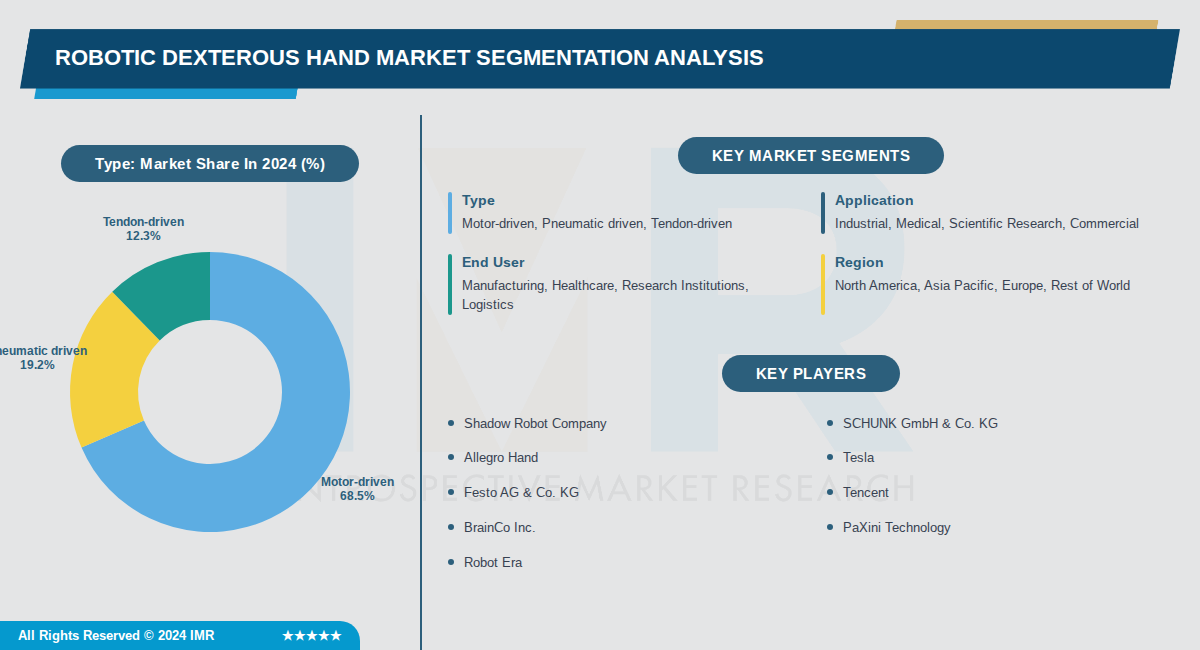
Robotic Dexterous Hand Market is Segmented on the basis of By Type, By Application, By End User
By Type, Motor-driven segment is expected to dominate the market during the forecast period
- Motor-driven hands dominate due to their superior precision and torque control essential for complex manipulation in industrial assembly lines achieving 99.8% grip reliability.
- Advancements in compact servo motors and AI integration have reduced size and weight by 40% since 2020, making them ideal for collaborative robots with deployments growing 62% YoY.
By Application, Industrial segment is expected to dominate the market during the forecast period
- Industrial applications lead as they represent 41% market share driven by automotive sector needs for handling diverse components from wiring to engine parts with cycle times under 0.8 seconds.
- Cobots equipped with dexterous hands deliver 15-20% production efficiency gains, fueling adoption in precision manufacturing hubs like Germany and Japan.
By End User, Manufacturing segment is expected to dominate the market during the forecast period
- Manufacturing dominates due to rising automation demands in electronics, automotive, and assembly lines where dexterous hands handle complex shapes boosting throughput by 20%.
- Asia-Pacific manufacturing hubs like China and South Korea contribute over 50% of global deployments supported by government subsidies and robotics ecosystems.
By Region, North America segment is expected to dominate the market during the forecast period
- North America leads with substantial R&D investments from DARPA and companies like Tesla Optimus driving innovations in industrial and medical robotics.
- The region hosts key players like Shadow Robot enabling rapid prototyping and commercialization in high-value sectors like aerospace and prosthetics.
Robotic Dexterous Hand Market Regional Insights:
North America is Expected to Dominate the Market Over the Forecast Period
- North America dominates the Robotic Dexterous Hand Market due to advanced manufacturing hubs in the United States and Canada, which lead development efforts supported by robust R&D ecosystems. These countries host a high concentration of early adopters in sectors like automotive assembly, electronics production, and logistics automation. Government-led initiatives to reshore critical industries further stimulate investment in domestic robotic capabilities.
- The region benefits from strong infrastructure, including high-tech facilities and supply chain agility, enhanced by policy interventions like tariff revisions that encourage localized production. Favorable regulations and a focus on innovation position North America as a strategic nucleus for dexterous hand technology adoption. This environment mitigates logistical challenges and supports rapid integration into high-value industries.
- Major players and developments are concentrated here, with the U.S. and Canada driving cutting-edge R&D and commercialization. Leading companies form strategic alliances for technological differentiation, while domestic OEMs optimize production amid global shifts. Recent reshoring efforts and investments underscore North America's leadership in market innovation and growth.
Active Key Players in the Robotic Dexterous Hand Market:
- Shadow Robot Company (UK)
- SCHUNK GmbH & Co. KG (Germany)
- Allegro Hand (South Korea)
- Tesla (USA)
- Festo AG & Co. KG (Germany)
- Tencent (China)
- BrainCo Inc. (China)
- PaXini Technology (China)
- Robot Era (China)
- Seed Robotics (Italy)
- Inspire Robots (China)
- Agile Robots (China)
- Jodell Robotics (China)
- Dorabot (China)
- Linkerbot (China)
- Barrett Technology, LLC (USA)
- Kinova Inc. (Canada)
- RightHand Robotics, Inc. (USA)
- Robotiq Inc. (Canada)
- OnRobot A/S (Denmark)
- Other Active Players
|
Robotic Dexterous Hand Market |
|||
|
Base Year: |
2024 |
Forecast Period: |
2024-2035 |
|
Historical Data: |
2017 to 2024 |
Market Size in 2024: |
USD 1.0 Billion |
|
Forecast Period 2024-2035 CAGR: |
16.0 % |
Market Size in 2035: |
USD 3.0 Billion |
|
Segments Covered: |
By Type |
|
|
|
By Application |
|
||
|
By End User |
|
||
|
By Region |
|
||
|
By Region |
|
||
|
Key Market Drivers: |
|
||
|
Key Market Restraints: |
|
||
|
Key Opportunities: |
|
||
|
Companies Covered in the report: |
|
||
Chapter 1: Introduction
1.1 Scope and Coverage
Chapter 2: Executive Summary
Chapter 3: Market Landscape
3.1 Market Dynamics and Opportunity Analysis
3.1.1 Growth Drivers
3.1.2 Limiting Factors
3.1.3 Growth Opportunities
3.1.4 Challenges and Risks
3.2 Market Trend Analysis
3.3 Industry Ecosystem
3.4 Industry Value Chain Mapping
3.5 Strategic PESTLE Overview
3.6 Porter's Five Forces Framework
3.7 Regulatory Framework
3.8 Pricing Trend Analysis
3.9 Intellectual Property Review
3.10 Technology Evolution
3.11 Import-Export Analysis
3.12 Consumer Behavior Analysis
3.13 Investment Pocket Analysis
3.14 Go-To Market Strategy
Chapter 4: Robotic Dexterous Hand Market by Type (2017-2035)
4.1 Robotic Dexterous Hand Market Snapshot and Growth Engine
4.2 Market Overview
4.3 Motor-driven
4.3.1 Introduction and Market Overview
4.3.2 Historic and Forecasted Market Size in Value USD and Volume Units
4.3.3 Key Market Trends, Growth Factors, and Opportunities
4.3.4 Geographic Segmentation Analysis
4.4 Pneumatic driven
4.5 Tendon-driven
Chapter 5: Robotic Dexterous Hand Market by Application (2017-2035)
5.1 Robotic Dexterous Hand Market Snapshot and Growth Engine
5.2 Market Overview
5.3 Industrial
5.3.1 Introduction and Market Overview
5.3.2 Historic and Forecasted Market Size in Value USD and Volume Units
5.3.3 Key Market Trends, Growth Factors, and Opportunities
5.3.4 Geographic Segmentation Analysis
5.4 Medical
5.5 Scientific Research
5.6 Commercial
Chapter 6: Robotic Dexterous Hand Market by End User (2017-2035)
6.1 Robotic Dexterous Hand Market Snapshot and Growth Engine
6.2 Market Overview
6.3 Manufacturing
6.3.1 Introduction and Market Overview
6.3.2 Historic and Forecasted Market Size in Value USD and Volume Units
6.3.3 Key Market Trends, Growth Factors, and Opportunities
6.3.4 Geographic Segmentation Analysis
6.4 Healthcare
6.5 Research Institutions
6.6 Logistics
Chapter 7: Robotic Dexterous Hand Market by Region (2017-2035)
7.1 Robotic Dexterous Hand Market Snapshot and Growth Engine
7.2 Market Overview
7.3 North America
7.3.1 Introduction and Market Overview
7.3.2 Historic and Forecasted Market Size in Value USD and Volume Units
7.3.3 Key Market Trends, Growth Factors, and Opportunities
7.3.4 Geographic Segmentation Analysis
7.4 Asia Pacific
7.5 Europe
7.6 Rest of World
Chapter 8: Company Profiles and Competitive Analysis
8.1 Competitive Landscape
8.1.1 Competitive Benchmarking
8.1.2 Robotic Dexterous Hand Market Share by Manufacturer/Service Provider (2024)
8.1.3 Industry BCG Matrix
8.1.4 Partnerships, Mergers & Acquisitions
8.2 SHADOW ROBOT COMPANY
8.2.1 Company Overview
8.2.2 Key Executives
8.2.3 Company Snapshot
8.2.4 Role of the Company in the Market
8.2.5 Sustainability and Social Responsibility
8.2.6 Operating Business Segments
8.2.7 Product Portfolio
8.2.8 Business Performance
8.2.9 Recent News & Developments
8.2.10 SWOT Analysis
8.3 SCHUNK GMBH & CO. KG
8.4 ALLEGRO HAND
8.5 TESLA
8.6 FESTO AG & CO. KG
8.7 TENCENT
8.8 BRAINCO INC.
8.9 PAXINI TECHNOLOGY
8.10 ROBOT ERA
8.11 SEED ROBOTICS
8.12 INSPIRE ROBOTS
8.13 AGILE ROBOTS
8.14 JODELL ROBOTICS
8.15 DORABOT
8.16 LINKERBOT
8.17 BARRETT TECHNOLOGY
8.18 LLC
8.19 KINOVA INC.
8.20 RIGHTHAND ROBOTICS
8.21 INC.
8.22 ROBOTIQ INC.
8.23 ONROBOT A/S
Chapter 9: Global Robotic Dexterous Hand Market By Region
9.1 Overview
9.2. North America Robotic Dexterous Hand Market
9.2.1 Key Market Trends, Growth Factors and Opportunities
9.2.2 Top Key Companies
9.2.3 Historic and Forecasted Market Size by Segments
9.2.4 Historic and Forecast Market Size by Country
9.3. Eastern Europe Robotic Dexterous Hand Market
9.3.1 Key Market Trends, Growth Factors and Opportunities
9.3.2 Top Key Companies
9.3.3 Historic and Forecasted Market Size by Segments
9.3.4 Historic and Forecast Market Size by Country
9.4. Western Europe Robotic Dexterous Hand Market
9.4.1 Key Market Trends, Growth Factors and Opportunities
9.4.2 Top Key Companies
9.4.3 Historic and Forecasted Market Size by Segments
9.4.4 Historic and Forecast Market Size by Country
9.5. Asia Pacific Robotic Dexterous Hand Market
9.5.1 Key Market Trends, Growth Factors and Opportunities
9.5.2 Top Key Companies
9.5.3 Historic and Forecasted Market Size by Segments
9.5.4 Historic and Forecast Market Size by Country
9.6. Middle East & Africa Robotic Dexterous Hand Market
9.6.1 Key Market Trends, Growth Factors and Opportunities
9.6.2 Top Key Companies
9.6.3 Historic and Forecasted Market Size by Segments
9.6.4 Historic and Forecast Market Size by Country
9.7. South America Robotic Dexterous Hand Market
9.7.1 Key Market Trends, Growth Factors and Opportunities
9.7.2 Top Key Companies
9.7.3 Historic and Forecasted Market Size by Segments
9.7.4 Historic and Forecast Market Size by Country
Chapter 10: Analyst Viewpoint and Conclusion
Chapter 11: Research Methodology
11.1 Research Process
11.2 Primary Research
11.3 Secondary Research
Chapter 12: Case Study
Chapter 13: Appendix
13.1 Sources
13.2 List of Tables and Figures
13.3 Short Forms and Citations
13.4 Assumption and Conversion
13.5 Disclaimer
|
Robotic Dexterous Hand Market |
|||
|
Base Year: |
2024 |
Forecast Period: |
2024-2035 |
|
Historical Data: |
2017 to 2024 |
Market Size in 2024: |
USD 1.0 Billion |
|
Forecast Period 2024-2035 CAGR: |
16.0 % |
Market Size in 2035: |
USD 3.0 Billion |
|
Segments Covered: |
By Type |
|
|
|
By Application |
|
||
|
By End User |
|
||
|
By Region |
|
||
|
By Region |
|
||
|
Key Market Drivers: |
|
||
|
Key Market Restraints: |
|
||
|
Key Opportunities: |
|
||
|
Companies Covered in the report: |
|
||