




Key Market Highlights
Biobanking Market Size Was Valued at USD 56.40 Billion in 2024, and is Projected to Reach USD 88.68 Billion by 2035, Growing at a CAGR of 4.2% from 2025-2035.
- Market Size in 2024: USD 56.40 Billion
- Projected Market Size by 2035: USD 88.68 Billion
- CAGR (2025–2035): 4.2%
- Leading Market in 2024: North America
- Fastest-Growing Market: Asia-Pacific
- By Application: The Regenerative Medicine segment is anticipated to lead the market by accounting for 31.7% of the market share throughout the forecast period.
- By End User: The Pharmaceutical & Biotechnology Companies segment is expected to capture 33.4% of the market share, thereby maintaining its dominance over the forecast period.
- By Region: North America region is projected to hold 32.5% of the market share during the forecast period.
- Active Players: Becton, Dickinson, and Company (BD) (United States), Biocision, LLC (United States), Biovault Family (United Kingdom), Brooks Life Sciences (United States), and Other Active Players.
Biobanking Market Synopsis:
The biobanking market encompasses the systematic collection, processing, storage, and distribution of human biological samples, including blood, tissues, cells, DNA, and other biospecimens, to support biomedical research and clinical applications. Biobanks play a critical role in drug discovery, personalized medicine, diagnostics, and regenerative therapies by providing high-quality, well-characterized samples linked with clinical and genomic data. The market is witnessing strong growth driven by rising investments in pharmaceutical R&D, increasing prevalence of chronic and life-threatening diseases, and expanding genomic and precision medicine initiatives. Technological advancements such as automation, digital data integration, and virtual biobanks are enhancing sample integrity, accessibility, and traceability. Growing reliance on biobanks for biomarker discovery, clinical trials, and population health studies underscores their increasing necessity within modern healthcare and life sciences research ecosystems.
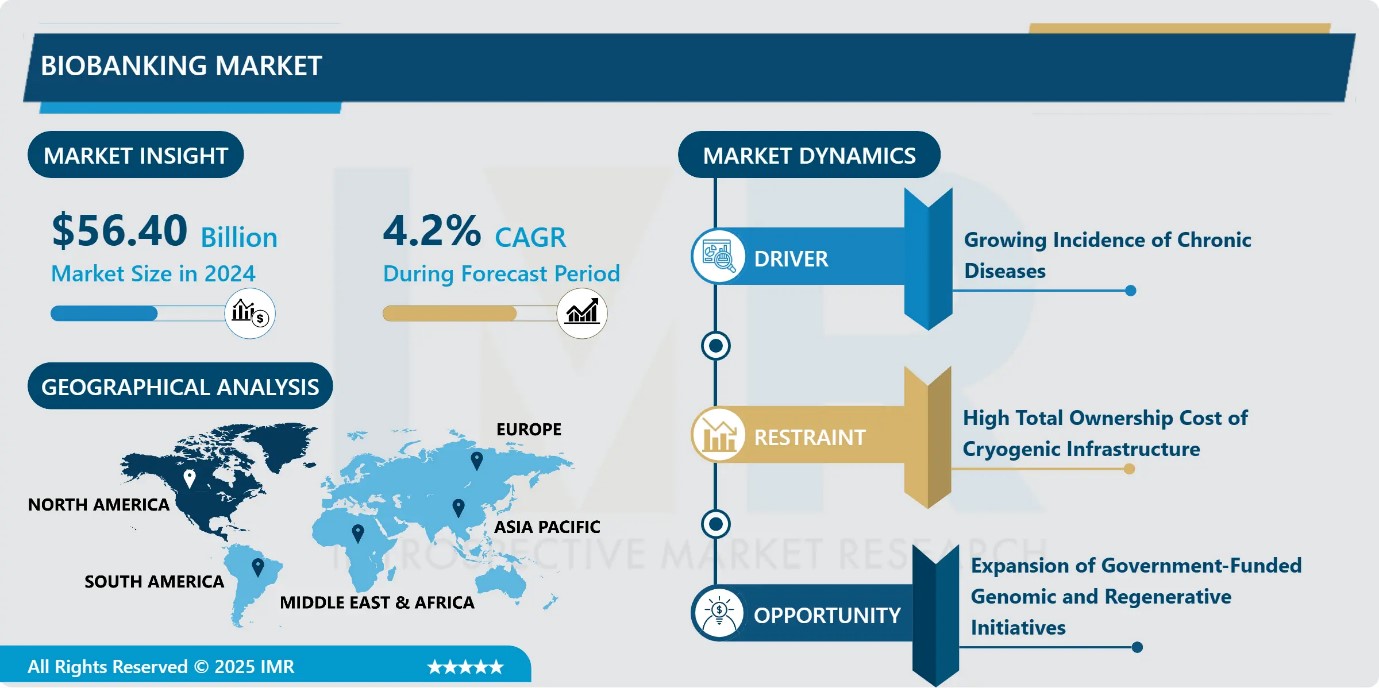
Biobanking Market Dynamics and Trend Analysis:
Biobanking Market Growth Driver
Growing Incidence of Chronic Diseases
- The rising prevalence of chronic and genetic diseases is a key driver accelerating growth in the biobanking market. Increasing clinical reliance on stored biological materials is evident as biobank-linked genetic data is increasingly used to predict patient responses to standard therapies through integration with electronic health records.
- Expanding applications of cord blood in treating inherited disorders, such as thalassemia, highlight the long-term therapeutic value of preserved samples. Advances in transplantation protocols that maximize the use of banked materials are further increasing demand on existing repositories. As chronic disease burdens grow globally, biobanking is steadily evolving from a research-focused model toward a therapy-driven clinical infrastructure.
Biobanking Market Limiting Factor
High Total Ownership Cost of Cryogenic Infrastructure
- The high total cost of ownership associated with cryogenic infrastructure remains a key restraint for the biobanking market. Significant capital investment is required for cryogenic freezers, monitoring and alarm systems, backup power supplies, and temperature-controlled facilities, while liquid nitrogen supply costs can be volatile. Although mechanical storage systems offer long-term operating cost savings, they still demand specialized maintenance and skilled personnel.
- Equipment failures and temperature excursions can result in costly remediation efforts and operational disruptions. In addition, stringent regional regulatory requirements often necessitate localized laboratory facilities, further raising entry barriers. These financial and operational pressures limit expansion, particularly in resource-constrained regions, unevenly impacting global market growth.
Biobanking Market Expansion Opportunity
Expansion of Government-Funded Genomic and Regenerative Initiatives
- The expansion of government-funded genomic and regenerative medicine programs presents a significant growth opportunity for the biobanking market. Large-scale public initiatives are driving the establishment of diverse, longitudinal biospecimen repositories to support population health research and precision medicine. Increased funding enables infrastructure upgrades, including automation, advanced cryogenic storage, and scalable data platforms, to manage rising sample volumes.
- Public–private collaborations are also promoting interoperability standards and expanding biobanks into emerging areas such as microbiome and epigenomic research. Additionally, advancements in regenerative and cell-based therapies are increasing demand for high-quality, clinically compliant samples. Together, sustained public investment and technological innovation are positioning biobanks as integral components of modern healthcare and therapeutic development ecosystems.
Biobanking Market Challenge and Risk
Ethical and Regulatory Hurdles
- Ethical and regulatory complexities pose a significant challenge to the growth of the biobanking market. Stringent requirements related to informed consent, data privacy, and donor protection increase administrative burden and extend operational timelines. Compliance with evolving regulations, such as GDPR in Europe, raises costs and disproportionately impacts smaller biobanks with limited resources. Inconsistent regulatory frameworks across regions further restrict cross-border data and sample sharing, limiting large-scale collaborative research.
- Enhanced scrutiny under regulations governing diagnostics and clinical evidence has added to compliance expenses, while concerns over data breaches may reduce public participation. These challenges necessitate robust governance models to balance ethical safeguards with operational efficiency.
Biobanking Market Trend
Advances in Drug Discovery & Development
- Advancements in drug discovery and development are shaping a major trend in the biobanking market, as pharmaceutical companies increasingly demand large-scale, data-rich biospecimen resources. Modern drug pipelines rely on extensive proteomic, genomic, and cellular datasets generated from well-curated biobank samples. The integration of high-throughput proteomics, real-time cell analysis, and multi-omics profiling is enhancing the depth and usability of biobank assets. Pharmaceutical collaborations are increasingly structured around access to proprietary datasets rather than standalone biological samples. This shift reflects the growing importance of biobanks as strategic partners in therapeutic innovation, positioning them as essential infrastructure for next-generation drug discovery programs.
Biobanking Market Segment Analysis:
Biobanking Market is segmented based on Product Type, Service, Biospecimen Type, Application, End User and Region.
By Application, Regenerative medicine segment is expected to dominate the market with around 31.7% share during the forecast period.
- Regenerative medicine dominates the biobanking market and continues to be the fastest-growing application segment. This leadership is driven by the increasing use of long-term stored biospecimens for cell- and tissue-based therapies, where sample quality and longevity are critical. Drug discovery also contributes significantly, supported by growing collaborations between pharmaceutical companies and biobanks for proteomics and multi-omics research.
- At the same time, disease-surveillance programs are adopting large biospecimen libraries to study and manage outbreak patterns. Successful therapeutic outcomes achieved using decades-old preserved samples further demonstrate the sustained clinical value of biobank repositories, reinforcing regenerative medicine’s dominant role in driving market growth.
By End User, Pharmaceutical and biotechnology companies is expected to dominate with close to 33.4% market share during the forecast period.
- Pharmaceutical and biotechnology companies dominate the biobanking end-user segment and are expected to retain this position due to their central role in drug discovery, biomarker development, and precision medicine. These organizations rely on access to high-quality, well-characterized biospecimens to support genomic studies, companion diagnostics, and targeted therapy development.
- The growing volume of clinical trials and the shift toward personalized treatment approaches are strengthening collaborations between biobanks, academic institutions, and CROs. In addition, biopharma companies increasingly invest in proprietary biorepositories to support translational research, predictive modeling, and regulatory submissions, reinforcing their dominant influence on biobanking demand and market growth.
Biobanking Market Regional Insights:
North America region is estimated to lead the market with around 32.5% share during the forecast period.
- North America dominated the biobanking market in 2024 due to its advanced healthcare and research infrastructure, strong public and private funding, and supportive regulatory frameworks. The region benefits from large-scale genomics and precision medicine initiatives, such as the NIH-funded All of Us research program, which significantly increase demand for high-quality biospecimen storage and data integration.
- In the U.S., sustained investments in cancer, rare disease, and personalized medicine research, along with the presence of leading pharmaceutical companies and research institutions, continue to drive market growth. Early adoption of automated, digital, and high-throughput biobanking solutions further strengthens North America’s dominant market position.
Biobanking Market Active Players:
- Becton, Dickinson, and Company (BD) (United States)
- Biocision, LLC (United States)
- Biovault Family (United Kingdom)
- Brooks Life Sciences (United States)
- Charles River Laboratories (United States)
- Danaher Corporation (United States)
- Hamilton Company (United States)
- Lonza (Switzerland)
- Merck KGaA (Germany)
- Promega Corporation (United States)
- QIAGEN (Netherlands
- Stemcell Technologies (Canada)
- Taylor-Wharton (United States)
- Tecan Trading AG (Switzerland)
- Thermo Fisher Scientific Inc. (United States)
- Other Active Players
Key Industry Developments in the Biobanking Market:
- In May 2025, BD introduced the FACSDiscover A8 Cell Analyzer. The system integrates advanced spectral analysis with real-time cell imaging. It enables profiling of up to 50 single-cell parameters to support enhanced biomarker discovery.
- In April 2025, Thermo Fisher Scientific announced a USD 2 billion investment in U.S. operations. The plan includes USD 1.5 billion for manufacturing expansion and USD 500 million for R&D. This initiative aims to strengthen domestic healthcare innovation and supply-chain resilience.
Automation, Robotics, and High-Throughput Sample Management
- Biobanking involves the standardized collection, processing, storage, and management of biological specimens such as blood, tissues, cells, DNA, RNA, and biofluids, along with associated clinical and genomic data. Technically, biobanks operate through integrated workflows that include sample accessioning, pre-analytical processing, cryogenic preservation, and long-term storage under controlled conditions. Storage technologies range from mechanical ultra-low temperature freezers to liquid nitrogen–based vapor and liquid-phase systems, supported by automated handling, barcode tracking, and laboratory information management systems (LIMS).
- Advanced monitoring solutions ensure temperature stability, chain-of-custody integrity, and regulatory compliance. Increasing adoption of automation, robotics, and digital platforms enables high-throughput sample processing and interoperability across research networks. Modern biobanks also integrate multi-omics data, imaging, and metadata analytics to enhance sample utility. These technical capabilities make biobanks critical infrastructure for drug discovery, precision medicine, regenerative therapies, and population health research.
|
Biobanking Market |
|||
|
Base Year: |
2024 |
Forecast Period: |
2025-2035 |
|
Historical Data: |
2018 to 2023 |
Market Size in 2024: |
USD 56.40 Bn. |
|
Forecast Period 2025-35 CAGR: |
4.2 % |
Market Size in 2035: |
USD 88.68 Bn. |
|
Segments Covered: |
By Product Type |
|
|
|
Service |
|
||
|
Biospecimen Type |
|
||
|
By Application
|
|
||
|
End User |
|
||
|
By Region |
|
||
|
Growth Driver: |
|
||
|
Limiting Factor |
|
||
|
Expansion Opportunity |
|
||
|
Challenge and Risk |
|
||
|
Companies Covered in the Report: |
|
||
Chapter 1: Introduction
1.1 Scope and Coverage
Chapter 2:Executive Summary
Chapter 3: Market Landscape
3.1 Market Dynamics and Opportunity Analysis
3.1.1 Growth Drivers
3.1.2 Limiting Factors
3.1.3 Growth Opportunities
3.1.4 Challenges and Risks
3.2 Market Trend Analysis
3.3 Industry Ecosystem
3.4 Industry Value Chain Mapping
3.5 Strategic PESTLE Overview
3.6 Porter's Five Forces Framework
3.7 Regulatory Framework
3.8 Pricing Trend Analysis
3.9 Intellectual Property Review
3.10 Technology Evolution
3.11 Import-Export Analysis
3.12 Consumer Behavior Analysis
3.13 Investment Pocket Analysis
3.14 Go-To Market Strategy
Chapter 4: Biobanking Market by Product Type (2018-2035)
4.1 Biobanking Market Snapshot and Growth Engine
4.2 Market Overview
4.3 Laboratory Information Management Systems
4.3.1 Introduction and Market Overview
4.3.2 Historic and Forecasted Market Size in Value USD and Volume Units
4.3.3 Key Market Trends, Growth Factors, and Opportunities
4.3.4 Geographic Segmentation Analysis
4.4 Biobanking Equipment
4.5 and Biobanking Consumables
Chapter 5: Biobanking Market by Service Type (2018-2035)
5.1 Biobanking Market Snapshot and Growth Engine
5.2 Market Overview
5.3 Biobanking & Repository
5.3.1 Introduction and Market Overview
5.3.2 Historic and Forecasted Market Size in Value USD and Volume Units
5.3.3 Key Market Trends, Growth Factors, and Opportunities
5.3.4 Geographic Segmentation Analysis
5.4 Qualification & Validation
5.5 Laboratory Processing
5.6 Cold Chain Logistics
5.7 and Others
Chapter 6: Biobanking Market by Biospecimen Type (2018-2035)
6.1 Biobanking Market Snapshot and Growth Engine
6.2 Market Overview
6.3 Stem Cells
6.3.1 Introduction and Market Overview
6.3.2 Historic and Forecasted Market Size in Value USD and Volume Units
6.3.3 Key Market Trends, Growth Factors, and Opportunities
6.3.4 Geographic Segmentation Analysis
6.4 Human Tissues
6.5 and Human Organs
Chapter 7: Biobanking Market by Application (2018-2035)
7.1 Biobanking Market Snapshot and Growth Engine
7.2 Market Overview
7.3 Drug Discovery & Clinical Research
7.3.1 Introduction and Market Overview
7.3.2 Historic and Forecasted Market Size in Value USD and Volume Units
7.3.3 Key Market Trends, Growth Factors, and Opportunities
7.3.4 Geographic Segmentation Analysis
7.4 Therapeutics
7.5 Clinical Diagnostics
7.6 Regenerative Medicine
7.7 and Other Applications
Chapter 8: Biobanking Market by End User (2018-2035)
8.1 Biobanking Market Snapshot and Growth Engine
8.2 Market Overview
8.3 Pharmaceutical & Biotechnology Companies
8.3.1 Introduction and Market Overview
8.3.2 Historic and Forecasted Market Size in Value USD and Volume Units
8.3.3 Key Market Trends, Growth Factors, and Opportunities
8.3.4 Geographic Segmentation Analysis
8.4 Hospitals
8.5 CROs & CMOs
8.6 and Academic & Research Institutes
Chapter 9: Company Profiles and Competitive Analysis
9.1 Competitive Landscape
9.1.1 Competitive Benchmarking
9.1.2 Biobanking Market Share by Manufacturer/Service Provider(2024)
9.1.3 Industry BCG Matrix
9.1.4 PArtnerships, Mergers & Acquisitions
9.2 BECTON
9.2.1 Company Overview
9.2.2 Key Executives
9.2.3 Company Snapshot
9.2.4 Role of the Company in the Market
9.2.5 Sustainability and Social Responsibility
9.2.6 Operating Business Segments
9.2.7 Product Portfolio
9.2.8 Business Performance
9.2.9 Recent News & Developments
9.2.10 SWOT Analysis
9.3 DICKINSON
9.4 AND COMPANY (BD) (UNITED STATES)
9.5 BIOCISION
9.6 LLC (UNITED STATES)
9.7 BIOVAULT FAMILY (UNITED KINGDOM)
9.8 BROOKS LIFE SCIENCES (UNITED STATES)
9.9 CHARLES RIVER LABORATORIES (UNITED STATES)
9.10 DANAHER CORPORATION (UNITED STATES)
9.11 HAMILTON COMPANY (UNITED STATES)
9.12 LONZA (SWITZERLAND)
9.13 MERCK KGAA (GERMANY)
9.14 PROMEGA CORPORATION (UNITED STATES)
9.15 QIAGEN (NETHERLANDS)
9.16 STEMCELL TECHNOLOGIES (CANADA)
9.17 TAYLOR-WHARTON (UNITED STATES)
9.18 TECAN TRADING AG (SWITZERLAND)
9.19 THERMO FISHER SCIENTIFIC INC. (UNITED STATES)
9.20 AND OTHER ACTIVE PLAYERS.
Chapter 10: Global Biobanking Market By Region
10.1 Overview
10.2. North America Biobanking Market
10.2.1 Key Market Trends, Growth Factors and Opportunities
10.2.2 Top Key Companies
10.2.3 Historic and Forecasted Market Size by Segments
10.2.4 Historic and Forecast Market Size by Country
10.2.4.1 US
10.2.4.2 Canada
10.2.4.3 Mexico
10.3. Eastern Europe Biobanking Market
10.3.1 Key Market Trends, Growth Factors and Opportunities
10.3.2 Top Key Companies
10.3.3 Historic and Forecasted Market Size by Segments
10.3.4 Historic and Forecast Market Size by Country
10.3.4.1 Russia
10.3.4.2 Bulgaria
10.3.4.3 The Czech Republic
10.3.4.4 Hungary
10.3.4.5 Poland
10.3.4.6 Romania
10.3.4.7 Rest of Eastern Europe
10.4. Western Europe Biobanking Market
10.4.1 Key Market Trends, Growth Factors and Opportunities
10.4.2 Top Key Companies
10.4.3 Historic and Forecasted Market Size by Segments
10.4.4 Historic and Forecast Market Size by Country
10.4.4.1 Germany
10.4.4.2 UK
10.4.4.3 France
10.4.4.4 The Netherlands
10.4.4.5 Italy
10.4.4.6 Spain
10.4.4.7 Rest of Western Europe
10.5. Asia Pacific Biobanking Market
10.5.1 Key Market Trends, Growth Factors and Opportunities
10.5.2 Top Key Companies
10.5.3 Historic and Forecasted Market Size by Segments
10.5.4 Historic and Forecast Market Size by Country
10.5.4.1 China
10.5.4.2 India
10.5.4.3 Japan
10.5.4.4 South Korea
10.5.4.5 Malaysia
10.5.4.6 Thailand
10.5.4.7 Vietnam
10.5.4.8 The Philippines
10.5.4.9 Australia
10.5.4.10 New Zealand
10.5.4.11 Rest of APAC
10.6. Middle East & Africa Biobanking Market
10.6.1 Key Market Trends, Growth Factors and Opportunities
10.6.2 Top Key Companies
10.6.3 Historic and Forecasted Market Size by Segments
10.6.4 Historic and Forecast Market Size by Country
10.6.4.1 Turkiye
10.6.4.2 Bahrain
10.6.4.3 Kuwait
10.6.4.4 Saudi Arabia
10.6.4.5 Qatar
10.6.4.6 UAE
10.6.4.7 Israel
10.6.4.8 South Africa
10.7. South America Biobanking Market
10.7.1 Key Market Trends, Growth Factors and Opportunities
10.7.2 Top Key Companies
10.7.3 Historic and Forecasted Market Size by Segments
10.7.4 Historic and Forecast Market Size by Country
10.7.4.1 Brazil
10.7.4.2 Argentina
10.7.4.3 Rest of SA
Chapter 11 Analyst Viewpoint and Conclusion
Chapter 12 Our Thematic Research Methodology
12.1 Research Process
12.2 Primary Research
12.3 Secondary Research
Chapter 13 Case Study
Chapter 14 Appendix
14.1 Sources
14.2 List of Tables and figures
14.3 Short Forms and Citations
14.4 Assumption and Conversion
14.5 Disclaimer
|
Biobanking Market |
|||
|
Base Year: |
2024 |
Forecast Period: |
2025-2035 |
|
Historical Data: |
2018 to 2023 |
Market Size in 2024: |
USD 56.40 Bn. |
|
Forecast Period 2025-35 CAGR: |
4.2 % |
Market Size in 2035: |
USD 88.68 Bn. |
|
Segments Covered: |
By Product Type |
|
|
|
Service |
|
||
|
Biospecimen Type |
|
||
|
By Application
|
|
||
|
End User |
|
||
|
By Region |
|
||
|
Growth Driver: |
|
||
|
Limiting Factor |
|
||
|
Expansion Opportunity |
|
||
|
Challenge and Risk |
|
||
|
Companies Covered in the Report: |
|
||


