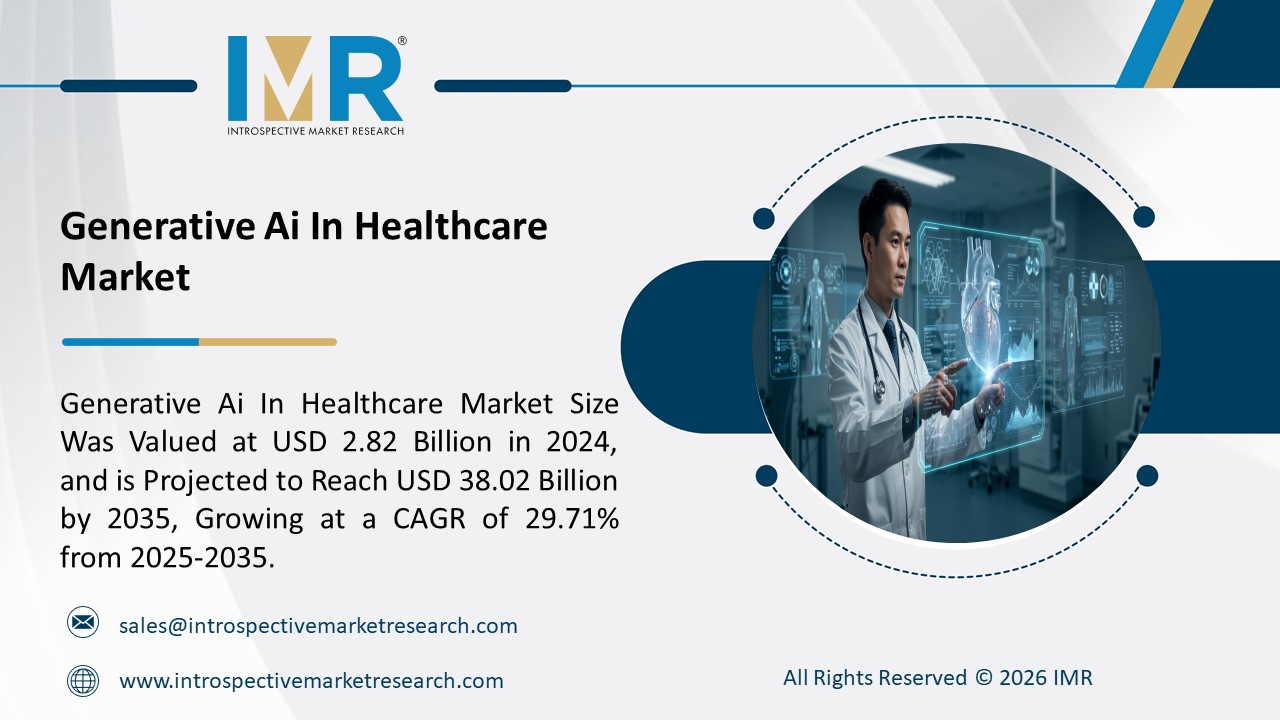
According to a new report published by Introspective Market Research, titled, “Generative AI in Healthcare Market by Component, Application, and End User,” The Global Generative AI in Healthcare Market Size Was Valued at USD 2.82 Billion in 2024 and is Projected to Reach USD 38.02 Billion by 2035, Growing at a CAGR of 29.71%.
The generative AI in healthcare market involves the application of artificial intelligence models, such as large language models (LLMs) and diffusion models, capable of creating new data, content, and solutions. Unlike traditional AI focused on analysis, generative AI produces novel outputs like synthetic patient data, drug molecule designs, personalized treatment plans, and AI-generated medical imagery. Its core advantage lies in its ability to accelerate innovation, automate complex creative tasks, and unlock insights from vast datasets in ways traditional analytics cannot, leading to breakthroughs in research, personalized care, and operational efficiency.
The paramount growth driver for generative AI in healthcare is the critical and urgent need to accelerate drug discovery and development while simultaneously reducing its exorbitant costs and high failure rates. The traditional R&D pipeline is notoriously slow and expensive. Generative AI addresses this by rapidly designing and screening millions of novel molecular compounds with desired properties, predicting their efficacy and safety profiles in silico, and even generating synthetic biological data for preclinical research. This capability not only slashes years off development timelines but also opens avenues for discovering treatments for complex diseases previously considered undruggable, compelling massive investment from pharmaceutical giants and biotech startups alike.
A monumental market opportunity lies in the automation and augmentation of clinical workflows and administrative tasks to address widespread clinician burnout and operational inefficiencies. Generative AI can revolutionize this space by autonomously drafting clinical notes from doctor-patient conversations, generating personalized patient education materials, automating prior authorization and coding, and providing AI-assisted diagnostic support. Developing secure, compliant, and highly accurate models that integrate seamlessly with existing Electronic Health Record (EHR) systems to act as a co-pilot for healthcare providers presents a vast, addressable market. Successfully deploying these tools can free up clinician time for direct patient care, reduce administrative burden, and significantly improve healthcare delivery economics.
Generative AI in Healthcare Market, Segmentation
The Generative AI in Healthcare Market is segmented on the basis of Component, Application, and End User.
Application
The Application segment is further classified into Medical Imaging & Diagnostics, Drug Discovery & Development, Patient Care & Management, Medical Research, and Others. Among these, the Drug Discovery & Development sub-segment accounted for the highest market share in 2024. This dominance is due to the exceptionally high value and clear ROI that generative AI delivers in this domain. The ability to generate novel drug candidates, predict clinical trial outcomes, and optimize molecular structures offers a direct path to multi-billion dollar revenue opportunities for pharma companies, driving concentrated and substantial investment in generative AI platforms and partnerships within this application.
End User
The End User segment is further classified into Pharmaceutical & Biotechnology Companies, Hospitals & Diagnostic Centers, Academic & Research Institutes, and Others. Among these, the Pharmaceutical & Biotechnology Companies sub-segment accounted for the highest market share in 2024. These entities are the earliest and most prolific adopters, leveraging generative AI’s potential to gain a decisive competitive edge in R&D. Their substantial financial resources allow for significant investment in proprietary AI platforms, partnerships with AI-native firms, and in-house talent acquisition, positioning them as the primary revenue generators and innovation drivers in the current market landscape.
Some of The Leading/Active Market Players Are-
- NVIDIA Corporation (USA)
- Microsoft Corporation (USA)
- Google (Alphabet Inc.) (USA)
- IBM Corporation (USA)
- Amazon Web Services, Inc. (USA)
- Insilico Medicine (Hong Kong)
- Exscientia plc (UK)
- Recursion Pharmaceuticals, Inc. (USA)
- Atomwise, Inc. (USA)
- BenevolentAI (UK)
- Owkin, Inc. (USA)
- PathAI, Inc. (USA)
- Tempus Labs, Inc. (USA)
- GE HealthCare Technologies Inc. (USA)
- Siemens Healthineers AG (Germany)
and other active players.
Key Industry Developments
In March 2024, NVIDIA launched NVIDIA BioNeMo, a generative AI platform specifically for drug discovery, offering cloud APIs to help biotech companies train and deploy AI models for generating molecular structures and predicting protein interactions.
This move by a leading hardware and software provider to offer a specialized, accessible platform underscores the commoditization of foundational generative AI tools for healthcare, lowering the barrier to entry and accelerating industry-wide adoption in life sciences R&D.
In February 2024, Microsoft and Nuance Communications (a Microsoft company) expanded the deployment of their DAX Copilot ambient clinical documentation tool to thousands of additional healthcare providers, using generative AI to automatically draft clinical notes from patient visits.
This large-scale rollout highlights the rapid transition of generative AI from experimental pilots to real-world clinical implementation, directly targeting the multi-billion dollar problem of clinician documentation burden and administrative overhead in care delivery.
Key Findings of the Study
- Drug Discovery & Development is the dominant and highest-value application segment.
- Pharmaceutical & Biotechnology Companies are the leading end-user investors.
- Explosive growth is driven by the need to reduce drug development costs and timelines and alleviate clinical administrative burdens.
- North America holds the commanding market share, with significant activity in Europe and Asia-Pacific.
- Key trends include the rise of specialized foundation models for biology and the integration of AI co-pilots into clinical workflows.