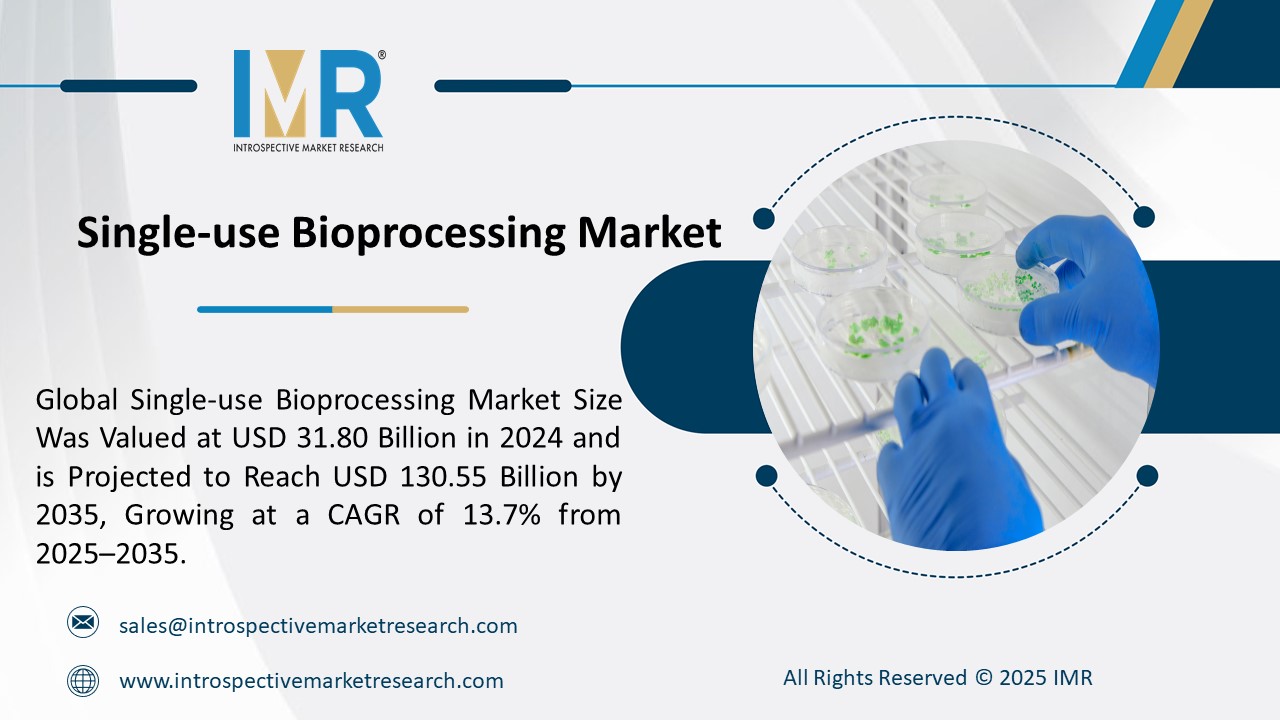
“According to a new report published by Introspective Market Research, titled, Single-use Bioprocessing Market by Product Type, Application, and End User, The Global Single-use Bioprocessing Market Size Was Valued at USD 31.80 Billion in 2024 and is Projected to Reach USD 130.55 Billion by 2035, Growing at a CAGR of 13.7% from 2025–2035.”
The single-use bioprocessing market is witnessing robust growth as biopharmaceutical manufacturers increasingly adopt disposable technologies across upstream and downstream processes. Single-use bioprocessing systems include bioreactors, bags, mixers, filtration assemblies, and connectors that are designed for one-time use, eliminating the need for cleaning, sterilization, and validation. These systems significantly reduce the risk of cross-contamination, shorten turnaround times, and lower operational costs compared to traditional stainless-steel equipment.
Single-use technologies offer flexibility and scalability, making them particularly suitable for multiproduct facilities and small-batch production. Their modular nature enables faster facility setup and easier capacity expansion, supporting rapid clinical development and commercialization of biologics. Additionally, reduced water and energy consumption aligns with sustainability goals, further accelerating adoption across the bioprocessing industry.
The market is primarily driven by rising biologics production, including monoclonal antibodies, vaccines, cell and gene therapies, and recombinant proteins. Major end users such as biopharmaceutical companies, contract manufacturing organizations (CMOs), and research institutes are increasingly integrating single-use systems to enhance efficiency, reduce capital expenditure, and improve process agility.
Market Segmentation
The Single-use Bioprocessing Market is segmented into Product Type, Application, and End User.
- By Product Type, the market is categorized into single-use bioreactors, single-use bags, single-use mixers, filtration systems, and other disposable components.
- By Application, the market is categorized into upstream bioprocessing, downstream bioprocessing, and process development.
- By End User, the market is categorized into biopharmaceutical manufacturers, contract research and manufacturing organizations (CROs/CMOs), and academic & research institutes.
Growth Driver
The primary growth driver of the single-use bioprocessing market is the rapid expansion of the global biopharmaceutical industry. Increasing demand for biologics, biosimilars, and advanced therapies such as cell and gene therapies has intensified the need for flexible and contamination-free manufacturing solutions. Single-use systems enable faster changeovers and support multi-product manufacturing, which is critical in today’s dynamic drug development environment. Moreover, reduced capital investment and lower facility operating costs make these technologies highly attractive for both established manufacturers and emerging biotech companies, fueling sustained market growth.
Market Opportunity
A key market opportunity lies in the growing adoption of single-use bioprocessing in emerging economies and for large-scale commercial manufacturing. Advancements in material science and film technologies are improving the durability and performance of disposable systems, making them suitable for higher-volume production. Additionally, increasing outsourcing of biomanufacturing to CMOs creates significant demand for standardized, scalable, and rapidly deployable single-use solutions. As regulatory frameworks continue to support innovation in biologics manufacturing, manufacturers investing in next-generation single-use platforms are expected to gain a competitive edge.
Detailed Segmentation
Single-use Bioprocessing Market, Segmentation
The Single-use Bioprocessing Market is segmented on the basis of Product Type, Application, and End User.
Product Type
The Product Type segment is further classified into single-use bioreactors, single-use bags, and single-use mixers. Among these, the single-use bioreactors sub-segment accounted for the highest market share in 2024. Single-use bioreactors are widely used in upstream processing due to their scalability, ease of integration, and reduced contamination risk. Their ability to support mammalian and microbial cell cultures makes them essential in biologics manufacturing, driving strong demand across both clinical and commercial production facilities.
Application
The Application segment is further classified into upstream bioprocessing, downstream bioprocessing, and process development. Among these, the upstream bioprocessing sub-segment accounted for the highest market share in 2024. Upstream processes such as cell culture and fermentation benefit significantly from single-use systems, as they offer operational flexibility, faster setup times, and improved process control. The increasing focus on biologics and cell-based therapies continues to propel the adoption of single-use technologies in upstream applications.
Some of The Leading/Active Market Players Are –
• Thermo Fisher Scientific (USA)
• Danaher Corporation (USA)
• Sartorius AG (Germany)
• Merck KGaA (Germany)
• Lonza Group (Switzerland)
• Avantor Inc. (USA)
• Corning Incorporated (USA)
• Saint-Gobain (France)
• Eppendorf AG (Germany)
• Getinge AB (Sweden)
…and other active players.
Key Industry Developments
In March 2024, a leading bioprocessing solutions provider announced the expansion of its single-use bioreactor portfolio to support larger production volumes.
The development focused on enhancing scalability and process control, enabling biopharmaceutical manufacturers to transition single-use systems from clinical to commercial-scale manufacturing while maintaining regulatory compliance.
In September 2024, a major life sciences company introduced advanced single-use mixing and filtration technologies.
These innovations were designed to improve process efficiency and reduce material waste, supporting sustainable manufacturing practices and addressing the growing demand for high-performance disposable bioprocessing solutions.
Key Findings of the Study
• Single-use bioreactors dominate the product segment due to high adoption in upstream processing
• North America leads the market, driven by strong biopharmaceutical manufacturing presence
• Rapid growth in biologics and cell & gene therapies is a key driver
• Technological advancements are expanding single-use applications in large-scale production