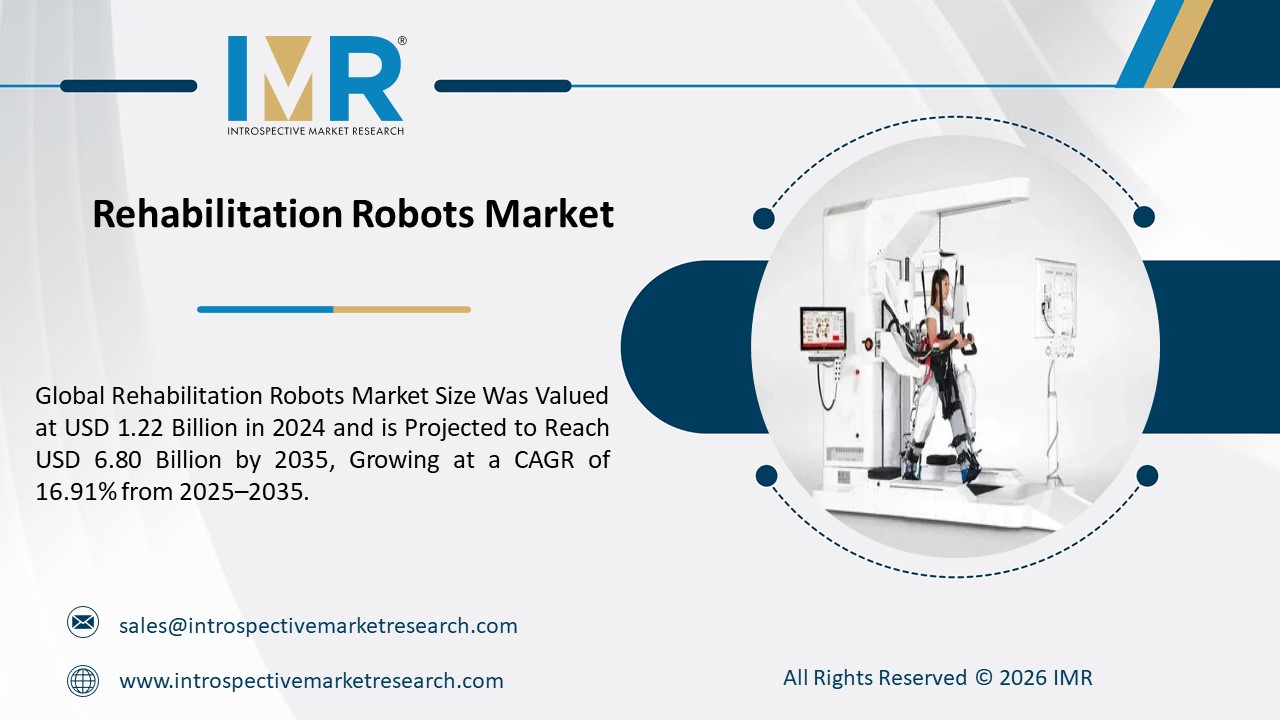
“According to a new report published by Introspective Market Research, titled, Rehabilitation Robots Market by Product Type, Application, and End User, The Global Rehabilitation Robots Market Size Was Valued at USD 1.22 Billion in 2024 and is Projected to Reach USD 6.80 Billion by 2035, Growing at a CAGR of 16.91% from 2025–2035.”
The Rehabilitation Robots Market is gaining strong momentum as healthcare systems worldwide increasingly adopt advanced robotic technologies to improve patient recovery outcomes. Rehabilitation robots are designed to assist patients with physical impairments by enabling repetitive, precise, and controlled therapeutic movements, particularly for individuals recovering from neurological disorders, musculoskeletal injuries, or post-surgical conditions. These systems enhance therapy efficiency while reducing the physical burden on healthcare professionals.
Compared to traditional rehabilitation methods, robotic rehabilitation solutions offer higher accuracy, data-driven progress tracking, and personalized therapy programs. They allow consistent therapy sessions, which are critical for neuroplasticity and motor recovery, especially in stroke and spinal cord injury patients. Integration with AI, sensors, and real-time feedback systems further improves clinical effectiveness.
Rehabilitation robots are widely used across hospitals, rehabilitation centers, and increasingly in home-care settings. Their application spans upper-limb rehabilitation, lower-limb therapy, gait training, and exoskeleton-assisted mobility, making them a transformative solution in modern rehabilitative care.
Market Segmentation
The Rehabilitation Robots Market is segmented into Product Type, Application, and End User. By Product Type, the market is categorized into Exoskeletons, Therapeutic Robots, and Assistive Robots. By Application, the market is categorized into Stroke Rehabilitation, Orthopedic Rehabilitation, Neurological Rehabilitation, and Others. By End User, the market is categorized into Hospitals, Rehabilitation Centers, Home Care Settings, and Others.
Growth Driver
One of the primary growth drivers of the Rehabilitation Robots Market is the rising prevalence of neurological and musculoskeletal disorders globally. Conditions such as stroke, Parkinson’s disease, spinal cord injuries, and age-related mobility impairments are increasing due to aging populations and sedentary lifestyles. Rehabilitation robots enable intensive, repetitive therapy essential for functional recovery, improving patient outcomes and reducing long-term disability. Additionally, the shortage of skilled rehabilitation professionals is accelerating the adoption of robotic systems that can deliver consistent therapy while optimizing clinical resources.
Market Opportunity
A major market opportunity lies in the expanding adoption of rehabilitation robots in home-care and outpatient settings. Technological advancements have led to compact, user-friendly, and cost-effective robotic systems suitable for home use. This shift supports long-term rehabilitation, reduces hospital stays, and lowers overall healthcare costs. Furthermore, increasing investments in AI-enabled and wearable robotic solutions, along with favorable reimbursement initiatives in developed markets, are expected to create lucrative growth opportunities for manufacturers during the forecast period.
Detailed Segmentation
Rehabilitation Robots Market, Segmentation
The Rehabilitation Robots Market is segmented on the basis of Product Type, Application, and End User.
Product Type
The Product Type segment is further classified into Exoskeletons, Therapeutic Robots, and Assistive Robots. Among these, the Exoskeletons sub-segment accounted for the highest market share in 2024. Exoskeletons are widely adopted for gait training and mobility restoration in patients with spinal cord injuries and stroke. Their ability to support weight-bearing movement, improve walking efficiency, and enhance patient independence has driven strong demand across hospitals and rehabilitation centers.
Application
The Application segment is further classified into Stroke Rehabilitation, Orthopedic Rehabilitation, and Neurological Rehabilitation. Among these, the Stroke Rehabilitation sub-segment accounted for the highest market share in 2024. Stroke remains one of the leading causes of long-term disability worldwide, and robotic rehabilitation systems play a critical role in restoring motor function. These robots enable repetitive upper- and lower-limb therapy, accelerating recovery and improving patient engagement through interactive training programs.
Some of The Leading/Active Market Players Are –
• Hocoma AG (Switzerland)
• Ekso Bionics Holdings Inc. (USA)
• ReWalk Robotics Ltd. (Israel)
• Bionik Laboratories Corp. (Canada)
• Cyberdyne Inc. (Japan)
• Fourier Intelligence (China)
• Rex Bionics Ltd. (New Zealand)
• Kinova Inc. (Canada)
• DIH Medical (China)
• Ottobock SE & Co. KGaA (Germany)
• Medtronic plc (Ireland)
• Yaskawa Electric Corporation (Japan)
• AlterG Inc. (USA)
• Honda Motor Co., Ltd. (Japan)
…and other active players.
Key Industry Developments
In March 2024, a leading rehabilitation robotics manufacturer launched an AI-powered exoskeleton designed for personalized gait training.
The system integrates real-time motion analysis and adaptive assistance, allowing therapists to tailor rehabilitation programs based on individual patient progress, significantly improving therapy efficiency and outcomes.
In September 2024, a major healthcare robotics company partnered with rehabilitation centers across Europe to expand access to robotic therapy solutions.
The collaboration focuses on deploying advanced rehabilitation robots in outpatient and home-care settings, supporting long-term recovery and reducing the burden on clinical facilities.
Key Findings of the Study
• Exoskeletons and stroke rehabilitation segments dominate the market
• North America holds the leading regional share, followed by Europe
• Rising neurological disorders are a key growth driver
• Home-based robotic rehabilitation is an emerging trend