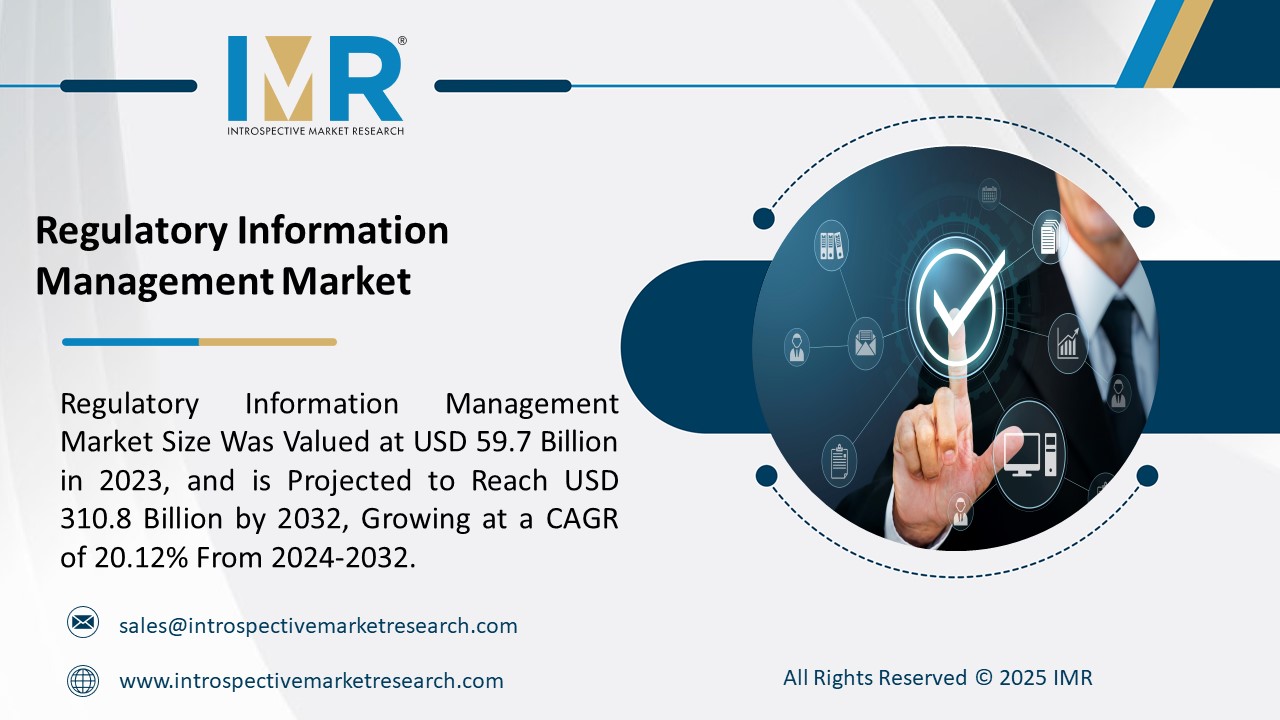
According to a new report published by Introspective Market Research, titled, Regulatory Information Management Market by Component, Deployment Mode, and End User,” The Global Regulatory Information Management Market Size Was Valued at USD 59.7 Billion in 2023 and is Projected to Reach USD 310.8 Billion by 2032, Growing at a CAGR of 20.12%. The Regulatory Information Management (RIM) Market is witnessing rapid growth, driven by increasing demand for streamlined regulatory processes across industries such as pharmaceuticals, biotechnology, medical devices, chemicals, and food & beverages. RIM solutions provide companies with centralized platforms to manage product registration, compliance documentation, labeling requirements, and regulatory submissions in multiple markets worldwide.
Compared to traditional manual methods, RIM systems reduce compliance risks, enhance operational efficiency, and support faster product approvals. With global regulatory frameworks becoming more complex, organizations are prioritizing digital regulatory systems to minimize compliance errors and accelerate time-to-market.
Furthermore, the integration of advanced technologies such as AI, cloud computing, and automation into RIM platforms is reshaping compliance management. These systems not only ensure adherence to ever-changing regulations but also provide predictive analytics to anticipate risks, optimize decision-making, and enhance transparency across global operations.
One of the key growth drivers for the market is the rising complexity of global regulatory requirements. With stringent compliance frameworks such as FDA (U.S.), EMA (Europe), and CDSCO (India), companies across industries are increasingly adopting RIM solutions to ensure product safety, streamline submissions, and achieve faster approvals. The need for operational efficiency, coupled with reduced risk of regulatory non-compliance penalties, continues to fuel demand for advanced RIM platforms worldwide.
The growing adoption of cloud-based RIM solutions presents a major market opportunity. Cloud deployment models enable organizations to scale operations, access real-time compliance data, and manage submissions globally at lower costs. As companies expand into multiple markets, cloud-enabled RIM systems facilitate centralized management of regulatory activities while supporting collaboration across stakeholders, thereby driving future market growth.
Regulatory Information Management Market, Segmentation
Component
- The Component segment is further classified into Software, Services, and Others. Among these, the Software sub-segment accounted for the highest market share in 2023. Software solutions dominate the market due to their ability to automate regulatory workflows, streamline submissions, and ensure compliance with multiple jurisdictional requirements. Increasing reliance on digital systems for labeling, data tracking, and submission management has strengthened the adoption of RIM software globally. The integration of AI and automation further enhances accuracy and reduces manual effort, making software the most preferred solution across industries.
Deployment Mode
- The Deployment Mode segment is further classified into On-Premises, Cloud-Based, and Hybrid. Among these, the Cloud-Based sub-segment accounted for the highest market share in 2023. Cloud-based platforms are increasingly preferred due to their scalability, cost-effectiveness, and ability to provide real-time access to compliance data across regions. Organizations with global operations benefit from centralized cloud solutions that streamline document management and regulatory submissions. Furthermore, the growing adoption of Software-as-a-Service (SaaS) models supports enhanced collaboration and security while significantly reducing infrastructure costs.
Some of The Leading/Active Market Players Are-
-
Veeva Systems (United States)
- Deloitte (United States)
- Infosys Limited (India)
- DXC Technology (United States)
- Amplexor (Luxembourg)
- ArisGlobal (United States)
- Wipro Limited (India)
- Oracle Corporation (United States)
- MasterControl Inc. (United States)
- Ennov (France)
- DDi (India)
- NAVEX Global (United States)
- Sparta Systems (United States)
- Parexel International (United States)
- NNIT (Denmark)
Key Industry Developments
- In March 2024, Veeva Systems launched an AI-powered regulatory management suite designed to automate submission readiness and improve compliance timelines.
This development highlights the increasing integration of artificial intelligence into RIM platforms. By leveraging AI, the system enables predictive analysis, automated document classification, and faster compliance review, ultimately helping pharmaceutical and biotech firms accelerate regulatory submissions while reducing manual errors. - In July 2024, ArisGlobal announced the expansion of its LifeSphere® Regulatory platform with enhanced cloud capabilities for global enterprises.
This upgrade enables multinational companies to manage regulatory submissions in real time across multiple geographies. The expanded features support collaboration, track compliance metrics, and provide scalable cloud solutions tailored for life sciences organizations, strengthening ArisGlobal’s market position.
Key Findings of the Study
-
Software dominated the market in 2023 due to automation and workflow management capabilities.
- Cloud-based RIM solutions emerged as the leading deployment mode for scalability and cost-effectiveness.
- Pharmaceuticals and biotech firms remain the largest end users of RIM platforms.
- AI integration and automation are major trends shaping the future of regulatory compliance.
- North America leads the market, while Asia-Pacific is the fastest-growing region.