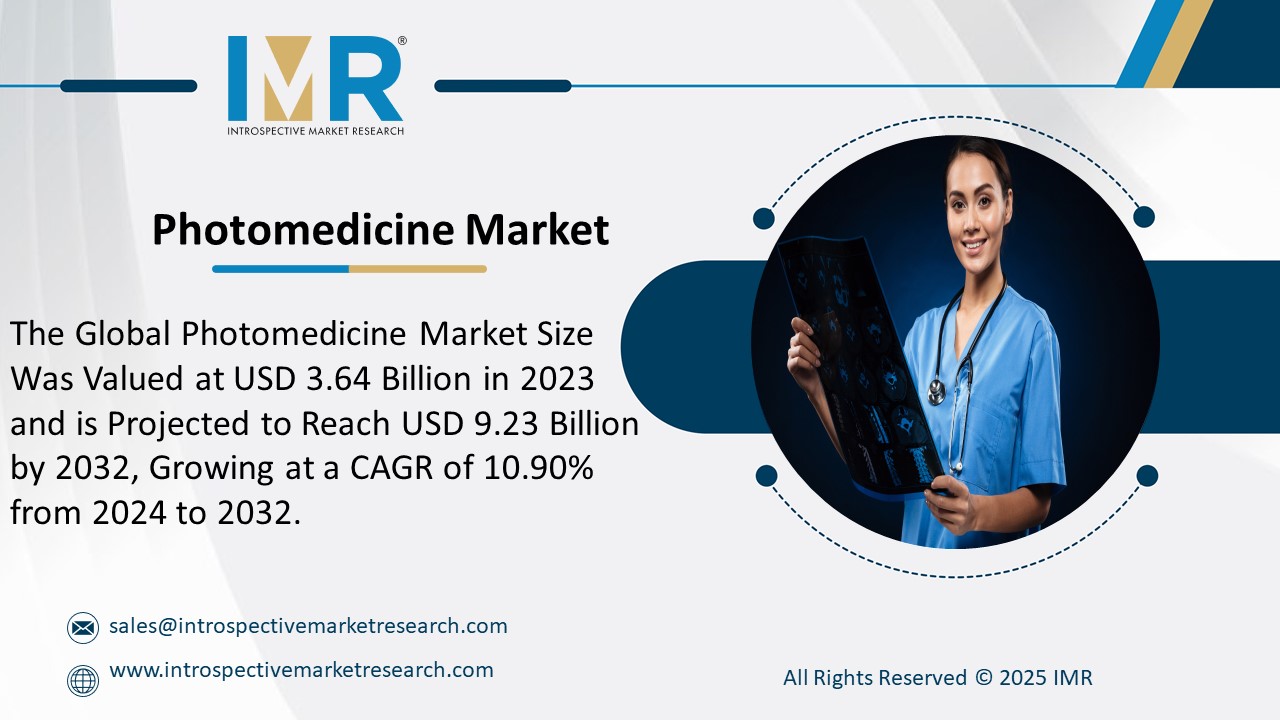
According to a new report published by Introspective Market Research, titled, Photomedicine Market by Application, Technology, and End-User, The Global Photomedicine Market Size Was Valued at USD 3.64 Billion in 2023 and is Projected to Reach USD 9.23 Billion by 2032, Growing at a CAGR of 10.90% from 2024 to 2032. The Global Photomedicine Market is witnessing robust growth driven by advancements in light-based technologies for therapeutic and diagnostic purposes. Photomedicine involves the use of light and its various wavelengths for medical treatment, ranging from dermatological applications to oncology, ophthalmology, and dental care. This innovative approach offers several advantages over traditional therapies, including reduced invasiveness, shorter recovery times, and minimal side effects, thereby enhancing patient compliance and treatment outcomes.
The field is expanding rapidly as the demand for non-invasive and precision-based medical treatments increases. Laser-based therapies, photodynamic therapy, and light-emitting diode (LED) treatments are being widely adopted in both clinical and cosmetic practices. The continuous evolution of light delivery systems, combined with increased awareness of phototherapy benefits, has significantly broadened its scope across hospitals, specialty clinics, and home care applications.
The Photomedicine Market is segmented into Application, Technology, and End-User. By Application, the market is categorized into (Dermatology, Oncology, Ophthalmology, Dentistry, Pain Management, Wound Healing, and Others). By Technology, the market is categorized into (Laser, LED, Fluorescence, and Others). By End-User, the market is categorized into (Hospitals, Clinics, and Home Care Settings).
One of the key growth drivers for the Photomedicine Market is the rising demand for non-invasive and painless treatment alternatives. With an increasing number of patients seeking aesthetic and therapeutic solutions without surgical interventions, photomedicine technologies have gained significant traction. The ability of light-based therapies to promote tissue repair, manage chronic pain, and treat skin disorders such as psoriasis and acne without pharmacological side effects makes them a preferred choice among healthcare providers and patients alike.
The Photomedicine Market presents vast opportunities in integrating artificial intelligence and advanced imaging technologies with light-based therapeutic systems. The combination of AI-driven diagnostics with precision-targeted light therapy can improve treatment efficacy and personalization. Additionally, growing applications of photomedicine in oncology for targeted cancer therapy, and in dermatology for cosmetic and regenerative treatments, are opening new avenues for market expansion, especially in emerging economies with rapidly modernizing healthcare systems.
Photomedicine Market, Segmentation
The Photomedicine Market is segmented on the basis of Application, Technology, and End-User.
Application
The Application segment is further classified into Dermatology, Oncology, Ophthalmology, Dentistry, Pain Management, Wound Healing, and Others. Among these, the Dermatology sub-segment accounted for the highest market share in 2023. The high share is attributed to the increasing adoption of laser and LED therapies for treating skin conditions such as acne, vitiligo, and psoriasis, as well as for aesthetic applications like wrinkle reduction and skin rejuvenation. Continuous advancements in dermatological laser systems and the growing cosmetic industry further contribute to this dominance.
Technology
The Technology segment is further classified into Laser, LED, Fluorescence, and Others. Among these, the Laser sub-segment accounted for the highest market share in 2023. Lasers are widely used across multiple therapeutic areas for their precision, minimal invasiveness, and efficiency in tissue ablation and stimulation. Their versatility in medical aesthetics, oncology, and ophthalmic surgeries continues to drive demand for advanced laser systems globally.
Some of The Leading/Active Market Players Are-
- IRIDEX Corporation (United States)
- Lumenis Ltd. (Israel)
- Candela Medical (United States)
- Alma Lasers Ltd. (Israel)
- Biolitec AG (Germany)
- Thor Photomedicine Ltd. (United Kingdom)
- BTL Aesthetics (Czech Republic)
- Koninklijke Philips N.V. (Netherlands)
- Sisram Medical Ltd. (China)
- Johnson & Johnson Services, Inc. (United States)
- other active players.
Key Industry Developments
-
In February 2025, Lumenis Ltd. launched its next-generation M22 Optima™ platform for multi-application light therapy.
The platform combines advanced IPL and laser technologies for treating over 30 dermatologic conditions. The new system enhances precision, reduces patient downtime, and offers customizable treatment settings for various skin types. The launch strengthens Lumenis’ position in the global aesthetic and therapeutic photomedicine segment. - In May 2025, Philips announced a strategic partnership with a leading cancer research institute to develop AI-powered photodynamic therapy solutions for oncology applications.
The collaboration aims to leverage machine learning to optimize light dosage and timing, improving therapeutic efficacy in cancer treatment. This initiative aligns with the growing trend toward personalized photomedicine and precision oncology, positioning Philips as a frontrunner in the integration of digital health with light-based therapies.
Key Findings of the Study
- Dermatology leads the application segment, driven by growing demand for aesthetic and therapeutic treatments.
- Laser technology dominates the market due to its precision and versatility.
- North America and Europe hold major shares, while Asia-Pacific shows fastest growth.
- Increasing adoption of non-invasive light-based treatments drives market expansion.
- Integration of AI and advanced imaging creates new growth opportunities