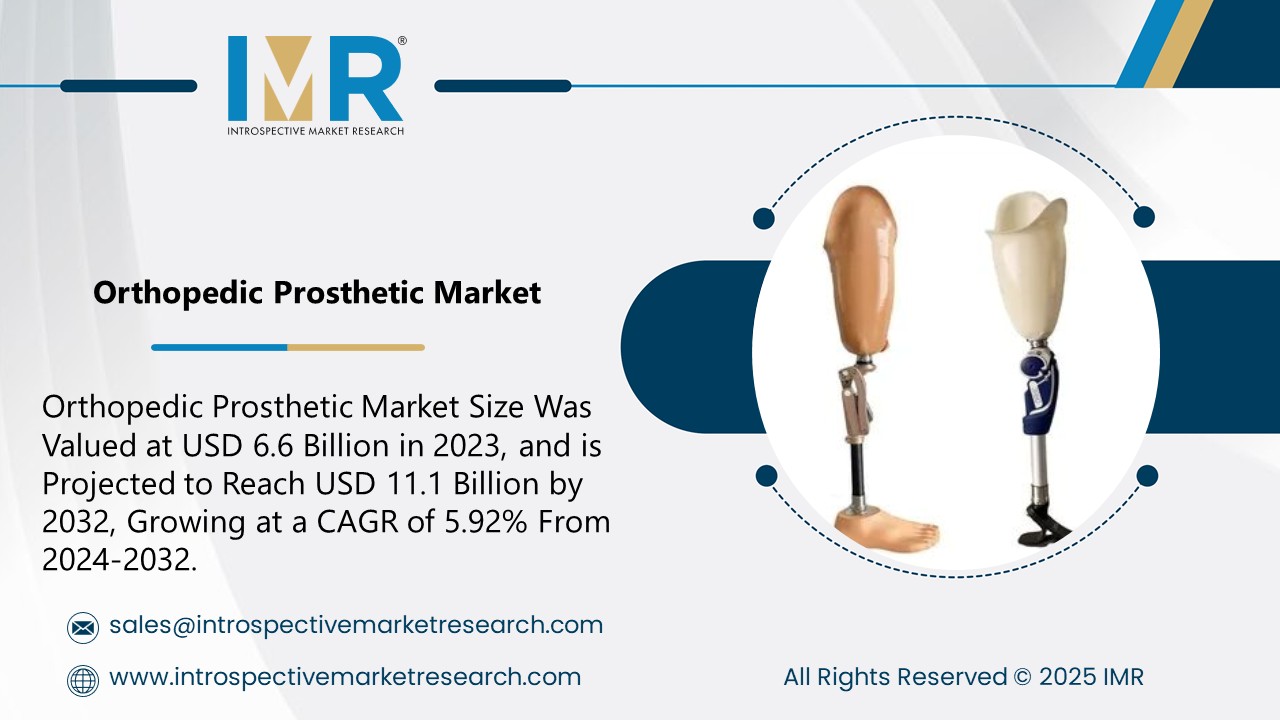
According to a new report published by Introspective Market Research, titled, Orthopedic Prosthetic Market by Product, Technology, and End User, The Global Orthopedic Prosthetic Market Size Was Valued at USD 6.6 Billion in 2024 and is Projected to Reach USD 11.1 Billion by 2032, Growing at a CAGR of 5.92% from 2025 to 2032.The orthopedic prosthetic market is witnessing significant growth as technological advancements revolutionize patient care. Orthopedic prosthetics are artificial devices that replace or support missing or impaired limbs, enabling patients to regain mobility and improve their quality of life. With the rise in trauma cases, sports injuries, and congenital conditions, the demand for advanced prosthetic solutions is expanding rapidly.
Unlike traditional mechanical alternatives, modern orthopedic prosthetics are integrated with smart sensors, lightweight materials, and robotics, offering enhanced functionality and comfort. These devices are increasingly used in rehabilitation, post-surgical recovery, and long-term patient mobility management. Their application spans across hospitals, orthopedic clinics, and rehabilitation centers, making them vital in modern healthcare infrastructure.
A key growth driver for the orthopedic prosthetic market is the increasing prevalence of accidents and trauma-related injuries. Road accidents, industrial mishaps, and war-related injuries have heightened the need for effective limb replacement solutions. Moreover, growing cases of diabetes-related amputations have also fueled market demand. Prosthetic manufacturers are addressing these needs by developing customized, durable, and advanced prosthetic solutions that restore mobility and independence for patients, driving adoption across both developed and developing regions.
An important opportunity for the orthopedic prosthetic market lies in the integration of artificial intelligence (AI) and robotics into prosthetic devices. With AI-powered sensors, prosthetics can now adapt to the user’s movements, terrain, and activity levels in real time. Robotic advancements further allow for greater dexterity, balance, and natural limb-like functionality. This opens new opportunities for manufacturers to differentiate through innovation, while meeting the rising global demand for patient-centric, high-performance prosthetics.
Orthopedic Prosthetic Market, Segmentation
The Orthopedic Prosthetic Market is segmented on the basis of Product, Technology, and End User.
Product Segment
- The product segment is further classified into Upper Extremity Prosthetics, Lower Extremity Prosthetics, and Liners & Sockets. Among these, the Lower Extremity Prosthetics sub-segment accounted for the highest market share in 2024. Lower extremity prosthetics are in high demand due to the increasing prevalence of diabetes-related amputations and accidents affecting legs and feet. These devices help restore essential mobility functions such as walking and running, enabling patients to lead active lives. Continuous product advancements and improved comfort levels have further boosted their adoption.
Technology Segment
- The technology segment is further classified into Conventional, Electric-Powered, and Hybrid. Among these, the Electric-Powered Prosthetics sub-segment accounted for the highest market share in 2024. These advanced devices are equipped with microprocessors and sensors that provide superior movement control, making them the preferred choice among patients seeking higher efficiency and functionality. With ongoing technological innovation and falling costs of advanced components, electric-powered prosthetics are expected to witness strong growth during the forecast period.
Some of The Leading/Active Market Players Are-
- Össur (Iceland)
- Ottobock SE & Co. KGaA (Germany)
- Blatchford Group (UK)
- WillowWood Global LLC (USA)
- Fillauer LLC (USA)
- Steeper Group (UK)
- Hanger, Inc. (USA)
- Proteor (France)
- Medi GmbH & Co. KG (Germany)
- Streifeneder ortho.production GmbH (Germany)
- College Park Industries (USA)
- Liberating Technologies, Inc. (USA)
- BionX Medical Technologies, Inc. (USA)
- Trulife (Ireland)
and other active players.
Key Industry Developments
- In January 2024, Ottobock launched its latest bionic knee prosthesis with advanced microprocessor technology.
The innovation enhances mobility, safety, and adaptability, offering patients a more natural walking experience and boosting Ottobock’s product portfolio. - In May 2024, Össur partnered with leading healthcare providers in North America to expand access to its AI-driven lower-limb prosthetics.
This collaboration aims to scale delivery of advanced prosthetic solutions, ensuring improved patient outcomes and strengthening Össur’s market footprint.
Key Findings of the Study
- Lower extremity prosthetics dominated the product segment in 2024.
- Electric-powered prosthetics held the largest technology share.
- North America led the global market, supported by advanced healthcare systems.
- Rising demand driven by trauma cases and diabetes-related amputations.
- Integration of AI and robotics shaping future market trends.