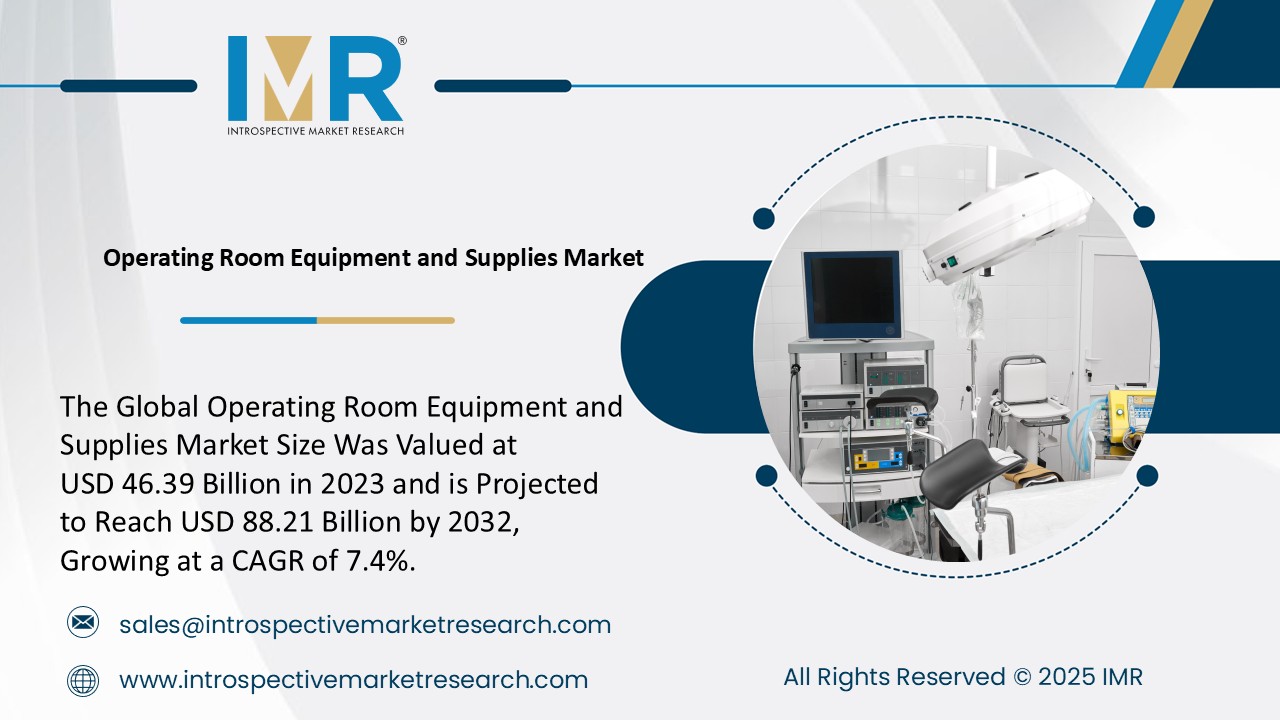
According to a new report published by Introspective Market Research, titled, Operating Room Equipment and Supplies Market by Product Type, End User, and Application, The Global Operating Room Equipment and Supplies Market Size Was Valued at USD 46.39 Billion in 2023 and is Projected to Reach USD 88.21 Billion by 2032, Growing at a CAGR of 7.4%. The global operating room (OR) equipment and supplies market is expanding rapidly, fueled by advancements in medical technology, rising volumes of surgical procedures, and increased investments in hospital infrastructure. OR equipment includes surgical tables, lights, anesthesia machines, electrosurgical units, and patient monitoring devices—each playing a critical role in enhancing surgical precision, patient safety, and overall efficiency. Unlike conventional surgical setups, modern integrated OR systems provide seamless digital connectivity, enabling real-time imaging, data sharing, and minimally invasive procedure support.
Surging demand for complex procedures such as orthopedic, cardiovascular, and neurosurgeries has accelerated the need for technologically advanced operating environments. Furthermore, the ongoing shift from traditional open surgeries to minimally invasive and robotic-assisted techniques has boosted demand for precision instruments and high-definition visualization systems. Hospitals and ambulatory surgical centers worldwide are increasingly adopting smart OR solutions that reduce human error, optimize space, and shorten recovery times.
The Operating Room Equipment and Supplies Market is segmented into Product Type, End User, and Application.
By Product Type, the market is categorized into (Anesthesia Devices, Surgical Tables, Surgical Lights, Electrosurgical Units, and Patient Monitoring Devices).
By End User, the market is categorized into (Hospitals, Ambulatory Surgical Centers, and Specialty Clinics).
By Application, the market is categorized into (General Surgery, Orthopedic Surgery, Cardiovascular Surgery, and Neurosurgery).
A key growth driver of the market is the global surge in surgical procedure volumes coupled with the modernization of healthcare facilities. Growing incidences of chronic diseases, trauma cases, and aging populations have increased the need for surgical interventions worldwide. In addition, governments are heavily investing in hospital digitalization and infrastructure upgrades to enhance surgical outcomes. Integrated OR technologies that provide automation, real-time data, and robotics compatibility are rapidly redefining clinical standards and driving market expansion.
An emerging opportunity for the market lies in the integration of artificial intelligence (AI), augmented reality (AR), and robotics in next-generation operating rooms. These innovations are transforming precision surgery by improving visual accuracy and procedure planning. Developing regions such as Asia-Pacific and Latin America offer strong potential due to rising healthcare spending, expanding hospital networks, and growing accessibility to surgical care. Manufacturers are focusing on customizable, cost-effective, and digitized equipment packages for small and mid-sized hospitals to penetrate these fast-growing markets.
Operating Room Equipment and Supplies Market, Segmentation
The Operating Room Equipment and Supplies Market is segmented on the basis of Product Type, End User, and Application.
Product Type
The Product Type segment is further classified into Anesthesia Devices, Surgical Tables, Surgical Lights, Electrosurgical Units, and Patient Monitoring Devices. Among these, the Surgical Tables sub-segment accounted for the highest market share in 2023. Surgical tables are indispensable in all procedures, offering modular functionality, ergonomic design, and compatibility with imaging systems. The increasing trend toward hybrid operating rooms and robotics-assisted surgeries continues to propel their adoption across hospitals and surgical centers.
End User
The End User segment is further classified into Hospitals, Ambulatory Surgical Centers, and Specialty Clinics. Among these, the Hospitals sub-segment accounted for the highest market share in 2023. Hospitals remain the primary end users due to their comprehensive surgical infrastructure and ability to handle multispecialty operations. Increasing government investments in hospital expansion projects and the rising burden of chronic diseases further reinforce hospital dominance in the operating room equipment sector.
Some of The Leading/Active Market Players Are-
- Stryker Corporation (USA)
- GE Healthcare (USA)
- Siemens Healthineers (Germany)
- Medtronic plc (Ireland)
- Johnson & Johnson (USA)
- Getinge AB (Sweden)
- Karl Storz GmbH & Co. KG (Germany)
- Hill-Rom Holdings (USA)
- B. Braun Melsungen AG (Germany)
- Steris Corporation (USA)
- Trumpf Medical (Germany)
- Zimmer Biomet Holdings Inc. (USA)
- Canon Medical Systems (Japan)
- Drägerwerk AG & Co. KGaA (Germany)
- Smith & Nephew plc (UK)
- Other active players
Key Industry Developments
In July 2025, Stryker Corporation unveiled its updated OR integration platform, SmartSuite 2.0, featuring cloud-enabled analytics and interoperability with robotic systems.
This advanced solution simplifies OR workflow management, enhances connectivity across multiple devices, and strengthens Stryker’s leadership in digital surgical infrastructure.
In May 2025, GE Healthcare launched its intelligent anesthesia delivery system, CAREstation AI™, aimed at improving real-time patient monitoring in operating rooms.
The innovation utilizes machine learning to personalize ventilation and anesthesia levels, enabling safer and more efficient procedures for complex surgeries across major hospitals.
Key Findings of the Study
- The Surgical Tables segment dominated the market in 2023.
- Hospitals represented the largest end-user segment globally.
- Asia-Pacific emerged as the fastest-growing regional market.
- AI and robotic integration are reshaping operating room efficiency.
- Rising chronic disease cases and hospital modernization are key growth drivers.