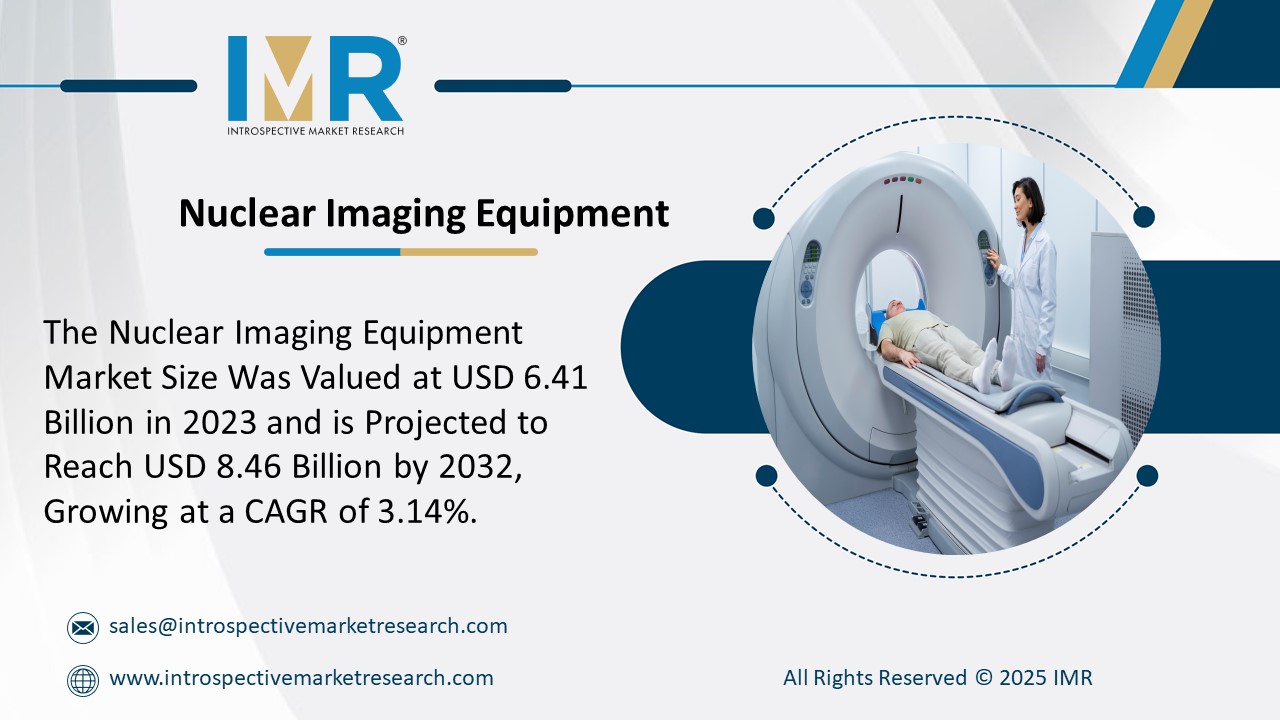
According to a new report published by Introspective Market Research, titled, Nuclear Imaging Equipment Market by Product Type, Application, and End-Use, The Global Nuclear Imaging Equipment Market Size Was Valued at USD 6.41 Billion in 2023 and is Projected to Reach USD 8.46 Billion by 2032, Growing at a CAGR of 3.14%. The nuclear imaging equipment market plays a pivotal role in modern diagnostic imaging by providing advanced visualization of physiological processes within the body. These technologies, including PET scanners, SPECT systems, and hybrid modalities, enable clinicians to identify diseases such as cancer, cardiovascular conditions, and neurological disorders at early stages.
Compared to conventional imaging methods, nuclear imaging offers superior functional insights that support precision medicine and personalized treatment approaches. Its applications extend across hospitals, diagnostic centers, and research institutes, making it an essential tool in healthcare systems worldwide. The increasing prevalence of chronic diseases, combined with technological advancements, is driving consistent adoption in developed and emerging markets.
The Nuclear Imaging Equipment Market is segmented into Product Type, Application, and End-Use. By Product Type, the market is categorized into PET, SPECT, and Hybrid Imaging Systems. By Application, the market is categorized into Oncology, Cardiology, Neurology, and Others. By End-Use, the market is categorized into Hospitals, Diagnostic Imaging Centers, and Research Institutes.
One of the key growth drivers of the nuclear imaging equipment market is the rising incidence of cancer and cardiovascular diseases worldwide. With cancer cases projected to continue increasing globally, nuclear imaging provides unmatched capabilities in detecting tumors, staging cancer, and monitoring therapeutic outcomes. Similarly, nuclear cardiology supports early diagnosis of ischemic heart disease, helping reduce mortality rates. Advances in radiotracers and hybrid modalities have further expanded diagnostic accuracy. This rising disease burden, coupled with greater reliance on precision imaging for treatment planning, significantly boosts demand for nuclear imaging equipment across healthcare facilities.
A major opportunity in the market lies in the integration of AI and digital health technologies into nuclear imaging systems. Artificial intelligence enables faster image reconstruction, enhanced accuracy in disease detection, and reduction of scan times, improving patient throughput. Additionally, the adoption of cloud-based platforms for image sharing supports telehealth applications, particularly in underserved regions with limited nuclear medicine specialists. The ongoing innovation in radiopharmaceuticals, along with government support for molecular imaging research, presents avenues for growth. This convergence of advanced imaging with AI-driven analytics will open opportunities for manufacturers to capture new market segments and expand their global footprint.
Nuclear Imaging Equipment Market segmentation
The Nuclear Imaging Equipment Market is segmented on the basis of Product Type, Application, and End-Use.
Product Type
The Product Type segment is further classified into PET, SPECT, and Hybrid Imaging Systems. Among these, the SPECT sub-segment accounted for the highest market share in 2023. SPECT systems are widely used due to their cost-effectiveness, versatility in cardiology and oncology imaging, and broad accessibility across healthcare facilities compared to PET. Advances in detector technology and image resolution have further enhanced their clinical applications, solidifying SPECT’s dominance in nuclear medicine.
Application
The Application segment is further classified into Oncology, Cardiology, Neurology, and Others. Among these, the Oncology sub-segment accounted for the highest market share in 2023. Nuclear imaging has become indispensable in oncology for tumor detection, staging, therapy monitoring, and recurrence assessment. The rising prevalence of cancer worldwide, combined with expanding adoption of PET and hybrid modalities, continues to drive strong demand from oncology departments. This makes oncology the most significant revenue-generating segment in the nuclear imaging equipment market.
Some of The Leading/Active Market Players Are-
- GE Healthcare (United States)
- Siemens Healthineers (Germany)
- Philips Healthcare (Netherlands)
- Canon Medical Systems Corporation (Japan)
- Bracco Imaging S.p.A (Italy)
- Digirad Corporation (United States)
- SurgicEye GmbH (Germany)
- Neusoft Medical Systems (China)
- Mediso Medical Imaging Systems (Hungary)
- CMR Naviscan Corporation (United States)
- Spectrum Dynamics Medical (Israel)
- Positron Corporation (United States)
- Jubilant DraxImage Inc. (Canada)
- ANKE Biotechnology (China)
- Segami Corporation (United States) and other active players.
Key Industry Developments
-
In April 2024, Siemens Healthineers introduced its latest Biograph Vision Quadra PET/CT scanner, designed to accelerate clinical trials and provide ultra-fast imaging with higher sensitivity. This launch enhances oncology and neurology imaging capabilities while supporting advanced research applications.
The system offers whole-body imaging in a single scan, significantly reducing exam times and providing improved diagnostic accuracy. With its high-resolution imaging, the product aims to meet the increasing demand for precise cancer detection and treatment monitoring, making it a milestone in hybrid imaging technology. - In January 2024, GE Healthcare partnered with the University of Cambridge Hospitals (UK) to advance nuclear medicine research using next-generation PET/MRI technology. The collaboration aims to improve early diagnosis of complex neurological disorders and accelerate radiopharmaceutical development.
This initiative combines GE’s imaging expertise with Cambridge’s research capabilities, supporting innovations in neuroimaging and oncology. By focusing on precision diagnostics and integrating imaging with AI-driven analytics, the partnership is expected to drive breakthroughs that could redefine the clinical applications of nuclear imaging globally.
Key Findings of the Study
- SPECT systems dominated the product segment in 2023 due to accessibility and cost-effectiveness.
- Oncology emerged as the leading application segment, driven by rising global cancer incidence.
- North America and Europe remain leading regions, supported by advanced healthcare infrastructure.
- Rising prevalence of chronic diseases and adoption of AI in imaging are key growth drivers.
- The market is projected to grow steadily at a CAGR of 3.14% through 2032.