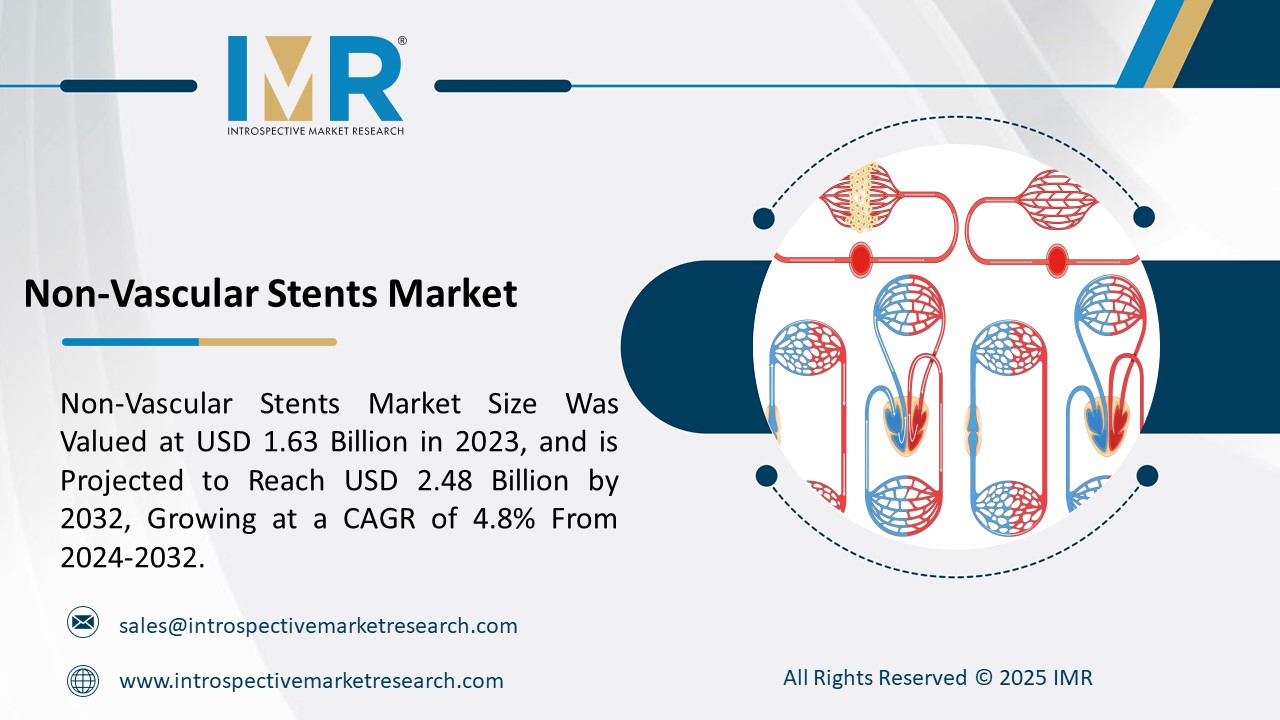
According to a new report published by Introspective Market Research, titled, Non-Vascular Stents Market by Type, Material, and End-User, The Global Non-Vascular Stents Market Size Was Valued at USD 1.63 Billion in 2023 and is Projected to Reach USD 2.48 Billion by 2032, Growing at a CAGR of 4.8%. The global non-vascular stents market is experiencing steady growth, driven by rising cases of chronic obstructive pulmonary disease (COPD), gastrointestinal disorders, and urinary tract obstructions. Non-vascular stents, unlike vascular stents, are designed to support and maintain the patency of non-vascular structures such as the esophagus, trachea, bile duct, and ureter. Their minimally invasive nature offers patients a faster recovery and fewer complications compared to open surgical procedures.
The market is also benefiting from advancements in stent technology, including drug-eluting stents, biodegradable materials, and improved designs that enhance patient comfort and reduce risks of migration or infection. Additionally, the increasing prevalence of an aging population, lifestyle-related diseases, and demand for less invasive medical procedures are expected to drive adoption. With a growing focus on improving healthcare access in developing regions, the non-vascular stents market is poised for sustainable expansion during the forecast period.
One of the major drivers of the non-vascular stents market is the rising prevalence of gastrointestinal cancers and biliary obstructions worldwide. The use of non-vascular stents in managing conditions such as esophageal cancer, bile duct obstruction, and colorectal cancer has significantly increased. These stents not only improve patient outcomes but also enhance quality of life by relieving obstructions and reducing complications. With the growing incidence of lifestyle-related cancers and the preference for minimally invasive treatments, healthcare providers are increasingly adopting advanced non-vascular stents, thereby fueling the market’s growth globally.
A significant opportunity for market growth lies in the development of biodegradable and drug-eluting stents. These innovative stents minimize the risk of long-term complications such as migration, infection, or re-obstruction while providing targeted therapeutic benefits. The demand for patient-friendly solutions and advancements in biomaterials are opening doors for companies to invest in next-generation stent technologies. Furthermore, expanding healthcare infrastructure in emerging economies, coupled with increasing patient awareness of minimally invasive procedures, presents manufacturers with lucrative opportunities to tap into new markets and strengthen their global footprint.
Non-Vascular Stents Market, Segmentation
The Non-Vascular Stents Market is segmented on the basis of Type, Material, and End-User.
Type
- The Type segment is further classified into Esophageal Stents, Tracheobronchial Stents, Gastrointestinal Stents, Biliary Stents, and Urinary Tract Stents. Among these, the Biliary Stents sub-segment accounted for the highest market share in 2023. Biliary stents are widely used to manage bile duct obstructions, often associated with gallstones, pancreatic cancer, or liver diseases. Their rising adoption can be attributed to the increasing incidence of biliary tract diseases and the effectiveness of stents in restoring bile flow. The development of advanced self-expanding metallic stents has further boosted demand, as they provide longer patency and improved clinical outcomes compared to traditional alternatives.
Material
-
The Material segment is further classified into Metallic Stents, Plastic Stents, and Others. Among these, the Metallic Stents sub-segment accounted for the highest market share in 2023. Metallic stents, particularly self-expanding metal stents (SEMS), are preferred due to their durability, lower risk of migration, and superior performance in treating obstructions compared to plastic stents. They are especially effective in long-term treatments for conditions such as esophageal strictures and biliary obstructions. Increasing adoption of advanced alloys and coatings in metallic stents has further enhanced their clinical efficiency, making them the dominant choice across hospitals and specialty clinics.
Some of The Leading/Active Market Players Are-
-
Boston Scientific Corporation (United States)
- Cook Medical (United States)
- C. R. Bard, Inc. (United States)
- Medtronic plc (Ireland)
- ELLA-CS, s.r.o. (Czech Republic)
- Taewoong Medical Co., Ltd. (South Korea)
- Merit Medical Systems, Inc. (United States)
- Olympus Corporation (Japan)
- CONMED Corporation (United States)
- Micro-Tech (Nanjing) Co., Ltd. (China)
- Becton, Dickinson and Company (United States)
- S&G Biotech Inc. (South Korea)
- Endo-Flex GmbH (Germany)
- M.I. Tech Co., Ltd. (South Korea)
- Balton Sp. z o.o. (Poland)
Key Industry Developments
-
In March 2024, Boston Scientific launched its next-generation fully covered self-expanding metallic biliary stent designed to reduce migration and enhance patient comfort.
This development is expected to strengthen Boston Scientific’s portfolio in gastrointestinal applications, providing physicians with improved tools to manage biliary obstructions and achieve better patient outcomes. - In July 2024, Taewoong Medical received U.S. FDA clearance for its innovative esophageal stent system with enhanced anti-migration features.
The approval is anticipated to expand the company’s footprint in North America and support the growing demand for advanced esophageal stents in patients with cancer-related dysphagia.
Key Findings of the Study
-
Biliary stents led the Type segment in 2023.
- Metallic stents dominated the Material segment due to superior performance.
- North America remains the leading region with high adoption of minimally invasive solutions.
- Rising cancer incidence and demand for non-invasive treatments are key growth drivers.
- Biodegradable and drug-eluting stents represent strong future opportunities.