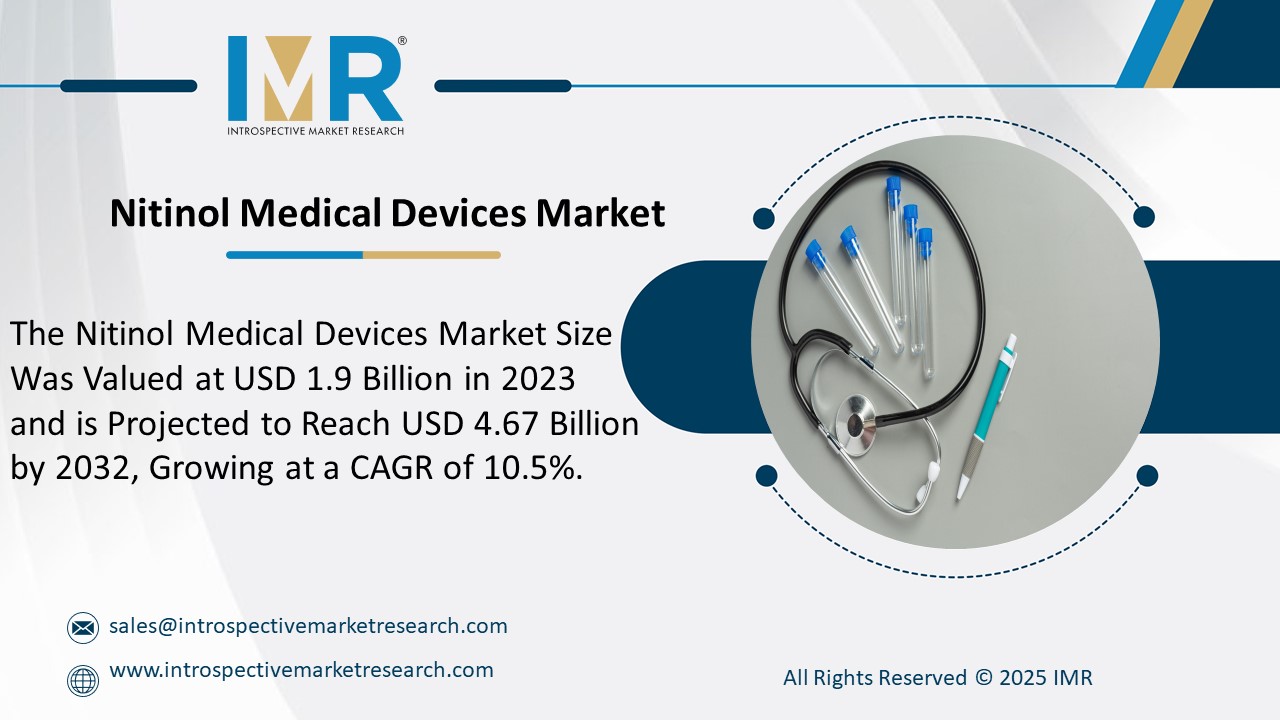
According to a new report published by Introspective Market Research, titled, Nitinol Medical Devices Market by Device Type, Application, End-User, and Region, The Global Nitinol Medical Devices Market Size Was Valued at USD 1.9 Billion in 2023 and is Projected to Reach USD 4.67 Billion by 2032, Growing at a CAGR of 10.5%.
The Nitinol Medical Devices Market covers medical devices made from nitinol (nickel-titanium alloy), valued for its superelasticity, shape memory, and biocompatibility. These properties enable minimally invasive device designs—such as stents, guidewires, clamps, and shape-changing implants—that outperform traditional stainless steel or titanium devices. Nitinol devices reduce trauma, allow complex geometries, and recover shape in situ, making them ideal in cardiovascular, orthopedic, and neurosurgical applications.
Compared to conventional metals, nitinol offers elastic deformation and recovery under stress, enabling devices to flex, conform, and return to intended form. In cardiovascular interventions, nitinol stents self-expand to vessel walls, while in orthopedic uses, nitinol staples or compression devices adapt to anatomy and maintain forces. As surgical procedures shift towards less invasive techniques, demand for nitinol-based devices is increasing across hospitals and specialty centers globally.
Technological advances—such as thinner wires, improved surface passivation, and hybrid composites—enhance performance, reduce fatigue, and extend device lifetime. Coupled with rising rates of cardiovascular disease, aging populations, and greater adoption of minimally invasive treatments, the nitinol device market is poised for strong growth across all regions.
The Nitinol Medical Devices Market is segmented into Device Type, Application, and End-User. By Device Type, the market is categorized into (Stents, Guidewires, Implants). By Application, the market is categorized into (Cardiovascular, Orthopedics, Neurovascular). By End-User, the market is categorized into (Hospitals, Ambulatory Surgical Centers, Specialty Clinics).
One key growth driver in the nitinol medical devices market is the rising prevalence of cardiovascular and vascular diseases globally. As coronary artery disease, peripheral artery disease, and atherosclerosis continue to expand with ageing populations and lifestyle risk factors, demand for stents, guidewires, and endovascular devices rises. Nitinol’s shape memory and superelastic properties make it especially suited to stents and devices that navigate tortuous vasculature and conform to vessel anatomy. Healthcare systems are also increasingly adopting minimally invasive interventions over open surgeries, further boosting reliance on nitinol device innovation and deployment.
A promising opportunity lies in expanding nitinol device applications into newer therapeutic areas and hybrid designs. Beyond cardiovascular and orthopedic use, nitinol is increasingly explored in neurosurgery, urology, spinal implants, and minimally invasive delivery systems. Integrating nitinol with drug-eluting coatings, bioresorbables, sensors, or shape-shifting smart materials opens new product classes. In emerging markets, adoption is still nascent—companies that bring cost-effective nitinol devices, robust post-sales support, and favorable regulatory pathways stand to capture substantial growth as healthcare infrastructure catches up.
Nitinol Medical Devices Market, Segmentation
The Nitinol Medical Devices Market is segmented on the basis of Device Type, Application, and End-User.
Stents
The stents segment is further classified into self-expanding, balloon-expandable, and shape-adaptive. Among these, the self-expanding sub-segment accounted for the highest market share in 2023. Nitinol self-expanding stents take advantage of the alloy’s shape memory—compressed during delivery, then expanding automatically when deployed. This makes them ideal for vascular applications with variable diameters, tortuous vessels, and restenosis risk. Their flexibility, conformability, and sustained radial strength are highly valued in cardiovascular interventions, driving their dominance in clinical use.
Guidewires / Implants
The guidewires / implants segment is further classified into guidewires, orthopedic staples/plates, and medical implants. Among these, the guidewires sub-segment accounted for the highest market share in 2023. Guidewires benefit substantially from nitinol’s flexibility, kink resistance, and fatigue resilience, enabling navigation through complex vascular pathways and support in catheter-delivered therapies. Their widespread use in interventional cardiology, endovascular surgery, and diagnostic procedures underpins their market leadership.
Some of The Leading/Active Market Players Are-
- Medtronic (USA)
- Abbott Laboratories (USA)
- Boston Scientific (USA)
- Terumo Corporation (Japan)
- Stryker Corporation (USA)
- B. Braun Melsungen AG (Germany)
- Biotronik (Germany)
- Cook Medical (USA)
- Minvasys (India)
- W. L. Gore & Associates (USA)
- other active players.
Key Industry Developments
-
In June 2025, Medtronic announced acquisition of a nitinol implant startup to expand its portfolio of shape-memory devices.
The acquisition includes technologies for nitinol-based spinal implants, MEMS-integrated shape-changing structures, and smart sensors. Medtronic plans to integrate these into its orthopedic and neurosurgical offerings, targeting better adaptation to patient anatomy and real-time monitoring. This move accelerates the convergence of nitinol mechanical devices and digital health, positioning Medtronic to lead next-generation adaptive implant systems. - In January 2025, Boston Scientific received FDA clearance for a new nitinol self-expanding stent with enhanced fatigue resistance.
The cleared stent uses novel surface treatment and alloy microstructure engineering to increase durability under cyclic loading. It is designed for peripheral vascular disease, with improved deliverability, conformability, and longer functional life in challenging anatomies. The advancement helps reduce restenosis and device failure risks, giving Boston Scientific an edge in competitive stent markets across U.S. and EU regions.
Key Findings of the Study
- Self-expanding nitinol stents lead due to conformability and deployment ease
- Guidewires dominate among non-stent device types thanks to flexibility and fatigue resistance
- Cardiovascular applications remain largest segment, driven by disease burden
- Opportunities exist in neurosurgery, smart implants, and emerging markets
- Investments in surface treatments and hybrid materials are critical to future growth