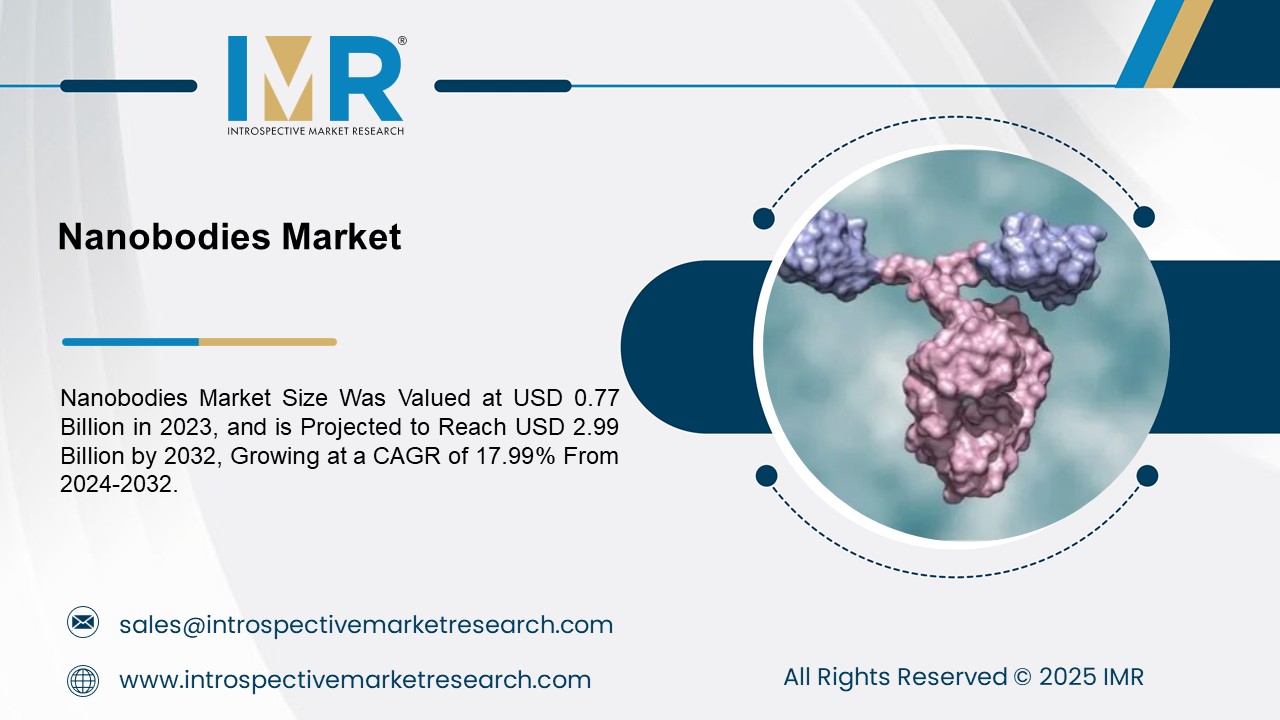
According to a new report published by Introspective Market Research, titled, Global Nanobodies Market by Product Type, Application, and End-User, The Global Nanobodies Market Size Was Valued at USD 1.48 Billion in 2023 and is Projected to Reach USD 2.99 Billion by 2032, Growing at a CAGR of 17.99%. The Global Nanobodies Market is witnessing rapid growth as these next-generation therapeutic and diagnostic agents gain momentum in biotechnology and pharmaceutical research. Nanobodies, or single-domain antibodies derived from camelids, are small, stable, and highly specific binding molecules that serve as effective alternatives to conventional monoclonal antibodies. Their small size, strong binding affinity, and ease of production make them highly attractive in therapeutic applications, drug discovery, and molecular imaging.
Compared to traditional antibodies, nanobodies offer unique advantages such as enhanced tissue penetration, stability under extreme conditions, and potential for cost-effective large-scale production. They are being widely explored for oncology, neurodegenerative diseases, inflammatory conditions, and infectious diseases, while also being used as valuable research tools in molecular biology.
The rising demand for innovative biologics, coupled with advancements in genetic engineering and increasing biopharmaceutical R&D investments, is fueling market growth. With expanding clinical trials and growing collaborations between biotech firms and academic research institutes, the nanobodies market is poised for significant expansion over the forecast period.
The Global Nanobodies Market is segmented into Product Type, Application, and End-User. By Product Type, the market is categorized into (Therapeutic Nanobodies, Diagnostic Nanobodies, Research Nanobodies). By Application, the market is categorized into (Oncology, Neurodegenerative Diseases, Infectious Diseases, Inflammatory Diseases, Others). By End-User, the market is categorized into (Pharmaceutical & Biotechnology Companies, Research Institutes, Hospitals & Clinics).
One of the key growth drivers of the Nanobodies Market is the increasing demand for targeted therapeutics in oncology. Nanobodies have shown exceptional potential in binding to tumor-specific antigens with high precision, offering opportunities for both treatment and early diagnosis. Their ability to penetrate tumors more effectively than conventional antibodies makes them valuable in improving drug delivery and reducing side effects. With cancer incidence rising globally, nanobody-based therapies are expected to play a pivotal role in transforming oncology treatment paradigms.
A major opportunity in the Nanobodies Market lies in their application in neurodegenerative disease treatment and imaging. Due to their small size, nanobodies can cross the blood-brain barrier more efficiently than monoclonal antibodies, enabling their use in Alzheimer’s, Parkinson’s, and multiple sclerosis research. Biotechnology firms are actively investing in nanobody-based diagnostic imaging and therapeutic solutions for central nervous system (CNS) disorders. With increasing global focus on neurological health and precision medicine, this segment presents lucrative growth prospects.
Global Nanobodies Market, Segmentation
The Global Nanobodies Market is segmented on the basis of Product Type, Application, and End-User.
Product Type
The Product Type segment is further classified into Therapeutic Nanobodies, Diagnostic Nanobodies, and Research Nanobodies. Among these, the Therapeutic Nanobodies sub-segment accounted for the highest market share in 2024. This dominance is attributed to their use in treating cancer, autoimmune diseases, and viral infections. Ongoing clinical trials and regulatory approvals are accelerating their commercialization, further boosting demand across global biopharmaceutical pipelines.
Application
The Application segment is further classified into Oncology, Neurodegenerative Diseases, Infectious Diseases, Inflammatory Diseases, and Others. Among these, the Oncology sub-segment accounted for the highest market share in 2024. The growing burden of cancer and the demand for effective precision therapies are driving adoption. Nanobody-based drug candidates are increasingly being developed for targeted cancer treatment, showing promising results in enhancing efficacy while minimizing toxicity.
Some of The Leading/Active Market Players Are-
- Ablynx (Belgium)
- Merck KGaA (Germany)
- Novartis AG (Switzerland)
- Amgen Inc. (USA)
- Pfizer Inc. (USA)
- Sanofi (France)
- Thermo Fisher Scientific (USA)
- Creative Biolabs (USA)
- GenScript Biotech Corporation (China)
- Roche Holding AG (Switzerland)
…and other active players.
Key Industry Developments
- In March 2024, Sanofi expanded its nanobody-based oncology research program through strategic collaborations with biotech startups in Europe.
This initiative aims to accelerate the development of next-generation nanobody therapies for solid tumors. Sanofi is leveraging its expertise in immuno-oncology along with innovative biotech platforms to advance nanobody candidates into clinical pipelines, strengthening its global oncology portfolio.
- In July 2024, Ablynx, a Sanofi company, announced promising Phase II clinical trial results for a nanobody therapy targeting autoimmune disorders.
The trial demonstrated strong efficacy and safety profiles, highlighting the therapeutic potential of nanobodies in chronic inflammatory diseases. This advancement positions Ablynx as a key leader in nanobody therapeutics while reinforcing the broader adoption of nanobody-based drug development across multiple indications.
Key Findings of the Study
- Therapeutic nanobodies dominate the market, driven by oncology applications.
- Oncology is the leading application segment, fueled by rising cancer prevalence.
- Europe and North America lead adoption due to strong biotech ecosystems.
- Rising biopharma R&D investments drive innovation in nanobody development.
- Growing opportunities exist in CNS disorder research and imaging.