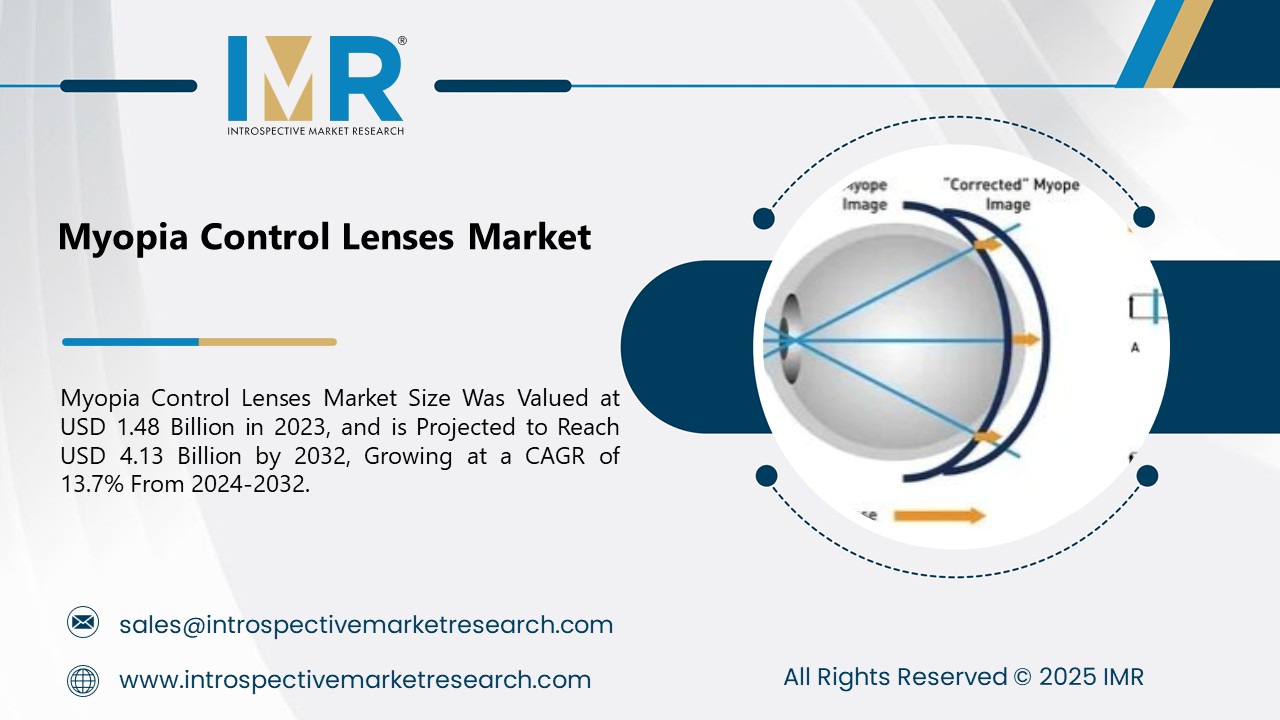
According to a new report published by Introspective Market Research, titled, Global Myopia Control Lenses Market by Product Type, Distribution Channel, and End-User, The Global Myopia Control Lenses Market Size Was Valued at USD 1.48 Billion in 2023 and is Projected to Reach USD 4.13 Billion by 2032, Growing at a CAGR of 13.7%.The Global Myopia Control Lenses Market is experiencing rapid expansion as the prevalence of myopia continues to rise, particularly among children and young adults. Myopia, or nearsightedness, has become a significant public health concern, with research indicating that nearly half of the world’s population could be affected by 2050. Myopia control lenses are designed to slow the progression of this condition and reduce the long-term risks of severe eye diseases such as glaucoma, retinal detachment, and macular degeneration.
Unlike traditional corrective lenses, myopia control lenses incorporate advanced optical designs that not only correct vision but also help reshape the peripheral focus of light entering the eye, thereby slowing axial elongation. They are widely used in pediatric ophthalmology and optometry practices, and their demand is rising across hospitals, specialty eye clinics, and retail optical stores.
Growing awareness among parents, coupled with technological advancements by lens manufacturers, is driving adoption globally. As healthcare systems and consumers prioritize preventive eye care, myopia control lenses are increasingly seen as a vital solution in managing one of the fastest-growing eye health challenges worldwide.
The Global Myopia Control Lenses Market is segmented into Product Type, Distribution Channel, and End-User. By Product Type, the market is categorized into (Spectacle Lenses, Contact Lenses, Ortho-K Lenses). By Distribution Channel, the market is categorized into (Hospital Pharmacies, Optical Stores, Online Retail). By End-User, the market is categorized into (Children, Teenagers, Adults).
One of the key growth drivers of the Myopia Control Lenses Market is the rising prevalence of childhood myopia worldwide. Increasing screen time, reduced outdoor activity, and lifestyle changes have accelerated the onset and progression of myopia at a younger age. Parents and healthcare providers are turning toward advanced myopia management solutions, leading to significant growth in demand for innovative lenses. Governments and medical associations are also advocating for early interventions, strengthening the role of myopia control products in pediatric care.
A major market opportunity lies in the integration of digital technology with myopia control solutions. The growing adoption of smart lenses and AI-powered diagnostic tools allows ophthalmologists to monitor vision progression more effectively. Moreover, expanding e-commerce platforms and online consultations are creating new sales channels, particularly in emerging economies. Companies investing in affordable, accessible lens products for middle-income populations are expected to capture a substantial share of untapped markets, especially across Asia-Pacific and Latin America, where myopia prevalence is among the highest globally.
Global Myopia Control Lenses Market, Segmentation
The Global Myopia Control Lenses Market is segmented on the basis of Product Type, Distribution Channel, and End-User.
Product Type
The Product Type segment is further classified into Spectacle Lenses, Contact Lenses, and Ortho-K Lenses. Among these, the Spectacle Lenses sub-segment accounted for the highest market share in 2024. Spectacle lenses dominate due to their affordability, accessibility, and non-invasive nature, making them the preferred choice for children. With the introduction of specialized myopia control spectacle designs by leading manufacturers, adoption continues to rise, especially in markets where awareness and affordability drive purchasing decisions.
Distribution Channel
The Distribution Channel segment is further classified into Hospital Pharmacies, Optical Stores, and Online Retail. Among these, the Optical Stores sub-segment accounted for the highest market share in 2024. Consumers prefer optical retail outlets due to professional consultation, personalized fitting, and immediate availability of products. The increasing presence of branded optical chains and collaborations between eye-care providers and retailers has further boosted the dominance of this segment globally.
Some of The Leading/Active Market Players Are-
- EssilorLuxottica (France)
- Hoya Corporation (Japan)
- CooperVision (USA)
- Johnson & Johnson Vision Care (USA)
- Carl Zeiss Meditec AG (Germany)
- Bausch + Lomb (USA)
- Menicon Co., Ltd. (Japan)
- SEED Co., Ltd. (Japan)
- Alcon Inc. (Switzerland)
- Visioneering Technologies, Inc. (USA)
…and other active players.
Key Industry Developments
- In February 2024, EssilorLuxottica introduced a new range of myopia control spectacle lenses designed for children in Asia.
The launch marked a strategic step toward addressing the high prevalence of pediatric myopia in the region. These lenses use cutting-edge optical designs to slow myopia progression while ensuring comfort and visual clarity. EssilorLuxottica partnered with local optometry chains and hospitals to enhance adoption and strengthen its leadership in the Asia-Pacific eye care market.
- In June 2024, CooperVision expanded its MiSight® 1 day contact lens availability across Europe and Latin America.
MiSight® is the first FDA-approved soft contact lens proven to slow myopia progression in children. With its expansion into new geographies, CooperVision is strengthening its global presence and catering to the growing demand for scientifically validated myopia control products. This move reflects the company’s focus on improving pediatric eye health worldwide.
Key Findings of the Study
- Spectacle lenses dominate product type due to affordability and adoption among children.
- Optical stores remain the leading distribution channel globally.
- Rising childhood myopia prevalence is the primary growth driver.
- Asia-Pacific leads due to high prevalence and early adoption.
- Digital and smart lens innovations create new growth opportunities.