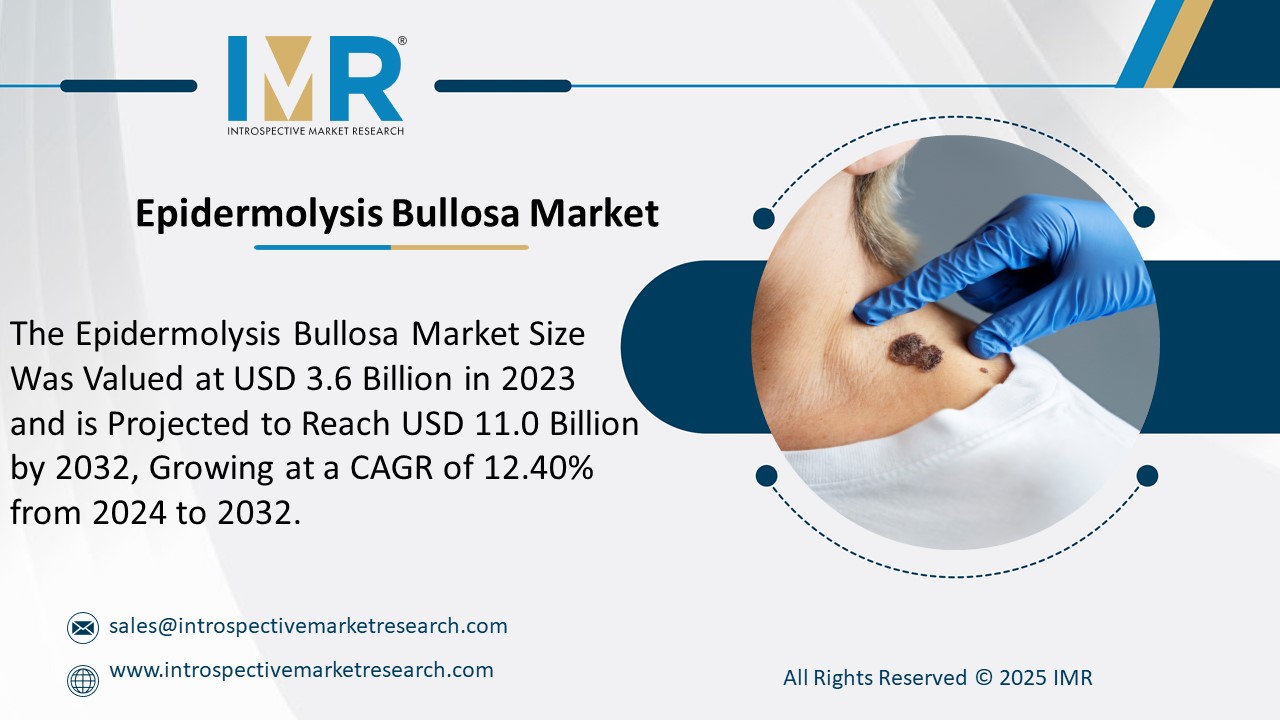
According to a new report published by Introspective Market Research, titled, Epidermolysis Bullosa Therapeutics Market by Therapy Type, Indication, and Region, The Global Epidermolysis Bullosa Market Size Was Valued at USD 3.6 Billion in 2023 and is Projected to Reach USD 11.0 Billion by 2032, Growing at a CAGR of 12.40% from 2024 to 2032.
Epidermolysis Bullosa (EB) is a group of rare, inherited skin disorders characterized by extreme skin fragility, where minimal friction or trauma causes painful blisters and wounds. The management of EB is complex, involving wound care, pain management, nutritional support, and advanced therapies under development. Recent advances in gene and cell therapies, protein replacement, and regenerative medicine are transforming the treatment outlook, offering potential disease-modifying options beyond symptomatic care.
Traditional care approaches—dressings, wound management, bandaging, and symptomatic treatments—focus on mitigating blistering and preventing infection. However, they do not address the underlying genetic defects. Novel therapies aim to correct or compensate for defective genes (such as COL7A1 in dystrophic EB), promote wound healing, and restore skin integrity. As clinical trial pipelines mature and regulatory frameworks evolve, the EB market is poised to expand rapidly.
Growth is supported by rising diagnosis rates, greater awareness of rare diseases, expanded access to genetic testing, and increasing investment in biopharma for orphan therapies. Markets with strong reimbursement policies and advanced healthcare systems are leading adoption of next-generation EB therapies.
The Epidermolysis Bullosa Market is segmented into Therapy Type, Indication, and Region. By Therapy Type, the market is categorized into (Gene Therapy, Cell Therapy, Protein Replacement / Biologics, Small Molecule / Symptomatic). By Indication, the market is categorized into (Dystrophic EB, Junctional EB, Simplex EB, Other Rare Subtypes). By Region, the market is categorized into (North America, Europe, Asia-Pacific, Latin America, Middle East & Africa).
One of the key growth drivers in the EB market is the surge in gene and cell therapy development targeting monogenic skin disorders. Because many forms of EB result from single-gene mutations, they are promising candidates for gene editing, viral vector delivery, or cell-based corrective approaches. As multiple therapies progress from preclinical to clinical stages with encouraging safety and efficacy data, investor confidence and regulatory support increase, accelerating pipeline investment. Moreover, expanded availability of diagnostic genetic testing helps identify patients earlier, enabling more timely and effective intervention and thus fueling demand for advanced therapies.
A major opportunity in the EB market lies in the commercialization of regenerative and combination therapies that both heal wounds and restore skin structure. Patients and physicians seek treatments that reduce blister formation, improve skin resilience, and minimize lifelong wound burden. Companies that can develop durable, low-risk, easy-to-administer therapies—such as in vivo gene editing, topical delivery of corrective proteins, or cell therapy approaches—stand to capture premium value. Furthermore, licensing partnerships, rare-disease incentives, and orphan drug exclusivities offer strategic advantages that can accelerate market entry and adoption.
Epidermolysis Bullosa Market, Segmentation
The Epidermolysis Bullosa Market is segmented on the basis of Therapy Type, Indication, and Region.
Therapy Type
The Therapy Type segment is further classified into Gene Therapy, Cell Therapy, Protein Replacement / Biologics, and Small Molecule / Symptomatic. Among these, the Gene Therapy sub-segment accounted for the highest market share in 2023. Gene therapy approaches, which aim to correct underlying genetic defects via viral vectors or gene-editing tools, are receiving strong investment and regulatory support due to their potential as curative or disease-modifying interventions. Their promise to address root causes rather than symptoms has drawn both clinical and commercial focus.
Indication
The Indication segment is further classified into Dystrophic EB, Junctional EB, Simplex EB, and Other Rare Subtypes. Among these, the Dystrophic EB sub-segment accounted for the highest share in 2023. This subtype often involves more severe and lifelong blistering, skin fragility, and associated complications, translating to higher medical burden and greater demand for advanced therapeutic interventions. The clinical unmet needs in Dystrophic EB—such as chronic wounds, scarring, and increased risk of squamous cell carcinoma—fuel the demand for novel therapies in this indication.
Some of The Leading/Active Market Players Are-
- Castle Creek Biosciences (USA)
- Amryt Pharma plc (UK / Ireland)
- Krystal Biotech (USA)
- Abeona Therapeutics (USA)
- ProQR Therapeutics (Netherlands)
- Phoenix Tissue Repair (USA)
- InMed Pharmaceuticals (Canada)
- BridgeBio Pharma (USA)
- AEGEL Therapeutics (Australia)
- RegeneRx Biopharmaceuticals (USA)
- other active players.
Key Industry Developments
-
In April 2025, the U.S. FDA approved Abeona Therapeutics’ cell-based gene therapy Zevaskyn (pz-cel) for recessive dystrophic EB, marking the first cell therapy approved for this disorder.
This landmark approval introduces a new treatment paradigm: skin cells from patients are genetically corrected ex vivo (inserting healthy COL7A1 gene), then re-transplanted, enabling improved wound healing, reduced blistering, and better quality of life. The therapy’s success may accelerate regulatory pathways for similar therapies and validate the commercial potential of EB gene and cell platforms. - In March 2025, Krystal Biotech expanded label for its Vyjuvek (beremagene geperpavec) to treat larger wound areas in certain EB patients.
Originally approved for smaller wound segments, the label expansion allows use in more extensive lesions under defined conditions. This growth strategy increases patient eligibility and revenue potential. It also signals regulatory willingness to broaden access for EB therapies based on accumulating clinical evidence, thereby expanding commercial viability for gene-therapy platforms targeting rare skin disorders.
Key Findings of the Study
- Gene therapy leads by therapy type due to its curative potential.
- Dystrophic EB is the largest indication segment because of high disease burden.
- North America and Europe dominate market share thanks to advanced rare-disease infrastructure.
- Growth is driven by increasing pipeline therapies, genetic diagnostics, and regulatory incentives.
- Regulatory approvals (e.g. Zevaskyn) and label expansions (e.g. Vyjuvek) underline shifting competitive dynamics.